

Develop a Language in Which We Can Both Understand and Challenge the World
The shift from the pathology paradigm to the neurodiversity paradigm calls for a radical shift in language, because the appropriate language for discussing medical problems is quite different from the appropriate language for discussing diversity.
THROW AWAY THE MASTER’S TOOLS: LIBERATING OURSELVES FROM THE PATHOLOGY PARADIGM
In politics our frames shape our social policies and the institutions we form to carry out policies. To change our frames is to change all of this. Reframing is social change.
The ALL NEW Don’t Think of an Elephant!: Know Your Values and Frame the Debate
When we successfully reframe public discourse, we change the way the public sees the world. We change what counts as common sense. Because language activates frames, new language is required for new frames. Thinking differently requires speaking differently.
Terror comes in many forms and one powerful expression is when people become too fearful to develop a language in which they can both understand and challenge the world in which they live. Not only does such linguistic deprivation fail to ward off the plague of propaganda, but it also contributes ‘to an annihilation of the self and the destruction of the capacity to recognize the real world’.
Giroux, Henry A.. Pedagogy of Resistance (p. 31). Bloomsbury Publishing.
You Cannot Change a Reality That You Cannot Name
Kimberlé Crenshaw | ‘You Cannot Change a Reality That You Cannot Name’: — FAIR
Language is also a place of struggle.
—bell hooks, Choosing the Margin as a Space of Radical Openness
“Language is also a place of struggle.” “Thinking differently requires speaking differently.” “Develop a language in which they can both understand and challenge the world in which they live.”
We may not know it, and be able to talk about it, because there’s been an agenda to erase our capacity to name that reality. And the clear fact is that you cannot change or transform a reality that you cannot name, you cannot historicize, you cannot conceptualize.
Kimberlé Crenshaw | ‘You Cannot Change a Reality That You Cannot Name’: — FAIR
People often take issue against the terms used by marginalized people. We experience this in our advocacy regarding Identity First Language and the terms neurodivergent and neurotypical. These terms were coined to examine power and privilege, which is exactly what some don’t like about them.
Our glossary grows rapidly. We’re defining the small truths and the big truths of our daily existence.
Post-truth is pre-fascism.
Snyder, Timothy. On Tyranny: Twenty Lessons from the Twentieth Century (p. 71). Crown/Archetype. Kindle Edition.
“Language is also a place of struggle.”
“Thinking differently requires speaking differently.“
“Develop a language in which they can both understand and challenge the world in which they live.”
Language is the most powerful tool we have.
Divisive, demeaning and devoid of feeling: how social work jargon causes problems for families
Let’s use it well.
Latest Glossary Terms
-
Monotropic Inertia
Monotropic inertia is the resistance a monotropic attention system has to changing state. It makes entering an attention tunnel hard and leaving one hard, and it is the same property in both directions. It follows directly from monotropism. Monotropic people have an interest-based nervous system, focusing more of their attention resources on fewer things at…
-
Psychological Torture
… the Special Rapporteur is of the view that, under human rights law, “psychological torture” should be interpreted to include all methods, techniques and circumstances which are intended or designed to purposefully inflict severe mental pain or suffering without using the conduit or effect of severe physical pain or suffering.
-
Developmental Pace
Developmental pace is the rate at which a person arrives at a skill, a concept, a capacity — and it varies enormously between people and within one person. School treats it as fixed. “Behind” is information about the ruler, not about the learner.
-
Co-Design
Co-design means the people affected by a design hold power over it — from the beginning, not at the end. Co-design isn’t consultation at the testing stage. It is power-sharing at the architecture stage.
-
Shared-Signal Space
Shared-Signal Space: The mode of connection carried by signal rather than proximity — a voice note, a thread, a call left open in the background, a message typed and read across distance. For many Autistic, ADHD, and otherwise neurodivergent people, this is where regulation, access, and honest connection come easiest, away from masking and sensory…
-
Threshold Anxiety
Also called transition anxiety. Threshold anxiety is the anxiety of crossing a threshold — the dread that lands at the edge of a change, before you have even begun it. It shows up at the small, literal edges and the big life-sized ones alike: The feeling arrives before the crossing. The doorway, the first day,…
-

Shared-Air Space
SAS (Shared-Air Space): An alternative to “IRL” (in real life) that names physical, co-located presence without implying that other spaces — online, digital, networked — are somehow less real. “IRL” quietly encodes a hierarchy: physical presence as real, everything else as lesser. For many Autistic, ADHD, and other neurodivergent people, this hierarchy doesn’t hold. Online…
-
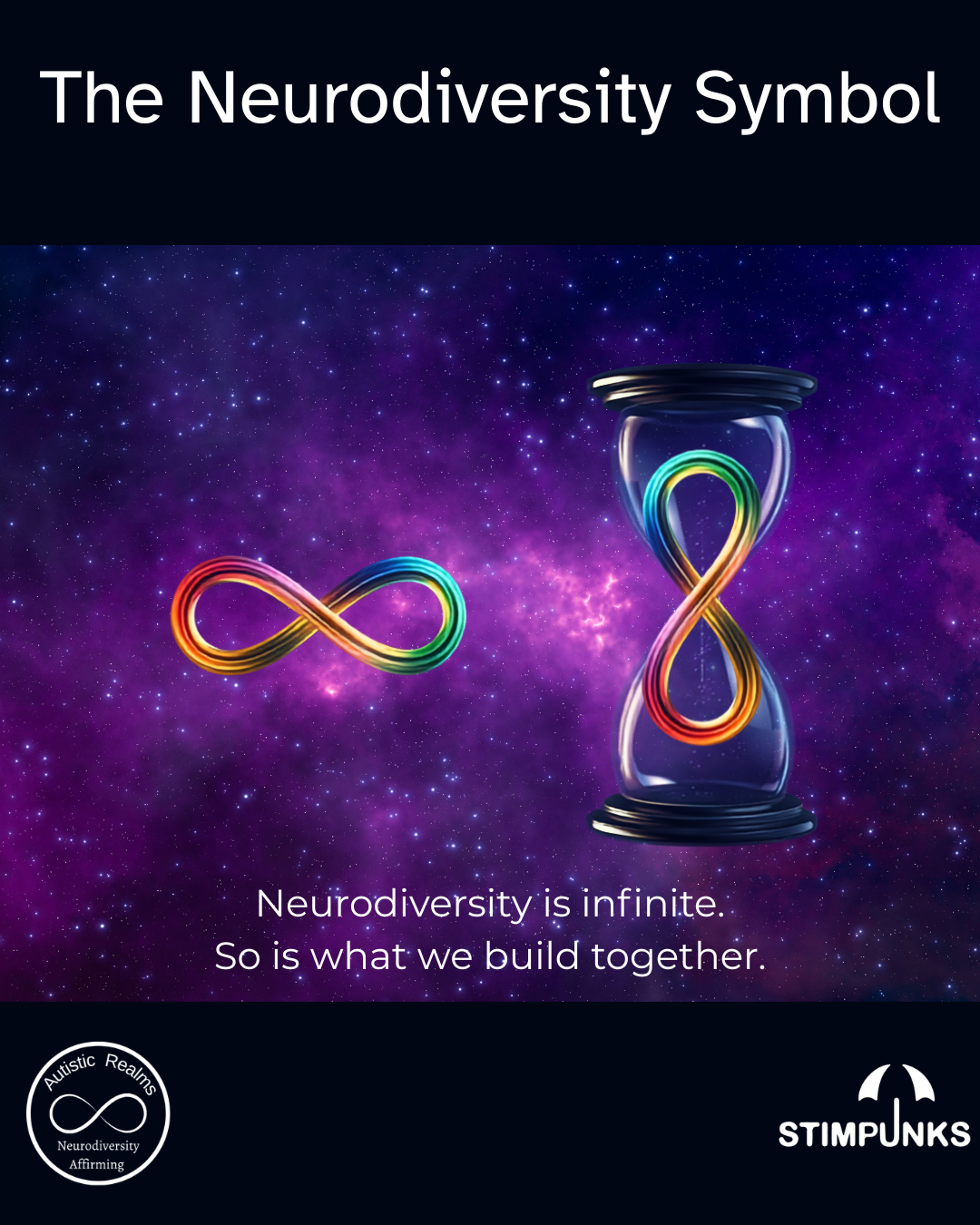
Neurodiversity Infinity Symbol
The neurodiversity infinity symbol in its original orientation represents belonging and infinite possibility. Turned, it becomes a pedagogy.
-
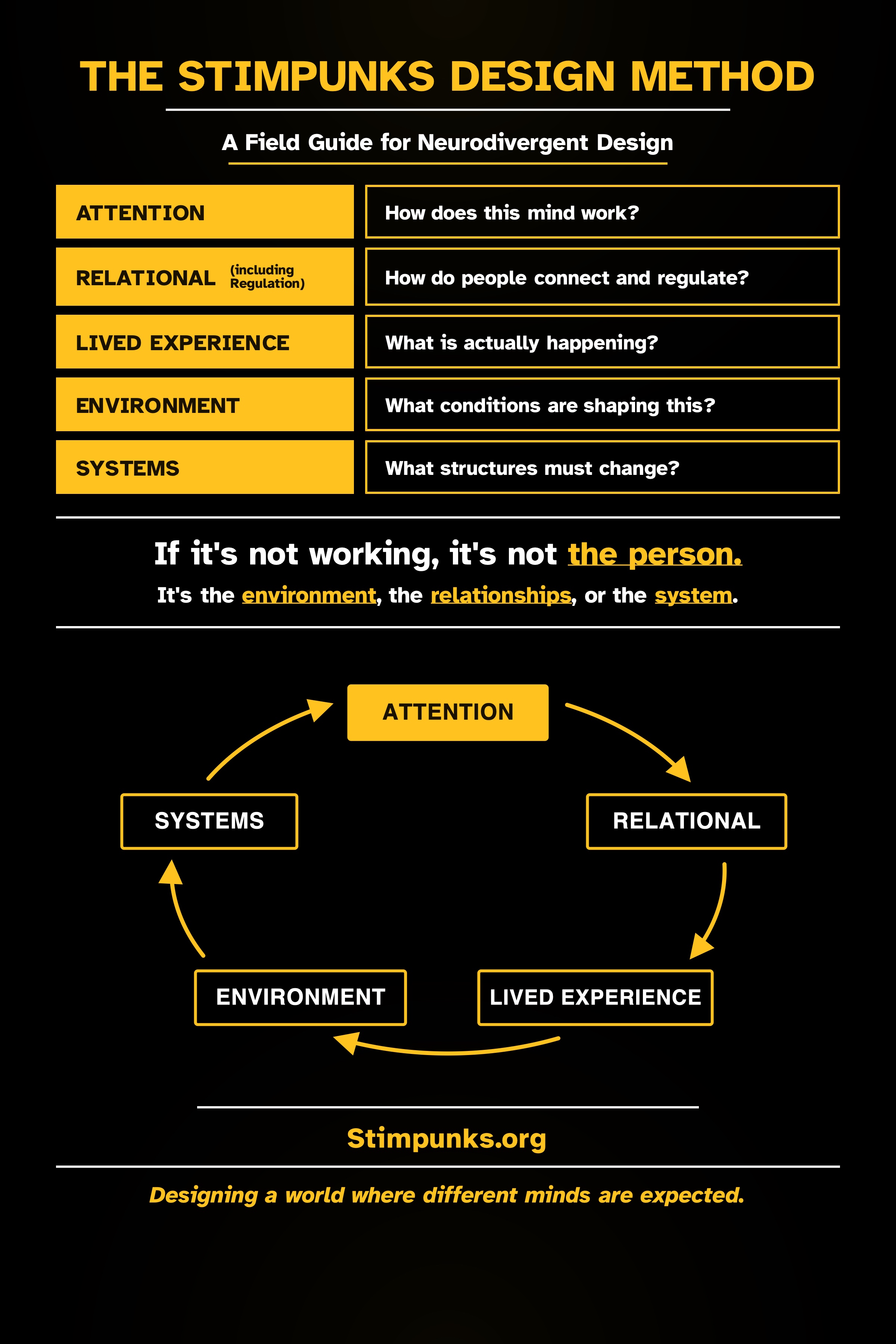
ARLES
ARLES is the Stimpunks Design Method. It names the five layers through which neurodivergent life is structured, and the order in which environments must be redesigned to support it: Attention → Relational (including Regulation) → Lived Experience → Environment → Systems. Each layer holds up the one above it. Begin with attention and nervous-system safety.…
-
Epistemic Enablement
Epistemic enablement describes the conditions that allow people to contribute knowledge from their own perspective, in their own form.
-
Attachment Theory
Attachment theory attempts to describe the way humans form emotional bonds with each other, particularly within long-standing relationships. Developed primarily by psychiatrist John Bowlby beginning in the 1930s and extended by his student Mary Ainsworth, it frames bonding as a developmental process shaped above all by early caregiver relationships — arguing that how a caregiver…
-
Affective Injustice
Affective injustice refers to an injustice related to a person as an affective being. It is thus a quite general category of injustice: it involves any kind of injustice in which emotions and affects play a central role.
All Glossary Entries
- Ableism
- Abraction
- Acceptance
- Access Intimacy
- Accessibility
- Accommodation
- ActuallyAutistic
- Addiction
- ADHD Tax
- Administrative Burden
- Advice Process
- Affective Injustice
- Affinity Group
- Affinity Space
- Alexithymia
- Algorithm
- Alien
- Allistic
- Allyship
- Aloneness
- Alt Text
- Alternative and Augmentative Communication
- Altruism
- Americans with Disabilities Act
- Anarchism
- Anti-library
- Aphantasia
- Applied Learning
- ARLES
- Art
- Artificial Intelligence
- Artificial Scarcity
- Asynchronous Communication
- Attachment Theory
- AuDHD
- Autigender
- Autism Grievance Parent
- Autism Warrior Parent
- Autistic
- Autistic Chronophobia Theory
- Autistic Joy
- Autistic Language Hypothesis
- Autistic Polling
- Autistic Rapport
- Autistic Rhizome
- Autistic Shielding
- Canary
- Care
- Care Web
- Cavendish Space
- Caves, Campfires, and Watering Holes
- Change
- Checklists
- Childism
- Chosen Family
- Chronic
- Chronic Constellation
- Clumping
- Co-Design
- Co-regulation
- Coddle
- Code
- Code-Meshing
- Cognitive Behavioral Therapy
- Cognitive Liberty
- Collaborative Morality
- Collective Risk Shift
- Comedy
- Commonplace Book
- Community
- Community of Practice
- Community Organizing
- Compassion
- Competency Network
- Conceptual Portmanteau
- Concision
- Connection
- Conservatism
- Constructionism
- Created Serendipity
- Crip
- Crip Linguistics
- Crip Tax
- Crip Time
- Cripple Punk
- Critical Race Theory
- Critical Thinking
- Critical Wellness
- Cyborg
- Dandelions, Tulips, and Orchids
- DARVO
- Data Void
- Deep Pressure
- Deficit Ideology
- DEIAB
- Demand Avoidance
- Design Justice
- Design Questioning
- Designed Dignity
- Developmental Pace
- Diagnosis
- Dialectical Behaviour Therapy
- Different
- Differentiated Instruction
- Digital Gardening
- Digital Sociology
- Disability Dongle
- Disability Double-bind
- Disability Justice
- Disability Police
- Disabled
- DisCrit
- Diversity
- Dolphining
- Dopamine Dressing
- Double Empathy Extreme Problem
- Double Empathy Problem
- Dress Codes
- Dyslexia
- Dyspraxia
- Echolalia
- Echophenomena
- Edges
- Education
- Efficiency
- Elopement
- Embodied Attunement
- Embodiment
- Emergence
- Emergent Allostasis
- Emotional Bid
- Empathy
- Empire of Normality
- Employee Resource Group
- Engineered Exclusion
- Enshittification
- Epistemic Authority
- Epistemic Enablement
- Epistemic Injustice
- Epistemic Pluralism
- Epistemic Trespassing
- Equity
- Ethodivergence
- Ethodiversity
- Eugenics
- Evidence-Based
- Evolution
- Executive Function
- Experiential Learning
- Expertise
- Exposure Anxiety
- Extractive Abandonment
- Eye Contact
- Identity
- Identity First Language
- Identity Politics
- Imposter Syndrome
- Inclusion
- Infodump
- Inspiration Exploitation
- Intelligence
- Intelligence Quotient
- Intensive Interaction
- Interdependence
- Interdisciplinary Learning
- Intermittent Collaboration
- Internalized Ableism
- Interoception
- Intersectionality
- Interviews
- Intrinsic Motivation
- Invisible Disability
- Iteration
- Nature
- Neoliberalism
- Nesting
- Neuro-anarchy
- Neuro-Holographic
- Neuroaffirming
- Neurocentrism
- Neuroception
- Neurocosmopolitanism
- Neurocousin
- NeurodiVenture
- Neurodivergent
- Neurodiversity
- Neurodiversity Infinity Symbol
- Neuroessentialism
- Neurokin
- Neurokit
- Neurological Pluralism
- Neurome
- Neurominority
- Neuronormativity
- Neuroqueer
- Neurospicy
- Neurosupremacy
- Neurotype
- Neurotypical
- Neurotypical Perspectivelessness
- Niche Construction
- Noncompliance
- Nonspeaking
- Normal
- Parallel Play
- Pathology Lite
- Pathology Paradigm
- Peer Respite
- Peer Support
- Penguin Pebbling
- Performative Neurodiversity (Neurodiversity Lite)
- Phone Calls
- Place-Based Education
- Plain Text
- Play
- Pluralism
- Polyvagal Theory
- Popular Education
- Posthumanism
- Postmortem
- Power
- Precarity
- Predatory Inclusion
- Prepping
- Privacy
- Privilege
- Problem Behavior
- Processing Time
- Progressive Education
- Prosocial
- Psychological Safety
- Psychological Torture
- Punk
- Puzzle
- Sadopopulism
- Safe Food
- Safe Space
- Samefood
- Scenius
- School-Induced Anxiety
- Schoolishness
- Scientific Essentialism
- Scientism
- Segregationist Discourse
- Self-Care
- Self-Determination Theory
- Self-Injurious Stimming
- Self-Organizing
- Semiotic Domains
- Sensory Fluid
- Sensory Hell
- Sensory Trauma
- Shame
- Shared-Air Space
- Shared-Signal Space
- Shutdown
- Situational Mutism
- Sleep
- Slow Pedagogy
- Social Model of Disability
- Solarpunk
- Somatic
- Somatic Rudder
- Southern Strategy
- Space Bunny
- Space Holder
- Spaced Repetition
- Sparkle Brain
- Special Interest
- Special Needs
- Spiky Profile
- SpInfodump
- Spoon Theory
- STEM
- Stigma
- Stim Listening
- Stim-Watching
- Stimming
- Stimpunk
- Strategic Essentialism
- Straws
- Stress Incoherence
- Structural Ideology
- Subtype
- Suicide
- Support Swapping
- Systems Generated Trauma
- Techno-Legal Solutionism
- Techno-solutionism
- Technoableism
- Tendril Theory
- Theory of Mind
- Thick Data
- Third Places
- Threshold Anxiety
- Tone Indicators
- Tonic Masculinity
- Toolbelt Theory
- Tourette Syndrome
- Toxic Masculinity
- Toxic Positivity
- Transcendent Thinking
- Transepistemics
- Transformative Justice
- Trauma
- Triple Empathy Problem
- Triskelion
- Trust
- Tryborg
Essential Neurodiversity Vocabulary: The Good, The Bad, The Different
Here’s some essential neurodiversity, disability, and equity vocabulary grouped by the good, the bad, and the different.
Other Glossaries
- Neuro-affirming Language & Glossaries | Autistic Realms
- Neuroaffirmative Neurodivergent Flashcards
- Autistic Glossary – AMASE
- Autism Glossary — Aurora Autistic Consulting
- The Words We Use | CommunicationFIRST
- Words that make me go hmmm… – Rewriting social care
- Parley Vouz Health & Social Care? (An A to Z of Carespeak) – Love, Belief and Balls
- Voices of Neurodiversity: An Inclusive Encyclopaedia