

The Reframer’s Journey
The first nine pages of our website are a scrollytellying journey through the rough terrain of lived experience punctuated with spectacular art and music. Made with agony and joy, this is our story of surviving, reframing, and finding like-minded misfits.
- Authenticity Is Our Purest Freedom
- Everything that was normally supposed to be hidden was brought to the front.
- Learning Pathways: Take a Walk in Our Shoes
- Our Story: Challenging the Norm and Changing the Narrative
- Take Them Together: Neurodiversity and Disability Justice
- Our Umbrella: It Is Time to Celebrate Our Interdependence!
- Reframe Disability and Difference: We’re Going to Rewrite the Narratives
- Happy Flappy: Let’s Bolster Against Stress and Pass Bodily Survival Knowledge Down
- An Encyclopedia of Disability and Difference
Pages in the journey are connected with a “Continue” button at the bottom of each page.
Art, music, poetry, and prose from our community of neurodivergent and disabled people await.
Join us in challenging the norm and changing the narrative by reframing our states of being.




Wear it out (The way a three-year-old would do)
Melt it down (You're gonna have to eventually anyway)
The fire trucks are comin' up around the bend
You live, you learn
You love, you learn
You cry, you learn
You lose, you learn
You bleed, you learn
You scream, you learn
You grieve, you learn
You choke, you learn
You laugh, you learn
You choose, you learn
You pray, you learn
You ask, you learn
You live, you learn
Content warning: Our website includes music, lyrics, writing, and art that address ableism, eugenics, exclusion, mental health, depression, dysphoria, behaviorism, abuse, chronic pain, chronic illness, trauma, and death. There are a few swear words in quoted materials. Also included is an outpouring of neurodivergent and disabled perspective, culture, and joy.
Header art: “Necroneuropunk” by Betsy Selvam is licensed under CC BY-NC 4.0
Stimpunks provide joy in every page, link, and exploration. An excellent place and space to deep dive.
Lisa Chapman (Speech and Language Therapist) of CommonSenseSLT, author of Humanising Care
Table of Contents
- 🌱 It is time to celebrate our interdependence. The parts we need to survive are scattered All amongst us.
- 🔦 Welcome to this house. We find our people.
- 🖊️ We’re Going to Rewrite the Narratives
- ✊ We’re a Feisty Group of Neurodivergent and Disabled People
- 🖼️ Our Ways of Being
- 🫀 We Ain’t Special
- 🆔 We Prefer Identity-First Language
- 🗣️ Language is a place of struggle.
- ⛺️ We Are a NeurodiVenture
- ⚖️ Our Creed
- 🎸 Our Rules of Punk
- 🌈♿️ Take Them Together: Neurodiversity and Disability Justice
🌱 It is time to celebrate our interdependence. The parts we need to survive are scattered All amongst us.
Stimpunks is a treasure trove of everything important to the neurodivergent and disabled community.
Feedback from a reader
We challenge the norm and change the narrative with our scrollytelling by first recognizing that “the parts we need to survive are scattered All amongst us.”
On this website, we curate the treasures of neurodivergent and disabled cultures.
We weave a colorful cloth of community relationships, voices, knowledge, and skills.
This website isn’t one voice. It is many. It is a chorus of interdependence.
We Are Woven Together
It is time to celebrate our interdependence!
The Myth of Independence: How The Social Model of Disability Exposes Society’s Double Standards » NeuroClastic
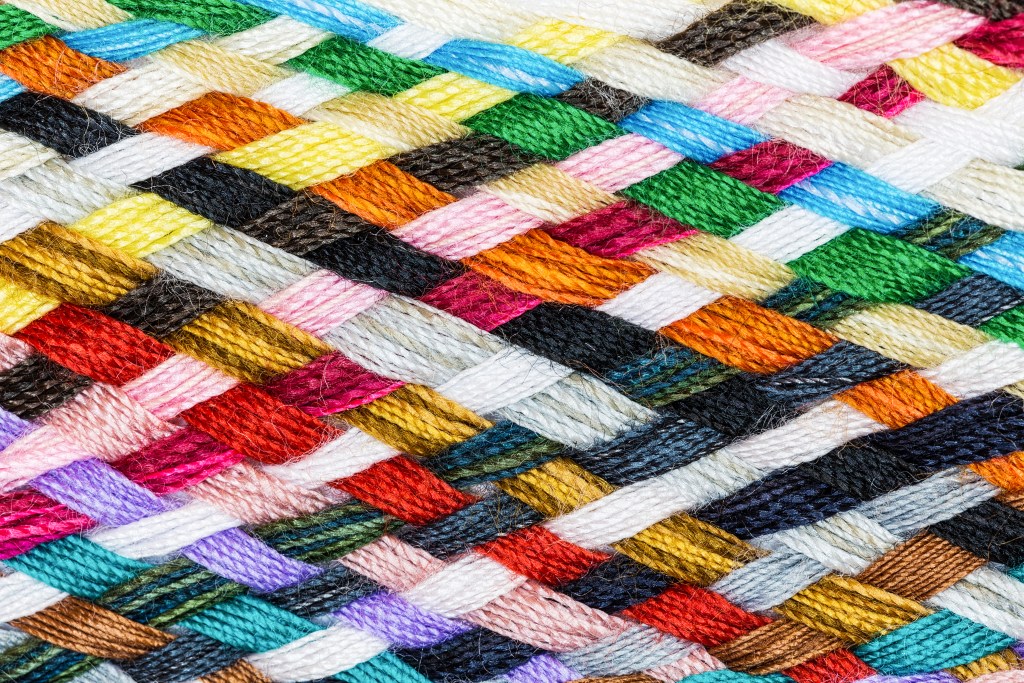
This swatch of rainbow woven cloth evokes our biopsychosocial complexity, our diversity, and our interdependence. It evokes the adaptive interdependence of body, mind, nature, and society.
evoke = to make someone remember something or feel an emotion
biopsychosocial = biological + psychological + social = to understand a person’s medical condition it is not simply the biological factors to consider, but also the psychological and social factors
interdependence = our survival is bound up together, we are interconnected, and what we do impacts others
Because we need stronger bonds – to hold each other together, and to keep the world from falling apart. Our mutual entwinement must be careful, spacious and supple, with no single knot tied too tight. In this macramé of loving design, we might find the wisdom, purpose and strength we need, to weave new worlds.
Rosa, Sophie K. Radical Intimacy (pp. 172-173). Pluto Press.
What would it mean to weave a colorful, durable cloth of individuals’ and communities’ relationships, knowledge and skills?
We take the analogy of weaving cloth to highlight the properties and valuable variations of effective educational systems.
PsyArXiv Preprints | Weaving a colorful cloth: Centering education on humans’ emergent developmental potentials
Envisioning humans and their contexts as mutually constitutive threads in a cloth, we ask, how can we most productively approach the interwoven micro- and macro-adaptations in the systems that make up the individual and context? How can we conceptualize and follow the humanistic threads and patterns that individuals and groups dynamically weave through educational environments and processes, in order to most strategically redesign educational systems to support the emergence of diverse human potentials and contributions? What would it mean to weave a colorful, durable cloth of individuals’ and communities’ relationships, knowledge and skills, designing educational systems that center equity and dignity, and attend to variability of experience? How could education systems be designed to enrich human capacities to invent and sustain vibrant and meaningful lives in a vibrant and healthy society?
PsyArXiv Preprints | Weaving a colorful cloth: Centering education on humans’ emergent developmental potentials
In this sense, examining learning and its contexts is like examining the weaving of a cloth—the twists and knots of different threads are interwoven, and distinct patterns, textures and colors are discernable depending on how the observer zooms in or looks from afar. At one distance, threads can represent people in community, holding each other in place in the weave; further magnified, threads could be composed of the fibers of an individual’s skills and experiences, twisted together across the threads of others as they extend through time. The fibers, patterns, and weaves of various cloths will vary substantially according to available resources, needs and aesthetics, from thick wool blankets or rugs, to flowing silk scarves, to sturdy nets or straps. Weaving itself is dynamic: it generates out of disparate parts a unified set of patterns, stronger together as a whole. Cloth also needs repair due to its day-to-day use as well as to unpredictable accidents and tears. Inevitably, new threads and new patterns will take hold. Thinking of education as supporting the weaving of fibers and also as tending to the condition of the whole cloth underscores the shared features of healthy learning communities with well- designed systems and structures, as well as the substantial and valuable variation that will emerge within and across contexts.
PsyArXiv Preprints | Weaving a colorful cloth: Centering education on humans’ emergent developmental potentials
Through their ideas and intentions as well as their actions, communities of individuals continually renew, together, the socio-cultural context in which they are living, including the beliefs, the norms, and the patterns of relationships that organize society’s social fabric—the cloth they are weaving.
PsyArXiv Preprints | Weaving a colorful cloth: Centering education on humans’ emergent developmental potentials
The cloth can be strengthened and enriched, new patterns can be collaboratively generated, and holes and tears repaired.
PsyArXiv Preprints | Weaving a colorful cloth: Centering education on humans’ emergent developmental potentials
Effective education does not simply produce a standardized, predetermined product. It is instead about weaving a colorful cloth that reflects community members’ rich skills and relationships, with generative patterns that integrate complex knowledge and ideas, and that can look different in different contexts.
PsyArXiv Preprints | Weaving a colorful cloth: Centering education on humans’ emergent developmental potentials
Pluralism is our reality.
- Embracing pluralism is good citizenship. Democracy demands equal accommodation.
- Fostering healthy pluralism, which democracy demands, means confronting intolerance.
- Pluralism is our reality.


I intended to represent ND as I made it. I wanted the colors to be the illuminates of the greater intricate whole crystal. I wanted to make something beautiful and detailed with the colors representing myself, and you, and all the people who would want to be those colored sections. Even though the homogeneous black sections are the majority, they are not the entire body. The entire bodymind includes us, with our wounds, our flaws and our sometimes uncharacterizable spiky profiles.
Adriel Jeremiah Wool
I am fighting for an interdependence that embraces need and tells the truth: no one does it on their own and the myth of independence is just that, a myth.
Interdependence acknowledges that our survival is bound up together, that we are interconnected and what you do impacts others. If this pandemic has done nothing else, it has illuminated how horrible our society is at valuing and practicing interdependence. Interdependence is the only way out of most of the most pressing issues we face today. If we do not understand that we are interdependent with the planet we as a species will not survive.
You Are Not Entitled To Our Deaths: COVID, Abled Supremacy & Interdependence
Abled culture teaches you to act as if you are independent, to buy into the myth of independence. Reject this. Embrace interdependence and know it is the only way we will be able to end this pandemic. Know that if we center disabled people, first and foremost those who are high risk, it will help everyone.
You Are Not Entitled To Our Deaths: COVID, Abled Supremacy & Interdependence
This work is about shifting how we understand access, moving away from the individualized and independence-framed notions of access put forth by the disability rights movement and, instead, working to view access as collective and interdependent.
With disability justice, we want to move away from the“myth of independence,” that everyone can and should be able to do everything on their own. I am not fighting for independence, as much of the disability rights movement rallies behind. I am fighting for an interdependence that embraces need and tells the truth: no one does it on their own and the myth of independence is just that, a myth.
Changing the Framework: Disability Justice | Leaving Evidence
It is from being disabled that I heave learned about the dangerous and privileged “myth of independence” and embraced the power of interdependence. The myth of independence being of course, that somehow we can and should be able to do everything on our own without any help from anyone. This requires such a high level of privilege and even then, it is still a myth. Whose oppression and exploitation must exist for your “independence?”
We believe and swallow ableist notions that people should be “independent,” that we would never want to have to have a nurse, or not be able to drive, or not be able to see, or hear. We believe that we should be able to do things on our own and push our selves (and the law) hard to ensure that we can. We believe ableist heteronormative ideas that families should function as independent little spheres. That I should just focus on MY family and make sure MY family is fed, clothed and provided for; that MY family inherits MY wealth; that families should not be dependent on the state or anyone else; that they should be “able-bodied,” essentially. We believe the ableist heteronormative racist classist myth that marriage, “independence” as sanctified through the state, is what we want because it allows us to be more “independent,” more “equal” to those who operate as if they are independent—That somehow, this makes us more “able.”
And to be clear, I do not desire independence, as much of the disability rights movement rallies behind. I am not fighting for independence. I desire community and movements that are collectively interdependent.
Interdependence (exerpts from several talks) | Leaving Evidence
Self-care is birthed by and through community care.
Self-care is birthed by and through community care.
Talila A. Lewis
What is mutual aid?
“Solidarity, not charity.”
Collective Community Care: Dreaming of Futures in Autistic Mutual Aid
- Interdependence, understanding and support
- Gives opportunity to help & care for other in on our own terms and within our own capacities
- Direct support in a community within a community
- It’s much easier to practice asking, offering, receiving, and declining among people who “get it”!
Moving from a rights-based perspective to a justice-based one necessitates a look at our care systems and re-envisioning how our communities function to ensure no one is left behind.
Collective Community Care: Dreaming of Futures in Autistic Mutual Aid, Autscape: 2020 Presentations
Interdependence, real interdependence can be the difference between making the best of a bad situation and spiraling into isolation, burnout and or mental illness. As such, the advice I tend to give new and prospective grad students is focus on building relationships, seek relationships, invest in relationships, lean on your relationships, because no matter how much you think you can just will yourself into focusing on your work, at some point the work is going to suck. Or maybe it won’t. I don’t know. Are you willing to bet your mental wellness?
Remember it’s interdependence, not just dependance. If you have the time and energy, see if you can pay it forward. It’s definitely a lot of work, but it can be a really rewarding to see yourself actually contribute to another person’s wellbeing. Try it sometime!
How to Survive Grad School (and Other Toxic Jobs) – YouTube
Multiple participants discussed how self-determination co-existed with meaningful relationships and partnerships, including family and parenting responsibilities. Although Kyle affirmed the value of freedom in making choices and decisions, he also acknowledged that interdependence is important because “having a group to lift you up or care for you is important for health and wellness.”
Frontiers | Toward understanding and enhancing self-determination: a qualitative exploration with autistic adults without co-occurring intellectual disability
Access intimacy is interdependence in action.
Access intimacy is one of the main ways that I have been building interdependence in my life. I have been pushing myself to grow it and not just subsist on the little I have been able to find, most significantly with my partner, as is the case for many disabled folks. Engaging in building any kind of interdependence will always be a risk, for everyone involved; and the risk will always be greater for those who are more oppressed and have less access to privilege. In an ableist world where disabled people are understood as disposable, it can be especially hard to build interdependence with people you need in order to survive, but who don’t need you in order to survive. In an ableist context, interdependence will always get framed as “burden,†and disability will always get framed as “inferior.†To actively work to build something that is thought of as undeniably undesirable and to try and reframe it to others as liberatory, is no small task.
Especially as disabled people, we know what it means to live interdependent lives and it does not always feel revolutionary or enjoyable.
The power of access intimacy is that it reorients our approach from one where disabled people are expected to squeeze into able bodied people’s world, and instead calls upon able bodied people to inhabit our world.
In my life, access intimacy continues to be a game-changer, a way to queer access into a tool we can use to get free. It has been a way to shift and queer how I and others understand disability and ableism. And because of the inherent interdependence of access intimacy—the “we†of access intimacy—it has transformed the kinds of conversations I am able to have with some of the able bodied people in my life.
Access Intimacy, Interdependence and Disability Justice | Leaving Evidence
Mia Mingus in Hamraie and Fritsch (2019) describe access intimacy as a “crip relational practice produced when interdependence informs the making of access” (p.14). As such, interdependent ways of languaging, like augmented speech, do not appeal to many abled people. For example, as Mackay’s (2003) work with aphasia patients showed, the patients were viewed as incompetent because of their voicelessness. Given an acceptance of interdependence and care work in languaging via crip time, the patients would be viewed as competent (Rossetti et al., 2008).
Unsettling Languages, Unruly Bodyminds: A Crip Linguistics Manifesto | Journal of Critical Study of Communication and Disability
Hamraie (2013) asks us to think about the politics of access through the framework of interdependence. Languaging, as an important site of access—to the world, to politics, to belonging, to citizenship—thus demands that we think about this through the lens of collective access and care. Rejecting monolingualism and mono-modality are two beginning steps. Embracing time, space, and material environments in meaning-making are also preliminary steps. Interdependence also asks us to think about our built environments and how that impacts access (Hamraie, 2013), and in our case, language. Hamraie (2017) also instigates us to consider how discrimination is built into the structures around us, the buildings, the foundations, the frameworks, and theories, and so on. When in the process of crippling linguistics, we question how modality chauvinism has been built into the various language focused fields and the perspectives of what language is and what is good languaging. Hamraie and Fritsch’s (2019) practices of “interdependence, access intimacy, and collective access can be understood as alternative political technologies through Crip technoscience” (p.13). Crip technoscience is “critique, alteration, and reinvention” (p.2). It is how disabled people alter and reinvent the world in order to make access happen. The relationship between science, technology, and language is such that the dismissal of disabled ways of languaging has resulted in inaccessible technologies.
Unsettling Languages, Unruly Bodyminds: A Crip Linguistics Manifesto | Journal of Critical Study of Communication and Disability
One lesson from crip languaging is the idea of interdependence and forms of access intimacy through the discourse process.
View of Unsettling Languages, Unruly Bodyminds: A Crip Linguistics Manifesto
These and other material practices describe a crip technoscientific sensibility wherein disabled interdependence also enables what Mingus (2017) calls “access intimacy,” a crip relational practice produced when interdependence informs the making of access.
Crip Technoscience Manifesto
If, as Kafer argues, disabled people have often uneasy or “ambivalent relationships to technology” (2013, p. 119), our practices of interdependence, access intimacy, and collective access can be understood as alternative political technologies: “disabled people,” she writes, “are not cyborgs…because of our bodies (e.g., our use of prosthetics, ventilators, or attendants), but because of our political practices” (p. 120). Crip technoscience offers interdependence as a central analytic for disability–technology relations, recognizing that in disability culture, community, and knower-maker practices, interdependence acts as a political technology for materializing better worlds.
Crip Technoscience Manifesto
Everyone is causally interconnected with, interdependent with, and fundamentally the same as all other humans.
…the eco-system arises from and responds to the multiple ways in which everyone is causally interconnected with, interdependent with, and fundamentally the same as all other humans, and literary representations of these various types of solidarity, their inherence in human nature, and their benefits to people who recognize and embrace them can help students incorporate these principles into their mental models of human nature and thus both recognize and enact them more productively in their personal, professional, and civic lives.
The most obviously systemic form of interconnectedness is existential: we all depend on other humans for our very existence and survival—that is, for the production and distribution of our food, clothing, and shelter, not to mention the complex technologies that we in the postindustrial world have come to rely on. We are dependent on the work of countless other individuals at every moment in our lives, and we simply could not exist without their direct and indirect contributions to our lives.
Literature, Social Wisdom, and Global Justice: Developing Systems Thinking
‘Rebellion’ is not enough. We need to build new systems from the ground up, right now.
Escaping extinction through paradigm shift
And it means grounding this effort in completely new frame of orientation, one in which human beings are inherently interconnected, and inter-embedded within the earth; where we are not atomistically separated from the reality in which we find ourselves as technocratic overlords, but are co-creators of that reality as individuated parts of a continuum of being.
We need a counterculture of care.
Putting care—not just care work, but care—at the center of our economy, our politics, is to orient ourselves around our interdependence.
The Year That Broke Care Work
The philosophers Joan Tronto and Berenice Fisher lay out five key elements of care…virtues to be developed if you wanted to APPLY an ethics of care to things in your life. Think of this as a sort of HOW TO manual for moral maturity UNDER an ethics of care. These virtues IN ORDER are:
Episode #168 – Introduction to an Ethics of Care — Philosophize This!
- Attentiveness
- Responsibility
- Competence
- Responsiveness
- Plurality
Episode #168 -Transcript — Philosophize This!
“An ethic of justice focuses on questions of fairness, equality, individual rights, abstract principles and the consistent application of them. An ethic of care focuses on attentiveness, trust, responsiveness to need, narrative nuance and cultivating caring relations.”
The Ethics of Care as Moral Theory | The Ethics of Care: Personal, Political, and Global | Oxford Academic
- Care work makes all other work possible.
- Putting care—not just care work, but care—at the center of our economy, our politics, is to orient ourselves around our interdependence.
- Care is an organizational structure needed to keep our nation running. It’s, by definition, infrastructure.
- Health is at the center of the human experience.
- We need a counterculture of care.
- I feel that that the fundamental property of humanness is to fill those spaces where humanity has been abandoned with love. Those who would change the system have to begin with love, and with the vision to build geographies of care built from that love.
- Reframing is self-care and social change.
- Those who are the most sensitive and traumatised and have not lost the ability to extend trust constitute an enormously rich and diverse repository of insights and hold many of the keys needed for co-creating ecologies of care.
- Create more anti-ableist spaces. Let’s act to hold ALL spaces accountable for providing care and access to disabled folks with all types of bodies and minds.
- We can start building more accessible, care-centered communities now. We can combat ableism now. We can lay the groundwork for a world that works better for all of us.
Care is not charity or kindness. Care is the deeply fraught, complex, abolitionist, political work of protecting one another and the planet, meeting everyone’s needs in balance with the collective good, and keeping our communities safe without the use of policing.
Freedom requires care because freedom is not just a right—it is also a responsibility. Freedom means getting to be our whole selves, in community with other whole selves, without any threat to or assault on our well-being. Freedom means an experience of daily life in which each of us is fully seen and affirmed, treated with unconditional dignity and care, and embraced as an invaluable person of immeasurable worth. Freedom, then, sets an incredibly high standard for community life. It requires that every member of the collective work toward the goals of protection, safety, and unconditional care for all people and for the natural world.
Are We Teaching Care or Control?
The activities that constitute care are crucial for human life. We defined care in this way: Care is “a species activity that includes everything that we do to maintain, continue, and repair our “world’ so that we can live in it as well as possible. That world includes our bodies, our selves, and our environment, all of which we seek to interweave in a complex, life-sustaining web” (Fisher and Tronto, 1990, p. 40).
Several aspects of this definition of care are noteworthy: First, we describe care as a “species activity,” a philosophical term we use because it suggests that how people care for one another is one of the features that make people human. Second, we describe care as an action, as a practice, not as a set of principles or rules. Third, our notion of care contains a standard, but a flexible one: We care so that we can live in the world as well as possible. The understanding of what will be good care depends upon the way of life, the set of values and conditions, of the people engaged in the caring practice.
Furthermore, caring is a process that can occur in a variety of institutions and settings.
Care is found in the household, in services and goods sold in the market, in the workings of bureaucratic organizations in contemporary life. Care is not restricted to the traditional realm of mother’s work, to welfare agencies, or to hired domestic servants but is found in all of these realms. Indeed, concerns about care permeate our daily lives, the institutions in the modern marketplace, the corridors of government. Because we tend to follow the traditional division of the world into public and private spheres and to think of caring as an aspect of private life, care is usually associated with activities of the household. As a result, caring is greatly undervalued in our culture- in the assumption that caring is somehow “women’s work,” in perceptions of caring occupations, in the wages and salaries paid to workers engaged in provision of care, in the assumption that care is menial. One of the central tasks for people interested in care is to change the overall public value associated with care. When our public values and priorities reflect the role that care actually plays in our lives, our world will be organized quite differently.
An Ethic of Care on JSTOR
Let's organize our lives around love and care
Let's write each other letters and call it prayer
Let's congregate in the place that isn't anywhere
At the temple of broken dreams
All the systems of oppression are woven together and our work to get free will only succeed when we are woven together.
find your place on deck
The parts we need to survive are scattered All amongst us.
Tinu Abayomi-Paul
For nothing is fixed,
forever, forever, forever,
it is not fixed;
the earth is always shifting,
the light is always changing,
the sea does not cease to grind down rock.
Generations do not cease to be born,
and we are responsible to them
because we are the only witnesses they have.
The sea rises, the light fails,
lovers cling to each other,
and children cling to us.
The moment we cease to hold each other,
the moment we break faith with one another,
the sea engulfs us and the light goes out.

James Baldwin
Interdependence acknowledges that our survival is bound up together, that we are interconnected and what you do impacts others. Interdependence is the only way out of most of the most pressing issues we face today. If we do not understand that we are interdependent with the planet we as a species will not survive.
You Are Not Entitled To Our Deaths: COVID, Abled Supremacy & Interdependence | Leaving Evidence
The great philosopher Ernst Bloch insisted that hope taps into our deepest experiences and that without it reason and justice cannot prevail.
Henry Giroux – Critical Pedagogy in a Time of Fascist Tyranny | Human Restoration Project | Podcast
In The Fire Next Time, James Baldwin, my favorite novelist, adds a call for compassion and social responsibility to this notion of hope, one that is indebted to those who follow us. He writes, “Generations do not cease to be born, and we are responsible to them. The moment we break with one another, the sea engulfs us and the lights go out.”
My friend, the late Howard Zinn, rightly insisted that hope is the willingness, “to sustain, even in times of pessimism, the possibility of surprise.” In addition to that eloquent appeal, I would say that history is open. It’s time to think differently in order to act differently.
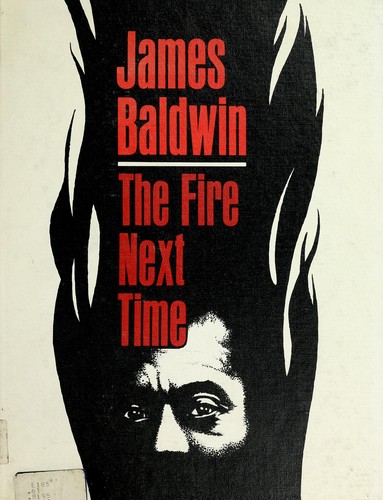
If we do not now dare everything, the fulfillment of that prophecy, re-created from the Bible in song by a slave, is upon us: God gave Noah the rainbow sign, No more water, the fire next time!
And here we are, at the center of the arc, trapped in the gaudiest, most valuable, and most improbable water wheel the world has ever seen. Everything now, we must assume, is in our hands; we have no right to assume otherwise. If we—and now I mean the relatively conscious whites and the relatively conscious blacks, who must, like lovers, insist on, or create, the consciousness of the others—do not falter in our duty now, we may be able, handful that we are, to end the racial nightmare, and achieve our country, and change the history of the world. If we do not now dare everything, the fulfillment of that prophecy, re-created from the Bible in song by a slave, is upon us: God gave Noah the rainbow sign, No more water, the fire next time!
The Fire Next Time by James Baldwin
In order for this to happen, your entire frame of reference will have to change, and you will be forced to surrender many things that you now scarcely know you have.
The Fire Next Time by James Baldwin
The glorification of one race and the consequent debasement of another—or others—always has been and always will be a recipe for murder. There is no way around this. If one is permitted to treat any group of people with special disfavor because of their race or the color of their skin, there is no limit to what one will force them to endure, and, since the entire race has been mysteriously indicted, no reason not to attempt to destroy it root and branch. This is precisely what the Nazis attempted. Their only originality lay in the means they used.
The Fire Next Time by James Baldwin
Whoever de-bases others is debasing himself. That is not a mystical statement but a most realistic one, which is proved by the eyes of any Alabama sheriff.
The Fire Next Time by James Baldwin
Please try to remember that what they believe, as well as what they do and cause you to endure, does not testify to your inferiority but to their inhumanity and fear.
The Fire Next Time by James Baldwin
We are caught in an inescapable network of mutuality, tied in a single garment of destiny.
Letter from Birmingham Jail, Dr. Martin Luther King, Jr.
🔦 Welcome to this house. We find our people.
This website is an encyclopedia of disability and difference.
We, Stimpunks
Learn about yourself.
Learn about your family.
Learn about your friends, co-workers, patients, and students.
We offer validation for thirsty souls yearning to be seen, heard, and understood.
We offer words on your behalf, ones which call out to include you.
We offer community and belonging.
Find Your People
Did you ever feel
That you don't quite belong
Just hold on
And go find your people

Find your people

Opening doors has become my calling

Welcome to this house
All Hail Open Doors by Swamburger and Scarlet Monk of Mugs and Pockets
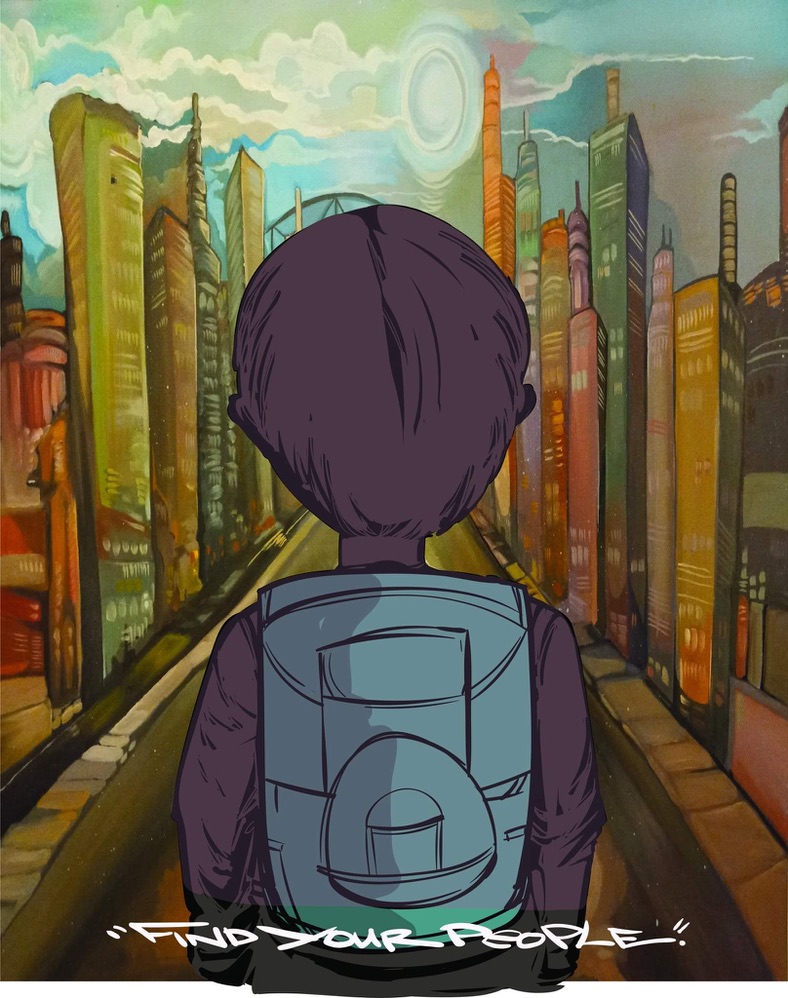
Image Credit: Swamburger and Scarlet Monk
🖊️ We’re Going to Rewrite the Narratives
We have protests to stage, driven by the fuel of our righteous anger. We have speeches to make, written from the soaring pleas of our individual and collective trauma, and our wildest dreams of joy and freedom and love. We have cultural narratives to rewrite because they really do hate us and they really will kill us, and if we’re going to rewrite the narratives, then there’s no reason to hold ourselves back from our most radical and defiant rewritings. We have autistic children who need us to support them as architects of their own liberation against the schools and clinicians and institutions and police and prosecutors who would crush and destroy them.
We’re going to need our anger and our public celebrations of stimming and our complicated, imperfect, messy selves for this long and hard road, because we need all of us, and all of our tactics and strategies, to keep a movement going and ultimately, to win.
Autistic Hoya — A blog by Lydia X. Z. Brown: The neurodiversity movements needs its shoes off, and fists up.
Selling yourself short tames the vision
How you're depicted can change the sentence

Innocent by Swamburger
If we have learned one thing from the civil rights movement in the U.S., it’s that when others speak for you, you lose.
Ed Roberts
This is radio clash using aural ammunition
The Clash – This Is Radio Clash Lyrics
This is radio clash can we get that world to listen?
✊ We’re a Feisty Group of Neurodivergent and Disabled People

This photo was taken by Chona Kasinger.
Disabled outrage is necessary and liberatory; it reveals the fissures in society and the consequences of structural oppression. It comes from a place of hurt and injustice. It is resistance against erasure.
Disabled Outrage and #PodSaveJon – Disability Visibility Project
The neurodiversity movements needs its shoes off, and fists up.
We have protests to stage, driven by the fuel of our righteous anger. We have speeches to make, written from the soaring pleas of our individual and collective trauma, and our wildest dreams of joy and freedom and love. We have cultural narratives to rewrite because they really do hate us and they really will kill us, and if we’re going to rewrite the narratives, then there’s no reason to hold ourselves back from our most radical and defiant rewritings. We have autistic children who need us to support them as architects of their own liberation against the schools and clinicians and institutions and police and prosecutors who would crush and destroy them.
We’re going to need our anger and our public celebrations of stimming and our complicated, imperfect, messy selves for this long and hard road, because we need all of us, and all of our tactics and strategies, to keep a movement going and ultimately, to win.
Autistic Hoya — A blog by Lydia X. Z. Brown: The neurodiversity movements needs its shoes off, and fists up.
My kids have been kicked out of many, many places for being different—just like I was.
Catapult | The World Doesn’t Bend for Disabled Kids (or Disabled Parents)
The question is simple: Is there room for disabled kids at a piano school? On a swim team? In most classrooms?
The answer, right now, seems to be no.
I, Victoria Lin Tanner, am just one of many people who discovered, after a lifetime of struggle, that I am autistic. This book is about my journey of self-discovery. It is also a scream into the cold, black void where no help is to be found for people like me. Autistic children become autistic adults, so why is there no support for us? I am here to shine a glaring spotlight on the ways that society has failed autistic adults. For many of the 5 million+ autistic Americans, and ~75 million worldwide, life would be made far more manageable and frankly, happier, if our struggles were supported in meaningful ways rather than through #autismawareness retweets and puzzle piece merchandise.
We are here, we are angry, and we are only going to get louder.
Autistic adults are not okay.
Autistic Adults Are Not Okay – Victoria Lin Tanner, Autistic Adults Not Okay, Autistic Visibility Project
Autistic Adults Are Not Okay – by Lin Tanner, Victoria
Because every single thing you hate about us, you will hate about yourself. And becoming us is a lot easier than you think it is.
The instant, almost the very instant, you become disabled, you cease to be seen as a reliable narrator of your own story to literally everybody else, except for disabled people.
Every single ableist stereotype that you’ve heard for your entire life that you’ve never evaluated, that will be the lens through which other people see you, including people that know you.
This is one of the many reasons why people need to do anti-ableism work. Because every single thing you hate about us, you will hate about yourself. And becoming us is a lot easier than you think it is.
Imani Barbarin, MAGC | Crutches&Spice
This is what disability advocates have said all along, not that it usually sinks in: The able and the disabled aren’t two different kinds of people but the same people at different times.
This is what disability advocates have said all along, not that it usually sinks in: The able and the disabled aren’t two different kinds of people but the same people at different times.
Tom Scocca’s Medical Mystery: The Year My Body Fell Apart
We are the only minority community that anyone can join at any time.
11 Disability Rights Activists on Where the Fight for Justice Stands | Teen Vogue
Disability always has been and always will be a natural part of the human condition.
Simply a form of human variation, disability is universally present across racial, gender, age and socioeconomic lines. Moreover, disability represents the only minority group that anyone can join at any time and, when all human impairments are taken into account, people with disabilities by far encompass the largest minority group in the United States.
Elements and Essentials of the ADA
They don’t take Disability Studies classes. They don’t socialize with us. They don’t listen to us.
CW: medical trauma, medical ableism
I remember laying there, remembering that this experience I’m having is like the other times that I almost died.
And I can feel my life slipping away.
Is it worth it for me to call out and have someone save me?
That’s how traumatized that I’ve been by being in hospitals and in medical settings.
And I need for doctors and healthcare professionals to understand that many of us are traumatized like that.
It’s not abnormal for people like myself who have chronic illnesses, who have cancer, and have high touch and high interactions with medical professionals, to feel traumatized, to feel, is it worth it for me to go and get help for this experience that I’m having, for the possibility that something major is wrong?
Because for some of us waiting to see is worth the risk of possibly dying.
That’s how much we are no longer emotionally prepared to go to the hospital.
That’s how bad a physical experience it is for some of us.
Tinu Abayomi-Paul – YouTube
During the hospital experience, I dealt with racism, I dealt with sexism.
The first doctor I had was fantastic, but they rotated him out.
And the rest of my experience, I had to fight every single day to be heard and understood and to get better care.
I didn’t have my chronic illnesses properly addressed, I didn’t have any of my neurodiversities taken into consideration at all, nor my comfort.
It was a hellish experience towards the end.
And I finally decided I just need to get out of there.
Tinu Abayomi-Paul – YouTube
Karrie Higgins
Which means THEY actually reduce us to “nothing but our conditions” far more than we do. #MedTwitter But hey, wouldn’t want to tell the good doctors they’re ignorant.
Karrie Higgins
The people society says are the most qualified to help are the people least equipped to understand.
How Autistic Mentors Can Help “Problematic” Autistic Students Succeed In School — THINKING PERSON’S GUIDE TO AUTISM
Our entire medical system from the rooter to the tooter is eugenics.
Imani Barbarin on Instagram: “The sad part is…I’m not even a little bit wrong. #ushealthcare #childfree #disability”
Bodies ride the waves
Somebody's gonna have to pay
Bodies, living on the shore in their sandcastles
Bodies, sea is getting rough and the walls rattle
Bodies, come with the tide
Nowhere left to hide
Bodies
Bodies

A thousand thoughts ride the waves
Can't save nobody, I'm too late
Bodies, no one cares about the coming last battle
Bodies, wavеs crashing down and the ocean swallows
Bodies
Whеre you gonna hide the bodies?
Bodies
Hey-oh-hey-oh
On the shore living in sandcastles
No one cares about the coming last battle
Sea is getting rough and the walls rattle
Waves crashing down and the ocean swallows
Bodies
Bodies

--Bodies by Rabbit Junk
Our movement needs nothing of respectability politics.
Respectability politics didn’t save me then, and they won’t save our community or movement now or in the future either.
Our movement, however, needs nothing of respectability politics. Accepting — conceding, surrendering, submitting to — that will only erode our movement until it crumbles entirely. Respectability politics is what’s gotten us into reliance on foundations and nonprofits, and elected officials and bureaucrats, and policies and programs that only benefit the most privileged and resourced members of our communities at the direct expense of the most marginalized. Radical, militant anger — and radical, militant hope, and radical, wild dreams, and radical, active love — that’s what’ll get us past the death machines of ableism and capitalism and white supremacy and laws and institutions working overtime to kill us.
Autistic Hoya — A blog by Lydia X. Z. Brown: The neurodiversity movements needs its shoes off, and fists up.

I wanna see a feisty group of disabled people around the world…if you don’t respect yourself and if you don’t demand what you believe in for yourself, you’re not gonna get it.
Judith Heumann
The world doesn’t want us around and wants us dead. We live with that reality, so there’s always gonna be, uh, ‘Am I gonna survive? Am I gonna push back? Am I gonna fight to be here?’ that’s always true. So, if you wanna call that anger, I call it kind of drive. You know, you have to be willing to thrive or you’re not going to make it.
Corbett O’Toole

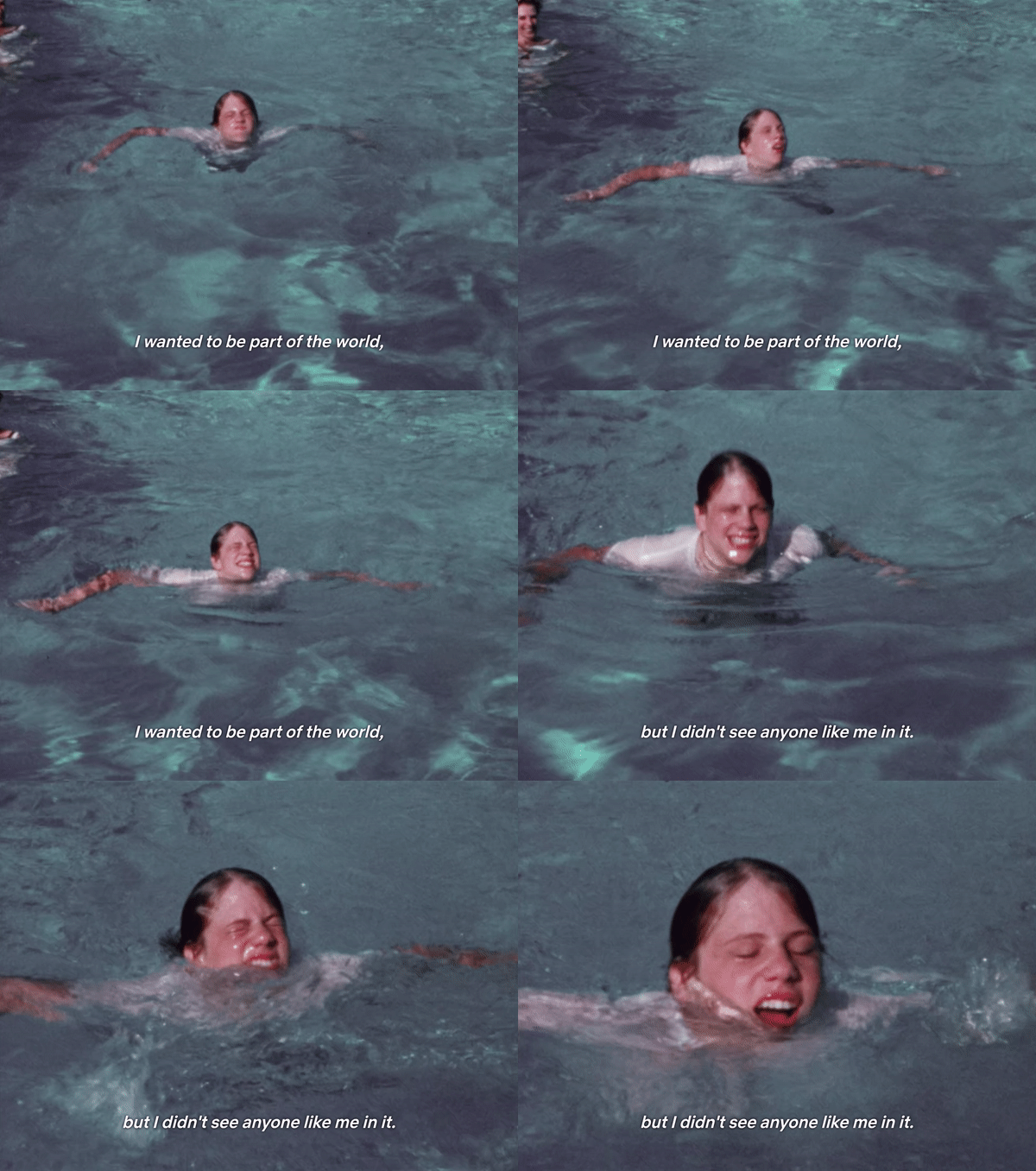
I wanted to be part of the world but I didn’t see anyone like me in it.
Jimmy Lebrecht
This isn’t just a story that disabled children will love; it’s a story about what is possible when we fight for ourselves and each other. It is a story about how tenacity, strength, the power of community, and the willingness to fight for what matters can start a revolution.
ROLLING WARRIOR: THE INCREDIBLE, SOMETIMES AWKWARD, TRUE STORY OF A REBEL GIRL ON WHEELS WHO HELPED SPARK A REVOLUTION
More quotes from the movie “Crip Camp: A Disability Revolution”
Crip Camp starts in 1971 at Camp Jened, a summer camp in New York described as a “loose, free-spirited camp designed for teens with disabilities”. Starring Larry Allison, Judith Heumann, James LeBrecht, Denise Sherer Jacobson, and Stephen Hofmann, the film focuses on those campers who turned themselves into activists for the disability rights movement and follows their fight for accessibility legislation.
Crip Camp – Wikipedia
What we saw at that camp was that our lives could be better. The fact of the matter is that you don’t have anything to strive for if you don’t know that it exists.
Jimmy Lebrecht

I had to try to adapt. I had to fit into this world that wasn’t built for me.
Jimmy Lebrecht

If I have to feel thankful about an accessible bathroom, when am I ever gonna be equal in the community?
Judith Heumann
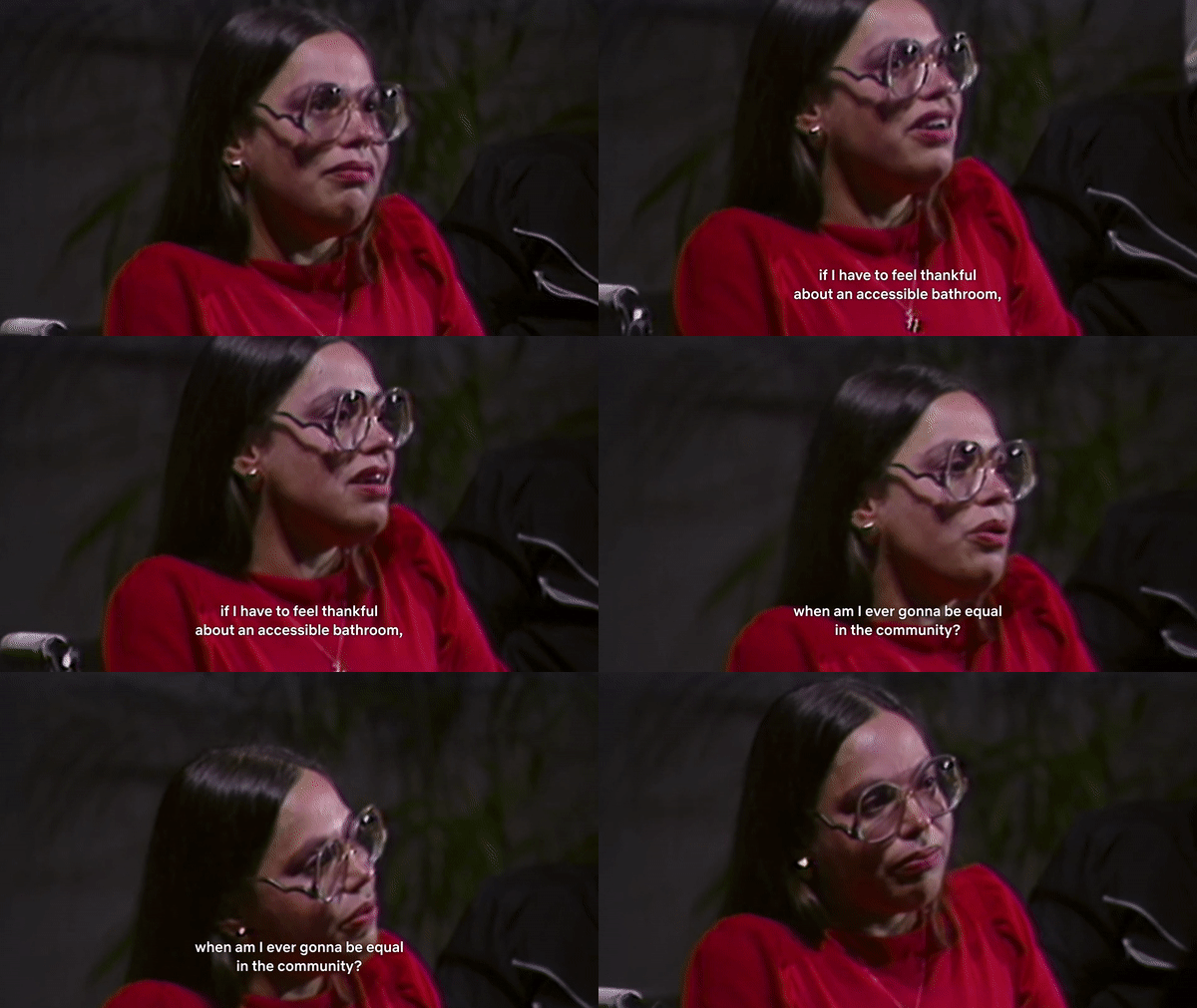
Watch Crip Camp.
Dear Problem Patients
Dear Problem Patients: An open letter to anyone who’s ever felt dismissed by their doctor – No End In Sight
- We believe you.
- You’re not alone.
- The wellness industry is gaslighting you.
- It’s not your fault.
- You are worthy of compassion.
- Medical bias is real.
- The way we see medicine practiced on television is a fantasy.
- We believe that you have a problem.
- We are angry and grieving too.
- Talking to other people who know what this feels like has changed everything for us.
- It’s okay to feel joy when your body is hurting.
- Feeling joy doesn’t undermine how much you are struggling.
- It’s okay if you haven’t found any joy in your struggle at all.
- Your story doesn’t need a neat and tidy ending.
- Somebody out there is yearning for a story just like yours that is honest about pain or maybe joy and that ends in an uncertain and messy place.
- Your story matters.
- We want to know your story.
- We want to help you find the stories you’ve been yearning for.
🖼️ Our Ways of Being
Reframe these states of being that have been labelled deficiencies or pathologies as human differences.
Normal Sucks: Author Jonathan Mooney on How Schools Fail Kids with Learning Differences
We Reframe
We, Stimpunks
We reframe out of the confines of the medical model and pathology paradigm and into the respectfully connected expanse of the biopsychosocial model and the Neurodiversity paradigm. We reframe from deficit ideology to structural ideology.
What does that mean?
In other words…
One Idea Per Line
- We shift away from the medical model and pathology paradigm.
- We embrace the biopsychosocial model and Neurodiversity paradigm.
- We move away from focusing solely on deficits.
- We adopt a more holistic approach that considers social structures and systems.
- We prioritize respectful connections.
One Paragraph Summary
Four Paragraph Summary
Furthermore, we adopt the Neurodiversity paradigm, which celebrates and values the diverse ways in which individuals’ brains function. Rather than pathologizing differences, we acknowledge and respect the unique strengths and perspectives that neurodivergent individuals bring to society.
As we reframe our thinking, we also transition from a deficit ideology to a structural ideology. Rather than solely blaming individuals for their challenges, we recognize the impact of societal structures and systems that may hinder their full participation and inclusion. By addressing these structural barriers, we aim to create a more equitable and supportive environment for all individuals, regardless of their neurodivergence.
In embracing this new framework, we strive to foster understanding, acceptance, and empowerment for individuals across the neurodiversity spectrum. By shifting our perspective and adopting these inclusive paradigms, we can create a more compassionate and inclusive society for everyone.
AI Disclosure: The summaries above were created with the help of Elephas AI Assistant.
Accordions labelled “In other words…” explain things in different ways, including easy read, one idea per line, and plain language summaries.
What is “framing”?
The ALL NEW Don’t Think of an Elephant!: Know Your Values and Frame the Debate
You can’t see or hear frames. They are part of what we cognitive scientists call the “cognitive unconscious”—structures in our brains that we cannot consciously access, but know by their consequences. What we call “common sense” is made up of unconscious, automatic, effortless inferences that follow from our unconscious frames.
The ALL NEW Don’t Think of an Elephant!: Know Your Values and Frame the Debate
When we successfully reframe public discourse, we change the way the public sees the world. We change what counts as common sense. Because language activates frames, new language is required for new frames. Thinking differently requires speaking differently.
The ALL NEW Don’t Think of an Elephant!: Know Your Values and Frame the Debate
We also know frames through language. All words are defined relative to conceptual frames. When you hear a word, its frame is activated in your brain.
Yes, in your brain. As the title of this book shows, even when you negate a frame, you activate the frame. If I tell you, “Don’t think of an elephant!,” you’ll think of an elephant.
Though I found this out first in the study of cognitive linguistics, it has begun to be confirmed by neuroscience. When a macaque monkey grasps an object, a certain group of neurons in the monkey’s ventral premotor cortex (which choreographs actions, but does not directly move the body) are activated. When the monkey is trained not to grasp the object, most of those neurons are inhibited (they turn off), but a portion of the same neurons used in grasping still turn on. That is, to actively not grasp requires thinking of what grasping would be.
Not only does negating a frame activate that frame, but the more it is activated, the stronger it gets. The moral for political discourse is clear: When you argue against someone on the other side using their language and their frames, you are activating their frames, strengthening their frames in those who hear you, and undermining your own views. For progressives, this means avoiding the use of conservative language and the frames that the language activates. It means that you should say what you believe using your language, not theirs.
The ALL NEW Don’t Think of an Elephant!: Know Your Values and Frame the Debate
I used to tell my students that ideology never announces itself as ideology. It naturalizes itself like the air we breath. It doesn’t acknowledge that it is a way of looking at the word; it proceeds as if it is the only way of looking at the world. At its most effective, it renders itself unassailable: just the way things are. Not an opinion, not the result of centuries of implicit and explicit messaging, not a means of upholding a power structure. It just is.
the shame is ours
In order for this to happen, your entire frame of reference will have to change, and you will be forced to surrender many things that you now scarcely know you have.
The Fire Next Time by James Baldwin
You never had to look at me. I had to look at you. I know more about you than you know about me. Not everything that is faced can be changed; but nothing can be changed until it is faced.
James Baldwin, I Am Not Your Negro
Language is also a place of struggle.
Choosing the Margin as a Space of Radical Openness, bell hooks
For me this space of radical openness is a margin a profound edge. Locating oneself there is difficult yet necessary. It is not a “safe” place. One is always at risk. One needs a community of resistance.
Choosing the Margin as a Space of Radical Openness, bell hooks
Living as we did on the edge we developed a particular way of seeing reality. We looked both from the outside in and from the inside out. We focused our attention on the centre as well as on the margin. We understood both.
Reframe these states of being that have been labelled deficiencies or pathologies as human differences.
Normal Sucks: Author Jonathan Mooney on How Schools Fail Kids with Learning Differences
What is the “pathology paradigm”?
The pathology paradigm ultimately boils down to just two fundamental assumptions:
THROW AWAY THE MASTER’S TOOLS: LIBERATING OURSELVES FROM THE PATHOLOGY PARADIGM • NEUROQUEER
- There is one “right,” “normal,” or “healthy” way for human brains and human minds to be configured and to function (or one relatively narrow “normal” range into which the configuration and functioning of human brains and minds ought to fall).
- If your neurological configuration and functioning (and, as a result, your ways of thinking and behaving) diverge substantially from the dominant standard of “normal,” then there is Something Wrong With You.
What is the “neurodiversity paradigm”?
The neurodiversity paradigm is a specific perspective on neurodiversity – a perspective or approach that boils down to these fundamental principles:
1.) Neurodiversity is a natural and valuable form of human diversity.
2.) The idea that there is one “normal” or “healthy” type of brain or mind, or one “right” style of neurocognitive functioning, is a culturally constructed fiction, no more valid (and no more conducive to a healthy society or to the overall well-being of humanity) than the idea that there is one “normal” or “right” ethnicity, gender, or culture.
What It Doesn’t Mean:
Example of Correct Usage:
“Those who have embraced the neurodiversity paradigm, and who truly understand it, do not use pathologizing terms like ‘disorder’ to describe neurocognitive variants like autism.”
NEURODIVERSITY: SOME BASIC TERMS & DEFINITIONS • NEUROQUEER
What is “respectful connection”?
The notion of Neurodiversity can allow you to embrace your child for who they are, and it can empower you to look for respectful solutions to everyday problems. It can also help you to raise your child to feel empowered and content in their own skin.
Respectfully Connected | Neurodiversity Paradigm Parenting FAQs
Instead of intensive speech therapy – we use a wonderful mash-up of communication including AAC, pictures scribbled on notepads, songs, scripts, and lots of patience and time.
Instead of sticker charts and time outs, or behavior therapy – we give hugs, we listen, solve problems together, and understand and respect that neurodivergent children need time to develop some skills
Instead of physical therapy – we climb rocks and trees, take risks with our bodies, are carried all day if we are tired, don’t wear shoes, paint and draw, play with lego and stickers, and eat with our fingers.
Instead of being told to shush, or be still- we stim, and mummies are joyful when they watch us move in beautiful ways.
Respectfully Connected | #HowWeDo Respectful Parenting and Support
A parent’s advice to a teacher of autistic kids
- Be patient. Autistic children are just as sensitive to frustration and disappointment in those around them as non-autistic children, and just like other children, if that frustration and disappointment is coming from caregivers, it’s soul-crushing.
- Presume competence. Begin any new learning adventure from a point of aspiration rather than deficit. Children know when you don’t believe in them and it affects their progress. Instead, assume they’re capable; they’ll usually surprise you. If you’re concerned, start small and build toward a goal.
- Meet them at their level. Try to adapt to the issues they’re struggling with, as well as their strengths and special interests. When possible, avoid a one-size-fits all approach to curriculum and activities.
- Treat challenges as opportunities. Each issue – whether it’s related to impulse control, a learning challenge, or a problem behavior – represents an opportunity for growth and accomplishment. Moreover, when you overcome one issue, you’re building infrastructure to overcome others.
- Communicate, communicate, communicate. For many parents, school can be a black box. Send home quick notes about the day’s events. Ask to hear what’s happening at home. Establish communication with people outside the classroom, including at-home therapists, grandparents, babysitters, etc. Encourage parents to come in to observe the classroom. In short, create a continuous feedback loop so all members of the caregiver team are sharing ideas and insights, and reinforcing tactics and strategies.
- Seek inclusion. This one’s a two-way street: not only do autistic children benefit from exposure to their non-autistic peers, those peers will get an invaluable life lesson in acceptance and neurodiversity. The point is to expose our kids to the world, and to expose the world to our kids.
- Embrace the obsession. Look for ways to turn an otherwise obsessive interest into a bridge mechanism, a way to connect with your students. Rather than constantly trying to redirect, find ways to incorporate and generalize interests into classroom activities and lessons.
- Create a calm oasis. Anxiety, sensory overload and focus issues affect many kids (and adults!), but are particularly pronounced in autistic children. By looking for ways to reduce noise, visual clutter and other distracting stimuli, your kids will be less anxious and better able to focus.
- Let them stim! Some parents want help extinguishing their child’s self-stimulatory behaviors, whether it’s hand-flapping, toe-walking, or any number of other “stimmy” things autistic kids do. Most of this concern comes from a fear of social stigma. Self-stimulatory behaviors, however, are soothing, relaxing, and even joy-inducing. They help kids cope during times of stress or uncertainty. You can help your kids by encouraging parents to understand what these behaviors are and how they help.
- Encourage play and creativity. Autistic children benefit from imaginative play and creative exercises just like their non-autistic peers, misconceptions aside. I shudder when I think about the schools who focus only on deficits and trying to “fix” our kids without letting them have the fun they so richly deserve. Imaginative play is a social skill, and the kids love it.
I just want to do what is best for my child. Can this notion of Neurodiversity help me do that?
Yes, absolutely! The notion of Neurodiversity can allow you to embrace your child for who they are, and it can empower you to look for respectful solutions to everyday problems. It can also help you to raise your child to feel empowered and content in their own skin.
Do you think I am ableist? I thought I was helping my child…
That is hard for me to hear. I didn’t think I was ableist and it hurts to be told I am.
That’s fair enough. However, if you want to do what is best for your child you will need to move past that in order to begin to shed this ableism from your everyday reactions and choices.
How does it feel to be autistic?
That is really complex and difficult to answer. I cannot explain that in as much depth as would give you a good knowledge of it, however there are so many autistic writers you can look to for guidance on that. If you are asking me to to describe how I experience life, as compared to how you experience life, this is a huge question.
Is there a quick way to understand all this?
Respectfully Connected | Neurodiversity Paradigm Parenting FAQs
1. Learn from autistic people
2. Tell your child they are autistic
3. Say NO to all things stressful & harmful
4. Slow down your life
5. Support & accommodate sensory needs
6. Value your child’s interests
7. Respect stimming
8. Honour & support all communication
9. Minimise therapy, increase accommodations & supports
10. Explore your own neurocognitive differences
Respectfully Connected | 10 ‘Autism Interventions’ for Families Embracing the Neurodiversity Paradigm
It’s people’s own attitudes that often lie behind alleged ‘autistic behaviour’.
Ann Memmott
Meeting our children where they are doesn’t mean giving up on them. It means seeing them as a whole person, broadening their access to communication, helping them figuring out their unique learning styles, helping them figuring out their sensory profile, and putting accommodations in place. When we work with our children instead of against them, instead of trying to fix them, we end up with happier children. And that is a goal worth striving for.
Meghan Ashburn, I Will Die On This Hill
Applying ABA in therapeutic practice is entirely unacceptable to us. Therapist Neurodiversity Collective does things differently:
- Zero ABA, including positive reinforcement
- Zero desensitization, tolerance, or extinction targets or approaches
- Zero neuronormative goals (masking of sensory systems, monotropic interests systems, anxiety)
- Zero training neurotypical social skills
We take the research framework from developmental and relationship-based therapy models, use our knowledge of client and caregiver perspectives (no goals for masking, eye contact, whole body listening, appearing neurotypical, etc.), and apply our clinical background to implement therapy practices which are respectful, culturally competent, trauma-sensitive and empathetic.
Non-ABA Evidence Based Practice | Therapist Neurodiversity Collective
We presume competence.
We believe that AAC has no prerequisites.
We respect sensory differences.
We respect body autonomy.
Most importantly, we continually learn from our neurodivergent mentors as to what therapy approaches and methodologies are respectful and uphold human rights and self-determination.
Non-ABA Evidence Based Practice | Therapist Neurodiversity Collective
The target of intervention is not autistic children, but their social and physical environments. Autistic children [need to be] supported in families and communities to develop as unique and valued human beings, without conforming to the developmental trajectory of their neurotypical peers.
Briannon Lee
What is the “biopsychosocial model”?
The proposed biopsychosocial model allows us to provide therapeutic intervention (medical model) and recommend structural accommodation (legislative obligation) without pathologization (social model). In other words, we can deal pragmatically with the individuals who approach us and strive for the best outcomes, given their profile and environment.
Neurodiversity at work: a biopsychosocial model and the impact on working adults | British Medical Bulletin | Oxford Academic
A reductive, medical paradigm of research is incongruent with the legal status of neurominorities as protected conditions in most developed countries, to which organizations must adjust.
The aim of occupational accommodations for neurominorities is to access the strengths of the spiky profile and palliate the struggles.
Neurodiversity at work: a biopsychosocial model and the impact on working adults | British Medical Bulletin | Oxford Academic

Bio (physiological pathology)
Psycho (thoughts emotions and behaviours such as psychological distress, fear/avoidance beliefs, current coping methods and attribution)
Biopsychosocial Model – Physiopedia
Autistic People Recognize Challenges Associated with Autism
Frontiers | Whose Expertise Is It? Evidence for Autistic Adults as Critical Autism Experts
What is “deficit ideology”?
Briefly, deficit ideology is a worldview that explains and justifies outcome inequalities— standardized test scores or levels of educational attainment, for example—by pointing to supposed deficiencies within disenfranchised individuals and communities (Brandon, 2003; Valencia, 1997a; Weiner, 2003; Yosso, 2005). Simultaneously, and of equal importance, deficit ideology discounts sociopolitical context, such as the systemic conditions (racism, economic injustice, and so on) that grant some people greater social, political, and economic access, such as that to high-quality schooling, than others (Brandon, 2003; Dudley-Marling, 2007; Gorski, 2008a; Hamovitch, 1996). The function of deficit ideology, as I will describe in greater detail later, is to justify existing social conditions by identifying the problem of inequality as located within, rather than as pressing upon, disenfranchised communities so that efforts to redress inequalities focus on “fixing” disenfranchised people rather than the conditions which disenfranchise them (Weiner, 2003; Yosso, 2005).
Unlearning Deficit Ideology and the Scornful Gaze: Thoughts on Authenticating the Class Discourse in Education
Unlearning Deficit Ideology and the Scornful Gaze: Thoughts on Authenticating the Class Discourse in Education
Unlearning Deficit Ideology and the Scornful Gaze: Thoughts on Authenticating the Class Discourse in Education
Equity is not compatible with deficit ideology because the function of deficit ideology is to obscure the actual causes of disparities.
Paul Gorski
No set of curricular or pedagogical strategies can turn a classroom led by a teacher with a deficit view of families experiencing poverty into an equitable learning space for those families (Gorski 2013; Robinson 2007).
Poverty and the ideological imperative: a call to unhook from deficit and grit ideology and to strive for structural ideology in teacher education
What is “structural ideology”?
Educators with a structural ideology understand that educational outcome disparities are dominantly the result of structural barriers, the logical if not purposeful outcome of inequitable distributions of opportunity and access in and out of school (Gorski 2016b).
Poverty and the ideological imperative: a call to unhook from deficit and grit ideology and to strive for structural ideology in teacher education: Journal of Education for Teaching: Vol 42, No 4
This is equity literacy: having the knowledge that a commitment to equity requires us to ask these questions and then having the will to ask them. There is no path to equity literacy that does not include the adoption of a structural ideology because there is no way to cultivate equity through an ideological standpoint, like deficit or grit ideology, that is formulated to discourage direct responses to inequity.
Poverty and the ideological imperative: a call to unhook from deficit and grit ideology and to strive for structural ideology in teacher education: Journal of Education for Teaching: Vol 42, No 4
‘Everybody works hard?’ one student asked timidly. ‘There must be more to the story than hard work?’ another proposed.
Poverty and the ideological imperative: a call to unhook from deficit and grit ideology and to strive for structural ideology in teacher education: Journal of Education for Teaching: Vol 42, No 4
With this we began our exploration on socioeconomically based educational outcome disparities and how to eliminate them.
In this article I explore the educational equity implications of three popular ideological positions that drive teachers’ and teacher educators’understandings of, and responses to, poverty and economic injustice in schools: deficit ideology, grit ideology, and structural ideology. The educator’s ideological position, I illustrate, determines their understandings of conditions such as socio-economic-based outcome disparities. Those understandings, in turn, determine the extent to which the strategies they can imagine have the potential to eliminate or mitigate those disparities. I then argue that teacher education for equity and economic justice must equip pre- and in-service educators with a structural ideology of poverty and economic injustice, based on a sophisticated understanding of relationships between structural inequalities and educational outcome disparities, rather than a deficit or grit ideology, both of which obscure structural inequalities and, as a result, render educators ill-equipped to enact equitable and just teaching, leadership and advocacy.
‘Everybody works hard?’one student asked timidly.‘There must be more to the story than hard work?’ another proposed.
With this we began our exploration on socioeconomically based educational outcome disparities and how to eliminate them.
With this in mind, my purpose is to argue that when it comes to issues surrounding poverty and economic justice the preparation of teachers must be first and foremost an ideological endeavour, focused on adjusting fundamental understandings not only about educational outcome disparities but also about poverty itself. I will argue that it is only through the cultivation of what I call a structural ideology of poverty and economic justice that teachers become equity literate (Gorski 2013), capable of imagining the sorts of solutions that pose a genuine threat to the existence of class inequity in their classrooms and schools. After a brief clarification of my case for the importance of ideology, I begin by describing deficit ideology, the dominant ideological position about poverty that is informed in the US and elsewhere by the myth of meritocracy (Mcnamee and Miller 2009), and its increasingly popular ideological offshoot, grit ideology (Gorski 2016b). after explicating these ideological positions and how they mis- direct interpretations of poverty and its implications, I describe structural ideology, an ideological position through which educators understand educational outcome disparities in the context of structural injustice and the unequal distribution of access and opportunity that underlies poverty (Gorski 2016a). I end by sharing three self-reflective questions designed to help me assess the extent to which my teacher education practice reflect the structural view.
Poverty and the ideological imperative: a call to unhook from deficit and grit ideology and to strive for structural ideology in teacher education: Journal of Education for Teaching: Vol 42, No 4
The long-term well-being and empowerment of Autistics and members of other neurocognitive minority groups hinges upon our ability to create a paradigm shift – a shift from the pathology paradigm to the neurodiversity paradigm.
THROW AWAY THE MASTER’S TOOLS: LIBERATING OURSELVES FROM THE PATHOLOGY PARADIGM
StimPunks has a great, up-to-date glossary that reflects the breadth and richness of this global neurodivergent community. It captures a reflection of the autistic, neurodivergent and disabled culture and language used within these communities. It is a beautiful display of acceptance, belonging and connecting (NATP). An example of this is their page Five Neurodivergent Love Locutions (Stimpunks, 2022), where they expanded on Myth’s (@neurowonderful) original Twitter/ X post:
“The five neurodivergent love languages: info-dumping, parallel play, support swapping, Please Crush My Soul Back Into My Body, and “I found this cool rock/button/leaf/etc and thought you would like it” (Myth, 2021).
These examples show the different ways many autistic people create a sense of belonging by sharing stories and developing friendships online, as these spaces are often not available or accessible elsewhere. It is through these online spaces that I have grown to feel more accepted and continue to un-learn and re-learn more authentic ways of being with the support of other neurodivergent people who ‘get it’.
Autistic Community: Connections & Becoming
The Five Neurodivergent Love Locutions

- Infodumping – Talking about an interest or passion of yours and thus sharing information, usually in detail and at length
- Parallel Play, Body Doubling – Parallel play is when people do separate activities with each other, not trying to influence each others behavior.
- Support Swapping, Sharing Spoons – Accommodating and supporting each other within a community. Asking, offering, and receiving help among people who “get it”.
- Deep Pressure: Please Crush My Soul Back Into My Body – Regulating with deep pressure input such as through swaddles, weighted blankets, and hugs.
- Penguin Pebbling: “I found this cool rock, button, leaf, etc. and thought you would like it” – Penguins pass pebbles to other penguins to show they care. Penguin Pebbling is a little exchange between people to show that they care and want to build a meaningful connection. Pebbles are a way of sharing SpIns, both inviting people into yours and encouraging other’s. SpIns are a trove for unconventional gift giving.
I have grown to feel more accepted and continue to un-learn and re-learn more authentic ways of being with the support of other neurodivergent people who ‘get it’.
Autistic Community: Connections & Becoming
Learn about our authentic ways of being.
Autistic ways of being are human neurological variants that can not be understood without the social model of disability.
Autistic ways of being are human neurological variants that can not be understood without the social model of disability.
A communal definition of Autistic ways of being
If you are wondering whether you are Autistic, spend time amongst Autistic people, online and offline. If you notice you relate to these people much better than to others, if they make you feel safe, and if they understand you, you have arrived.
Autistic people / Autists must take ownership of the label in the same way that other minorities describe their experience and define their identity. Pathologisation of Autistic ways of being is a social power game that removes agency from Autistic people. Our suicide and mental health statistics are the result of discrimination and not a “feature” of being Autistic.
A communal definition of Autistic ways of being
Autistic inertia is similar to Newton’s inertia, in that not only do Autistic people have difficulty starting things, but they also have difficulty in stopping things. Inertia can allow Autists to hyperfocus for long periods of time, but it also manifests as a feeling of paralysis and a severe loss of energy when needing to switch from one task to the next.
A communal definition of Autistic ways of being
Every autistic person experiences autism differently, but there are some things that many of us have in common.
- We think differently. We may have very strong interests in things other people don’t understand or seem to care about. We might be great problem-solvers, or pay close attention to detail. It might take us longer to think about things. We might have trouble with executive functioning, like figuring out how to start and finish a task, moving on to a new task, or making decisions.
Routines are important for many autistic people. It can be hard for us to deal with surprises or unexpected changes. When we get overwhelmed, we might not be able to process our thoughts, feelings, and surroundings, which can make us lose control of our body.- We process our senses differently. We might be extra sensitive to things like bright lights or loud sounds. We might have trouble understanding what we hear or what our senses tell us. We might not notice if we are in pain or hungry. We might do the same movement over and over again. This is called “stimming,” and it helps us regulate our senses. For example, we might rock back and forth, play with our hands, or hum.
- We move differently. We might have trouble with fine motor skills or coordination. It can feel like our minds and bodies are disconnected. It can be hard for us to start or stop moving. Speech can be extra hard because it requires a lot of coordination. We might not be able to control how loud our voices are, or we might not be able to speak at all–even though we can understand what other people say.
- We communicate differently. We might talk using echolalia (repeating things we have heard before), or by scripting out what we want to say. Some autistic people use Augmentative and Alternative Communication (AAC) to communicate. For example, we may communicate by typing on a computer, spelling on a letter board, or pointing to pictures on an iPad. Some people may also communicate with behavior or the way we act. Not every autistic person can talk, but we all have important things to say.
- We socialize differently. Some of us might not understand or follow social rules that non-autistic people made up. We might be more direct than other people. Eye contact might make us uncomfortable. We might have a hard time controlling our body language or facial expressions, which can confuse non-autistic people or make it hard to socialize.
Some of us might not be able to guess how people feel. This doesn’t mean we don’t care how people feel! We just need people to tell us how they feel so we don’t have to guess. Some autistic people are extra sensitive to other people’s feelings.- We might need help with daily living. It can take a lot of energy to live in a society built for non-autistic people. We may not have the energy to do some things in our daily lives. Or, parts of being autistic can make doing those things too hard. We may need help with things like cooking, doing our jobs, or going out. We might be able to do things on our own sometimes, but need help other times. We might need to take more breaks so we can recover our energy.
Not every autistic person will relate to all of these things. There are lots of different ways to be autistic. That is okay!
About Autism – Autistic Self Advocacy Network
Autism + environment = outcome. Understanding the sensing and perceptual world of autistic people is central to understanding autism.
I have written elsewhere about what I refer to as ‘the golden equation’ – which is:
Autism + environment = outcome
What this means in an anxiety context is that it is the combination of the child and the environment that causes the outcome (anxiety), not ‘just’ being autistic in and of itself. This is both horribly depressing but also a positive. It’s horribly depressing because it demonstrates just how wrong we are currently getting things, but positive in that there are all sorts of things we can do to change environmental situations to subsequently alleviate the anxiety.
Avoiding Anxiety in Autistic Children: A Guide for Autistic Wellbeing, Dr Luke Beardon
Understanding the sensing and perceptual world of autistic people is central to understanding autism.
“It’s Not Rocket Science” – NDTi
it is so crucial that all environments to which your child has frequent access are assessed from a sensory perspective so that he has the least risk of anxiety. Very often within the sensory world, what seems so minor to others can be the key in terms of what is causing an issue for your child.
Avoiding Anxiety in Autistic Children: A Guide for Autistic Wellbeing, Dr Luke Beardon
All these examples show that sensory issues play a massive part in the day-to-day living experiences of your child. It is imperative that this is taken into account in as many environments as possible, in order that anxiety risk is minimized.
Avoiding Anxiety in Autistic Children: A Guide for Autistic Wellbeing, Dr Luke Beardon
Sensory needs are an absolute necessity to get right if your child is to feel comfortable (literally and figuratively) at school.
Avoiding Anxiety in Autistic Children: A Guide for Autistic Wellbeing, Dr Luke Beardon
Sensory pleasure (which could be viewed as almost the opposite feeling to anxiety) can be one of the richest, most delightful experiences known to the autistic population – and should be encouraged at any appropriate opportunity.
Avoiding Anxiety in Autistic Children: A Guide for Autistic Wellbeing, Dr Luke Beardon
Considering and meeting the sensory needs of autistic people in housing | Local Government Association
If we are serious about enabling thriving in autistic lives, we must be serious about the sensory needs of autistic people, in every setting. The benefits of this extend well beyond the autistic communities; what helps autistic people will often help everyone else as well.
Considering and meeting the sensory needs of autistic people in housing | Local Government Association
Finally, the involvement of autistic people in reviewing and changing the sensory environment will support the identification of things that are not visible or audible to their neurotypical counterparts. We strongly encourage this wherever possible.
Considering and meeting the sensory needs of autistic people in housing | Local Government Association
“Small changes that can easily be made to accommodate autism really do add up and can transform a young person’s experience of being in hospital. It really can make all the difference.”
“It’s Not Rocket Science” – NDTi
This report introduces autism viewed as a sensory processing difference. It outlines some of the different sensory challenges commonly caused by physical environments and offers adjustments that would better meet sensory need in inpatient services.
“It’s Not Rocket Science” – NDTi
We have five external senses and three internal senses. All must be processed at the same time and therefore add to the ‘sensory load’.
“It’s Not Rocket Science” – NDTi
Autism is viewed as a sensory processing difference. Information from all of the senses can become overwhelming and can take more time to process. This can cause meltdown or shutdown.
“It’s Not Rocket Science” – NDTi
ADHD (Kinetic Cognitive Style) is not a damaged or defective nervous system. It is a nervous system that works well using its own set of rules.
ADHD or what I prefer to call Kinetic Cognitive Style (KCS) is another good example. (Nick Walker coined this alternative term.) The name ADHD implies that Kinetics like me have a deficit of attention, which could be the case as seen from a certain perspective. On the other hand, a better, more invariantly consistent perspective is that Kinetics distribute their attention differently. New research seems to point out that KCS was present at least as far back as the days in which humans lived in hunter-gatherer societies. In a sense, being a Kinetic in the days that humans were nomads would have been a great advantage. As hunters they would have noticed any changes in their surroundings more easily, and they would have been more active and ready for the hunt. In modern society it is seen as a disorder, but this again is more of a value judgment than a scientific fact.
Bias: From Normalization to Neurodiversity – Neurodivergencia Latina

I’m not a fan of the “ADHD” label because it stands for “Attention Deficit Hyperactivity Disorder,” and the terms “deficit” and “disorder” absolutely reek of the pathology paradigm. I’ve frequently suggested replacing it with the term Kinetic Cognitive Style, or KCS; whether that particular suggestion ever catches on or not, I certainly hope that the ADHD label ends up getting replaced with something less pathologizing.
Toward a Neuroqueer Future: An Interview with Nick Walker | Autism in Adulthood
Almost every one of my patients wants to drop the term Attention Deficit Hyperactivity Disorder, because it describes the opposite of what they experience every moment of their lives. It is hard to call something a disorder when it imparts many positives. ADHD is not a damaged or defective nervous system. It is a nervous system that works well using its own set of rules.
Secrets of the ADHD Brain: Why we think, act, and feel the way we do.
First thing and this really is probably the most important thing that defines the syndrome is the cognitive component of ADHD: an interest-based nervous system.
So ADHD is a genetic neurological brain based difficulty with getting engaged as the situation demands.
People with ADHD are able to get engaged and have their performance, their mood, their energy level, determined by the momentary sense of four things:
Defining Features of ADHD That Everyone Overlooks: RSD, Hyperarousal, More (w/ Dr. William Dodson)
- Interest (Fascination)
- Challenge or Competitiveness
- Novelty (Creativity)
- Urgency (Usually a deadline)
Glickman & Dodd (1998) found that adults with self-reported ADHD scored higher than other adults on self-reported ability to hyper-focus on “urgent tasks”, such as last-minute projects or preparations. Adults in the ADHD group were uniquely able to postpone eating, sleeping and other personal needs and stay absorbed in the “urgent task” for an extended time.
From an evolutionary viewpoint, “hyperfocus” was advantageous, conferring superb hunting skills and a prompt response to predators. Also, hominins have been hunter gatherers throughout 90% of human history from the beginning, before evolutionary changes, fire-making, and countless breakthroughs in stone-age societies.
Hunter versus farmer hypothesis – Wikipedia
The most important feature is that attention is not deficit, it is inconsistent.
“Look back over your entire life; if you have been able to get engaged and stay engaged with literally any task of your life, have you ever found something you couldn’t do?”
A person with ADHD will answer, “No. If I can get started and stay in the flow, I can do anything.
Omnipotential
People with ADHD are omnipotential. It’s not an exaggeration, it’s true. They really can do anything.
Defining Features of ADHD That Everyone Overlooks: RSD, Hyperarousal, More (w/ Dr. William Dodson)
People with ADHD live right now.
Defining Features of ADHD That Everyone Overlooks: RSD, Hyperarousal, More (w/ Dr. William Dodson)
Defining Features of ADHD That Everyone Overlooks: RSD, Hyperarousal, More (w/ Dr. William Dodson)
- Performance is usually the only aspect that most people look for.
- Boredom and lack of engagement is almost physically painful to people with an ADHD nervous system.
- When bored, ADHDers are irritable, negativistic, tense,
argumentative, and have no energy to do anything.- ADDers will do almost anything to relieve this dysphoria. Self-medication. Stimulus seeking. “Pick a fight.”
- When engaged, ADHDers are instantly energetic, positive, and social.
- This shifting of mood and energy is often misinterpreted as Bipolar Disorder.
People with ADHD do not fit in any school system.
Defining Features of ADHD That Everyone Overlooks: RSD, Hyperarousal, More (w/ Dr. William Dodson)
People with ADHD live right now. They have to be personally interested, challenged, and find it novel or urgent right now, this instant, or nothing happens because they can’t get engaged with the task.
Passion. What is it about your life that gives your life meaning purpose? What is it that you’re eager to get up and go do in the morning? Unfortunately, only about one in four people ever discover what that is, but it is probably the most reliable way of staying in the zone that we know of.
Defining Features of ADHD That Everyone Overlooks: RSD, Hyperarousal, More (w/ Dr. William Dodson)
People who have ADHD nervous systems lead intense passionate lives. Their highs are higher, their lows are lower, all of their emotions are much more intense.
An ADHD Guide to Emotional Dysregulation and Rejection Sensitive Dysphoria (w/ William Dodson, M.D.)
At all points in the life cycle, people who have an ADHD nervous system lead intense, passionate lives.
They feel more in every way than do Neurotypicals.
Consequently, everyone with ADHD but especially children are always at risk of being overwhelmed from within.
Rejection sensitive dysphoria (RSD) is extreme emotional sensitivity and pain triggered by the perception that a person has been rejected or criticized by important people in their life. It may also be triggered by a sense of falling short—failing to meet their own high standards or others’ expectations.
How ADHD Ignites Rejection Sensitive Dysphoria
We have a couple of theme songs for KCS/DREAD/ADHD in our community: Guided by Angels by Amyl and the Sniffers and Monkey Mind by The Bobby Lees.
Guided by angels
But they're not heavenly
They're on my body
And they guide me heavenly
The angels guide me heavenly, heavenly
Energy, good energy and bad energy
I've got plenty of energy
It's my currency
I spend, protect my energy, currency

Guided by Angels by Amyl and the Sniffers
Monkey Mind
It's just my monkey mind
Monkey Mind
It's just my

I take him out, and then I sit him down
I look him in the eye, and say no more
monkeying around
Now you look-y here, you gonna leave me
alone
Cause there's no room here for a little
monkey in my home

Monkey Mind
It's just my monkey mind
Monkey Mind
It's just my
That monkey mind, he likes to eat himself alive
Think he's done, and then he takes another bite
Now see, I gotta learn to be kind
To my monkey mind, cause he'll be with me till I die

Monkey Mind
It's just my monkey mind
Monkey just my

Monkey Mind by The Bobby Lees
Redefining Autism Science with Monotropism and the Double Empathy Problem
If we are right, then monotropism is one of the key ideas required for making sense of autism, along with the double empathy problem and neurodiversity. Monotropism makes sense of many autistic experiences at the individual level. The double empathy problem explains the misunderstandings that occur between people who process the world differently, often mistaken for a lack of empathy on the autistic side. Neurodiversity describes the place of autistic people and other ‘neurominorities’ in society.
Monotropism – Welcome
Monotropism and the Double Empathy Problem are two of the biggest and most important things to happen to autism research. In the previous two issues of the Guide to the NeurodiVerse, “From an Ivory Tower Built on Sand to Open, Participatory, Emancipatory, Activist Research” and “Mental Health and Epistemic Justice“, we tackled some bad trends in autism science. Here, we celebrate two trends that get it right.
Monotropism is a theory of autism developed by autistic people, initially by Dinah Murray and Wenn Lawson.
Welcome – Monotropism
Monotropic minds tend to have their attention pulled more strongly towards a smaller number of interests at any given time, leaving fewer resources for other processes. We argue that this can explain nearly all of the features commonly associated with autism, directly or indirectly. However, you do not need to accept it as a general theory of autism in order for it to be a useful description of common autistic experiences and how to work with them.
The ‘double empathy problem’: Ten years on – Damian Milton, Emine Gurbuz, Betriz Lopez, 2022
These two videos, totaling less than 10 minutes, are wonderful ways to get in touch with modern autism science.
Understanding monotropism and the double empathy problem will help you get things right, instead of wrong, when interacting with autistic people.
If an autistic person is pulled out of monotropic flow too quickly, it causes our sensory systems to disregulate.
This in turn triggers us into emotional dysregulation, and we quickly find ourselves in a state ranging from uncomfortable, to grumpy, to angry, or even triggered into a meltdown or a shutdown.
This reaction is also often classed as challenging behavior when really it is an expression of distress caused by the behavior of those around us.
How you can get things wrong:
An introduction to monotropism – YouTube
- Not preparing for transition
- Too many instructions
- Speaking too quickly
- Not allowing processing time
- Using demanding language
- Using rewards or punishments
- Poor sensory environments
- Poor communication environments
- Making assumptions
- A lack of insightful and informed staff reflection
It is also important to recognise that autistic people inevitably change the structures they inhabit in a unique way because they are autistic and despite any neurotypical attempts to kerb their tendency to do that. If their autistic disposition were not what it is, the neurotypical world would not try to manage and control it. Existing as an autistic person, therefore, is almost a forceful demonstration in agency.
Frontiers | A Critical Realist Approach on Autism: Ontological and Epistemological Implications for Knowledge Production in Autism Research | Psychology
You think you know me?
No, you don't know me
Don't fence me in, I wanna be big
I wanna be part of everyone and everything
No fence around me
No, you can't limit me
I'm in-between, your set of rules
Don't even come close to applying to me

Bah! binaries
It's all make believe
I wanna be part of everyone and everything

Dont' Fence Me In by Amyl and the Sniffers
🫀 We Ain’t Special
Whenever my needs are referred to as being special, I hate it.
Why disabled people’s needs aren’t “special” – Life of a Blind Girl
That study identified, unsurprisingly, that it’s parents & professionals are ones fighting to hang onto ‘special‘ but here’s the thing I honestly don’t get – you are depriving the kid of their membership in a big, welcoming, fantastic, supportive community by doing so. Why?
@mssinenomine
Our needs are human needs, not special needs.
The word “special” is used to sugar-coat segregation and societal exclusion – and its continued use in our language, education systems, media etc serves to maintain those increasingly antiquated “special” concepts that line the path to a life of exclusion and low expectations.
“He ain’t special, he’s my brother” – Time to ditch the phrase “special needs” – Starting With Julius
“Special” is the language of patients captive to a disability industrial complex. “We have a medical community that’s found a sickness for every single human difference. DSM keeps growing every single year with new ways to be defective, with new ways to be lessened.” “We have created a system that has you submit yourself, or your child, to patient-hood to access the right to learn differently. The right to learn differently should be a universal human right that’s not mediated by a diagnosis.” Identity-first is the language of agents. By replacing “special” with social model language, we can begin the transformation from patient to agent.
“Special” is the language of compliance. Disabled kids “are driven to comply, and comply, and comply. It strips them of agency. It puts them at risk for abuse.” “Prioritize teaching noncompliance and autonomy to your kids. Prioritize agency.” “The most important thing a developmentally disabled child needs to learn is how to say “no.” If they only learn one thing, let it be that.” “It’s of crucial importance that behavior based compliance training not be central to the way we parent, teach, or offer therapy to autistic children. Because of the way it leaves them vulnerable to harm, not only as children, but for the rest of their lives.“
“Special” is the language of forced intimacy.
Forced intimacy is a cornerstone of how ableism functions in an able bodied supremacist world. Disabled people are expected to “strip down” and “show all our cards” metaphorically in order to get the basic access we need in order to survive.
Forced Intimacy: An Ableist Norm | Leaving Evidence
“Special” is the language of abuse. People that are “special” can be tormented and murdered.
- Why I Left ABA | Socially Anxious Advocate
- I Abused Children For A Living – Diary Of A Birdmad girl
- I Abused Children And SO DO YOU: A Response To An ABA Apologist – Diary Of A Birdmad girl
- I’m an ABA therapist, I’ve noticed a lot of the… – neurowonderful
- I’m sorry, but that’s not earning your token
- ‘Cardgate’ Scandal Uncovers Widespread Disrespect of Autistic People | NOS Magazine
- The Misbehaviour of Behaviourists
- Applied Behaviour Analysis – Personal Reflections
- Read what one autistic adult had to say the day she realised that the therapy she went through as a child was actually ABA.
- Mindset Marketing, Behaviorism, and Deficit Ideology
- Autistic Empathy
- The Double Empathy Problem: Developing Empathy and Reciprocity in Neurotypical Adults
- My Thoughts on ABA – Autism Women’s Network
Change our vocabulary, and change our framing. Use the inclusive language of neurodiversity & the social model of disability. Use the power of identity first language to connect disabled kids with an identity and tribe. With identity-first pride and a social model tribe at their backs, kids can better develop voice, agency, and the tools of self-determination.
People forget disability is a term that comes w/ civil rights because it’s codified in statute. “Differently abled” “handicapable” & “special needs” aren’t. It’s also a word WE chose when we named the ADA, not a word chose by nondisabled ppl 2 make them feel better. #saytheword
@RebeccaCokley
The time is now for social model inclusion. Our needs are human needs, not special needs. Language matters.
A disabled person’s right to access public spaces isn’t a special need.
A disabled person’s diet isn’t a special need.
A disabled person’s right to information & communication isn’t a special need.
A disabled person’s accommodation isn’t a special need.
Charis Hill | they/them on Twitter
A child with “special needs” catches the “special bus” to receive “special assistance” in a “special school” from “special education teachers” to prepare them for a “special” future living in a “special home” and working in a “special workshop”.
Does that sound “special” to you?
The word “special” is used to sugar-coat segregation and societal exclusion – and its continued use in our language, education systems, media etc serves to maintain those increasingly antiquated “special” concepts that line the path to a life of exclusion and low expectations.
The logic of the connection between “special needs” and “special [segregated] places” is very strong – it doesn’t need reinforcement – it needs to be broken.
There is another insidious but serious consequence of being labelled (as having or being) “special needs”. The label carries with it the implication that a person with “special needs” can only have their needs met by “special” help or “specially-trained” people – by “specialists”. That implication is particularly powerful and damaging in our mainstream schooling systems – it is a barrier to mainstream schools, administrators and teachers feeling responsible, empowered or skilled to embrace and practice inclusive education in regular classrooms, and accordingly perpetuates attitudinal resistance to realising the human right to inclusive education under Article 24 of the Convention on the Rights of Persons with Disabilities.
In other words, the language of “special needs” leads to, and serves to excuse, a “can’t do” attitude as the default position of many general educators – it effectively deprives inclusive education of its necessary oxygen – a conducive “can do” classroom culture.
“He ain’t special, he’s my brother” – Time to ditch the phrase “special needs” – Starting With Julius
The label of “special needs” is inconsistent with recognition of disability as part of human diversity. In that social framework, none of us are “special” as we are all equal siblings in the diverse family of humanity.
“He ain’t special, he’s my brother” – Time to ditch the phrase “special needs” – Starting With Julius
Special needs?
Really?
It would be “special”
if people with Down syndrome
needed to eat dinosaur eggs.
That would be special.
If we needed to wear
a giant suit of armor.
That would be special.
It would be special
if we needed to be massaged by a cat.
If we needed to be woken up by a celebrity.
But what we really need is…
education, jobs, opportunities,
friends and some love.
Just like everybody else.
Are these needs special?
There is no such thing as “normal” and no such thing as “special needs.” There is just interdependence.
Disability Ain’t for Ya Dozens (or Demons): 10 Ableist Phrases Black Folks Should Retire Immediately | by Talila “TL” Lewis | Medium
🆔 We Prefer Identity-First Language
Words have the power to change attitudes toward autistic people.
Keating et al., 2022

Like most self-advocacy, neurodiversity, and disability communities, we prefer identity-first language (IFL), not person-first language (PFL).
- I’m autistic, not a person with autism.
- Autistic is an important part of my identity.
- I’m a disabled person, not a person with disabilities.
- Disabled is an important part of my identity.
You have probably been taught to use PFL despite the overwhelming preference for IFL among Blind, Deaf, Autistic, and Disabled people. We proudly and defiantly use IFL all over our website.
The label “disabled” means so much to me. It means I have community. It means I have rights. It means I can be proud. It means I can affirm myself in the face of ableists. It means I can be myself and so much more.
@twitchyspoonie
Identity first language is common among neurodivergent and disabled self-advocates. When hanging out in social model, neurodiversity, and self-advocacy communities, identity first is a better default than person first.
Keep in mind that the more culture there is around a disability, and the more that disability changes someone’s fundamental perceptions and interactions with the world, the more likely it is that identity-first language is probably a better bet.
Person-First Language: What It Is, and When Not To Use It » NeuroClastic
Every autistic and disabled person in our community uses identity first language. The words autistic and disabled connect us with an identity, a community, and a culture. They help us advocate for ourselves.
“Disability” and “disabled” are indicators of culture and identity. Thus, “disabled person” is an accepted term.
Person-First Language Doesn’t Always Put the Person First
Expand for infographic: Of the more than 800 self-advocates who completed the survey, 88.6% indicated a preference for identity-first language. There is a clear preference for identity-first language among our audience.
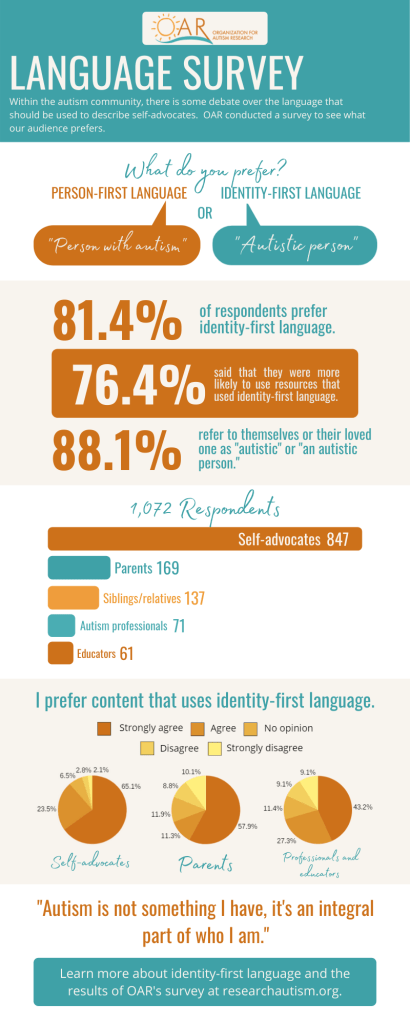
Of the more than 800 self-advocates who completed the survey, 88.6% indicated a preference for identity-first language. When asked to elaborate, they responded with insights such as:
1,000 People Surveyed, Survey Says… | Organization for Autism Research
- “When a publication uses the word ‘autistic’…I feel seen and accepted.”
- “My autism is not an accessory that I can set aside. It is not something external that has latched onto me. It is not an illness or disease I have ‘caught.’ It is a fundamental, inseparable part of me and who I am.”
- “I use them interchangeably sometimes and don’t personally take offense to either. However, with autism, I try to use identity-first because that’s what the neurodivergent community seems to prefer.”
This survey confirmed what OAR had suspected. Times and attitudes have changed considerably in this regard. There is a clear preference for identity-first language among our audience. In response, OAR has decided to adopt identity-first language as its default: moving forward, when referring to autistic people in general, we will use identity-first language.
1,000 People Surveyed, Survey Says… | Organization for Autism Research
🗣️ Language is a place of struggle.
Language is also a place of struggle.
Choosing the Margin as a Space of Radical Openness, bell hooks
Language is a place of struggle. Language matters. We have a moral imperative to connect with the communities we serve and use the language they prefer. Learn more:
- Identity First Language: Thinking differently requires speaking differently.
- Autism‐Related Language Preferences of English‐Speaking Individuals Across the Globe
- Navigating Autism Acceptance Month and Autism Myths
- Determining a Good Autism Organization
The oppressed struggle in language to recover ourselves, to reconcile, to reunite, to renew. Our words are not without meaning, they are an action, resistance. Language is also a place of struggle.
Often when the radical voice speaks about domination we are speaking to those who dominate. Their presence changes the nature and direction of our words. Language is also a place of struggle. I was just a girl coming slowly into womanhood when I read Adrienne Rich’s words “this is the oppressor’s language, yet I need it to talk to you.” This language that enabled me to attend graduate school, to write a dissertation, to speak at job interviews carries the scent of oppression. Language is also a place of struggle.
Choosing the Margin as a Space of Radical Openness, bell hooks
Language is also a place of struggle. We are wedded in language, have our being in words. Language is also a place of struggle. Dare I speak to oppressed and oppressor in the same voice? Dare I speak to you in a language that will move beyond the boundaries of domination — a language that will not bind you, fence you in, or hold you. Language is also a place of struggle. The oppressed struggle in language to recover ourselves, to reconcile, to reunite, to renew. Our words are not without meaning, they are an action, resistance. Language is also a place of struggle.
“Person-Centered”
Note: This is satire.
⛺️ We Are a NeurodiVenture
NeurodiVenture : an inclusive non-hierarchical organisation operated by neurodivergent people that provides a safe and nurturing environment for divergent thinking, creativity, exploration, and collaborative niche construction.
NeurodiVentures | Autistic Collaboration
We are a NeurodiVenture and a Teal organization running on:
How We Operate
The NeurodiVenture Operating Model
NeurodiVenture : an inclusive non-hierarchical organisation operated by neurodivergent people that provides a safe and nurturing environment for divergent thinking, creativity, exploration, and collaborative niche construction.
NeurodiVentures | Autistic Collaboration
NeurodiVentures create safe spaces for groups of autistic and otherwise neurodivergent to share knowledge, to cultivate collective intelligence, and to offer their gifts to the world in the form of genuinely innovative and unique services.
The Beauty of Collaboration at Human Scale: Timeless patterns of human limitations
By definition, the main purpose of existence of a NeurodiVenture is the creation of a psychologically safe and egalitarian communal space for neurodivergent people.
The Beauty of Collaboration at Human Scale: Timeless patterns of human limitations
The tailored core prosocial design principles we use:
Operating Model and Backbone
- Trusted relationships within the group and strong understanding of purpose (to support an open and inclusive neurodiverse and creative team)
- Fair distribution of costs and benefits
- Fair and inclusive decision-making
- Fast and empathetic conflict resolution
- Authority to self-govern
- Appropriate relations with other groups
- Tracking agreed upon behaviours (a working advice process minimises the need for tracking)
- Graduated responses to transgressions to prevent a person or a subgroup from gaining power over others (appropriate focus on fair and inclusive distribution of resources minimises the need for coercion)
The eight prosocial design principles provide guidance for dealing with people who regularly ignore relevant advice (or consistently refuse to seek or give advice) and therefore regularly cause downstream problems for others as a result. Such situations are obvious for all involved. A persistent breakdown of collaboration either results in a significant change in behaviour once the downstream problems are recognised, or in the non-cooperative person leaving the organisation.
The Beauty of Collaboration at Human Scale: Timeless patterns of human limitations
At the level of small (human scale) groups, the NeurodiVenture model provides a set of first principles for creative collaboration that can be implemented in appropriate ways to accommodate local needs. The prosocial principles (Atkins et al., 2019) that are part of the NeurodiVenture model not only provide guidance for collaboration within the group, but also for collaboration with other groups, and thereby they pave the path for the development of collaborative bioregional networks of NeurodiVentures and other human scale groups.
The Beauty of Collaboration at Human Scale: Timeless patterns of human limitations
Individual competency networks are one of the three ingredients of the collaborative (not secret) sauce of good company. The other two essential ingredients that define the NeurodiVenture model include eight trust-reinforcing organisational principles and rituals and eight more generic tailored 8 prosocial core design principles.
The NeurodiVenture model is the result of incremental evolution. The eight trust-reinforcing principles and rituals are not unique to our approach and have proven their worth in various contexts to catalyse collective intelligence:
- A clear purpose, a long term perspective, and revenue sharing instead of salaries
☞ resilience- Twenty-six critical thinking tools (backbone principles) to support the purpose
☞ an inclusive culture of thinking and learning- Employee ownership and zero debt
☞ no distractions by stakeholders with short term motivations and hidden agendas- An intensive 12-month induction and on-boarding process
☞ a foundation for mutual understanding- Organising around the talents and needs of specific people
☞ ability to benefit from an incredible diversity of talents- Relying entirely on equitable team-oriented incentives and zero individual incentives
☞ elimination of in-group competition- Operating an advice process instead of hierarchy
☞ maximising learning opportunities - Open source intellectual property
☞ no barriers to flows of tacit knowledgeAt S23M we started with these eight complementary principles and rituals as an initial minimal viable operating model. Then several painful lessons from attempts of interfacing with the neuronormative social world prompted us to add a missing generic principle, to clamp down on toxic social power dynamics. The tailored core prosocial design principles we use:
- Trusted relationships within the group and strong understanding of purpose (to support an open and inclusive neurodiverse and creative team)
- Fair distribution of costs and benefits
- Fair and inclusive decision-making
- Fast and empathetic conflict resolution
- Authority to self-govern
- Appropriate relations with other groups
- Tracking agreed upon behaviours (a working advice process minimises the need for tracking)
- Graduated responses to transgressions to prevent a person or a subgroup from gaining power over others (appropriate focus on fair and inclusive distribution of resources minimises the need for coercion)
Our established undocumented practices meant that we already had implementations for 7 of the 8 prosocial principles (Atkins et al. 2019) identified by Elinor Ostrom (2015), Michael Cox and David Sloan Wilson, but we were missing the 8th principle “Graduated responses to transgressions”. We have qualified this principle as shown in the list above, to remind us to stick to an incremental approach when extending trust to candidates who are still in the on-boarding phase, and still in the process of unlearning W.E.I.R.D. social norms.
The Beauty of Collaboration at Human Scale: Timeless patterns of human limitations
Applying evolutionary science to coordinate action, avoid disruptive behaviours among group members, and cultivate appropriate relationships with other groups in a multi-group ecosystem (the work of Elinor Ostrom, Michael Cox and David Sloan Wilson).
With the needs of autistic people in mind, the original pro-social design principles from Elinor Ostrom have been modified (a) to emphasise trusted relationships over strong group identity, and (b) to limit the legitimacy of coercion to a narrow use case.
Operating Model and Backbone
We do it in a trauma and neurodiversity informed way using polyvagal theory and the neuroscience of community.
The Beauty of Collaboration at Human Scale: Timeless patterns of human limitations
By definition, the main purpose of existence of a NeurodiVenture is the creation of a psychologically safe and egalitarian communal space for neurodivergent people.
The Beauty of Collaboration at Human Scale: Timeless patterns of human limitations
What does that mean?
In other words…
One Idea Per Line
- NeurodiVenture is an organization run by neurodivergent people.
- It provides a safe and nurturing environment for divergent thinking, creativity, exploration, and collaborative niche construction.
- It is inclusive and non-hierarchical.
- It operates on principles such as the advice process, psychological safety, self-determination theory, the prosocial framework, mutual trust, collaborative niche construction, open source, restorative practices, and transformative justice.
- It is trauma and neurodiversity informed, using polyvagal theory and the neuroscience of community.
- NeurodiVentures create safe spaces for groups of autistic and neurodivergent individuals.
- These spaces allow for sharing knowledge, cultivating collective intelligence, and offering unique and innovative services to the world.
One Paragraph Summary
NeurodiVenture is an organization that is run by neurodivergent people. It aims to create a safe and supportive environment for different ways of thinking, creativity, exploration, and working together on specific interests. They use various methods and theories, such as the advice process, psychological safety, self-determination theory, prosocial framework, mutual trust, collaborative niche construction, open source, restorative practices, transformative justice, trauma-informed approaches, and neurodiversity-informed approaches. The goal is to provide a space where autistic and other neurodivergent individuals can come together, share knowledge, and use their unique skills and talents to create innovative and valuable services for the world.
Extended Summary
NeurodiVenture is an organization that is operated by neurodivergent individuals and aims to create a safe and nurturing environment for divergent thinking, creativity, exploration, and collaborative niche construction. It is an inclusive organization that values the contributions and perspectives of neurodivergent people.
The organization follows the principles of Teal organizations, which emphasize self-management and distributed decision-making. They use the advice process, where decisions are made by seeking advice from those who will be affected by the decision, rather than relying on a hierarchical structure.
Psychological safety is a key aspect of NeurodiVenture, ensuring that individuals feel safe to express themselves and share their ideas without fear of judgment or criticism. This fosters an environment that encourages open communication and collaboration.
The organization also follows the principles of self-determination theory, which focuses on supporting individuals’ autonomy, competence, and relatedness. This means that individuals have the freedom to make choices, develop their skills, and build meaningful relationships within the organization.
NeurodiVenture operates within the prosocial framework, which promotes behaviors that benefit others and society as a whole. This framework encourages cooperation, empathy, and compassion among members of the organization.
Mutual trust is another important aspect of NeurodiVenture. Trust is built through open and honest communication, reliability, and respect for each other’s perspectives and contributions.
Collaborative niche construction is a concept that involves creating and shaping environments that align with the unique strengths and abilities of neurodivergent individuals. This allows them to contribute their innovative and unique services to the world.
The organization also embraces open source principles, which means that knowledge, information, and resources are shared openly and freely. This fosters a culture of collaboration and continuous learning.
Restorative practices and transformative justice are approaches used by NeurodiVenture to address conflicts and restore relationships within the organization. These approaches focus on repairing harm, building understanding, and promoting healing.
NeurodiVenture takes a trauma-informed and neurodiversity-informed approach, recognizing and accommodating the unique needs and experiences of individuals who have experienced trauma or who are neurodivergent. This ensures that the organization is sensitive to their needs and provides a supportive environment.
Polyvagal theory and the neuroscience of community are used to understand and support the social and emotional well-being of individuals within NeurodiVenture. These theories provide insights into how the nervous system responds to social interactions and how to create environments that promote connection and belonging.
Overall, NeurodiVenture is a collaborative and inclusive organization that values the contributions of neurodivergent individuals. It provides a safe and nurturing environment for them to share their knowledge, cultivate collective intelligence, and offer innovative and unique services to the world.
AI Disclosure: The summaries above were created with the help of Elephas AI Assistant.
We’re co-creating Autistic collaboration at human scale.
The Stimpunks website is also an awesomely rich source of links! Semantic links rather than commercial advertisements are the life blood of the internet – the Autistic online habitat.
We’re co-recreating Autistic collaboration at human scale on a daily basis, in the many wide open cracks, in the cognitive blind spots of the algorithms of capital.
Jorn Bettin, author of “The Beauty of Collaboration at Human Scale: Timeless patterns of human limitations“
The force of life is distributed and decentralised, and it might be a good idea to organise and collaborate accordingly.
The Beauty of Collaboration at Human Scale: Timeless patterns of human limitations
The limits of human scale, the capacity for cultural evolution, and the resultant cultural diversity are best appreciated as the most valuable and unique species level survival advantage of humans over all other primate species. Human societies that operate at human scales are highly resilient and adaptive. Bands of hunter gatherers could rely on the human capacity for flexible cooperation and collective intelligence that is unlocked by egalitarian social norms within small groups.
The Beauty of Collaboration at Human Scale: Timeless patterns of human limitations
It takes a village.
Whānau = extended family, family group, a familiar term of address to a number of people – the primary economic unit of traditional Māori society. In the modern context the term is sometimes used to include friends who may not have any kinship ties to other members.
There is the saying that “It takes a village to raise a child.” The Autistic translation of this saying is “For an Autistic person it takes an Autistic whānau to feel loved and alive.” Without the support of an Autistic whānau, Autistic life feels like a life in continuous emergency mode.
Whānau : extended family, family group, a familiar term of address to a number of people – the primary economic unit of traditional Māori society. In the modern context the term is sometimes used to include friends who may not have any kinship ties to other members.
Whānau are not powered by adrenalin but by love and mutual care. Most Autists are not born into healthy Autistic whānau.
Takiwātanga : Autistic ways of being, takiwātanga literally means “in their own space and time.”
Whānau is much more than the Western notion of “family”. It is a deep connection, a bond that you are born into that no one can take away from you.
Whakawhanaungatanga : process of establishing relationships, relating well to others.
Whakapapa : the “genealogical descent of all living things from God to the present time. “Since all living things including rocks and mountains are believed to possess whakapapa, it is further defined as “a basis for the organisation of knowledge in the respect of the creation and development of all things”. Hence, whakapapa also implies a deep connection to land and the roots of one’s ancestry. In order to trace one’s whakapapa it is essential to identify the location where one’s ancestral heritage began; “you can’t trace it back any further”. “Whakapapa links all people back to the land and sea and sky and outer universe, therefore, the obligations of whanaungatanga extend to the physical world and all being in it”.
In a healthy culture Autistic children are assisted in co-creating their unique Autistic whānau, but in our “civilisation” this cultural knowledge has been lost and is suppressed. In mainstream society people don’t understand how Autistic people support each other, love each other, and care for each other in ways that go far beyond the culturally impaired neuronormative imagination.
Autists depend on assistance from others in ways that differ from the cultural norm – and that is pathologised in hypernormative societies. However, the many ways in which non-autistic people depend on others is considered “normal”. The endless chains of trauma must be broken.
There is the saying that “It takes a village to raise a child.” The Autistic translation of this saying is “For an Autistic person it takes an Autistic whānau to feel loved and alive.”
The foundation of our whakapapa is the ocean and the mountains. Via Autistic trauma peer support we are embarking on the journey of co-creating healthy Autistic whānau and Autistic culture all over the world.
Depowered feral Autistic relationships | Autistic Collaboration
A NeurodiVenture is an inclusive non-hierarchical organisation operated by neurodivergent people that provides a safe and nurturing environment for divergent thinking, creativity, exploration, and collaborative niche construction.
In Te Reo Māori the NeurodiVenture concept translates to Neurodivergent whānau. Indigenous languages like Te Reo Māori have important words for concepts that have been suppressed by colonialism.
Without the support of an Autistic whānau, Autistic life feels like a life in continuous emergency mode.
Autistic people – The cultural immune system of human societies
Many Artistic & Autistic people are unemployable by organisations that operate hierarchical structures. There is an urgent need to catalyse and co-create NeurodiVentures (worker co-ops) and healthy A♾tistic whānau all over the world.
Many Artistic & Autistic people are unemployable by organisations that operate hierarchical structures. There is an urgent need to catalyse and co-create NeurodiVentures (worker co-ops) and healthy A♾tistic whānau all over the world. A♾tists depend on assistance from others in ways that differ from the cultural norm – and that is pathologised in hypernormative societies. However, the many ways in which non-a♾tistic people depend on others is considered “normal”. The endless chains of trauma must be broken.
The ecological niche of A♾tistic peoples | Autistic Collaboration
The technologies we develop and use tend to reflect the level of collaboration and competitiveness within our culture. In our role as conscious designers of technology, humans have the potential to influence the level of collaboration in our culture in profound ways, especially in a highly networked digital world.
The NeurodiVenture operating model not only raises neurodiversity as a top level concern for good company but by imposing a hard limit on group size (in the case of S23M enforced by our company constitution) it also ensures that every member of the team has spare cognitive capacity for building and maintaining trusted relationships with the outside world, whilst at the same time encouraging creative collaboration for life.
Organising for neurodivergent collaboration | Autistic Collaboration
Beyond eliminating formal hierarchical structures the NeurodiVenture model also removes all incentives for the emergence of informal “power-over” structures via transparency of all individual competency networks for the benefit of everyone within the company. This is perhaps the most radical idea within the NeurodiVenture model.
Transparency of individual competency networks enables meta knowledge (who has which knowledge and who entrusts whom with questions or needs in relation to specific domains of knowledge) to flow freely within an organisation.
The conceptualisation of meta knowledge flows via individual competency networks assists the coordination of activities via the advice process outlined above and via regular Open Space workshops, and it acts as an effective dampener on the informal hierarchies that can easily come to plague hierarchical and “non-hierarchical” organisations.
Organising for neurodivergent collaboration | Autistic Collaboration
NeurodiVentures are a concrete example of an emerging cultural species that provides safe and nurturing environments for divergent thinking, creativity, exploration, and collaborative niche construction.
The Beauty of Collaboration at Human Scale: Timeless patterns of human limitations
- Visibly extend trust to people, to release the handbrake to collaboration.
- Unlock the tacit knowledge within the group.
- Provide a space for creative freedom.
- Help repair frayed relationships.
- Replace fear with courage.
By focusing on the human scale outside the theatre we can reconnect with the physical and ecological niche that supports our human needs. The more collaborative, egalitarian, and accomodating of cultural diversity, the surrounding cultural environment becomes, the less NeurodiVentures will be perceived as unusual, and the more neurodivergent people will be able to spend significant time outside the protective islands of safety provided by a NeurodiVenture without getting overwhelmed.
The Beauty of Collaboration at Human Scale: Timeless patterns of human limitations
The open source NeurodiVenture operating model for employee owned companies primarily consists of a set of first principles that can be adapted to the unique needs of a specific team of neurodivergent people. There is no need to be prescriptive about how to go about forming and operating a NeurodiVenture, because there is no right way or best way.
Autistic people with complementary talents and skills are ideally positioned to jointly design, develop, and offer highly unique products and services, without any need for external capital, and without any need for an employer or manager.
The Beauty of Collaboration at Human Scale: Timeless patterns of human limitations
The Beauty of Collaboration at Human Scale: Timeless patterns of human limitations
Digital communication and collaboration technologies enable NeurodiVentures to act as a catalyst for trusted collaboration between groups.
The Beauty of Collaboration at Human Scale: Timeless patterns of human limitations
Chosen families are nonbiological kinship bonds, whether legally recognized or not, deliberately chosen for the purpose of mutual support and love.
According to the SAGE Encyclopedia of Marriage, Family, and Couples Counseling, “chosen families are nonbiological kinship bonds, whether legally recognized or not, deliberately chosen for the purpose of mutual support and love.” The term originated within the LGBTQ community and was used to describe early queer gatherings like the Harlem Drag Balls of the late nineteenth century.
The circumstances surrounding the birth of the first “chosen families”—intense loneliness and isolation faced by those rejected by their biological kin—continue today. Nearly 40 percent of today’s homeless youth identify as queer, and a recent study found that roughly 64 percent of LGBTQ baby boomers have built, and continue to rely on, chosen families.
“Chosen families,” though, can form as a result of any person’s experience with their biological family that leaves needs unmet. Friends who become your family of choice may provide you with a healthier family environment than the one in which you were raised, or their proximity may allow you to rely on them when your biological family isn’t located nearby. A chosen family can be part of a person’s growing network, and can help construct a wide foundation of support that continues to grow with time.
Finding Connection Through “Chosen Family” | Psychology Today
So many people around the world are not accepted by their parents or their family for who they are.
Rina Sawayama: Tiny Desk (Home) Concert
Here’s a heart-strumming rendition of “Chosen Family” from Rina Sawayama (starting at 8:29).
Settle down, put your bags down
Rina Sawayama – Chosen Family
You’re alright now
Tell me your story and I'll tell you mine
I'm all ears, take your time, we've got all night
Show me the rivers crossed, the mountains scaled
Show me who made you walk all the way here
Family of choice might seem like a contradiction but your ‘chosen’ family consists of those who accept you for who you are and they want the best for you. They support you in your chosen ventures, help you when you need to make decisions and tell you when you might be going down the wrong track! As in any other family, you might have your differences, but they are always there for you. If you can find yourself among a unit of supporters who love you unconditionally, will offer a place to you that allows you to be yourself, safely and without barriers, you might have found your ‘chosen’ family. This family might not be all in one place.
The Autistic Trans Guide to Life
There is something very special about forming relationships with people who understand and accept you for who you are. You may hear the phrase ‘chosen family’ used by LGBTQIA+ people to describe these relationships – people they have met, formed bonds with, and chosen to have as their family separately to their ‘real’ family.
Queerly Autistic: The Ultimate Guide For LGBTQIA+ Teens On The Spectrum
These types of relationships are especially important to LGBTQIA+ people. There is a long history of us being isolated from our ‘official’ family and friends due to our sexuality and gender, and so the idea of ‘found’ or ‘chosen’ family has a strong emotional meaning in the community. There are still people today whose family react badly to them coming out (as we discussed in the chapter on coming out), so relationships with other people in the LGBTQIA+ community are just as important as they ever were.
Even if your family is accepting and loving, relationships within the community can still be very important. They certainly have been for me.
Queerly Autistic: The Ultimate Guide For LGBTQIA+ Teens On The Spectrum
I will also say this: I have never, not even for one single second, regretted it. I have never regretted doing the right thing or fighting for the health and wholeness of others even when it causes me pain and puts me at significant personal risk. I have lost nothing that I needed, because I had it all inside me. And the people that have now become my precious, chosen family are people I would never have met if I hadn’t been walking this path.
#ChurchToo: How Purity Culture Upholds Abuse and How to Find Healing
“In my phone contacts, I put emojis by their names. I put strawberries next to people who were super loving. I put seedling emojis by folks who taught me things that made me think or grow.”
Within a year of his making these changes in his life, many of Samuel’s “strawberry people” had become members of his found family. They had his back as he worked through therapy for PTSD and eating disorder recovery. The strawberry people even became friends with one another—Samuel writes that they all talk in a single group chat.
Unmasking Autism: Discovering the New Faces of Neurodiversity
Exile and Pride: Disability, Queerness, and Liberation
Where do I belong?
Intro to song starts at 8:29
Where do I belong?
Tell me your story and I'll tell you mine
I'm all ears, take your time, we got all night
Show me the rivers crossed, the mountains scaled
Show me who made you walk all the way here

Settle down, put your bags down
(Ooh) You're alright now

We don't need to be related to relate
We don't need to share genes or a surname
You are
You are
My chosen
Chosen family
So what if we don't look the same?
We been going through the same thing
You are
You are
My chosen
Chosen family
So many people around the world are not accepted by their parents or their family for who they are.
Rina Sawayama: Tiny Desk (Home) Concert
⚖️ Our Creed
If you’re building a startup or any sort of organization, take a few moments to reflect on the qualities that the people you most enjoy working with embody and the user experience of new people joining your organization, from the offer letter to their first day.
Why Your Company Should Have a Creed
Here is our creed, broken into 4 sets of statements.
I know that pluralism is our reality. I know that Neurodiversity is one of the most powerful ideas of our generation, and that…
I know that pluralism is our reality. I know that Neurodiversity is one of the most powerful ideas of our generation, and that Neurodiversity friendly forms of collaboration hold the potential to transform pathologically competitive and toxic teams and cultures. I know Autistic forms of communication within a neurodiverse team and within a psychologically safe environment impart a collaborative advantage to the entire team. I know neurodiversity, the social model of disability, and intersectionality are urgently needed reframing necessary to equity and inclusion.
I reframe out of the confines of the medical model and pathology paradigm and into…
I reframe out of the confines of the medical model and pathology paradigm and into the respectfully connected expanse of the biopsychosocial model and the Neurodiversity paradigm. I reframe from deficit ideology to structural ideology.
I center the marginalized and the different. I center edge cases, because…
I center the marginalized and the different. I center edge cases, because edge cases are stress cases and design is tested at the edges. I center neurodivergent and disabled experience in service to all bodyminds.
I will never stop learning. I will communicate as much as possible because…
I will never stop learning. I will communicate as much as possible because communication is oxygen to an organization. I will never pass up an opportunity to help out another Stimpunk. I will maintain learner safety and remember what it is like to be a new contributor. I will make other people feel equal and not alone. I will build with, not for. I will default to open. I will move carefully and fix things. I will make things that help people, and I will not make things that harm people. I will bake ethics into everything I do. I will be a threat to inequity in my spheres of influence.
🎸 Our Rules of Punk

By Helen Edgar, Autistic Realms
The forces of neuronormativity feel overwhelming in this age of mass behaviorism and unvarnished eugenics.
…mass neurodivergent disablement and constant, widespread anxiety, panic, depression, and mental illness, combined with systemic discrimination of neurodivergent people, is a problem specific to the current historical era. Hegemonic neuronormative domination, in other words, is a key problem of our time.
Empire of Normality: Neurodiversity and Capitalism by Robert Chapman
Against that tide, we embrace our weird potentials. We neuroqueer the social world.
In line with a disability justice approach, one of the more positive recent developments is the theory and praxis of neuroqueering. Stemming from the work of Nick Walker and Remi Yergeau, neuroqueering focuses on embracing weird potentials within one’s neurocognitive space, and turning everyday comportment and behaviour into forms of resistance. This has provided a new tool for combatting neuronormativity from within the constraints imposed by history and current material conditions. By queering the social world, new possibilities are carved out for the future, helping us not just challenge aspects of the current order but to start collectively imagining what a different world could be like.
Empire of Normality: Neurodiversity and Capitalism by Robert Chapman
We make room for all of us when we embrace the rules of punk.
The First Rule of Punk: Be Yourself
Our Second Rule of Punk: Reframe

When we reframe, we perceive others such that they too can be themselves.
Autistic ways of being are human neurological variants that can not be understood without the social model of disability.
A communal definition of Autistic ways of being
I make the right mistakes
And I say what I mean

Spare me from the mold
Reframe these states of being that have been labelled deficiencies or pathologies as human differences.
Normal Sucks: Author Jonathan Mooney on How Schools Fail Kids with Learning Differences
Because we′re standing in the way of control
We will live our lives
Tell the truth in such a way that you’re allowing others to tell their truths, too.
Design for Real Life
Our Third Rule of Punk: Live Your Truth
Our Fourth Rule of Punk: Shred Some Gnar
Live Your Truth; Shred some Gnar
NOBRO
Livin’ my truth (I gotta live my truth!) while shredding some gnar!
🌈♿️ Take Them Together: Neurodiversity and Disability Justice
On the next page, we get personal, we get feisty, and we get punk rock about it. We celebrate neurodiversity, disability justice, pluralism, weird pride, queer pride, and chosen family while making it clear that:
- We are not okay.
- You are killing us.
- We are the canaries,
- and y’all selling coal.


