
Here are some questions posed to us for inclusion in an allied organization’s newsletter. We cover community art, direct giving, research, ableism, and more.
Table of Contents
- The artwork on your website is amazing, where does it come from?
- What is your latest research on?
- What does direct support look like for your organization? The website mentions a lot about mutual aid?
- How can individuals reading get involved in mutual aid in their communities?
- What are some wins you want to share with the community at large?
- What are some barriers you want the community at large to know about regarding ableism?
- How can we best support Stimpunks.org?
- How can Non-Disabled People show up better? And love better?
- I love how activist research is also about transformative action. Can you speak more to this?
- The ideas of community, interdependence, and the political really spoke to me, can you speak more on this?
- “We recognize that there is no justice that neglects disability.” (Philosophy – Stimpunks Foundation)
- I really like these ideas: Community is resistance. Asking for help. Showing up to give help. Collaboration.
The artwork on your website is amazing, where does it come from?
Our art comes from our community. We practice constructionism and actively engage in constructing things in the world. Practicing our art makes our souls grow.
Featured Art
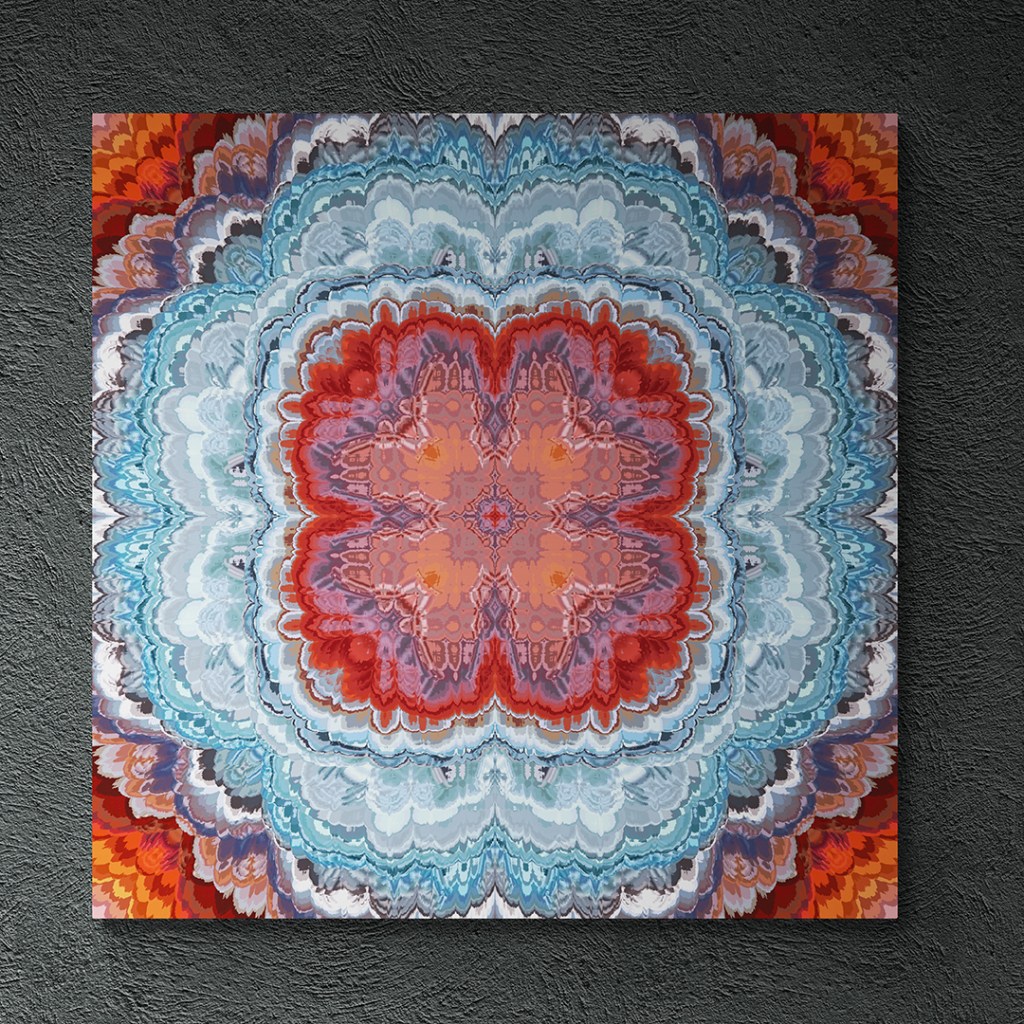
About the art: Floralis (Flourite Spheralite)
Description: A bursting kaleidoscopic geometrical form with 4 sides of symmetry pointing angularly to each of the four corners of a square shaped canvas against a dark grey textured wall. There is a small red shaped plus at the very center, surrounded by orangish-peach and periwinkle butterfly like shapes at 45 degree angles from each other aligned to the mid center going up and also to the sides. The butterfly shapes are encased in a deeper red flower like shape before a region of light blue geometric textures. Near the corners are feathered white, dark grey-purple, burgundy and orange feather like edges.
About the artist: Adriel Jeremiah Wool
Our featured artist is Adriel Jeremiah Wool.
Adriel Jeremiah is an computer programmer with a deep background in origami and folding. This artwork is an extension of a world view involving folding; often involving higher dimensional spaces. Many of these designs contain the mathematical magic of the transcendental numbers of nature, and all of them are the extension of the provisions of space itself; to be both physically folded, and conceptually folded, circularily and across many levels of expression.Shop Art by Adriel
His spectacular new piece derives its color stream from a fluorite crystal that has a spheralite imperfection / inclusion (the red, purple, and orange).
AJ describes what these fractal pieces are in this accordion. Their construction will broaden your perspective on perspective.My artwork is digital photography in a world where objects exist in more than 3 dimensions, and where no known means of physical representation has yet been discovered to exist.
AJ is a regular contributor at Stimpunks. He kindly licenses his work as free cultural work. He helps us tell our stories with his art, music, photography, videos, audio engineering, poetry, prose, and lived experience.
AJ has a gallery in Ketchum, Idaho. Drop by if you’re around. He tries to make it a welcoming third place.
Stimpunks is gently debugging society.
Adriel Jeremiah Wool
The charity protects, helps and comforts individuals, while pointing out library-level flaws in some of the concepts that end up harming those individuals.
This help is profoundly wonderful, morally and functionally coherent to great need, and as true as a pure circle in its cause-and-effect form.
About the process: My artwork is digital photography in a world where objects exist in more than 3 dimensions, and where no known means of physical representation has yet been discovered to exist.
The artist hopes to convey this: that the universe is given forth folded and unfolded. Although explicit understanding helps, it is too cumbersome, and should only provide refinement to something already greater that exists.
Adriel Jeremiah Wool
That greater thing is what was given to the artist first by the practice of origami. An enlivening of the intuitive mind, experience with a universe of many dimensions, and the promise of creation revealed when one folds a flat square into the likeness of a higher dimensional thing. That inspiration reaches a young mind in a powerful way.
The artist wants the viewer to see proof of what their intuitive mind already knows is true, the universe is a multidimensional phenomenon and the ability to understand its nature already exists within us each.
The artist hopes the viewer will be inspired to seek the understanding of freedoms available to the individual inspired by the exposure to artistic expressions, and of a nature of dimensionality unimaginably greater than the object presented here.
Adriel Jeremiah Wool
It’s gonna be an art party.
We’re gonna make, make something great for
All of us to see and appreciate
It’s gonna be an art party
It’s gonna be an art party

Come on over it’s time to start
It’s a great big party where we make and share art
Art Party (feat. Portugal. The Man & Paul Williams) – YouTube
What is your latest research on?
Monotropism, neuroqueer learning spaces, and Cavendish Space.
What does direct support look like for your organization? The website mentions a lot about mutual aid?
Direct support includes, first and foremost, giving people money with no strings attached. Folks know what they need and how best to spend the money. We also help people navigate our systems by filling forms and making calls for them. We provide warm lines and peer respite. We practice library economies, competency networks, sharing spoons, and support swapping.
“Mutuality is a feeling, an action, and a relationship based on shared benefit between individuals and groups in a society. It materialises in many, many ways and is arguably a universal constant of our human nature. We rely on mutuality to survive and progress through our day to day life.” (Andrewism)
“When systems of power fail, it is mutuality—neighbours helping neighbours—that holds communities together.” (Andrewism)
How can individuals reading get involved in mutual aid in their communities?
Start with pod mapping.
- Find a few people.
- Identify your zone.
- Invite neighbors.
- Get a name.
- Have conversations.
- Support each other.
Source: Mutual Aid 101 – Google Slides
What are some wins you want to share with the community at large?
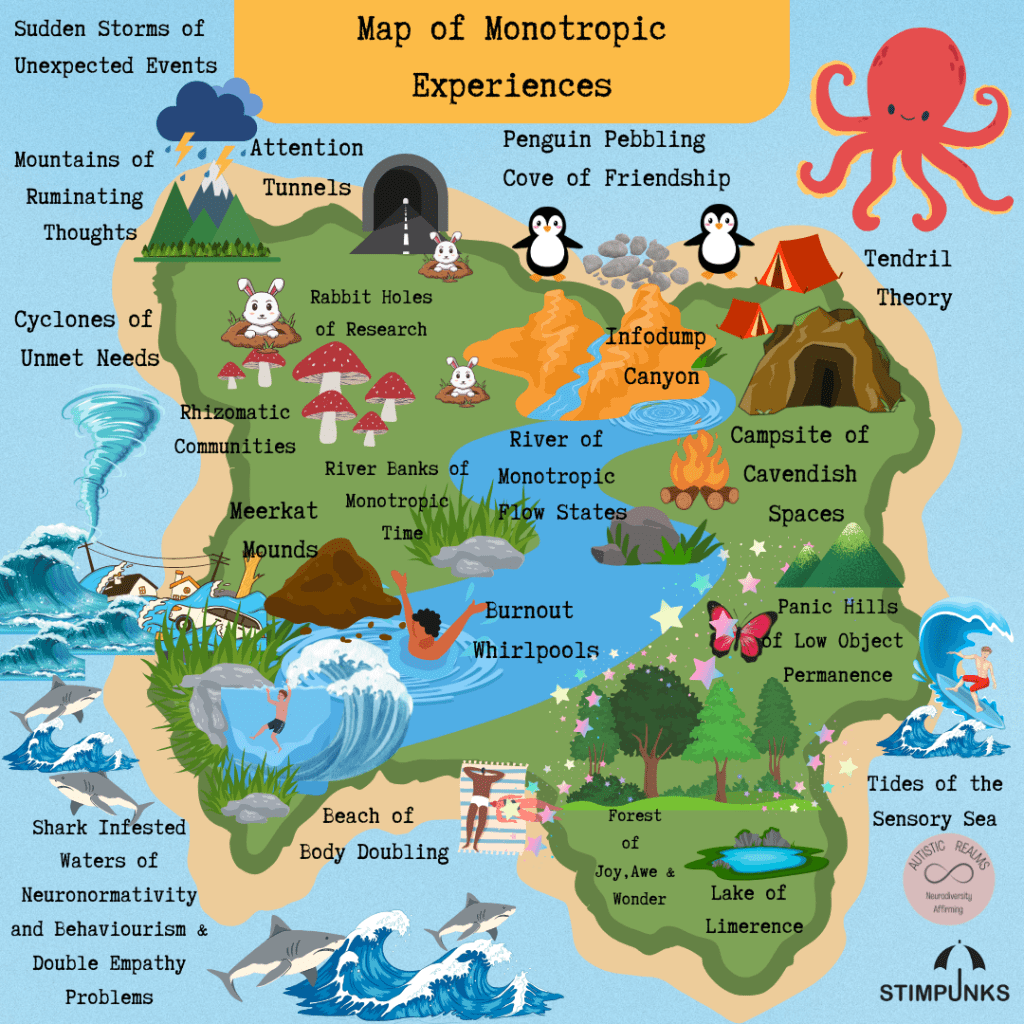
Our Map of Monotropic Experiences has been widely shared and incorporated into care settings and training.
What are some barriers you want the community at large to know about regarding ableism?
We live in an age of mass behaviorism. Behaviorism such as ABA and PBS are rife in education and healthcare settings. “Behaviorism is a dehumanizing mechanism of learning that reduces human beings to simple inputs and outputs. There is an ever-growing body of research suggesting that behaviorism is not only harmful to how we learn, but is also oppressive, ableist, and racist.” (Human Restoration Project)
Behaviorist education is ableist education. Behaviorist healthcare is ableist healthcare.
How can we best support Stimpunks.org?
- Read our website.
- Share our website.
- Amplify us on social media.
- Give whatever you can, be it time or money or attention.
How can Non-Disabled People show up better? And love better?
We exist as friction. Load-share the burden of existing as friction.
- Promote and practice access intimacy instead of forced intimacy.
- Question the narratives of wellness, and engage in critical wellness instead.
- Reframe yourself and others. Help people reframe from the pathology paradigm and medical model to the neurodiversity paradigm and biopsychosocial model. This is hard and important work necessary to all other work. Change the narrative. Start reframing.
- Advocate for accessibility at school, work, and in your community.
- Be a threat to inequity in your spheres of influence.
- Combat the myths.
- Use and promote Identity First Language.
- Elevate care as infrastructure. Stimpunks exists because our systems effectively don’t.
- Celebrate our interdependence!
I love how activist research is also about transformative action. Can you speak more to this?
“three characteristics that delineate activist research from other types of research:”
(1) combination of knowledge production and transformative action;
(2) systematic multi-level collaboration; and
(3) challenges to power.
(Denisha Jones)
A hallmark of good research is that it embraces epistemic justice and rejects scientism.
Another hallmark of good research is naming the systems of power. If you’re not naming the systems of power in your research, you’re missing a vital component.
The ideas of community, interdependence, and the political really spoke to me, can you speak more on this?
In the past, the disability rights movement focused on independence, including it as one of the pillars of the ADA. Disability Justice moves away from independence framing, because independence is a myth.
“I am fighting for an interdependence that embraces need and tells the truth: no one does it on their own and the myth of independence is just that, a myth.” (Mia Mingus)
“Access intimacy is interdependence in action.” (Mia Mingus)
“It is time to celebrate our interdependence!” (Jorn Bettin)
“We recognize that there is no justice that neglects disability.” (Philosophy – Stimpunks Foundation)
Working at my org I really believe this and feel that everyone who works here also believes this. We cannot neglect disability in our policy and conversations and our care. If you have anything to add to this.
There is no path to justice that does not involve direct confrontation with ableism and inaccessibility. To neglect disability is to neglect two of the major forces of injustice.
Ableism is at the root of all -isms.
“Ableism is what makes all other “isms” effective.
White supremacy is the goal, ableism is the toolkit.” (Imani Barbarin)
“…so much of what disability actually is, is just humanity; and so much of what ableism is, is a humanity heist.” “Ableism enables all forms of inequity and hampers all liberation efforts.” (Talila A. Lewis)
Disabled and neurodivergent people are always edge cases, and edge cases are stress cases.
We choose the margin, because design is tested at the edges.
“Living as we did on the edge we developed a particular way of seeing reality. We looked both from the outside in and from the inside out. We focused our attention on the centre as well as on the margin. We understood both.” (bell hooks)
“No one knows best the motion of the ocean than the fish that must fight the current to swim upstream.” “By focusing on the parts of the system that are most complex and where the people living it are the most vulnerable we understand the system best.” (Tressie McMillan Cottom)
I really like these ideas: Community is resistance. Asking for help. Showing up to give help. Collaboration.
I think if we’re going to have a future we need to embrace and act in these ideas. How would someone start if they are new to these ideas and new to community engagement?
Find people with which you share a concern or passion. You can do this via the pod mapping described above.
“Communities of Practice are groups of people who share a concern or passion for something they do and learn how to do it better as they interact regularly.” (Wenger-Trayner, E. & Wenger-Trayner, B. 2015)
“Through free association, people will find those of mutual interests in every sphere of life to form groups on the basis of their affinity.” (Andrewism)


Leave a Reply