

Caves, Campfires, and Watering Holes for Dandelions, Tulips, and Orchids
Cavendish Space: psychologically and sensory safe spaces suited to zone work, flow states, intermittent collaboration, and collaborative niche construction.
The Main Elements of Cavendish Space Are
- caves, campfires, and watering holes
- intermittent collaboration
- niche construction
- flow states
- sensory safety
- psychological safety
- learner safety
- embodiment and regulation
- cognitive liberty
- somatic liberty
- neurological pluralism
What do those mean?
*caves = spaces for quiet reflection, introspection and self-directed learning.
*campfires = spaces for learning with a storyteller – teacher, mentor, elder, expert.
*watering holes = spaces for social learning with peers.
intermittent collaboration = group work punctuated by breaks to think and work by ourselves.
niche construction = directly modifying the environment in such a way that it enhances someone’s chances for success.
flow state = the experience of complete absorption in the present moment.
sensory safety = understanding the sensing and perceptual world (especially for neurodivergent people) and being serious about our sensory needs in every setting.
***psychological safety = a condition in which you feel (1) included, (2) safe to learn, (3) safe to contribute, and (4) safe to challenge the status quo—all without fear of being embarrassed, marginalized, or punished in some way.
***learner safety = safety to engage in the discovery process, ask questions, experiment, and even make mistakes.
embodiment = staying present in our own bodies to sensations, emotions and the external environment without going into dysregulation without going into fight/flight/freeze/fawn.
regulation = tending to and responding to the body’s needs.
**cognitive liberty = the idea that individuals have the right to absolute sovereignty over their own minds and their own cognitive processes.
**somatic liberty = freedom of embodiment, freedom to indulge, adopt, and/or experiment with any styles or quirks of movement and embodiment, whether they come naturally to one or whether one chooses them. the freedom to give bodily expression to one’s neurodivergence.
neurological pluralism = the multiplicity of different bodyminds with diverse and conflicting needs coexisting peaceably and interdependently.
* = Inspired by David Thornburg’s ‘primordial learning metaphors’ from “Campfire to Holodeck” (2013)
** = Inspired by Nick Walker’s “Neuroqueer Heresies” (2021)
*** = Inspired by Timothy R. Clark’s “The 4 Stages of Psychological Safety” (2020)
DESPITE HIS ECCENTRIC COUTURE and the strange totem rising from his backyard, Henry Cavendish was not a wizard. He was, in eighteenth-century terms, a natural philosopher, or what we now call a scientist. (The word scientist wasn’t coined until the nineteenth century, when it was proposed as a counterpart to artist by oceanographer and poet William Whewell.) He was not only one of the most ingenious natural philosophers who ever lived, he was one of the first true scientists in the modern sense.
Silberman, Steve. NeuroTribes: The Legacy of Autism and the Future of Neurodiversity (p. 21). Penguin Publishing Group.
Since reading NeuroTribes, we think of psychologically and sensory safe spaces suited to zone work as “Cavendish bubbles” and “Cavendish space”, after Henry Cavendish, the wizard of Clapham Common and discoverer of hydrogen. The privileges of nobility afforded room for his differences, allowing him the space and opportunity to become “one of the first true scientists in the modern sense.”
Let’s build psychologically safe homes of opportunity without the requirement of nobility or privilege. Cavendish’s autistic ways of being offer insight on how to do that.
“Stimpunks addresses the idea of how education may provide ‘psychological & sensory safe spaces’ that simultaneously provide opportunities for ‘intermittent collaboration’, rather than enforced large group interactions, and ‘collaborative niche construction’.”
Stenning, Anna. Narrating the Many Autisms: Identity, Agency, Mattering (The Routledge Series Integrating Science and Culture) (p. 179).
We dedicate this page and the concept of Cavendish Space to Steve Silberman, author of NeuroTribes and inspiration behind Cavendish Space.
May his memory be a revolution.
Steve Silberman (Dec 23, 1957 – August 28, 2024)
Table of Contents
- Make Space for Cavendish
- There is no learning without the body.
- Timeless Patterns in Primordial Spaces
- It’s About Finding the Right Niche
- Neuroqueer DIY: The place where we belong does not exist. We will build it.
- We need Cavendish Space now.
- We build Cavendish Space with these tools.
- Caves, Campfires, and Watering Holes
- Intermittent Collaboration
- Niche Construction
- Flow States
- Psychological Safety
- Dandelions, Tulips, and Orchids
- Sensory Safety
- Embodiment and Regulation
- Cognitive Liberty
- Somatic Liberty
- Neurological Pluralism: Weaving Cognitive and Somatic Liberty
- A Closing Thought on Human Nature
- ⏭ Continue with “✌️ We Believe”
Make Space for Cavendish
A school struggling with the ravages of American poverty has to first be a home — the kind of home the children may not have at home. A place that is relentlessly safe, that is both calming and exciting, that offers unconditional love, and that offers boundless opportunity.
That ‘home’ must be supportive and accepting, loving and encouraging, and it must provide the biggest possible window on to the world, on to the universe.
A home of opportunity.
What does opportunity look like? First, it looks like trust. It looks like freedom. And it looks like choice.
You must see your school as a home of opportunity | by Ira David Socol | Medium
Cavendish spaces are homes of opportunity that recognize that:
If Henry Cavendish hadn’t had a home of opportunity that suited his sensory and social needs, we would have lost him and his revelations to an asylum.
One of the greatest scientists in history might have ended up on a ward at Bedlam.
Cavendish was clearly an extraordinary man, fortunate enough to be born to a family of extraordinary means. If his father had been a brakeman or a miner, one of the greatest scientists in history might have ended up on a ward at the Bethlem Royal Hospital (commonly known as “Bedlam”), enduring the regimen of cold baths in vogue for the treatment of “withdrawn” patients at the time.
Silberman, Steve. NeuroTribes: The Legacy of Autism and the Future of Neurodiversity (p. 34). Penguin Publishing Group.
Let’s build homes of opportunity that meet the sensory and social needs of all humans. Cavendish’s life shows us the way.
Build Homes of Opportunity
- Replace the trappings of the compliance classroom with student-created context, BYOD (Bring Your Own Device), and BYOC (Bring/Build Your Own Comfort).
- Inform spaces with neurodiversity and the social model of disability so that they welcome and include all bodyminds.
- Provide quiet spaces for high memory state zone work where students can escape sensory overwhelm, slip into flow states, and enjoy a maker’s schedule.
- Provide social spaces for collaboration and camaraderie.
- Create cave, campfire, and watering hole zones.
- Develop neurological curb cuts.
- Provide psychological safety, learner safety, and sensory safety.
- Enable cognitive liberty and somatic liberty.
- Fill our spaces with choice and comfort, instructional tolerance, continuous connectivity, and assistive technology.
In other words, make space for Cavendish.
Good ideas can come from anywhere.
Everyone can contribute.
There is no learning without the body.
Cavendish learning spaces are based on flexibility, interaction, movement and the role of embodied responsive experiences. We reject the boundaries of traditional classroom settings and look at how they not only restrict embodied experiences but lead to disembodied experiences and harm.
There is no learning without the body.
Embodied Education: Creating Safe Space for Learning, Facilitating and Sharing
A radical change to learning spaces is needed to enable children to be embodied, feel safe and feel liberated enough to explore and be curious about the world around them. We can work and learn in infinitely creative ways, but we need to be embodied in order to do that. To feel embodied, you need feelings of safety; people need to value strengths, validate difficulties, and provide support where needed. The work by McGreevey et al.(2023) based on the Life World Model by Todres et al. (2009) applies equally to health care and education. It offers a humanising framework for everyone, not just autistic people. Everyone deserves to feel a sense of togetherness and have their journeys make sense so they have agency and autonomy over their learning journeys.
…freedom of embodiment—that is, the freedom to indulge, adopt, and/or experiment with any styles or quirks of movement and embodiment, whether they come naturally to one or whether one chooses them—is an essential element of cognitive liberty, and thus an essential area of focus for the Neurodiversity Movement. The freedom to be autistic necessarily includes the freedom to give bodily expression to one’s neurodivergence.
Walker, Nick. Neuroqueer Heresies: Notes on the Neurodiversity Paradigm, Autistic Empowerment, and Postnormal Possibilities (pp. 142-143). Autonomous Press.
Neuroscientific evidence suggests that we can no longer justify learning theories that dissociate the mind from the body, the self from social context.
Emotions, Learning, and the Brain: Exploring the Educational Implications of Affective Neuroscience by Mary Helen Immordino-Yang
Exceptional learning and growth organically flow from body comfort and regulated nervous system. These conditions activate curiosity and discovery, connection and resilience. Impactful learning will only take place if the nervous system has capacity and regulation.
Embodied Education: Creating Safe Space for Learning, Facilitating and Sharing
Timeless Patterns in Primordial Spaces
Our favorite tool for designing for whole bodyminds is “Caves, Campfires, and Watering Holes”.

Caves
Spaces for quiet reflection, introspection and self-directed learning.

Campfires
Spaces for learning with a storyteller – teacher, mentor, elder, expert.

Watering Holes
Spaces for social learning with peers.
Futurist David Thornburg identifies three archetypal learning spaces— the campfire, cave, and watering hole—that schools can use as physical spaces and virtual spaces for student and adult learning.
Australia’s Campfires, Caves, and Watering Holes: Educators on ISTE’s Australian Study Tour Discovered How to Create New Learning and Teaching Environments where Curriculum and Instructional Tools Meet the Digital Age, UNCG NC DOCKS (North Carolina Digital Online Collection of Knowledge and Scholarship)
“Campfires in Cyberspace” explored the idea that humans have always occupied one of four primordial learning spaces at any given time, ranging from the Campfire (home to the presentation of information by a teacher) to the Watering Hole (the domain of social learning from peers), the Cave (home of reflective construction) and Life (home to the construction of artifacts based on what we have learned).
In Cavendish Space, learners move between these spaces on their own, and computer technology has a positive role to play in each of these learning spaces.
When students have developed a little bit of metacognitive language around their learning spaces, they are also able to take control of their learning and their learning spaces – they can move to the space that best fits the type of learning that they are doing, and be able to explain exactly why this space is going to help them in achieving their learning goals.
Re-imagining Learning Spaces to inspire contemporary learning – Part One: Models for Change – Linking Learning
We provide caves, campfires, and watering holes so that dandelions, tulips, and orchids alike can find respite from an intense world designed against us.
Caves, campfires, and watering holes are…
- necessary to providing psychological safety and sensory safety.
- necessary to positive niche construction.
- necessary to intermittent collaboration.
- necessary to designing for neurological pluralism.
- essential to our conception of Cavendish Space.
In schools, we find that the cave form of learning is never a priority. This is a serious problem because the millions of dollars spent on many new schools will do little to improve educational outcomes if they are built without cave spaces.
The Language of School Design : Design Patterns for 21st Century Schools : Nair, Prakash
Developed by an alumni of Xerox PARC in its R&D heyday, “Caves, Campfires, and Watering Holes” have spread to progressive education, progressive workplaces, and the neurodiversity movement. Stimpunk Ryan helped create and run a multi-billion dollar company and a global Open Source community using the ideas that would become Cavendish Space. “Caves, Campfires, and Watering Holes” and “intermittent collaboration” provide core insight into how the creative teams Ryan worked on for 30 years operated.
“Caves, Campfires, and Watering Holes” and “intermittent collaboration” provide core insight into how creative teams work.
Stimpunk Helen was a classroom teacher working with kids with “Profound and Multiple Learning Disabilities (PMLD)” for 20 years. Helen with her classroom experience and Ryan with his tech team building experience were both working with caves, campfires, and watering holes and intermittent collaboration all those years.
At home, Ryan always liked small spaces. As a kid, he read books under the bed. The small space distanced him from the overload of his physical reality while stories transported him to fantasies and realities beyond his life, body, and experience. His pocket universes, though small in this world, possessed the depth and breadth for a book to unfurl.
He hid in closets. He created pillow and blanket forts and set up house in tool sheds. He sought and created small spaces in a big world of sensory and social overwhelm. He found room to be himself in edges, underneaths, and in-betweens.
…it is in solitude that students assimilate, synthesize and internalize learning so that it becomes knowledge and (sometimes) wisdom. s
(Nair, Prakash. The Language of School Design : Design Patterns for 21st Century Schools)
Likewise, Helen and her family spent years building niches in their home, building sensory spaces suitable to their bodyminds leveraging Helen’s classroom experience.
We were both making Cavendish Space long before we developed the language for it.
We independently re-discovered the “Timeless Patterns in Primordial Spaces” that have been with us all along.
Cavendish Space can be found in PMLD/SpEd/SEND classrooms as well as in tech companies. What works for early years children also works for adult professionals, of all neurotypes, profiles, and abilities.
What worked for Henry Cavendish works for everyone.
These are timeless patterns of human learning and collaboration that cannot be stifled without harm.
Timeless Patterns in Primordial Spaces
The path to escape the box of a sick society involves rediscovering timeless and minimalistic principles for coordinating creative collaboration.
Bettin, Jorn. The Beauty of Collaboration at Human Scale: Timeless patterns of human limitations (p. 292). S23M Limited.
Could it be that humans have always occupied these diverse learning spaces, moving between them as needed?
From the Campfire to the Holodeck by David Thornburg
NeurodiVentures are a concrete example of an emerging cultural species that provides safe and nurturing environments for divergent thinking, creativity, exploration, and collaborative niche construction. NeurodiVentures are built on timeless and minimalistic principles for coordinating trusted collaboration that predate the emergence of civilisation.
The Beauty of Collaboration at Human Scale: Timeless patterns of human limitations
Cavendish Space = Timeless Patterns in Primordial Spaces
At our learning space, we use Cavendish Space to pursue special interests and intrinsic motivation. We use it to assist attention tunnels so that learners can slip into flow states.
Online and offline, we provide individual spaces as well as community spaces so that learners can progressively socialize according to their interaction capacity.
We use the timeless patterns and primordial spaces used by those who created laser printers, Ethernet, the modern personal computer, and the GUI. We use patterns and spaces that have been with humanity all along. These patterns and spaces are there at the heart of progressive, human-centered education. We repress these timeless patterns to our peril.
Timeless Patterns and Progressive Education
Although our coordinated neuroscientific and classroom studies are still in progress, educating for dispositions of mind is not new—in fact it is highly consistent with a century of educational research and theory (for example, Dewey, Montessori, Bruner, Perkins, Gardner), as well as with Doug’s decades of experience working with successful progressive public secondary schools.
But tying these dispositions to neural development, life success, and mental health gives this effort new urgency, and points us due north in an attempt to reimagine adolescents’ schooling. Evidence suggests that educators can learn to recognize, model, and support the development of these dispositions if they know what kind of narratives to listen for and what kind of learning experiences lead to these patterns of thinking.
Building Meaning Builds Teens’ Brains
New research on the connections between adolescents’ narrative building and brain development aligns closely with old lessons from progressive practices.
Building Meaning Builds Teens’ Brains
In short, progressive education isn’t just more engaging than what might be called regressive education; according to decades of research, it’s also more effective — particularly with regard to the kinds of learning that matter most. And that remains true even after taking our cognitive architecture into account.
Cognitive Load Theory: An Unpersuasive Attempt to Justify Direct Instruction – Alfie Kohn
In fact, much as they disagreed on many other things, as they did, Dewey and Russell did agree on what Russell called this “humanistic conception,” with its roots in the Enlightenment, the idea that education is not to be viewed as something like filling a vessel with water but, rather, assisting a flower to grow in its own way-an eighteenth-century view that they revived. In other words, providing the circumstances in which the normal creative patterns will flourish.
Democracy and Education on JSTOR
Principles of progressivism are timeless pathways that support children to take their place in a democratic society by engaging them actively. This can only happen when educators see value in understanding childhood as they support cognitive, social‐emotional, and physical development, and foster empathy and relationships.
Timeless Learning: How Imagination, Observation, and Zero-Based Thinking Change Schools
When learning becomes timeless, it becomes authentically human, owned by learners.
Socol, Ira; Moran, Pam; Ratliff, Chad. Timeless Learning: How Imagination, Observation, and Zero-Based Thinking Change Schools (p. 201). Wiley.
These are timeless patterns of human learning and collaboration that cannot be stifled without harm.
We repress these timeless patterns to our peril.
The Triskelion: Our Symbol for Timeless Patterns in Primordial Spaces

This artwork embodies the timeless beauty and significance of the Neolithic Triple Spiral, a symbol that has been revered in various cultures throughout history. The Triskele is an ancient symbol with profound meaning, associated in many cultures with themes such as growth, change, and spiritual development. Its repeating curves symbolize a journey from the outer world to the inner and back again – a representation of the life cycle and the interconnectedness of all things in the universe.
Veskor Cassiopeia

We like the triskelion as a symbol for “Timeless Patterns in Primordial Spaces”. We reclaim it from historical bad actors and restore its timeless humanity. For us, it symbolizes flowing seamlessly between our spaces while staying connected. It symbolizes monotropism, flow states, intermittent collaboration, caves+campfires+watering holes, and more. It is a celebration of the constant flux and fluidity of movement in the world and the possibilities that emerge from spaces between things and connections. The triskelion embraces diversity and difference, seeing the world as a spiral of constantly unfolding newness and potential.
These constantly evolving spirals of feedback and emergence reflect the expanding nature of learning and collaboration.
Perpetual Expanding Spiral of Support and Knowledge
When we speak of systemic change, we need to be fractal. Fractals—a way to speak of the patterns we see—move from the micro to macro level. The same spirals on sea shells can be found in the shape of galaxies. We must create patterns that cycle upwards. We are microsystems.
Emergent Strategy: Shaping Change, Changing Worlds

Emergence is our inheritance as a part of this universe; it is how we change. Emergent strategy is how we intentionally change in ways that grow our capacity to embody the just and liberated worlds we long for.
Emergence is the way complex systems and patterns arise out of a multiplicity of relatively simple interactions.
Emergent Strategy: Shaping Change, Changing Worlds
But emergence notices the way small actions and connections create complex systems, patterns that become ecosystems and societies. Emergence is our inheritance as a part of this universe; it is how we change. Emergent strategy is how we intentionally change in ways that grow our capacity to embody the just and liberated worlds we long for.
Emergent Strategy: Shaping Change, Changing Worlds
What is Emergent Strategy? “Emergence is the way complex systems and patterns arise out of a multiplicity of relatively simple interactions”—I will repeat these words from Nick Obolenksy throughout this book because they are the clearest articulation of emergence that I have come across. In the framework of emergence, the whole is a mirror of the parts. Existence is fractal—the health of the cell is the health of the species and the planet.
Emergent Strategy: Shaping Change, Changing Worlds
Octavia wrote novels with young Black women protagonists meeting aliens, surviving apocalypse, evolving into vampires, becoming telepathic networks, time traveling to reckon with slave-owning ancestors. Woven throughout her work are two things: 1) a coherent visionary exploration of humanity and 2) emergent strategies for being better humans.
Emergent Strategy: Shaping Change, Changing Worlds
The idea of interdependence is that we can meet each other’s needs in a variety of ways, that we can truly lean on others and they can lean on us. It means we have to decentralize our idea of where solutions and decisions happen, where ideas come from.
Emergent Strategy: Shaping Change, Changing Worlds
We have to embrace our complexity. We are complex.
I was looking for language and frameworks to use when exploring the kind of leadership Butler’s protagonists practiced, and found them in conversations with ill and Grace about emergence—interdependence, iteration, being in relationship with constantly changing conditions, fractals.
Emergent Strategy: Shaping Change, Changing Worlds
fractals: the relationship between small and large
A fractal is a never-ending pattern. Fractals are infinitely complex patterns that are self-similar across different scales. They are created by repeating a simple process over and over in an ongoing feedback loop.
Emergent Strategy: Shaping Change, Changing Worlds
Rather than narrowing into one path forward, Octavia’s leaders were creating more and more possibilities. Not one perfect path forward, but an abundance of futures, of ways to manage resources together, to be brilliant together.
Emergent Strategy: Shaping Change, Changing Worlds
Fractals are one form of redundancy that has attracted particular attention from scientists. A fractal pattern is one in which the same motif is repeated at differing scales. Picture the frond of a fern, for example: each segment, from the largest at the base of the plant to the tiniest at its tip, is essentially the same shape. Such “self-similar” organization is found not only in plants but also in clouds and flames, sand dunes and mountain ranges, ocean waves and rock formations, the contours of coastlines and the gaps in tree canopies. All these phenomena are structured as forms built of smaller forms built of still smaller forms, an order underlying nature’s apparently casual disarray.
Fractal patterns are much more common in nature than in man-made environments. Moreover, nature’s fractals are of a distinctive kind. Mathematicians rank fractal patterns according to their complexity on a scale from 0 to 3; fractals found in nature tend to fall in a middle range, with a value of between 1.3 and 1.5. Research shows that, when presented with computer-generated fractal patterns, people prefer mid-range fractals to those that are more or less complex. Studies have also demonstrated that looking at these patterns has a soothing effect on the human nervous system; measures of skin conductance reveal a dip in physiological arousal when subjects are shown mid-range fractals. Likewise, people whose brain activity is being recorded with EEG equipment enter a state that researchers call “wakefully relaxed”—simultaneously alert and at ease—when viewing fractals like those found in nature.
There is even evidence that our ability to think clearly and solve problems is enhanced by encounters with these nature-like fractals.
The Extended Mind – Annie Murphy Paul
It’s About Finding the Right Niche
We will do little to change educational outcomes without cave spaces.
My favourite spots have to be quiet. So I can regroup myself. Umm regain my energy. Sometimes, just have a moment of peace. My main favourite spots are libraries, churches, and green spaces. But lately it’s almost like I’m losing my habitat. Because I can’t get a moment of silence.
Habitat – by GP — Re•Storying Autism
In schools, we find that the cave form of learning is never a priority. This is a serious problem because the millions of dollars spent on many new schools will do little to improve educational outcomes if they are built without cave spaces.
The Language of School Design : Design Patterns for 21st Century Schools : Nair, Prakash
Ensure there is quiet space and outdoor space that people can access at any time.
It’s Not Rocket Science: Considering and meeting the sensory needs of autistic children and young people
I have written elsewhere about what I refer to as ‘the golden equation’ – which is:
Avoiding Anxiety in Autistic Children by Luke Beardon
Autism + environment = outcome.
For an autistic person ‘it’s about finding the right niche’, because ‘if you have a particular interest, you can really thrive in a particular niche.’
Happier on the outside? Discourses of exclusion, disempowerment and belonging from former autistic school staff
Neuroqueer DIY: The place where we belong does not exist. We will build it.
…intentionally liberating oneself from the culturally ingrained and enforced performance of neuronormativity can be thought of as neuroqueering.
Neuroqueer Heresies: Notes on the Neurodiversity Paradigm, Autistic Empowerment, and Postnormal Possibilitie
neuronormativity = a set of norms, standards, expectations and ideals that centre a particular way of functioning as the right way to function.
neuroqueer = subverting, defying, disrupting, liberating oneself from neuronormativity.
“The contemporary classroom is a temple of neuronormativity. Every act in the fight for the right to learn differently can be a neuroqueering act (based on Nick Walker’s Neuroqueer Theory, 2021). We suggest fundamentally neuroqueer learning spaces that enable “freedom of embodiment” and “cognitive liberty” are needed. We need learning facilitators to be ‘space holders’ so children’s bodyminds are allowed to live and learn authentically. Our Cavendish Space is an incubator and catalyst for neuroqueer becoming.”
We are asking: How can we transform and liberate the expectations of neuronormative education and create neuroqueer learning spaces?
We are suggesting: A neuroqueer transformation = unlearning, collaborating, creating
Transform and Liberate Neuronormative Education
How can we transform and liberate the expectations of neuronormative education and create neuroqueer learning spaces?
A neuroqueer transformation = unlearning, collaborating creating
Education
Unlearn
Teachers need information and knowledge to UN-LEARN their training, discover new possibilities and become neuroqueer facilitators of education
⬇
Collaborate
Trust from settings to allow educational facilitators to have autonomy of their students learning journey and follow their lead
⬇
Create
Freedom to create neuroqueer learning spaces
Family
Unlearn
Educating families on different possibilities for learning – it does not have to be the neuronormative way
⬇
Collaborate
Valuing community networks so they can foster empowerment and share stories and knowledge, validate experiences and create connections
⬇
Create
Providing resources for families to give back agency and autonomy so they are equipped to advocate
⬇
Child happy, curious, full of wonder & free to learn in an embodied way that suits their bodymind

Neuroqueer Practice in the Primordial Spaces
Caves
Space for quiet reflection, introspection and self-directed learning.
“A private space to transform learning from external knowledge to internal belief. Home of reflective construction”.
Campfires
Space for learning with a story teller.
Education facilitators need to actively subvert neuronormativity. They need to embark on their own transformative neuroqueer journey so their re-storying can inspire neuro-cosmopolitanism.
Watering Holes
Space for being with peers and social learning.
Community enables thoughts and ideas to expand rhizomatically. Embracing unique strengths expands creativity into new horizons & a collective flow full of potential.
Let’s neuroqueer learning spaces, however we can. We must to survive.
The burden of neuronormativity is weighing our children down.
We would argue, however, that it is the narrow scope and uniformity of the system, (accessible to a limited number of students only), which has actually failed them. The current system is not working, and neither is it fit for purpose or preference. In 2020 the independent journalism UK-focused charity, Each Other, reported that ‘Government statistics show that permanent exclusions have increased by 71% in the UK in the last seven years.’ Young people and their families are also voting with their feet against is. An article in The Guardian newspaper reported in November 2021 that local councils in England were reporting a ‘34% rise in elective home education.’
Embodied Education: Creating Safe Space for Learning, Facilitating and Sharing
“Mass school refusal among neurodivergent children is an early form of resistance to neuronormativity.” –Robert Chapman
Mass school refusal among neurodivergent children is an early form of resistance to neuronormativity.
Robert Chapman
The number of autistic young people who stop attending mainstream schools appears to be rising.
My research suggests these absent pupils are not rejecting learning but rejecting a setting that makes it impossible for them to learn.
We need to change the circumstances.
Walk in My Shoes – The Donaldson Trust
Take a walk in our shoes. The video below is a powerful and moving account of what we go through in school.
This powerful animation reveals that the barriers and solutions lie not within the young person, but in the school environment, its ethos and in peer and teacher relationships and attitudes.
Erin’s experiences shine a light on issues beyond her control that could be resolved by others; by listening and by showing they care. She could not have done more. Telling young autistic people struggling to attend school to be more resilient is profoundly inappropriate, if what you are really asking is for them to keep going under circumstances they should not be asked to endure. We need to change the circumstances.
Walk in My Shoes – The Donaldson Trust
The term ‘school refusal’ is linguistically weaponised; it implies intent and choice. It swiftly and subtly frames the child as having taken an active, conscious decision to reject school. This misnomer apportions blame and responsibility to the young person while simultaneously diminishing their genuine distress.
Mental Health and Attendance at School
My daughter – one of thousands struggling with school-induced anxiety – has lost half of her precious childhood to experiencing acute and sustained fear on a daily basis and viewing herself as a failure.
Mental Health and Attendance at School
There is much debate around the appropriateness of the term school refusal. This gives the impression that someone has a choice around whether or not they want to go to school. For many autistic young people, it is not so simple, and might be more accurately described as school phobia. They are as able to return to school as an arachnophobe is to allow a spider to crawl over their hand.
School Phobia/Refusal — Children and Young People — Autism Understanding Scotland
Many autistic people are highly driven, and really want to succeed, but if school becomes unmanageable, it does not matter how much we want to learn, we just can’t go. This can be for many different reasons including, but not limited to:
- bullying
- lack of staff understanding
- inaccessible environment
- work being either too challenging or not challenging enough.
Often it can be a mixture of some or all of the above. Tackling the root of the problem is essential for settling an autistic young person back into school, and it is important that the young person feels listened to and valued.
If it gets to the stage that the young person is unable to manage school, there are some dos and don’ts to bear in mind:
- Do recognise that when an autistic young person tells you they are anxious it may have taken them a huge amount of courage to approach you. They have spent time thinking about the words they are going to use, the order to put them in, when is best to approach you, they will have worried about whether or not they are going to be taken seriously – coming and saying “school makes me feel anxious” is an enormous step for some young people, so it needs to be taken seriously.
- Don’t be dismissive. We know that everyone feels anxious at times, but many autistic people have high levels of anxiety nearly all the time. We often need more help with it than others.
- Do realise that high anxiety = more sensory sensitivity. The more anxious we are the more heightened our sensory processing is. This means that it may not take much for us to become overwhelmed with sensory input
- Don’t treat it like truancy. Showing us absentee reports will compound that anxiety. Telling us how much we have missed is not useful and something we already know.
- Do ask what can be done to make school more accessible. Not “what one thing can we do?”, ask about all the things that have made school difficult in the first place, and ask how you can work together to make things easier. Our Environmental Checklist and Sensory Profile may help with this.
- Don’t assume that what has helped one other autistic young person will help another. All autistic people are unique in our abilities, sensory needs, how much social contact we need, how academic we are and so on. Treat us as individuals and recognise that your autistic young people may teach you more about what it means to be autistic than you already knew.
- Do speak with the autistic young person about where they are most comfortable. Do they prefer working in the mainstream classroom, a quieter area with fewer students, the library, computer suite?
- Don’t dismiss ideas out of hand. Just because it has not been done before does not mean it can’t be done.
- Do ask how they are physically. How are their fine motor skills? Would typing be easier than writing? Do they need jotters with bigger lines to accommodate bigger writing? Do they need more time to get changed after PE? More time with exams? Do they need support from CAMHS or a counsellor?
- Do check for co-occurring conditions. Autistic people can also have dyslexia, dyscalculia, dyspraxia, Ehlers-Danlos, depression, eating disorders, and many more things we can list. All of these can have an impact on whether or not we can attend school
- Do deal with bullying. Autistic people are often bullied. Being fundamentally built differently means we are often viewed as easy targets for bullies. If you have a zero tolerance approach to bullying, ensure that is acted upon. Autistic people should never have to build resilience to bullying.
- Do help us to “own” our being autistic and any accompanying quirkiness. Many autistic adults report that when they started to become more accepting of their own differences, they felt much better about themselves and boosted confidence. We cannot change the fact we are autistic, but we can learn to embrace being autistic.
- Do check that the workload is appropriately challenging, and there is enough support to complete it. Check that we understand the point of doing the work. Due to our anxiety and need to do well, we may benefit from a little one on one time with a teacher regularly to ask questions, have work checked halfway through, or just check in emotionally.
- Do ask about personal goals. What does your young person want to achieve? Where do they excel? Give time to work on personal goals. Allowing time to focus on writing, photography, football, whatever it is that the autistic young person does well will help.
- Do consider who should be at the meeting. Lots of input from different professionals could be useful, but will it make the young person less likely to contribute? Who is the young person comfortable with? Where in the room are they best to sit? Is it a good time of day?
Most importantly, be patient and don’t blame. Meetings to sort these issues out may take longer than others, you may need to have several meetings about it. Ensure the young person has access to school work and that all options are explored.
School Phobia/Refusal — Children and Young People — Autism Understanding Scotland
“I think our children have been holding a mirror up to us – the life we are asking them to live, the expectations on them, the pressures on them.” This isn’t just an argument about attendance – in part, it’s about the nature of childhood itself.
Ellie Costello of Square Peg in ‘Children are holding a mirror up to us’: why are England’s kids refusing to go to school? | Schools | The Guardian
DIY: It’s inherently part of surviving.
In the DIY tradition of punk and disabled communities, let’s hit thrift stores, buy lumber, apply some hacker ethos, and turn the compliance classroom into something psychologically safe and comfortable to a diverse team of bodyminds engaged in experiential learning.
The most important message I got from punk, was the DIY ethos. The DIY ethic. It’s inherently part of surviving.
Don Letts, SHOWstudio: Stussy – Talking Punk with Don Letts and John Ingham
For practical examples of how to create Cavendish Space on any budget:
- Creating Cavendish Space on a Budget – Stimpunks Foundation
- Classroom UX: Designing for Pluralism – Stimpunks Foundation
“So if you can’t do the expensive stuff — you can still do the effective stuff.” –Ira Socol, co-author of Timeless Learning: How Imagination, Observation, and Zero-Based Thinking Change Schools
“Everybody always has a building project,” I finally said.
Because every school should be changing all the time. And should be changing with a purpose — moving from adult centered teaching spaces to child centered learning spaces — moving from static environments to flexible environments — moving from controlling design to inspiring design.
Every school needs a building project every year, because you don’t need contractors and bulldozers to change a school environment — you just need commitment.
So if you can’t do the expensive stuff — you can still do the effective stuff. So here are four things you can do to change your school’s space.
How Will You Redesign Your School Over The Next Six Months?
In addition to building and transforming and iterating, we need to deconstruct.
Deconstruct With Zero-Based Design
We need to deconstruct, dismantle and un-learn as part of the neuroqueering process to lift the burden of neuronormativity that is weighing our children down. We are exploring the idea of an embodied education. We are exploring how learning spaces may impact neuroqueer learning potential and radical cognitive and somatic liberty.
Inspired by Ira Socol, who suggests Zero-Based Design as part of this process which means children will be no longer be trapped in your past. It will enable us to:
“Reimagine the Learner Experience.
Reimagine the Learning Spaces.
Reimagine How Professionals Learn”. (Ira Socol)
Zero-Based Design. It means you do not keep your kids trapped in your past.
What would you do if you had to justify and defend every school rule? Every school procedure? Every school tradition? And you had to do that before every new school year?
Zero-Based School Rules. Zero-Based School Procedures. | by Ira David Socol | Medium
If you had never seen a school, never heard of a school, never known of formal education…how would you choose to get our children from age four to age 18? or age 22?
If you had never seen a school, never heard of a school, never known of formal education…how would you choose to get our children from age four to age 18? or age 22?
What would you create for that very complex task? What would your community build? What would your society want?
The heart of Zero-Based Thinking lies in that deceptively simple question. It seems simple — but indeed it is very, very difficult to remove what we know, to break the ties of experience that bind us conceptually, to the system we have inherited.
The road to Zero-Based Thinking begins with observation. But not observation limited to — or even primarily within — schools. Go outside, watch kids, watch humans. Watch them learn when you are not interfering. Watch them learn in parks and coffee shops, on playgrounds and playing fields, in museums and in stores, while riding on buses and trains, while playing with legos, while watching the tide come in. Learn to watch learning. What does a four-month-old do? a four-year-old? a 14-year-old? a 40-year-old? Keep your mind blank and observe. And then begin to imagine…
Zero-Based Thinking in Education — What? Why? and Sort of How… | by Ira David Socol | Medium
We need Cavendish Space now.
We need Cavendish Space now.
Neurodivergent people have significant barriers to accessing safety.
Hyper-plasticity predisposes us to have strong associative reactions to trauma. Our threat-response learning system is turned to high alert. The flip side of this hyper-plasticity is that we also adapt quickly to environments that are truly safe for our nervous system.
The stereotypes of meltdowns and self-harm in autism come from the fact that we frequently have stress responses to things that others do not perceive as distressing. Because our unique safety needs are not widely understood, growing up with extensive trauma has become our default.
Discovering a Trauma-Informed Positive Autistic Identity | by Trauma Geek | Medium
Let’ s make space for Cavendish.
We build Cavendish Space with these tools.
We build Cavendish Space with these tools. We expand on each below, weaving in the story of Henry Cavendish and his autistic ways of being.
Coming Up: The Tools of Cavendish Space
- Caves, Campfires, and Watering Holes
- Intermittent Collaboration
- Niche Construction
- Flow States
- Psychological Safety
- Dandelions, Tulips, and Orchids
- Sensory Safety
- Embodiment and Regulation
- Cognitive Liberty
- Somatic Liberty
- Neurological Pluralism
He was an outstanding scientist, and one of the most baffling personalities in the history of science. A fuller understanding of him benefits both his biography and the history of science.
The Personality of Henry Cavendish – A Great Scientist with Extraordinary Peculiarities
Young people must break machines to learn how to use them; get another made!
Henry Cavendish as quoted in Biographical Memoir of Henry Cavendish, by Georges Cuvier, The Edinburgh New Philosophical Journal (1828), p. 222.
Caves, Campfires, and Watering Holes
Campfires are a way to learn from experts or storytellers; Watering Holes help you learn from peers; Caves are places to learn from yourself; and Life is where you bring it all together by applying what you learn to projects in the real world.
The Language of School Design : Design Patterns for 21st Century Schools : Nair, Prakash
Caves
Like Cavendish, we’re autistic. We relate to much of his personal life. He needed his bubble, his cave, his sensory and social cocoon.
The cave is a private space where an individual can think, reflect, and transform learning from external knowledge to internal belief.
The cave is a private space where an individual can think, reflect, and transform learning from external knowledge to internal belief.
Australia’s Campfires, Caves, and Watering Holes
The cave is a private space, where students can find that much needed alone time useful for reflection on their learning or just to recharge. (a necessary space for those students with Aspergers).
Campfires, Caves and Watering holes | Libraries, Youth and the Digital Age
The story of Newton seeing the apple fall is probably one of the most famous stories ever told about the history of science. The fact that the experience leading to this profound discovery was a result of the Cave is significant. In today’s hectic life, there is precious little time for quiet contemplation, yet, as Newton found, it is through such contemplation that some of the greatest discoveries are made.
From the Campfire to the Holodeck by David Thornburg
The Cave—the home to reflective learning. This process is solitary and involves self-directed meaning making that can be facilitated with outside resources (books, online informational services, etc.). If the Campfire is home to the lecture, and the Watering Hole is home to the dialogue, the Cave is home to the cognitive construction of understanding of the sort described by Jean Piaget. Unlike the social constructivism of Vygotsky, the cognitive constructivism of Piaget is largely a personal act, although it is informed by presentations and conversations. The point here is for the learner to internalize what he or she knows through experimenting and reflecting on observations.
From the Campfire to the Holodeck by David Thornburg
The process of developing Understanding in any domain is highly iterative and nonlinear. Cave work involves the kind of deep and prolonged thought and research needed to build a personal understanding of a domain of inquiry.
From the Campfire to the Holodeck by David Thornburg
In schools, we find that the cave form of learning is never a priority. This is a serious problem because the millions of dollars spent on many new schools will do little to improve educational outcomes if they are built without cave spaces.
The Language of School Design : Design Patterns for 21st Century Schools : Nair, Prakash
…it is in solitude that students assimilate, synthesize and internalize learning so that it becomes knowledge and (sometimes) wisdom.
The Language of School Design : Design Patterns for 21st Century Schools : Nair, Prakash
Campfires
Cavendish also needed, occasionally, the company of a small set of his Royal Society peers. The Royal Society Monday Club was his campfire, his place where he could lurk at the edges and socialize with a small group on his terms.
The campfire is a space where people gather to learn from an expert. In the days of yore, wise elders passed down insights through storytelling, and in doing so replicated culture for the next generation.
The Campfire is, for many cultures, home to storytelling—a place where people gather to hear stories told by others. Many of these stories evolved into myths that were used to explain the complexities of existence. One (of many) incredibly rich examples of this kind of story can be found in the legends of the Northwest Indian cultures in North America. Many stories in this tradition involved the escapades of Raven—a trickster—whose adventures explained the origin of day and night cycles and many other things. One fine example of this kind of story can be found in Raven stories told by Pacific Northwest Indians.1 These stories were the primary method that knowledge of the universe was shared with youngsters. The use of primordial archetypes (trickster, etc.) made them particularly engaging. This engagement was essential in preliterate societies because oral tradition was the only way to pass stories from one generation to another and it was important that the stories be remembered.
From the Campfire to the Holodeck by David Thornburg
Cavendish’s Neurodivergent Traits
The source of this apparent shyness was social anxiety so intense that it nearly immobilized him in certain situations.
It is not true, however, that he wanted to remove himself entirely from the company of his peers; he just wanted to stand off to the side, soaking everything in. Two scientists conversing on a topic of interest at the Royal Society’s Monday Club might notice a hunched figure in a gray-green coat lurking in the shadows, listening intently. Eager to solicit his appraisal of their work, his fellow natural philosophers devised a devious but effective method of drawing him into an exchange. “The way to talk to Cavendish is never to look at him,” said astronomer Francis Wollaston, “but to talk as it were into a vacancy, and then it is not unlikely but you may set him going.”
NeuroTribes: The Legacy of Autism and the Future of Neurodiversity
Learn about Cavendish’s neurodivergent traits in our glossary.
Watering Holes
Cavendish was very uncomfortable in the public eye. He formed an alliance with Charles Blagden, an extroverted and outgoing Monday Club peer, whereby Blagden introduced Cavendish and his ideas to wider audiences. Blagden brought Cavendish to the creative commons, to the watering holes of science and naturalism.
The watering hole is an informal space where peers can share information and discoveries, acting as both learner and teacher simultaneously.
The watering hole is an informal space where peers can share information and discoveries, acting as both learner and teacher simultaneously. This shared space can serve as an incubator for ideas and can promote a sense of shared culture. It is an informal area, where students can share in collaborative learning experiences.
Australia’s Campfires, Caves, and Watering Holes
If the Campfire is home to the didactic presentation of material, the Watering Hole is the place for social learning among peers. This learning takes place through conversations, not lectures. Each of us takes part in the Watering Hole—whether it is the water cooler or copying machine at work, the lunchroom, or any other gathering place where peers interact—social learning is a dominant activity in all societies and always has been.
From the Campfire to the Holodeck by David Thornburg
As for the success of this approach, the computer on which this book was written has a graphical user interface, a mouse, an Ethernet connection, and connection to a laser printer—all of which were invented or (in the case of the mouse, refined) at Xerox PARC in the 1970s. Although I can’t speak for others, my own experience was that the Watering Hole environments there made it easy for me and others to engage in crossdisciplinary projects, many of which emerged serendipitously. For example, although I had my own research responsibilities in the area of device physics, I also would hang out with the systems scientists one floor up, where, among other things, I was able to invent the resistive touch tablet still in wide use today. These kinds of inventions were born from chance encounters with people across disciplines who shared their needs and others who had skills no one had thought about before.
From the Campfire to the Holodeck by David Thornburg
One of the more interesting ideas emerging from attention capital theory is the surprising role environment can play in supporting elite cognitive performance.
Professional writers seem to be at the cutting edge of this experimentation, but I wouldn’t be surprised if, in the near future, we start to see more serious attention paid to constructing seriously deep spaces as our economy shifts towards increasingly demanding knowledge work.
Simon Winchester’s Writing Barn – Study Hacks – Cal Newport
Cavendish needed control over parts of his world in order to build his niche.
This is my space. It allows me to have control over one small part of a traumatic and offensive world.
AuDHD and me: My nesting habits – Emergent Divergence
And Cavendish needed intermittent collaboration.
Intermittent Collaboration
Groups whose members interacted only intermittently preserved the best of both worlds, rather than succumbing to the worst. These groups had an average quality of solution that was nearly identical to those groups that interacted constantly, yet they preserved enough variation to find some of the best solutions, too.
Problem-solving techniques take on new twist: For best solutions, intermittent collaboration provides the right formula
Our cave, campfire, and watering hole moods map to the red, yellow, and green of interaction badges (aka color communication badges).

The three-level and three-speed communication flow used at Automattic, WordPress, Stimpunks, and other distributed organizations reflects the progressive sociality of cave, campfire, and watering hole contexts and red, yellow, green interaction moods.
With our communication stack, we cover the three levels, three speeds, and three archetypal spaces of communication, collaboration, and sociality.
- Three Levels: Conversation, Discussion, Publication
- Three Speeds: Realtime, Async, Storage
- Three Spaces: Caves, Campfires, Watering Holes
- Three Sensitivities: Dandelions, Tulips, Orchids
Three Levels: Conversation, Discussion, Publication
An example of the three levels of communication at Automattic
Say I have a new idea about something at work, for example, I think we should automatically check for JavaScript console errors during our e2e automated test execution. I might start with an asynchronous conversation in Slack about this, just mentioning it and seeing if anyone has any ideas. Someone might mention they saw a blog article about that recently, and post a link to it. I’m immediately ahead before I started that conversation since I now have a head-start on how to achieve this.
I go about my ways of working on this and having resolved a few different issues along the way through conversation, I am now ready for discussion on my idea. At Automattic we make extensive use of internal sites called P2s which are a way to quickly post an idea internally for people to read and have threaded discussions. So for example I could post all the details I have about my idea so far, and it’s via this I learn about another approach that’s currently taking place by a different team using a service called Sentry.
Taking all the discussion and feedback into account, I may choose to add information on JavaScript console logging to a new or existing article on our knowledge base called The Field Guide. This is the guide to all things Automattic and contains only the publication of information, not discussion. It’s still kept very up to date by allowing everyone edit access to any part of it (much like a wiki) – and each page shows the people who have edited it the most.
How we Communicate at Automattic – Quality Thoughts
Three Speeds: Realtime, Async, Storage
This is the speed where you must be there to engage in the conversation. This kind of collaboration happens often in one-to-one discussions, with a lot of messages exchanged in a short amount of time and quick replies. Sometimes this can happen with more than 2 people, but it’s unlikely to reach a large team. For this speed to work well it’s very important to have a good notifications system in place.
This is the speed where you will be there at some point to reply in the conversation. This form of discussion involves small groups of people. Usually, the groups consist of 1- 3 participants but not often more than 10 or conversation becomes very difficult. It is frequently represented by content displayed in an activity flow.
This is the speed where you are not there anymore in the conversation after you wrote it. This is a form of broadcast communication: one person writes, many people listen, often in a long timeframe. It’s often a piece of content that is able to stand on its own, covering a specific topic or subject.
The Three Speeds of Collaboration: Tool Selection and Culture Fit · Intense Minimalism
Three Spaces: Caves, Campfires, Watering Holes
Futurist David Thornburg identifies three archetypal learning spaces- the campfire, cave, and watering hole-that schools can use as physical spaces and virtual spaces for student and adult learning,
The cave is a private space where an individual can think, reflect, and transform learning from external knowledge to internal belief. Schools across Australia had both posters and places to encourage this private individual time.
Australia’s Campfires, Caves, and Watering Holes: Educators on ISTE’s Australian Study Tour Discovered How to Create New Learning and Teaching Environments where Curriculum and Instructional Tools Meet the Digital Age, UNCG NC DOCKS (North Carolina Digital Online Collection of Knowledge and Scholarship)
In creating such a system, today’s educators go back to the best of our roots in the earliest teachers who understood that learning occurs in many spaces, from caves to campfires to watering holes. The tools we use and the curriculum we learn shift across time.
Timeless Learning – How Imagination, Observation, and Zero-Based Thinking Change Schools
First, and make no mistake here, all three sacred learning spaces will have analogs in cyberspace. If they don’t, then cyberspace will cease to exist as a domain of interaction among humans. Those using the new media will create their own analogs for these learning places, even if they are not designed into the system.
Campfires in Cyberspace: Primordial Metaphors for Learning in the 21st Century
Three Sensitivities: Dandelions, Tulips, Orchids
According to empirical studies and recent theories, people differ substantially in their reactivity or sensitivity to environmental influences with some being generally more affected than others. More sensitive individuals have been described as orchids and less-sensitive ones as dandelions.
Although our analysis supports the existence of highly sensitive or responsive individuals (i.e. orchids), the story regarding ‘dandelions’ is more complicated because they can be further divided into two categories. If we consider ‘dandelions’ as the metaphorical example of the low-sensitive group, what plant species best reflects the medium-sensitive group? Sticking to the well-known flower metaphor, we suggest ‘tulips’ as a prototypical example for medium sensitivity. Tulips are very common, but less fragile than orchids while more sensitive to climate than dandelions. In summary, while some people are highly sensitive (i.e. orchids), the majority have a medium sensitivity (i.e. tulips) and a substantial minority are characterised by a particularly low sensitivity (i.e. dandelions).
Dandelions, tulips and orchids: evidence for the existence of low-sensitive, medium-sensitive and high-sensitive individuals | Translational Psychiatry
At first glance, this idea, which I’ll call the orchid hypothesis, may seem a simple amendment to the vulnerability hypothesis. It merely adds that environment and experience can steer a person up instead of down. Yet it’s actually a completely new way to think about genetics and human behavior. Risk becomes possibility; vulnerability becomes plasticity and responsiveness. It’s one of those simple ideas with big, spreading implications. Gene variants generally considered misfortunes (poor Jim, he got the “bad” gene) can instead now be understood as highly leveraged evolutionary bets, with both high risks and high potential rewards: gambles that help create a diversified-portfolio approach to survival, with selection favoring parents who happen to invest in both dandelions and orchids.
The Science of Success – The Atlantic
For in the story of the figure of speech from which this book draws its enigmatic title-the metaphor of orchid and dandelion-lies a deep and often helpful truth about the origins of affliction and the redemption of individual lives. Most children-in our families, classrooms, or communities-are more or less like dandelions; they prosper and thrive almost anywhere they are planted. Like dandelions, these are the majority of children whose well-being is all but assured by their constitutional hardiness and strength. There are others, however, who, more like orchids, can wither and fade when unattended by caring support, but who-also like orchids-can become creatures of rare beauty, complexity, and elegance when met with compassion and kindness.
While a conventional but arguably deficient wisdom has held that children are either “vulnerable” or “resilient” to the trials that the world presents them, what our research and that of others has increasingly revealed is that the vulnerability/resilience contrast is a false (or at least misleading) dualism. It is a flawed dichotomy that attributes weakness or strength-frailty or vigor-to individual subgroups of youth and obscures a deeper reality that children simply differ, like orchids and dandelions, in their susceptibilities and sensitivities to the conditions of life that surround and sustain them. Most of our children can, like dandelions, thrive in all but the harshest, most bestial circumstances, but a minority of others, like orchids, either blossom beautifully or wane disappointingly, depending upon how we tend and spare and care for them. This is the redemptive secret the story herein reveals: that those orchid children who founder and fail can as easily become those who enliven and thrive in singular ways.
The Orchid and the Dandelion: Why Some Children Struggle and How All Can Thrive
First, and make no mistake here, all three sacred learning spaces will have analogs in cyberspace. If they don’t, then cyberspace will cease to exist as a domain of interaction among humans. Those using the new media will create their own analogs for these learning places, even if they are not designed into the system.
Campfires in Cyberspace: Primordial Metaphors for Learning in the 21st Century
Together, all these tools facilitate intermittent collaboration, psychological safety, and sensory safety. They help us develop and respect flow states. They help us solve problems together.
Is it better to solve problems in isolation or by collaborating with others?
Daniel Pink
Harvard research says . . . neither.
The best solutions come from “intermittent collaboration” — group work punctuated by breaks to think & work by ourselves.
Niche Construction
He (Cavendish) transformed his whole environment into a playground for his keenly focused senses and intellect.
Silberman, Steve. NeuroTribes: The Legacy of Autism and the Future of Neurodiversity (p. 28). Penguin Publishing Group.

For an autistic person ‘it’s about finding the right niche’, because ‘if you have a particular interest, you can really thrive in a particular niche.’
Happier on the outside? Discourses of exclusion, disempowerment and belonging from former autistic school staff
Niche Construction
In Nature: Helping to ensure the thriving of an organism by directly modifying the environment in such a way that it enhances that organism’s chances for survival.
In Culture: Helping to ensure the thriving of a child by directly modifying the environment in such a way that it enhances that child’s chances for success.
Neurodiversity in the Classroom
niche construction may be every bit as important for survival as natural selection
Reimagining Inclusion with Positive Niche Construction
The fundamental point here is that changing one’s environment can be just as effective – and often far more effective – in aiding that navigation than simply looking inside the head for solutions, or trying to – often forcibly – alter behaviours.
PsyArXiv Preprints | Smart Environments for Diverse Cognitive Styles: the Case of Autism
Most people utilise the degree of power they have in changing their environment to fit their cognitive style.
Most people utilise the degree of power they have in changing their environment to fit their cognitive style fairly regularly. For instance, depending on one’s cognitive preferences, mood, energy levels, or the task to be completed, on any given day of work one might choose to work alone in a very quiet room, or to work in a buzzing cafe. Indeed, some individuals will have a consistent bias towards one environment over another. People often design and customise their work environments to minimise distractions and anxieties and maximise efficiency and reduce cognitive load. Doing so can be viewed as a form of situated cognition (see, e.g., Kirsh, 1995). To claim that we can alter our environments to support healthy coping is nothing new.
PsyArXiv Preprints | Smart Environments for Diverse Cognitive Styles: the Case of Autism
The fundamental point here is that changing one’s environment can be just as effective – and often far more effective – in aiding that navigation than simply looking inside the head for solutions, or trying to – often forcibly – alter behaviours.
PsyArXiv Preprints | Smart Environments for Diverse Cognitive Styles: the Case of Autism
Another shortcoming of current approaches is that they have exclusively targeted the remedying of perceived shortcomings, rather than attempting to find ways to accentuate the strengths and talents of individuals with ASC (Sharmin et al., 2018). Rather shockingly, the review notes that not a single research paper they looked at had assessed the ways that technology could serve to accentuate some of the unique strengths of individuals with ASC.
PsyArXiv Preprints | Smart Environments for Diverse Cognitive Styles: the Case of Autism
A person’s strengths are, essentially, paths of least resistance in terms of trajectories that effectively minimise uncertainty. By designing environments that only remedy shortcomings rather than greasing the grooves that allow for the application of a person’s natural talents we implicitly deny them a trajectory that visits their most naturally stable sets of attractor points.
PsyArXiv Preprints | Smart Environments for Diverse Cognitive Styles: the Case of Autism
As mentioned earlier, having an environment that allows an individual to exist in a way whereby they can cope with free energy minimization more fluidly allows for an environment in which they can develop and learn more effectively.
PsyArXiv Preprints | Smart Environments for Diverse Cognitive Styles: the Case of Autism
An agent can minimise its free energy by acting upon the world to make it more suited to its preferred states.
This tending towards a stable attracting point can be explained as the minimisation of free energy. An agent can minimise its free energy by acting upon the world to make it more suited to its preferred states. This process is called active inference, which involves selecting actions that are most likely to lead to preferred outcomes while minimising the cost or surprise associated with the interaction with the world. Active Inference is a framework that provides a first-principle account of how autonomous agents operate and persist in dynamic, non-stationary environments.
PsyArXiv Preprints | Smart Environments for Diverse Cognitive Styles: the Case of Autism
Individuals with autism (as well as other dynamical systems) tend towards stable configurations of attracting points, which can be explained through the principle of minimising free energy. In this context, free energy refers to the difference between a system’s predicted state and its actual state. When the environment is perceived as uncertain or unpredictable, the measure of free energy increases, indicating a mismatch between the expected and actual states of the system. Scaling up to an agent’s behaviour, agents as open systems interact with the world to seek states that best suit the maintenance of their integrity by adjusting and attuning to their environments. Adaptive behaviour can be explained as Active Inference over action policies that are most likely to lead to preferred outcomes while minimising the cost or surprise associated with the sensory inputs. In the context of autism, an individual may actively seek out or avoid certain environments or situations in order to maintain a stable and predictable state that minimises their free energy. Individuals with autism tend to minimise free energy by seeking out stable and reliable attracting points in their environment. This involves an agent’s tendency to seek familiar states or patterns. This tendency leads to repetitive or rigid behaviours, fixated interests, and a preference for routines that provide a sense of stability in an otherwise uncertain world. Thus, seeking stable attractive points can be seen as a strategy for reducing free energy and increasing the predictability of the environment for individuals with autism.
PsyArXiv Preprints | Smart Environments for Diverse Cognitive Styles: the Case of Autism
A person’s behaviour can therefore be understood as always attempting to minimise uncertainty (free energy) through a navigation between sets of attractor and repeller points, wherein the inability to navigate effectively results in phenomenological experiences of stress and discomfort. The attracting points in the system represent stable patterns offering comfort and familiarity.
PsyArXiv Preprints | Smart Environments for Diverse Cognitive Styles: the Case of Autism
Autistic people have built many niche communities from the ground up—both out of necessity and because our interests and modes of being are, well, weird.
Unmasking Autism: Discovering the New Faces of Neurodiversity (p. 218)
Positive Niche Construction
Positive Niche Construction–practice of differentiating instruction for the neurodiverse brain
Neurodiversity in the Classroom
In his book, Neurodiversity in the Classroom, Thomas Armstrong argues that the concept of neurodiversity is a “concept whose time has come.” What he means by this is to re-imagine how special education is constructed in our education system. The idea Armstrong highlights in his book is called, “positive niche construction” (PNC). Armstrong proposes this idea as an alternative to the more classic idea of “least restrictive environment” (LRE).
Reimagining Inclusion with Positive Niche Construction
Positive niche construction is a strengths-based approach to educating students with disabilities.
Reimagining Inclusion with Positive Niche Construction
Seven Components of Positive Niche Construction
Neurodiversity in the Classroom: Strength-Based Strategies to Help Students with Special Needs Succeed in School and Life
- Assessment of students’ strengths
- The use of assistive technology and Universal Design for Learning
- Enhanced human resources
- The implementation of strengths-based learning strategies
- Envisioning positive role models
- Activation of affirmative career aspirations
- The engineering of appropriate environmental modifications to support the development of neurodiverse students
Collaborative Niche Construction
Collaborative niche construction allows organisations and people to participate in the evolution of a living system and results in resilient social ecosystems.
The Beauty of Collaboration at Human Scale: Timeless patterns of human limitations
NeurodiVenture : an inclusive non-hierarchical organisation operated by neurodivergent people that provides a safe and nurturing environment for divergent thinking, creativity, exploration, and collaborative niche construction.
NeurodiVentures | Autistic Collaboration
A Space of One’s Own
This is my space. It allows me to have control over one small part of a traumatic and offensive world.
AuDHD and me: My nesting habits – Emergent Divergence
In schools, we find that the cave form of learning is never a priority. This is a serious problem because the millions of dollars spent on many new schools will do little to improve educational outcomes if they are built without cave spaces.
The Language of School Design : Design Patterns for 21st Century Schools : Nair, Prakash
…it is in solitude that students assimilate, synthesize and internalize learning so that it becomes knowledge and (sometimes) wisdom.
The Language of School Design : Design Patterns for 21st Century Schools : Nair, Prakash
When we operate within a space over which we feel ownership—a space that feels like it’s ours—a host of psychological and even physiological changes ensues. These effects were first observed in studies of a phenomenon known as the “home advantage”: the consistent finding that athletes tend to win more and bigger victories when they are playing in their own fields, courts, and stadiums. On their home turf, teams play more aggressively, and their members (both male and female) exhibit higher levels of testosterone, a hormone associated with the expression of social dominance.
But the home advantage is not limited to sports. Researchers have identified a more general effect as well: when people occupy spaces that they consider their own, they experience themselves as more confident and capable. They are more efficient and productive. They are more focused and less distractible. And they advance their own interests more forcefully and effectively. A study by psychologists Graham Brown and Markus Baer, for example, found that people who engage in negotiation within the bounds of their own space claim between 60 and 160 percent more value than the “visiting” party.
Benjamin Meagher, an assistant professor of psychology at Kenyon College in Ohio, has advanced an intriguing theory that may explain these outcomes. The way we act, the way we think, and even the way we perceive the world around us differ when we’re in a space that’s familiar to us—one that we have shaped through our own choices and imbued with our own memories of learning and working there in the past. When we’re on our home turf, Meagher has found, our mental and perceptual processes operate more efficiently, with less need for effortful self-control. The mind works better because it doesn’t do all the work on its own; it gets an assist from the structure embedded in its environment, structure that marshals useful information, supports effective habits and routines, and restrains unproductive impulses. In a familiar space over which we feel ownership, he suggests, “our cognition is distributed across the entire setting.” The place itself helps us think.
The Extended Mind – Annie Murphy Paul
Perhaps the most important form of control over one’s space is authority over who comes in and out—a point missed by those who believe that our workspaces should resemble a bustling coffeehouse. The informal exchanges facilitated by proximity are indeed generative. But the value of such interactions can be extracted only if it is also possible, when necessary, to avoid interacting at all.
The Extended Mind – Annie Murphy Paul
Living by her own rules has had a massive positive effect. She’s constantly making adjustments, finding new ways to make herself more comfortable. “Everything feels different, it really does impact everything. Like my body was masked!” she says. Now that her daily environment works with her body rather than against it, she feels physically and mentally free. Marta Rose writes that divergent design should honor the unique relationships Autistic people have to objects.
Unmasking Autism: Discovering the New Faces of Neurodiversity (p. 16
It took me decades to learn how to change my environment to make myself comfortable.
@steve_asbell
@willaful
It took decades to learn I was allowed.
The place itself helps us think.
The colleagues invited to join him (Cavendish) for a dish of mutton must have seen something amazing: a house transformed into a vast apparatus for interrogating the mysteries of existence.
Silberman, Steve. NeuroTribes: The Legacy of Autism and the Future of Neurodiversity (p. 27). Penguin Publishing Group.
The place itself helps us think.
The Extended Mind – Annie Murphy Paul
Flow States
Wilson also recognized, however, that Cavendish’s reserve made it possible for him to conduct his research with such single-minded intensity. He was not self-absorbed; he was the opposite. He was wholly engaged in his study of nature, which provided its own form of communion—if not with the souls of other people, then with the hidden forces behind the visible face of things.
Silberman, Steve. NeuroTribes: The Legacy of Autism and the Future of Neurodiversity (p. 26). Penguin Publishing Group. Kindle Edition.
Entering flow states – or attention tunnels – is a necessary coping strategy for many of us.
Fergus Murray
People need to feel appreciated and safe, to give themselves to an activity; and they need to feel like they are making progress to keep giving themselves to it. To get into The Zone, you need to know you’re getting somewhere, that you’re in the process of mastering a skill – you need ongoing feedback, whether from another person or another source. There is also something uniquely satisfying about working with other people effectively, towards a shared goal; in my experience there is no substitute when it comes to building a community.
Flow states are the pinnacle of intrinsic motivation, where somebody wants to do something for themselves, for the sake of doing it and doing it well.
Flow allows us to recharge, to feel a sense of achievement and satisfaction, and a kind of respite from the often-baffling demands of the school social environment.
Craft, Flow and Cognitive Styles
Down the rabbit hole: If it exists, you can reasonably assume there will be an autistic person to whom that thing is the subject of intense obsession and time spent. When engaging in a special interest, autistic people are typically calmer, more relaxed, happier and more focused.
The reality is that if it exists, you can reasonably assume there will be an autistic person to whom that thing is the subject of intense obsession and time spent, from blankets to drain covers (both of these are special interests of people in my acquaintance) and pretty much anything in between. When engaging in a special interest, autistic people are typically calmer, more relaxed, happier and more focused than they would otherwise be – for many, it is a form of release or even self-medication: a well-timed foray into a special interest can stave off meltdown and be a generally extremely positive force in an autistic person’s life.
Learning From Autistic Teachers (pp. 30-31)
Learning From Autistic Teachers (pp. 30-31)
Many people with autism are stressed individuals who find the world a confusing place (Vermeulen, 2013). So how does someone with autism achieve a sense of flow? McDonnell & Milton (2014) have argued that many repetitive activities may achieve a flow state. One obvious area where flow can be achieved is when engaging in special interests. Special interests allow people to become absorbed in an area that gives them specialist knowledge and a sense of achievement. In addition, certain repetitive tasks can help people achieve a flow like state of mind. These tasks can become absorbing and are an important part of people’s lives. The next time you see an individual with autism engaging in a repetitive task (like stacking Lego or playing a computer game), remember that these are not in themselves negative activities, they may well be reducing stress.
If you want to improve your supports to people with autism from a stress perspective, a useful tool is to identify flow states for that person and try to develop a flow plan. Remember, the next time you see a person repeating seemingly meaningless behaviours, do not assume that this is always unpleasant for them – it might be a flow state, and beneficial for reducing stress.
What is ‘flow’?
“Down the rabbit hole” is an English-language idiom or trope which refers to getting deep into something, or ending up somewhere strange.
Down the rabbit hole – Wikipedia
Learning how to learn on his own proved one of the most important lessons of his life.
What the Dormouse Said: How the Sixties Counterculture Shaped the Personal Computer Industry
In another moment down went Alice after it, never once considering how in the world she was to get out again.
Alice’s Adventures in Wonderland
When focused like this an Autistic person can enter a ‘flow state‘ which can bring great joy and satisfaction to the person experiencing it.
Monotropism
However it can make switching between tasks and other transitions difficult.
If you imagine that an autistic kid at school is likely to be wrenched out of their attention tunnel multiple times every day, each time leading to disorientation and deep discomfort, you are on your way to understanding why school environments can be so stressful for many autistic students. If you can avoid contributing to that, you may find that you have an easier time with your autistic students: try entering into their attention tunnel when you can, rather than tugging them out of it. Parallel play is one powerful tool for this; start where the child is, show interest in what they’re focused on. If you do need to pull them out of whatever they’re focusing on, it’s best to give them a bit of time.
Craft, Flow and Cognitive Styles
How You Can Get Things Wrong
If an autistic person is pulled out of monotropic flow too quickly, it causes our sensory systems to disregulate.
This in turn triggers us into emotional dysregulation, and we quickly find ourselves in a state ranging from uncomfortable, to grumpy, to angry, or even triggered into a meltdown or a shutdown.
This reaction is also often classed as challenging behavior when really it is an expression of distress caused by the behavior of those around us.
How you can get things wrong:
An introduction to monotropism – YouTube
- Not preparing for transition
- Too many instructions
- Speaking too quickly
- Not allowing processing time
- Using demanding language
- Using rewards or punishments
- Poor sensory environments
- Poor communication environments
- Making assumptions
- A lack of insightful and informed staff reflection
The NEST Approach to Supporting Autistic Young People With Meltdowns
The NEST Approach
Supporting autistic young people with meltdowns
Understanding Meltdowns | Autism Barriers to Education
- STEP 1: NURTURE
- Be calm
- Use distractions
- Be wary of physical touch
- Keep your distance
- Slow your movement down
- Gestures can be misinterpreted
- Avoid gathering staff
- Remove other people
- Avoid direct eye contact
- Tactically withdraw from the person
- Reduce demands
- Remove environmental triggers
- Be flexible with the rules
- STEP 2: EMPATHISE
- Initial enquiry
- Understand more
- Try to understand their perspective
- Stay impartial and show no signs of judgement
- Recognise and communicate their emotions.
- STEP 3: SHARING CONTEXT
- Example starting phrases
- When talking about concerns…
- How the problem is affecting them
- How the problem is affecting others
- STEP 4: TEAMWORK
- Initial enquiry
- When you are problem solving
- Don’t just put the onus on the young person
- Work out the probability of the solution being successful
- Remember you should focus on solutions that focus on meeting needs/ fixing underlying reasons
- You don’t have to come up with solutions straight away
- Important key factors
- Make sure the proposed solutions are possible from both sides, and address everyone’s concerns.
- The teamwork step always ends with agreeing to start this process from the beginning if your proposed solution does not stand the test of time.
But I’m tortured because whilst I don’t want to make a scene or have strangers adding to the overload and overwhelm, I’m simultaneously desperate for someone to give me a massive, firm, bear-hug. To hide me, cocoon me, and shield me from the shock waves that travel from their universe into mine.
On meltdowns
Psychological Safety
Psychological safety is a condition in which you feel (1) included, (2) safe to learn, (3) safe to contribute, and (4) safe to challenge the status quo—all without fear of being embarrassed, marginalized, or punished in some way.
The 4 Stages of Psychological Safety: Defining the Path to Inclusion and Innovation
All human beings have the same innate need: We long to belong.
In the hierarchy of needs, psychological safety straddles fulfillment, belonging, and security needs—three of the four basic need categories (figure 3). Once the basic physical needs of food and shelter are met, psychological safety becomes a priority.
The 4 Stages of Psychological Safety
Psychological safety is a belief that one will not be punished or humiliated for speaking up with ideas, questions, concerns, or mistakes.
Building a psychologically safe workplace: Amy Edmondson at TEDxHGSE – YouTube
You have to be safe. You have to have time.
Safety and time.
Future Learning Design Podcast – The Philosopher & the Neuroscientist – A Conversation with Zak Stein and Mary Helen Immordino-Yang
All human beings have the same innate need: We long to belong.
The 4 Stages of Psychological Safety
Dandelions, Tulips, and Orchids
Neurodivergent people are hypersensitive to mindset and environment due to a greater number of neuronal connections.
Neuroception and the 3 Part Brain
They have both a higher risk for trauma and a large capacity for sensing safety.

In summary, while some people are highly sensitive (i.e. orchids), the majority have a medium sensitivity (i.e. tulips) and a substantial minority are characterised by a particularly low sensitivity (i.e. dandelions).
Dandelions, tulips and orchids: evidence for the existence of low-sensitive, medium-sensitive and high-sensitive individuals | Translational Psychiatry
People differ substantially in their reactivity or sensitivity to environmental influences with some being generally more affected than others. More sensitive individuals have been described as orchids and less-sensitive ones as dandelions.
According to empirical studies and recent theories, people differ substantially in their reactivity or sensitivity to environmental influences with some being generally more affected than others. More sensitive individuals have been described as orchids and less-sensitive ones as dandelions.
Although our analysis supports the existence of highly sensitive or responsive individuals (i.e. orchids), the story regarding ‘dandelions’ is more complicated because they can be further divided into two categories. If we consider ‘dandelions’ as the metaphorical example of the low-sensitive group, what plant species best reflects the medium-sensitive group? Sticking to the well-known flower metaphor, we suggest ‘tulips’ as a prototypical example for medium sensitivity. Tulips are very common, but less fragile than orchids while more sensitive to climate than dandelions. In summary, while some people are highly sensitive (i.e. orchids), the majority have a medium sensitivity (i.e. tulips) and a substantial minority are characterised by a particularly low sensitivity (i.e. dandelions).
Dandelions, tulips and orchids: evidence for the existence of low-sensitive, medium-sensitive and high-sensitive individuals | Translational Psychiatry
sensory hyperreactivity can greatly impact quality of life and has been found to correlate with clinically elevated levels of anxiety in both autistic children and adults
Autistic sensory experiences, in our own words
According to this view, orchid individuals are more environment-sensitive: they thrive under ideal conditions but are also more susceptible to deterioration in poor environmental conditions [see Boyce and Ellis (2005) and Ellis et al. (2011)]. In contrast, dandelion individuals are relatively less environment-sensitive: they do not thrive to the same degree as orchid individuals in ideal conditions but are also more resilient to deterioration in poor environmental conditions (Luthar et al., 1993; Masten, 2001).
Frontiers | Does cognitive aging follow an orchid and dandelion phenomenon?
The analysis revealed dichotomous findings on individuals’ overall susceptibility to lifestyle factors.
The possibility of this individual predisposition leads us to our second critical result–the analysis revealed dichotomous findings on individuals’ overall susceptibility to lifestyle factors. Individuals in the intermediate CC were largely resistant to the effects of lifestyle factors, be they detrimental or enriching. By comparison, individuals in the extreme CCs were especially susceptible to these same lifestyle factors.
An explanation for this pattern of results may come not from gerontology but from the developmental sciences. Boyce and Ellis (2005) advanced a theory that accounts for biological sensitivities in childhood to various harmful and protective environmental effects and their impact on development into adulthood. They proposed a developmental dichotomy to describe their pediatric patients: the theory of orchidsand dandelions. According to this view, orchid individuals are more environment-sensitive: they thrive under ideal conditions but are also more susceptible to deterioration in poor environmental conditions [see Boyce and Ellis (2005) and Ellis et al. (2011)]. In contrast, dandelion individuals are relatively less environment-sensitive: they do not thrive to the same degree as orchid individuals in ideal conditions but are also more resilient to deterioration in poor environmental conditions (Luthar et al., 1993; Masten, 2001). Although concepts of orchid and dandelion individuals were first developed to account for different trajectories in childhood development, the present results suggest that a similar framework may also apply at the other end of the life continuum, with more- and less-environment-sensitive older adults. The extreme cognitive categories may reflect the environment-sensitive qualities of orchid older adults. Conversely, the stability of the central cognitive score category may represent the environment-insensitive qualities of dandelion older adults.
Frontiers | Does cognitive aging follow an orchid and dandelion phenomenon?
In fact, much as they disagreed on many other things, as they did, Dewey and Russell did agree on what Russell called this “humanistic conception,” with its roots in the Enlightenment, the idea that education is not to be viewed as something like filling a vessel with water but, rather, assisting a flower to grow in its own way-an eighteenth-century view that they revived. In other words, providing the circumstances in which the normal creative patterns will flourish.
Democracy and Education on JSTOR
Sensory Safety
Understanding the sensing and perceptual world of autistic people is central to understanding autism.
Considering and meeting the sensory needs of autistic people in housing | Local Government Association
Understanding the sensing and perceptual world of autistic people is central to understanding autism.
Everyone has eight sensing systems: the first five being the familiar sight, hearing, smell, touch and taste. These five give us information about the world outside our bodies. Three internal sensing systems give us information from inside our bodies – our vestibular system (coordinating movement with balance), proprioception (awareness of position and movement of the body) and interoception (knowing our internal state including feelings, temperature, pain, hunger and thirst). Although not all the external senses are equally affected by the physical environment, we consider them all – as they collectively add to the ‘sensory load’ that many autistic people often experience. Any sensory input needs to be processed and can reduce the capacity to manage and process other things.
As many autistic people process one thing at a time, sensory stimulation can stack up. As the brain’s highways become congested, there are repercussions throughout the entire neural network. This can lead to headaches, nausea and the fight and flight response, this is what causes many meltdowns and shutdowns.
Considering and meeting the sensory needs of autistic people in housing | Local Government Association
Imagine having no choice but to zoom in on life.
Perpetual defense mode – the silent wave

Sensory Overload by Alexis Quinn
If we are serious about enabling thriving in autistic lives, we must be serious about the sensory needs of autistic people, in every setting. The benefits of this extend well beyond the autistic communities; what helps autistic people will often help everyone else as well.
Considering and meeting the sensory needs of autistic people in housing | Local Government Association
“Patterns are a real problem for me. I get absorbed by them – they take all my focus and it’s really distressing. When I’m overloaded sound and visuals can become too intense. My ability to manage fluctuates depending on how overloaded I am. When I’m overloaded, I can’t manage visual clutter, things on mantelpieces and walls, open fires, pattered carpets or clocks ticking. These are all things that would seem fine on a good day but become too much.”
“I have massive sensory sensitivity. Especially to light and sound. My sensitivity fluctuates depending on how overloaded I am. If I’m not overloaded, then I can tolerate a lot more.”
Supporting Autistic Flourishing at Home and Beyond – Alexis Quinn artwork – NDTi
The divergent ways in which we process the world around us can also leave us fatigued and sapped of energy, as autistic people have “higher perceptual capacity” than our neurotypical counterparts, meaning that we process greater volumes of information from our environment. Autistic people commonly use the concept of ‘spoon theory‘ to conceptualize this experience of having limited energy resources. Initially theorized in the context of chronic illness, spoon theory can be explained as every task and activity (enjoyable or otherwise) requiring a certain number of ‘spoons’. Most people start their day with such an abundance of spoons that they can do whatever they choose, and rarely run low. We autistic folk start with a limited number of spoons, and when those spoons run dangerously low, we need to step back, rest, engage in self-care, and wait for our spoons to replenish.
Doing More by Doing Less: Reducing Autistic Burnout | Psychology Today
The long-term effects of misunderstanding or mislabeling sensory trauma can be catastrophic.
How sensory trauma affects how we grow develop and learn
Embodiment and Regulation
Exceptional learning and growth organically flow from body comfort and regulated nervous system. These conditions activate curiosity and discovery, connection and resilience. Impactful learning will only take place if the nervous system has capacity and regulation.
Embodied Education: Creating Safe Space for Learning, Facilitating and Sharing
Embodied Education aims to integrate the body into learning spaces, and so careful consideration of the following policies and procedures are important for changing the paradigm in learning and sharing – which regulates the nervous system and promotes health and the intelligence of the body:
Embodied Education: Creating Safe Space for Learning, Facilitating and Sharing
- Sickness
- Wellbeing
- Menstrual
- Menopause
- Trauma and Stress
- Neurodiversity and Neurodivergence
- Work/Life Balance
- Rest
- Holiday
- Team Building
- Reciprocity – Financial or other exchange
Embodiment
Embodiment: to stay present in our own bodies to sensations, emotions and the external environment without going into dysregulation without going into fight/flight/freeze/fawn.
Embodiment and Sensory Systems
Embodied / Embodiment
Incarnated – to give bodily form to. In, through and of the body.
Embodied Education: Creating Safe Space for Learning, Facilitating and Sharing
There is no learning without the body.
Embodied Education: Creating Safe Space for Learning, Facilitating and Sharing
What does it mean to be embodied?
For our children to feel safe they need to feel
Embodiment and Sensory Systems
connected and regulated. We need to support them to
understand the way their mind, body and sensory
system all work together and to feel ‘embodied’. When people are regulated they will be able to learn, enjoy life and be the best version of themselves.
Somatic
Somatic: soma is ‘of the body’, being able to be in a relationship with the body and to support the body to do what it needs to do to be healthy.
Embodiment and Sensory Systems
This may involve releasing what we hold physically in the body (ie a trauma response).
…somatic psychology, a field which among other things studies how the organization and functioning of the psyche are entwined with the organization and usage of the body.
Walker, Nick. Neuroqueer Heresies: Notes on the Neurodiversity Paradigm, Autistic Empowerment, and Postnormal Possibilities (p. 170). Autonomous Press.
The field of somatic psychology encompasses a broad, diverse, and evolving realm of theories and practices, united by two central principles; these same principles underlie the transformative capacities of numerous practices from a wide diversity of cultures—various martial arts, yogic and ecstatic traditions, bodywork methods, embodiment-focused mindfulness techniques, and more—which are sometimes collectively referred to as somatic practices. The first principle is that body and mind are a single unified system. The psyche or self is constructed and organized somatically; subjective experience and the workings of the psyche are inextricably entwined with specific embodiments. Consciousness, experience, perspectives, mindsets, attitudes, sense of self, and capacities for feeling, cognition, and action are grounded in—and shaped and delimited by—ingrained habits of bodily usage and bodily organization, including habits of tension, relaxation, excitation, posture, breath, restriction, and movement. The second principle follows from the first: since the dynamics of the psyche are grounded in the organization and usage of the body, intentional alterations to the habitual organization and use of the body can effect profound transformations of the psyche (Grand, 1978, 2015a, 2015b; Heckler, 1984; Walker, 2019).
From a somatically-informed perspective, then, the states of psychological rigidity and reactivity that are obstacles to creativity are entwined with and anchored in chronic bodily rigidities. These bodily rigidities, which Reich (1933/1972a) referred to as character armor, have little to do with stiffness or flexibility in the conventional athletic sense; one’s degree of prejudice or open-mindedness cannot be measured by how easily one can touch one’s toes. Rather, the rigidities in question are deeply ingrained and largely unconscious patterns of habitual muscular tension or “holding,” which originate as instinctual defensive reactions to frightening or traumatic events, attempts to adapt to external demands in the developmental environment, or self-protective efforts to suppress feelings, excitations, and/or selfexpressions that are unsafe or unacceptable in the developmental environment (Conger, 1994; Grand, 1978, 2015b; Heckler, 1984).
The Use of Transformative Somatic Practices in Processes of Collective Imagination and Collaborative Future-Shaping – Nick Walker
Embodied Attunement
This section defends that Autism Spectrum Condition (ASC) can be described and understood as embodied misattunement with a neurotypical (sociocultural) environment (Bolis et al., 2018; Bolis, Dumas and Schilbach, 2023).
PsyArXiv Preprints | Smart Environments for Diverse Cognitive Styles: the Case of Autism
In phenomenology, embodied attunement refers to the way in which individuals experience the world through their embodied interactions with the environment. This includes the physical, sensory, and emotional aspects of our interactions with the environment. Embodied attunement involves a reciprocal relationship between the body and the environment, where the body is attuned to the environment and the environment is attuned to the body (Merleau- Ponty, 1962; Varela, Thompson and Rosch, 2017; Gallagher and Zahavi, 2020; Gallagher, 2022).
PsyArXiv Preprints | Smart Environments for Diverse Cognitive Styles: the Case of Autism
Phenomenologists posit that embodied attunement is a fundamental aspect of our experience of the world, as it allows us to navigate and interact with our surroundings in a meaningful way (Fuchs, 2002; Gallagher, 2008).
PsyArXiv Preprints | Smart Environments for Diverse Cognitive Styles: the Case of Autism
In conclusion, ASC can be understood as embodied disattunement with a neurotypical environment, such that individuals with autism may experience difficulties in their sensory, emotional, and bodily interactions with the environment, which can result in a broad array of challenges, including understanding and responding appropriately to social cues, regu- lating emotional responses, and processing sensory information.
PsyArXiv Preprints | Smart Environments for Diverse Cognitive Styles: the Case of Autism
Trauma
Understanding the nervous system and its functions, trauma, and trauma responses, is vital for effective learning, safe space holding and non-toxic wellness and spiritual communities –and in any learning environment. It is also important to recognise and understand the stress responses of the body. As an educator, facilitator, space holder or practitioner, working under the premise of ‘first do no harm’ is part of a well-rounded trauma-informed approach.
Embodied Education: Creating Safe Space for Learning, Facilitating and Sharing
Exceptional learning and growth organically flow from body comfort and regulated nervous system. These conditions activate curiosity and discovery, connection and resilience. Impactful learning will only take place if the nervous system has capacity and regulation.
Embodied Education: Creating Safe Space for Learning, Facilitating and Sharing
Trauma is the reaction within the nervous system and brain, which occurs when someone does not have the capacity to stay present to it. The experience overwhelms us and takes us out of regulation.
Embodied Education: Creating Safe Space for Learning, Facilitating and Sharing
Being trauma-informed means recognising the prevalence and impact of the behaviour, signs and symptoms of trauma on all members within the space, group, and institution –alongside understanding and being educated about stress and the nervous system, whilst avoiding possible re-traumatisation, dissociation, bypassing or adding to an individual’s existing trauma and stress. Trauma-informed organisations and practitioners understand adverse childhood experiences and the impact of them, alongside other types of traumas and their impact.
Embodied Education: Creating Safe Space for Learning, Facilitating and Sharing
Regulation
In practical terms, supporting nervous system regulation means tending to and responding to the body’s needs first and foremost. This means prioritising physiological needs. Things like taking rest breaks, keeping warm, cooling down, regularly hydrating, moving when the body feels it needs to, and going to the toilet as soon as you need to.
Embodied Education: Creating Safe Space for Learning, Facilitating and Sharing
Outstanding learning and care start with well, embodied and regulated children and adults – which starts with well, embodied and regulated staff – which starts with well, embodied and regulated leaders. This is what we are committed to being. We embody, lead, and behave by example. In a nervous system friendly, trauma-informed, embodied organisation, learning, facilitation and space holding is progressive, cutting-edge and the new paradigm being birthed through us – and is especially needed in the wake of the Covid 19 pandemic.
Embodied Education: Creating Safe Space for Learning, Facilitating and Sharing
...if we spend too long in activation, we start to experience an escalation of emotions and body symptoms, anxiety, and panic (flight, moving away from the threat), anger and rage (fight, moving towards the threat aggressively) and merging with others’ views and people-pleasing (fawn).
Embodied Education: Creating Safe Space for Learning, Facilitating and Sharing
Finally, if we feel we cannot escape the stress of threat we move into freeze, the dorsal vagal aspect of our nervous system. Here the body immobilises and collapses. We are completely overwhelmed, feel helpless, numb, depressed, and can dissociate.
Embodied Education: Creating Safe Space for Learning, Facilitating and Sharing
A stressor is the trigger for the activation of the body’s (nervous system’s sympathetic portion) stress response. The aim is to recognise the activation and our body’s preferred way of responding – whether it be flight, fight, fawn, or freeze –and to stay present to it, taking steps to manage and reduce it using the mind AND body.
Embodied Education: Creating Safe Space for Learning, Facilitating and Sharing
Adriel says:
The question mark represents being dysregulated, the face is close to the word ME. The word ME can represent a target, but it can also represent a quantity of one. Being able to flip the symmetry of the M into a W, also happened to be the symmetry of flipping the frown to a smile. I hope the imagery will be stimulating to the symbolic part of the brain and I hope the overall experience will be a reinforcement of the belief that we are better when we are together.
Ryan says:
I relate this piece to the relief I get from co-regulation. When my partner or my dog lays against my back, I feel bolstered, and that “me to we” co-regulation switch flips.
The illustration below captures the coziness of co-regulation, when a dysregulated “me” has eased into a regulated “we”.
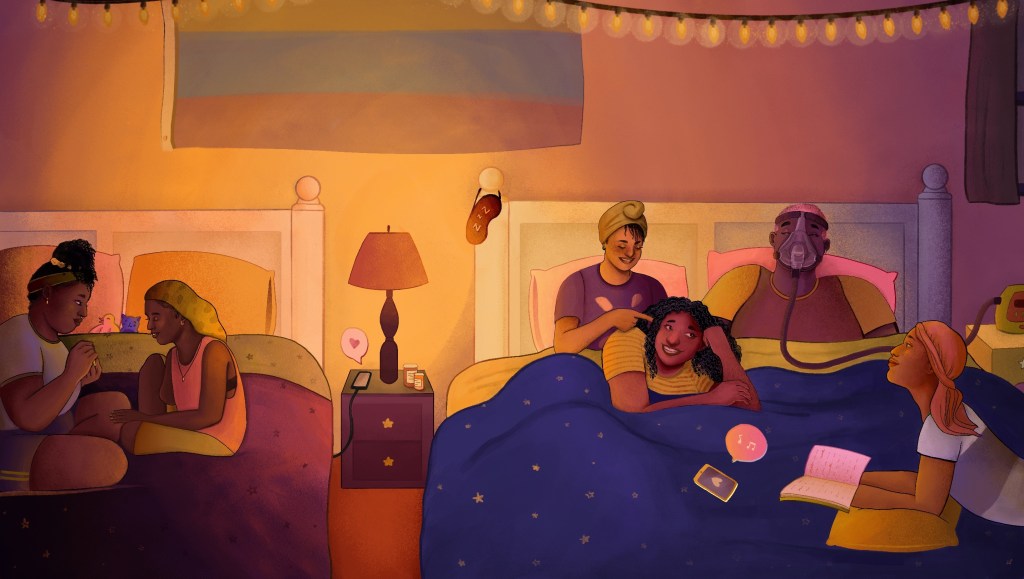
Space Holder
A space holder is someone who can create and hold a safe space for a person so they can be themselves around them.
Embodiment and Sensory Systems
A space holder is someone who can create and hold a safe space for a person so they can be themselves around them, knowing they will not be judged, they will be understood, valued and have an authentic meaningful connection.
As adults, we need to try and be embodied, calm and grounded to support our children to regulate, rather than expecting a child or young person to modify their behaviour themselves or change for external reward systems. We need to be a space holder for them.
Embodiment and Sensory Systems
Understanding the nervous system and its functions, trauma, and trauma responses, is vital for effective learning, safe space holding and non-toxic wellness and spiritual communities –and in any learning environment. It is also important to recognise and understand the stress responses of the body. As an educator, facilitator, space holder or practitioner, working under the premise of ‘first do no harm’ is part of a well-rounded trauma-informed approach.
Embodied Education: Creating Safe Space for Learning, Facilitating and Sharing
The Five Neurodivergent Love Locutions
“The Five Neurodivergent Love Locutions” are much about co-regulation and holding space.
Cognitive Liberty
I see cognitive liberty as a core value of the Neurodiversity Movement.
The term cognitive liberty was coined by Wrye Sententia and Richard Glen Boire, the founders of the Center for Cognitive Liberty and Ethics. Cognitive liberty as an ethical value boils down to the idea that individuals have the right to absolute sovereignty over their own brains and their own cognitive processes. Advocates of cognitive liberty often break this idea down into two fundamental guiding ethical principles (originally inspired by the two “commandments” offered by Timothy Leary in The Politics of Ecstasy):
- Individuals have the right to not have their brains and cognitive processes tampered with non-consensually.
- Individuals have the right to tamper with their own brains and cognitive processes, or to voluntarily have them tampered with, in any way they choose.
Those of us who are deeply involved in transformative somatic practices or in the field of Somatic Psychology understand that the psyche is somatically organized, which means that each individual’s distinctive neurocognitive processes are intimately entwined with that individual’s style of movement and embodiment. Changes in movement and embodiment create changes in cognition.
This means that to tamper with a person’s unique individual style of movement and embodiment (for instance, through the behaviorist techniques that are frequently used to make autistic children suppress the outward signs of autism) is to tamper with that person’s cognition, and thus to violate their cognitive liberty.
In other words, freedom of embodiment—that is, the freedom to indulge, adopt, and/or experiment with any styles or quirks of movement and embodiment, whether they come naturally to one or whether one chooses them—is an essential element of cognitive liberty, and thus an essential area of focus for the Neurodiversity Movement. The freedom to be autistic necessarily includes the freedom to give bodily expression to one’s neurodivergence.
Walker, Nick. Neuroqueer Heresies: Notes on the Neurodiversity Paradigm, Autistic Empowerment, and Postnormal Possibilities (pp. 142-143). Autonomous Press.
Somatic Liberty
The breaking down of character armor and other patterns of inhibition is a powerful somatic approach to the liberation of creative potentials but is not necessarily sufficient. The capacity to recognize and attune to the deep internal stirrings of the creative impulse, and to bring creative impulses into coherent expression and enactment, can remain underdeveloped in individuals whose characterological rigidities and/or life circumstances have afforded them little opportunity to freely explore their creativity. Such individuals may still have difficulty accessing that creativity or bringing it into expression even after rigid patterns of embodiment and cognition have been loosened. Fortunately, this creative capacity can be developed, strengthened, and refined through various forms of somatic practice. Grand (2015b) observes that the creative impulse, like other phenomena that occur in the psyche, has a somatic com- ponent that one can learn to tune into on a bodily level. Through practice, “attunement to the somatic processes of unconscious creation can be learned,” enabling the individual to more effectively “follow impulses from their inchoate beginnings … to their enactment and solidification” (p. 215). Forms of somatic practice that can be especially helpful in this regard include those that involve a combination of subtle body awareness and spontaneous physical action, such as Authentic Movement (Adler, 2002), Continuum (Conrad, 2007), the physical theatre techniques developed by Alli (2003), and various approaches to dance therapy, expressive arts therapy, and play therapy (Grand, 2015b).
While somatic practices, in general, tend to focus a great deal on bringing about liberatory transformations within the bodymind of the individual, these transformations often include an expansion of the individual’s capacities for harmonious interpersonal interaction and collaboration. Through this expansion of relational capacities, somatic practices can serve to foster not only greater personal creativity but also enhanced participation in processes of collective creativity.
The cultivation of richer and more empathic interpersonal connections and of harmony and creative problem-solving on a collective level has long been an explicit goal of various traditions of somatic practice. Reich (1933/1972b) maintained that the psychological rigidity and repression that made people susceptible to participation in the horrors of fascism was anchored in their character armor and that the process of releasing character armor could serve as an antidote to authoritarianism and make people more capable of participating in the co-creation of free and egalitarian societies. Morihei Ueshiba developed the martial art of aikido with the express intent of fostering compassion on a societal level by teaching people on a bodily level how to act with mindfulness and harmony in situations of conflict (Leonard, 1999); in my own years as a practitioner and teacher of aikido, I’ve experienced first-hand how effectively that art can train one over time to consciously override one’s conditioned bodily defensive reactions, so that in the face of potential conflicts and challenges, one has the opportunity to choose harmonious, constructive, and creative responses over knee-jerk reactivity (Walker, 2018, 2019). More recently, somatically-informed thinkers like Menakem (2017) have begun exploring how racism and other forms of bigotry are anchored in acquired bodily defensive reactions and how somatic practices that address those habitual bodily reactions could thus play an essential role in helping individuals, communities, and societies to overcome pervasive patterns of bigotry and oppression. In short, the integration of transformative somatic practices into processes of collective collaboration and creative future-building would by no means be much of a stretch, as many of these practices have always aimed at fostering harmonious cooperation among humans and have always been inspired by visions of better futures.
The Use of Transformative Somatic Practices in Processes of Collective Imagination and Collaborative Future-Shaping – Nick Walker
Neurological Pluralism: Weaving Cognitive and Somatic Liberty
Neurodivergent people are psychological safety barometers.
When everything is a monoculture, diversity can look scary, wild, out of control. It’s understandable, but it’s unsustainable. To reconnect with diversity, we need to expand and rewild our thinking, and change our practices on a fundamental level. We need to notice and challenge the things that we take for granted.
But when we get too used to seeing monocultures, we forget that there can be anything else. We don’t notice what is being pushed out in favour of the familiar sameness we have gotten used to. Diversity becomes worrisome and weird and unfamiliar.
Counselling for different ways of being | by Sonny Hallett | Jun, 2023 | Medium
Recognizing diversity enables collaborative niche construction that supports monotropic minds, and any type of mind. Monotropic people are recognizing and diversifying monocultures so we have the flexibility to create our niche and get into flow states.
We must build for the psychological, social, and sensory safety of neurodivergent people.
- Caves, Campfires, Watering Holes
- Dandelions, Tulips, Orchids
- Red, Yellow, Green
- Conversation, Discussion, Publication
- Realtime, Async, Storage
These reductions are a useful starting place when creating Cavendish Space and designing for neurological pluralism.
For practical examples of how to create Cavendish Space on any budget:
When we design for pluralism, we design for real life, for the actuality of humanity.
Stimpunks was forged in the quest for survival and educational inclusion. We had to roll our own education, because even the “all means all” of public education failed to include us. We’ve learned a lot along the way and present to you Stimpunks Space as the syncretic synthesis of our forced interdisciplinary learning. That learning connected us with neurodiversity communities, disability communities, educators, doctors, nurses, autism researchers, sociologists, tech workers, care workers, social workers, and a long list of others.
We wove together the aspects of these disciplines that were compatible with our community of neurodivergent and disabled people into a human-centered pedagogy and philosophy. We left out the stuff incompatible with and harmful to us, such as all forms of behaviorism. We built a learning space that works for us using a zero-based design approach.
Neurological pluralism comes in the weaving, a weaving arrived at through neuroqueer deconstruction and construction.
We Weave Together

Effective education does not simply produce a standardized, predetermined product. It is instead about weaving a colorful cloth that reflects community members’ rich skills and relationships, with generative patterns that integrate complex knowledge and ideas, and that can look different in different contexts.
PsyArXiv Preprints | Weaving a colorful cloth: Centering education on humans’ emergent developmental potentials
We take the analogy of weaving cloth to highlight the properties and valuable variations of effective educational systems.
PsyArXiv Preprints | Weaving a colorful cloth: Centering education on humans’ emergent developmental potentials
What would it mean to weave a colorful, durable cloth of individuals’ and communities’ relationships, knowledge and skills?
We take the analogy of weaving cloth to highlight the properties and valuable variations of effective educational systems.
PsyArXiv Preprints | Weaving a colorful cloth: Centering education on humans’ emergent developmental potentials
Envisioning humans and their contexts as mutually constitutive threads in a cloth, we ask, how can we most productively approach the interwoven micro- and macro-adaptations in the systems that make up the individual and context? How can we conceptualize and follow the humanistic threads and patterns that individuals and groups dynamically weave through educational environments and processes, in order to most strategically redesign educational systems to support the emergence of diverse human potentials and contributions? What would it mean to weave a colorful, durable cloth of individuals’ and communities’ relationships, knowledge and skills, designing educational systems that center equity and dignity, and attend to variability of experience? How could education systems be designed to enrich human capacities to invent and sustain vibrant and meaningful lives in a vibrant and healthy society?
PsyArXiv Preprints | Weaving a colorful cloth: Centering education on humans’ emergent developmental potentials
In this sense, examining learning and its contexts is like examining the weaving of a cloth—the twists and knots of different threads are interwoven, and distinct patterns, textures and colors are discernable depending on how the observer zooms in or looks from afar. At one distance, threads can represent people in community, holding each other in place in the weave; further magnified, threads could be composed of the fibers of an individual’s skills and experiences, twisted together across the threads of others as they extend through time. The fibers, patterns, and weaves of various cloths will vary substantially according to available resources, needs and aesthetics, from thick wool blankets or rugs, to flowing silk scarves, to sturdy nets or straps. Weaving itself is dynamic: it generates out of disparate parts a unified set of patterns, stronger together as a whole. Cloth also needs repair due to its day-to-day use as well as to unpredictable accidents and tears. Inevitably, new threads and new patterns will take hold. Thinking of education as supporting the weaving of fibers and also as tending to the condition of the whole cloth underscores the shared features of healthy learning communities with well- designed systems and structures, as well as the substantial and valuable variation that will emerge within and across contexts.
PsyArXiv Preprints | Weaving a colorful cloth: Centering education on humans’ emergent developmental potentials
Through their ideas and intentions as well as their actions, communities of individuals continually renew, together, the socio-cultural context in which they are living, including the beliefs, the norms, and the patterns of relationships that organize society’s social fabric—the cloth they are weaving.
PsyArXiv Preprints | Weaving a colorful cloth: Centering education on humans’ emergent developmental potentials
The cloth can be strengthened and enriched, new patterns can be collaboratively generated, and holes and tears repaired.
PsyArXiv Preprints | Weaving a colorful cloth: Centering education on humans’ emergent developmental potentials
Effective education does not simply produce a standardized, predetermined product. It is instead about weaving a colorful cloth that reflects community members’ rich skills and relationships, with generative patterns that integrate complex knowledge and ideas, and that can look different in different contexts.
PsyArXiv Preprints | Weaving a colorful cloth: Centering education on humans’ emergent developmental potentials
We need Cavendish Space now.
Our threat-response learning system is turned to high alert. The flip side of this hyper-plasticity is that we also adapt quickly to environments that are truly safe for our nervous system.
Discovering a Trauma-Informed Positive Autistic Identity | by Trauma Geek | Medium
Make space for Cavendish.
A Closing Thought on Human Nature
…human nature is to nurture and be nurtured.
Emotions, Learning, and the Brain: Exploring the Educational Implications of Affective Neuroscience by Mary Helen Immordino-Yang
⏭ Continue with “✌️ We Believe”
The story concludes on page 5, “✌️ We Believe“.


