
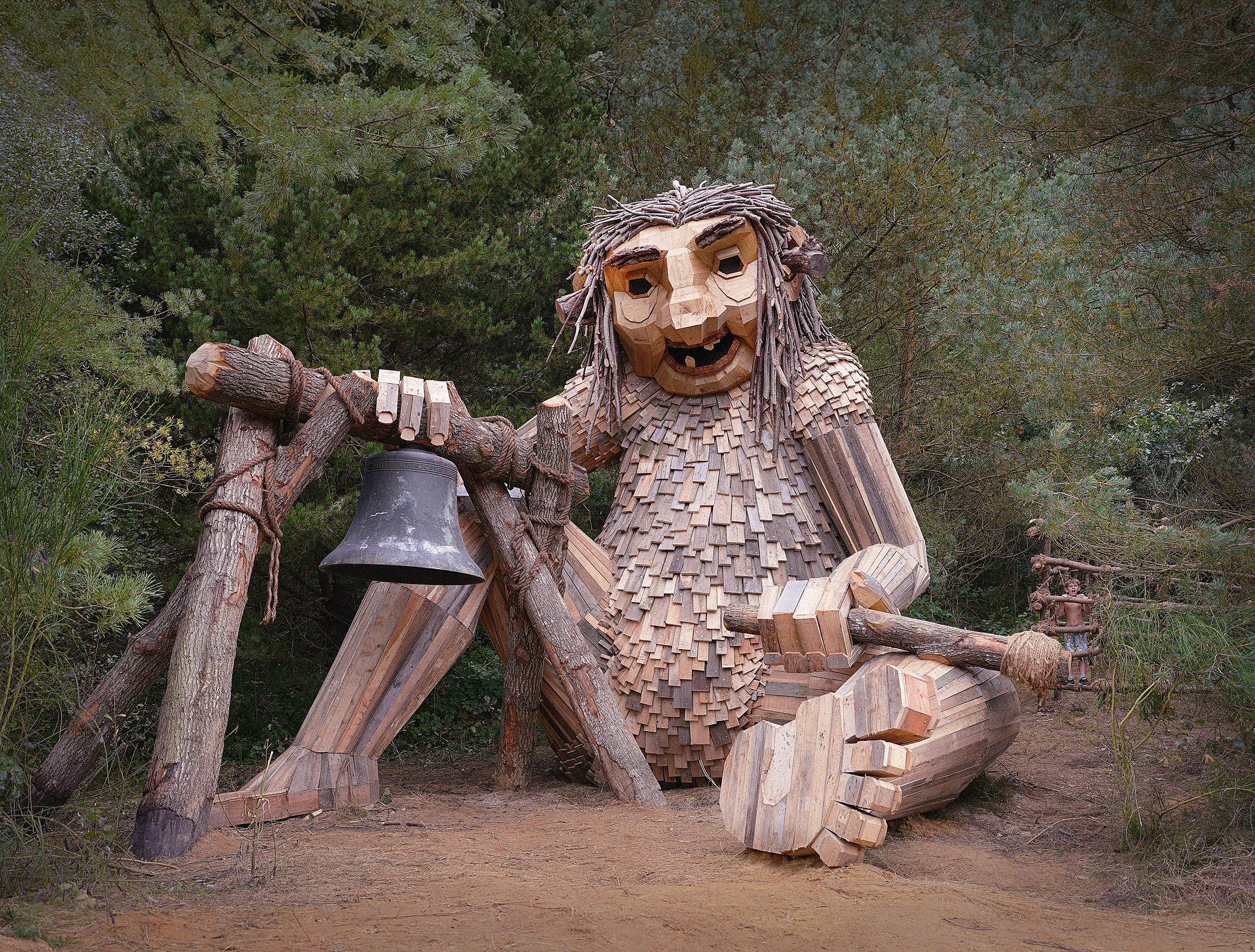
A Thomas Dambo troll is made of what the world discarded. Old pallets. Salvaged timber. Debris from construction sites. The castoffs of a throwaway civilization, shaped into giants with hands wide enough to cradle a full-grown tree and eyes watching you from the shadows of the understory.
The trolls don’t go in galleries. They go in forests. On islands. Along hiking trails where you have to actually leave the screen behind, walk through rain and mud, follow a trail through the understory, and arrive — suddenly, impossibly — in the presence of something enormous and alive-seeming that grew, apparently, right out of the forest floor. You have to go get them. They will not come to you.
The thesis: this is what the Solarpunk future looks like when you get your hands dirty making it.
We’re gathering for an Infodump on the troll art of Danish artist Thomas Dambo — on recycling, upcycling, biodiversity, and the integration of made things into the living world. On what it means to bricolage not just a sculpture but an argument. On the radical claim, embedded in every one of his giants, that the waste of this civilization can become something wondrous if you put your hands on it.
We’ll watch together, take a bodymind break, riff on the reflection questions, and open the mic.
Come as you are. Bring your recycled parts, your splinter skills, your love of the woods.
Everyone who has ever wanted to build something enormous out of nothing is precisely right for this.
Header image: Thomas Dambo – LOTTE LOKKEKLOKKE
Videos
Two videos that let you watch Dambo work: the philosophy and the mud.
Meet Stifinder Stig Before He Finds You: I Built a Troll on a Mysterious Island!
Dambo builds a troll called Stifinder Stig — “the Pathfinder” — on a secluded island, working with volunteers, scavenging timber, and embedding the finished creature into the landscape so completely that it belongs there. Watch for the community. Watch for the integration. Watch for what Stig looks like when the forest begins to take him back.
Rain, Mud, and a 900-Kilo Bell: Lotte Lokkeklokke is now alive!
This one lives in the weather. Rain, mud, a hand-carved bell weighing nearly a ton, and the specific conditions of outdoor collaborative making. Lotte Lokkeklokke means “Lotte the Bell-Ringer.” The name tells you about tone. The video tells you about process — messy, joyful, embodied, and fully outside.
The Stimpunks Frame
Stimpunks is a neurodivergent- and disabled-led community built on a few bedrock beliefs that map directly onto what Dambo does.
The Artist Shapes the Beautiful from the Dump Heap
Our bricolage page opens with this, from Lévi-Strauss: “the artist shapes the beautiful and useful out of the dump heap of human life.” It is a useful formulation for art criticism. It is an urgent one for Dambo.
His trolls are not made from new materials selected for aesthetic effect. They are made from what was already there: discarded pallets, reclaimed wood, the debris of construction sites, the leftovers of an economy that treats most things as disposable. He takes the dump heap at something like face value — it’s full of material. It’s full of possibility. The waste of a throwaway civilization turns out to contain, if you know how to look, the raw material for giants.
Bricolage is what we do when the world doesn’t offer what we need. We improvise from available materials. We make do. For neurodivergent and disabled people, this isn’t a creative preference — it’s a structural condition. The tools weren’t built for us. The spaces didn’t accommodate us. The systems weren’t designed with us in mind. So we built our own. We hacked what existed. We shaped the beautiful from the dump heap.
Dambo is doing the same thing at the scale of the forest. The trolls are bricolage as ecological argument. They say: nothing is waste. The dump heap is a materials library. The question is only what you’re going to make.
Solarpunk Isn’t a Genre. It’s a Practice.
Solarpunk is “the future with humanity put back in.” In Andrewism’s formulation: “a future with a human face and dirt behind its ears.”
Dambo’s trolls have dirt behind their ears. Literally.
Solarpunk, at its heart, is not an aesthetic to be rendered — it is a mode of living to be built, from the ground up, using what is available, in community. It is grassroots, not imposed from above. It merges the practical with the beautiful. It refuses to treat nature and humanity as opposed. It asks not “what does the future look like” but “what does the future feel like to live in” — and then builds that, imperfectly, now.
What Dambo builds is Solarpunk not as vision board but as embodied practice. He takes discarded materials. He recruits volunteers. He works outside, in the weather, with his hands. He makes things that draw people into the forest — not to look at art with their minds but to move through living landscape with their whole bodyminds. The trolls are Solarpunk proposals built from reclaimed timber: this is what it looks like when humans make things that belong in the world rather than dominate it.
Solarpunk resists the nihilism and doomerism of grim technological dystopias. So do the trolls. Each one is a refusal of the premise that the ecological crisis can only be grieved. Dambo picks up the discarded wood and makes something that makes people walk into the forest smiling. That is not naivety. It is a different kind of argument.
Nature Is Not a Backdrop. It Is the Whole Point.
A Dambo troll is not placed in nature like a painting hung on a wall. It is built from nature — from fallen wood, salvaged timber, materials already in dialogue with weather and time — and then returned to it. After he finishes, the moss comes. The rain works on the wood. The forest begins to take the troll back, slowly, returning the material to the cycle it was always part of.
This is biophilic design operating at its most elemental: not the introduction of plants into an office to improve productivity, but the abolition of the distinction between the built thing and the living world around it. The troll is the forest. The forest contains the troll. They are in reciprocal relationship.
Our Nature glossary holds this: “as long as we protect nature, nature will protect us.” And this, from Barry Lopez: that a lasting connection to place requires not just function or beauty but reciprocal ethical unity — living as if your children’s future mattered, taking care of the land as if both your material and spiritual lives depended on it. Because they do.
Dambo’s trolls are woven into that ethics. They use biodegradable materials. They integrate with local ecosystems. They require you to move through the landscape to find them — not to observe from a platform but to be in the place, with your body, noticing the light and smell and mud underfoot. To find a troll is to have a storied relationship with a place. You will remember where you found it. You will know something about that forest. You will care.
The Body That Goes Outside
Offline is how we describe the part of learning and living that requires fresh air, daylight, and large muscle movement. It is not a break from the real thing. It is the real thing for an embodied organism that evolved in reciprocity with the natural world.
Finding a Dambo troll is an offline experience by design. There is no virtual version. You go outside. You walk. You move through weather — Lotte Lokkeklokke was built in the rain, and rain is part of her story. You use your body. You feel the geosmin in the soil. You arrive. And then there is something there, enormous and made from the same stuff as the forest, and your whole nervous system responds in a way that no screen ever quite reaches.
This isn’t incidental to Dambo’s work. It is the whole point. The trolls are not art that happens to be outdoors. They are an argument that the outdoors is where we are most ourselves — most grounded, most alive, most in right relationship with the world that sustains us.
The Offline principle holds that neurodivergent people have heightened neuroception and different bio-social responses to stimulus. The natural environment — with its non-rhythmic sensory stimuli, its diffuse light, its presence of water and wind and soil — is often regulating in ways that built environments simply cannot replicate. Nature is not a therapy. It is a belonging. The trolls are outposts in that belonging.
Join Us
Infodumplings happens every Thursday at 7PM Central, online via Discord. No preparation needed. No expertise required. Come as you are. Our Thomas Dambo discussion is on Thursday, May 14.
You can participate by video, voice, text chat, or just by being in the room. All modes are welcome.
Cameras optional. Chat-only participation fully valid. Stims, movement, and fidget tools encouraged. No one will be called on. Silence is participation. If something lands, share it when it’s ready. This is a come-as-you-are space — not a performance.
Join our community to get access, then find us in our online space. Our Infodumplings page describes what to expect.
How the Hour Goes
| Timestamp | Session |
|---|---|
| 0:00 | Welcome & Grounding — Brief framing: who Dambo is, what the trolls are, and why we’re here together. No wrong way to be in this space. |
| 0:05 | Watch Together — “Meet Stifinder Stig Before He Finds You” (~20 minutes). Screen-shared, no talking over it. |
| 0:26 | Open Infodump Round — Anyone who wants to share what they already knew, felt, or noticed — no filter, no order. Pure neurodivergent passion mode. |
| 0:35 | Bodymind Break — A few minutes to move, stim, stretch, breathe. Intentional and encouraged. |
| 0:40 | Watch Together — “Rain, Mud, and a 900-Kilo Bell: Lotte Lokkeklokke” (~18 minutes). Or discussion continues if energy is high. |
| 0:50 | Facilitated Discussion — Guided questions connecting Dambo’s work to bricolage, Solarpunk, nature connection, and making. |
| 0:55 | Personal Reflection — Optional soft prompt: What would you build from the dump heap? Sharing welcome, silence equally welcome. |
| 0:57 | Close & Resources — Links, gratitude, gentle goodbye. |
Related Glossary Entries
Reflection Questions
On making from what was thrown away
Dambo doesn’t buy new timber. He goes where the timber already is — at demolition sites, on beaches, in the debris left behind by construction. His starting condition is not a blank canvas but a dump heap.
Bricolage names this as a cognitive and cultural practice: the artist shapes the beautiful and useful from available materials, working with what is already there rather than waiting for the ideal. For neurodivergent and disabled people, this is less philosophy than survival. We improvise. We adapt. We work with what exists because the alternative — waiting for systems that were built without us to suddenly accommodate us — is no alternative at all.
What is the dump heap in your life — the things you have been given, the discards and the misfits and the materials that didn’t fit the original plan — that you have shaped into something? Not as inspiration, but as the actual material of how you operate?
What have you built from what was left over?
On the troll as argument
Every Dambo troll is making a claim. The claim is not symbolic. It is structural: this pile of discarded wood was not waste. This island, this forest, this particular hillside in a park that most people walk past without slowing down — it was always interesting. It always had something in it worth finding. You just hadn’t gone to look.
Solarpunk asks what a sustainable civilization actually looks like — not as a political program but as a lived texture, as an experience of daily life. Part of the answer is: like this. A path through a forest that leads to a giant made of reclaimed timber. A community of volunteers who showed up to build something together. A landscape that is wilder and stranger and more alive because a human came and added to it without taking anything away.
What does the Solarpunk world feel like to live in, in your imagination? Not what politics it requires — what does it feel like in the morning, underfoot, on your skin? What does the built environment smell like? What sounds does it make?
And: what would you add to it, with your hands, if you could?
On integration versus installation
There is a difference between placing something in nature and making something of nature. A gallery sculpture moved to a park is installation. A Dambo troll — built from local salvaged timber, sited to fit the specific landform, designed to weather and moss and return to the soil — is integration.
Our Biophilic Design glossary names a pattern it calls “Mystery: The promise of more information, achieved through partially obscured views or other sensory devices that entice the individual to travel deeper into the environment.” Dambo’s trolls are pure Mystery pattern. They hide. You have to go deeper into the forest to find them. The forest doesn’t stop at the edge of the troll. The troll leads you further in.
Biophilic design also holds that humans have an innate biological connection with nature — biophilia — and that when we are cut off from it, our nervous systems know. The crackling fire, the crashing wave, the dappled light through leaves, the smell of rain on soil: these are not aesthetic preferences. They are biological facts about what human organisms need.
Where are you cut off from nature in your daily life, and what does it cost you? Where do you have access to it — however imperfectly, however briefly — and what does that feel like in your body when you arrive?
On building in community
Dambo does not build alone. The videos show it: the volunteers arrive, often people who found the project online or heard about it locally, and they work together — hauling timber, climbing scaffolding, holding pieces while others fasten them. The troll is a community artifact. The collaboration is structural, not incidental. A single person could not make something that large.
This maps onto something fundamental in Stimpunks’ philosophy of mutual aid: that we do not become ourselves in isolation. The competency network is not a metaphor for community — it is the actual mechanism by which different spiky profiles fit together, each person’s strengths slotting into another person’s gap, the whole becoming capable of something no individual could have done.
A Dambo troll is a physical competency network. The person who knew how to work with the chainsaw, the person who understood the structural requirements, the person who figured out where to source the timber, the person who kept everyone fed — each contributed something the others didn’t have. The troll exists because no one person had to do all of it.
Who do you build with? Whose chainsaw skills complement your structural thinking? Whose warmth holds the group together while the hard work gets done? Who shows up in the rain because they said they would?
On the body in the weather
Lotte Lokkeklokke was built in the rain. The video does not apologize for this. Rain is part of the video’s texture, part of the troll’s origin story. Lotte exists in a world where it rains, and her creation happened in that world, not despite it.
Our Offline page holds that for neurodivergent people especially, fresh air, large muscle movement, and daylight are not luxuries. They are what we are built for — what our nervous systems evolved in and return to. The natural environment with its non-rhythmic stimuli, its diffuse light, its petrichor and soil and wind, is often regulating in ways that built environments cannot replicate.
What does your body know when it is outside that it forgets when it is in? What happens to your nervous system when you are moving through a landscape — not exercising in it, not performing wellness in it, but just present in it, letting it be what it is?
And: when did you last get rained on — not by accident and not with dread, but with some degree of willingness? What was it like?
On upcycling as ethics
There is a political economy embedded in Dambo’s practice. He takes materials that the throwaway economy designated as waste — old pallets from a logistics system, timber from demolished buildings, debris from a construction site — and demonstrates that they were never actually waste. That “waste” is a designation, not a property. It means: we have decided this no longer has value in the system as it currently runs. It does not mean: this is without use, without beauty, without the capacity to become something else.
The same logic runs through disability justice and neurodivergent liberation: neurodivergent minds were not designed for the systems that currently exist. The system designated them defective. But “defective for this system” is not “without value.” It is a specific finding about the fit between a person and a set of conditions — not a finding about the person.
You were not thrown away. You were discarded by systems that couldn’t see your use. There is a difference. What would it mean to look at the parts of yourself that got left in the dump heap — the traits that got pathologized, the interests that got dismissed, the ways of being that got labeled deficient — and ask: what could be built from this?
What is your reclaimed timber?