
Stimpunks Space is a private, invite only Space for our community where we bring safety to the serendipity.
How do we help our students navigate the world of public, digital scholarship in a world increasingly dominated by harassment, abuse, disinformation, and polarization?
Closing Tabs, Episode 3: Teaching with(out) Social Media – UMW Division of Teaching and Learning Technologies
That’s the piece that’s been missing, bringing the safety to the serendipity.
Discord is our choice for team and community chat.
A quick Discord vocabulary primer:
Beginner’s Guide to Discord – Discord
- Servers are an invite-only home for your friends or community – a place where you can talk, hang out, and have fun.
- Text channels are separate spaces for talking over text. They keep conversations organized and give everyone plenty of room to talk. Create separate channels for all the topics your group likes to talk about–from fishing trips to cooking tips.
- Voice channels are where you can hang out over voice and video. There’s no calling or ringing required – just click on a voice channel to enter it. Friends in your server can see you’re in there, and pop in to talk, wave hello over video, or share their screen.
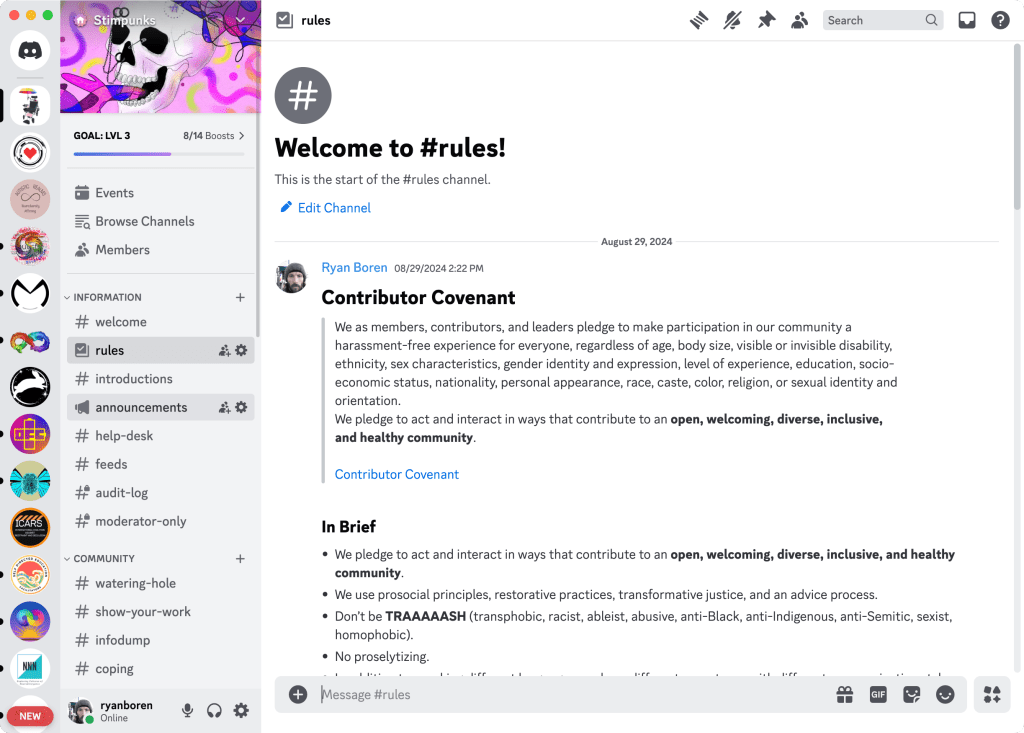
Our Channels
Stimpunks Space has over 40 Channels. Among them are:
- Information
- welcome
- rules
- introductions
- announcements
- help-desk
- feeds
- Community
- watering-hole
- discourse
- show-your-work
- coping
- body-doubling
- mutual-aid
- events
- pink-portal-club
- work-opportunities
- Community Live
- Cave / Quiet Room (voice+video)
- Campfire (voice+video)
- Watering Hole (voice+video)
- Body Doubling (voice+video)
- Listening Party (voice+video)
- Stage (voice+video)
- Boards
- infodump
- prompts
- gallery
- booths
- Media
- reading
- video-tv-movies
- music
- gaming
- art
- Interests / Topics
- education
- deib
- stem
- nature
- niche-construction
- flow-toolbelt
- Teams / Areas
- operations
- editorial
- systems
- event-planning
- volunteers
- teams campfire (voice+video)
- Projects
- neuroqueer-learning-spaces
Caves, Campfires, and Watering Holes

Caves
Spaces for quiet reflection, introspection and self-directed learning.
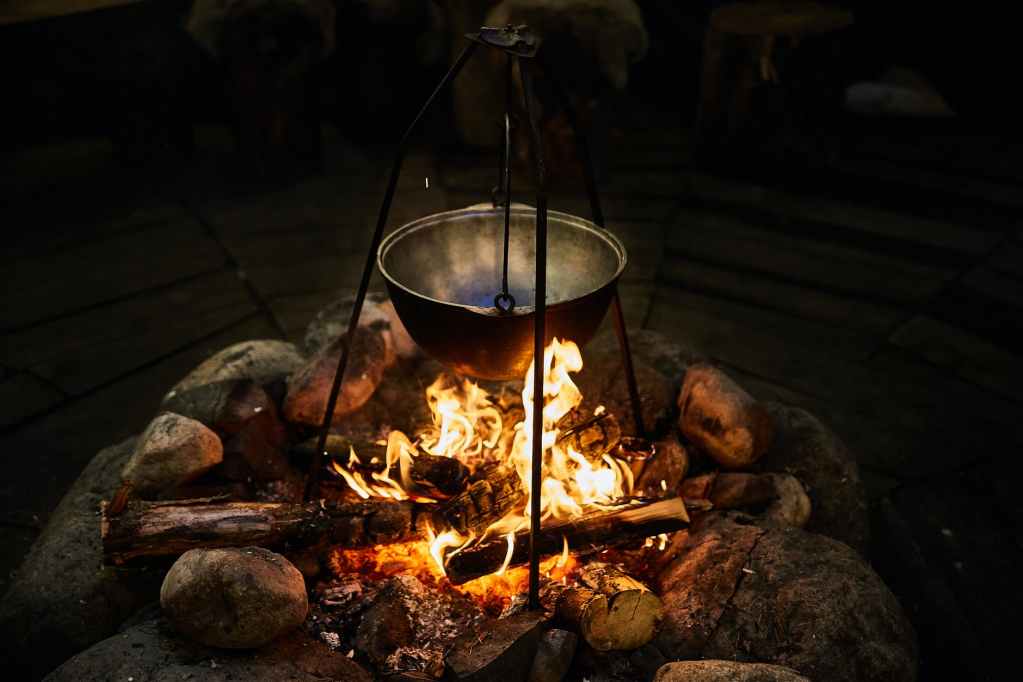
Campfires
Spaces for learning with a storyteller – teacher, mentor, elder, expert.

Watering Holes
Spaces for social learning with peers.
Many of our channels serve the roles of the primordial learning spaces: Caves, Campfires, and Watering Holes.
We think of the teams and projects channels as campfires, places for omni-directional learning among a small group. The famous “Two pizza teams” concept could be called “campfire-sized teams”. Small, self-organized, two-pizza team = a campfire team.
PARA System
With the PARA system, every piece of information you want to save can be placed into one of just four categories:
- Projects: Short-term efforts in your work or life that you’re working on now.
- Areas: Long-term responsibilities you want to manage over time.
- Resources: Topics or interests that may be useful in the future.
- Archives: Inactive items from the other three categories.
Some of our channels are grouped along the lines of the PARA system.
- Projects = Projects channels
- Areas = Teams / Areas channels
- Resources = Media and Topics / Interests channels
- Archives = none yet
Community Channels
The main community channel is #watering-hole. That’s where we hang out and talk about anything.
The #watercooler channel allows for serendipitous interactions, so “striking up a conversation” never has to be forced or disruptive.
Building Remote Office Culture with a Watercooler Channel
In the neurodiversity and disability communities we frequent, we noticed a pattern of the following channels popping up over time. They’re not always named like these, but they serve similar functions.
- watering-hole– chit chat on any topic, hanging out, sharing penguin pebbles, serendipitous interaction
- body doubling – parallel existence and body doubling in text and video
- coping – mental health, physical health, executive function, warm line, anything related to coping as a bodymind. Everything said here stays here. Use content warnings. Respect triggers.
- mutual aid - give and get help, library economy, competency network, sharing spoons, support swapping
- show your work – share what you make and the process of making it, self-promotion allowed, “Share what you love, and the people who love the same things will find you.“
- events – Internal and external events of community interest.
- pink-portal-club – Welcome to the Pink Portal Club, a place for Weird Pride, Queer Pride, Neurodivergent Pride, Crip Pride, and self-expression. Let your freak flag fly. Show your style. Use spoiler tags for risqué stuff. No nudity.
- work-opportunities – Internal and external work opportunities.
Community Live Channels
- Cave / Quiet Room (voice+video)
- Campfire (voice+video)
- Watering Hole (voice+video)
- Body Doubling (voice+video)
- Listening Party (voice+video)
- Stage (voice+video)
Bulletin Board Channels
- infodump – go on at length in text or video about whatever special interests you are in to, infodumping encouraged, flash talks encouraged
- prompts – Pose a writing prompt question for our community.
- gallery – Share you art.
- booths – Share your business / organization.
Media Channels
- reading – Share what you are eye-reading, ear-reading, and finger-reading. Extensive block quoting encouraged. This room becomes a multimedia commonplace book. Markdown enables block quoting and selective bolding in many chat platforms, including Discord and Element. This enhances the commonplace book feel and increases skimmability and cognitive accessibility.
- video-tv-movies
- music
- gaming
- art
Interests / Topics Channels
We have rooms for interest-based affinity groups: Nature, STEAM, Music, etc.. Our #watering-hole serves an outlet for affinity groups and gets more chat than the individual rooms, but sometimes folks want to go deep. Affinity group rooms are great for connecting people with resident experts willing to campfire with folks.
Our Interests channels are for talking about our interests, fascinations, and hobbies.
- education – All things education.
- deib – Discussion of Diversity, Equity, Inclusion, and Belonging.
- stem – Making and appreciating Science Technology Engineering Math.
- nature – Appreciation and celebration of the natural world, including gardening.
- niche-construction – Share your niche constructions. Share your cave spaces.
- flow-toolbelt – What’s in your toolbelt? How do you achieve and maintain flow states? What tools do you use, be they digital or physical? Flow sharing encouraged. Share your workflows, workflow automation, and productivity hacks here.
Teams / Areas Channels
Our Team channels are where the various teams at Stimpunks do the work of running our organization. These tend to be 2 – 5 person teams (with others lurking as learners), which makes for a nice campfire setting. 2 – 5 person teams are human scale teams that can accomplish much.
- The #editorial channel is Editorial team space for working on our website and print materials. Writing, editing, and designing for publication. This is our busiest room. We use it to collaborate on this website.
- The #operations channel is where we handle day to day operations work.
- The #systems channel is where we talk IT and offer IT support. Got an IT problem? Drop in the systems channel and we’ll help. Want to learn how all of this technology works together? Hang out in the room as we work.
Projects Channels
Identity-Based Affinity Groups
We don’t have rooms for identity-based affinity groups at Stimpunks at the moment. We’re small and we’re all loudly out and haven’t created one yet, though we might in the future. At the company Stimpunk Ryan helped start before Stimpunks, where there were a couple thousand people, we had affinity groups for Black, Neurodivergent, Physically Disabled, Queer, Latinx, etc. people. Each group had their own public channel in team chat, and a private channel, as well as a company-wide website.
In the public channel for each group, employees who were out and loud tried to create space. Anyone in the company was welcome to join the channel and learn.
In the public channels, we openly worked on the team website for the affinity group. We’d incorporate feedback from our peers and post about how to include us better in the company. This was another space making exercise. When talking to their team leads, folks could use the information on the websites of the affinity groups to advocate for themselves.
In the private channels, folks who weren’t comfortable being so public could feel freer to talk and ask questions. You had to request to be in the private channels from someone already in it. Those elected to the board of the group offered themselves as public vectors into the group. There was a no gatekeeping identity policy, so we let in everyone seeking themselves.
Stimpunk Kristina Daniele built the Employee Resource Group (ERG) system at Automattic. Stimpunk Ryan built on her work to help create the Neurodiversity Employee Resource Group. The ERGs featured in employee comments that contributed to us winning a “Most Loved Workplace” award.
Automattic, Inc. – Most Loved Workplace®


