
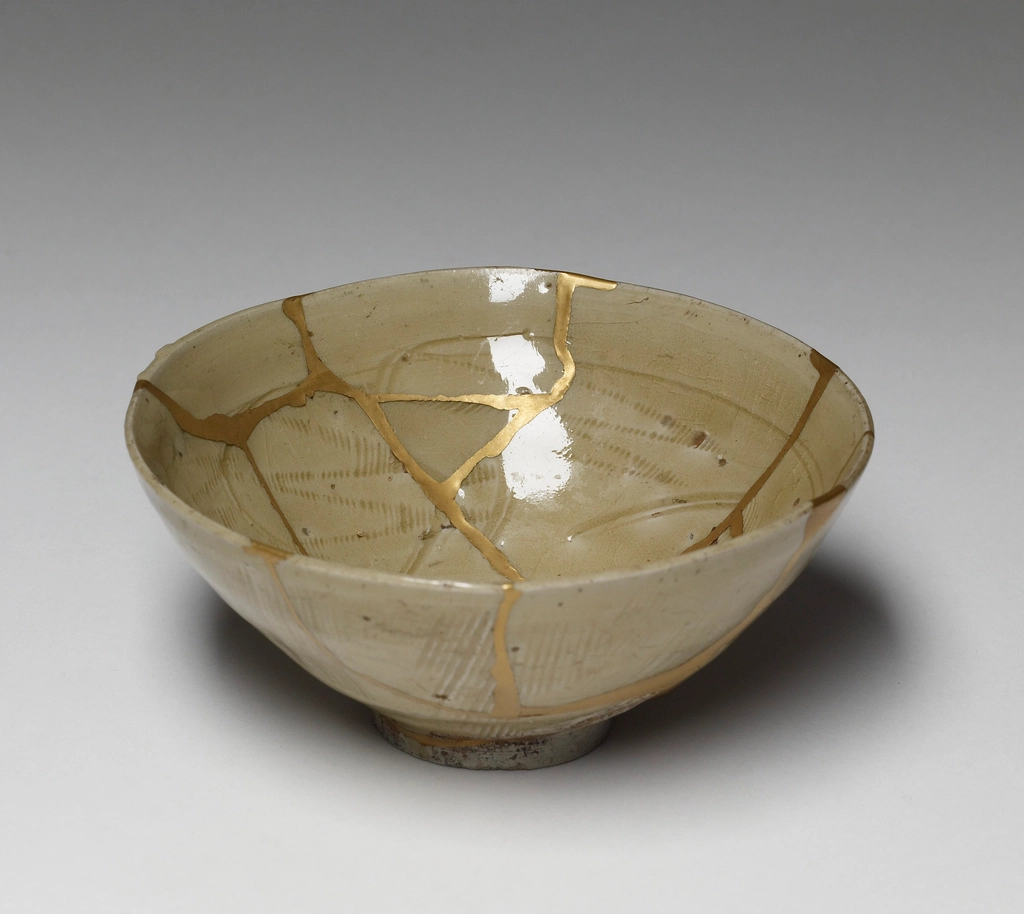
A Kintsugi Infodump — on broken things made beautiful, star stuff that can’t be pathologized, and the gold in you
For the next edition of Infodumplings: Bring Your Muchness Down the Rabbit Hole, our curator is sharing on kintsugi — the Japanese art of repairing broken pottery with gold or silver lacquer, treating every fracture as part of the vessel’s history rather than a flaw to erase. The more it has broken and been repaired, the more it carries. The more it glows.
The thesis: we are not broken. We are kintsugi.
Trauma leaves marks. Our spiky profiles mean we fracture in places others don’t — and soar in places others can’t see. Our survivorship — the fact that we kept going when systems failed us, when we failed ourselves, when the weight was real — is the gold in the cracks. And the competency networks we build with each other are what make us whole again, differently, stronger, unmistakably ourselves.
Kintsugi doesn’t restore the original object. It makes something that couldn’t have existed without the break. That is not a metaphor. It is a material fact. And for neurodivergent and disabled people who have spent lifetimes being told they are too much, not enough, or wrong in some fundamental way — it is also a cosmological argument: you were star stuff all along. The gold was always in you. You were just waiting for the right break — and the right community — to let it show.
We’re gathering for an hour to watch a short, gorgeous video on Kintsugi together, infodump everything we know and feel about it, and follow the thread wherever it leads — into philosophy, into our own lives, into what it means to be loved not despite your cracks but through them.
We’ll watch together, take a bodymind break, riff on the reflection questions, and open the mic.
The cracks are where the gold goes.
Come as you are.
Bring your breaks, your repairs, your star stuff.
Everyone who has ever been called too much is precisely right for this.
Videos
A short, gorgeous introduction to kintsugi from The School of Life — on Zen aesthetics, wabi-sabi, and why care expended on broken things is the most beautiful thing of all.
The history of kintsugi, from ancient lacquerware to the shogun’s ugly metal staples, and the philosophical argument that repair requires transformation — that the true shape of a thing can only be seen once it’s been cracked open.
The Stimpunks Frame
Stimpunks is a neurodivergent- and disabled-led community built on a few bedrock beliefs that map onto Kintsugi.
- Broken systems, not broken people. Kintsugi knows this: the fracture is not the pottery’s failure. It is the record of what the pottery survived. The system failed. The vessel endures. We fill the cracks with gold.
- Authenticity is our purest freedom. Kintsugi refuses to hide the repair. So do we. Masking is the opposite of Kintsugi.
- No one is broken. The cracks are not proof of failure. They are the record of a life actually lived — and they are where the gold goes.
- Care is infrastructure. Kintsugi takes time. The repair is slow, careful, and precious. That’s not a bug — it’s the whole point.
Join Us
Infodumplings happens every Thursday at 7PM Central, online via Discord. No preparation needed. No expertise required. Come as you are. Our Kintsugi discussion is on Thursday, May 7.
You can participate by video, voice, text chat, or just by being in the room. All modes are welcome.
Cameras optional. Chat-only participation fully valid. Stims, movement, and fidget tools encouraged. No one will be called on. Silence is participation. If something lands, share it when it’s ready. This is a come-as-you-are space — not a performance.
Join our community to get access, then find us in our online space. Our Infodumplings page describes what to expect.
How the Hour Goes
| Timestamp | Session |
|---|---|
| 0:00 | Welcome & Grounding Brief framing — what Kintsugi is, what Stimpunks is, and why we’re here together. No wrong way to be in this space. |
| 0:05 | Watch Together “Eastern Philosophy — Kintsugi” by The School of Life. ~6 minutes. “Kintsugi: The Art of Embracing Damage” by Nerdwriter1. ~5 minutes. Screen-shared, no talking over it. |
| 0:17 | Open Infodump Round Anyone who wants to share what they already knew, felt, or noticed — no filter, no order. Pure neurodivergent passion mode. |
| 0:25 | Facilitated Discussion Guided questions connecting Kintsugi to star stuff, masking, authenticity, broken systems, and loving yourself. |
| 0:45 | Personal Reflection Optional soft prompt: Where is your gold? Sharing welcome, silence equally welcome. |
| 0:57 | Close & Resources Links, L★S zines, gratitude. Gentle goodbye. |
Related Glossary Entries
- Trauma
- Spiky Profile
- Competency Network
- Bodymind
- Masking
- Monotropism
- Resilience
- Mutual Aid
- Belonging
- Interdependence
Reflection Questions
On kintsugi as philosophy
Kintsugi began as a practice: a broken bowl repaired with gold becomes a bowl with a history. The damage is not hidden. It is honored. The repaired object is worth more, not less, for having broken.
Most of us were taught the opposite: that cracks are shameful, that what is repaired is second-rate, that the goal is to look unbroken. Where did you learn that? What did it cost you to carry it?
On trauma and the body that keeps the score
Our trauma glossary holds this: “trauma doesn’t just happen at home — students can be traumatized by conditions and events in schools, and schools can cause trauma.” Trauma is not only a personal event. It is structural. It is intergenerational. It is built into the everyday architecture of institutions that were not designed for us.
When your brain goes into survival mode, it is not broken. It is doing exactly what it is built to do: keeping you alive under conditions it has learned are dangerous. The survival mode is the repair already in progress.
What would it mean to look at your nervous system’s responses — the freeze, the fawn, the hypervigilance — not as damage, but as kintsugi? As gold where the breaks were?
On spiky profiles, splinter skills, and finding your gold
Spiky profiles describe the defining characteristic of many neurodivergent people: “the disparity between strengths and weaknesses is more pronounced than for the average person.” Plotted on a graph, we are peaks and troughs. High spikes. Deep valleys. Not the smooth arc of the average.
The valleys are where we feel broken. The peaks — the splinter skills, the deep-dives, the things we know with our whole bodies — are the gold.
But here’s the thing kintsugi teaches: it’s not the peaks alone that make the object beautiful. It’s the lines where the breaks were sealed. The strength comes from the specific shape of the fracture and the specific material used to fill it.
What are your peaks? What do you know, love, or do with an intensity that feels almost embarrassing? What splinter skill has someone else found useful, even when you couldn’t yet see it as a gift?
On aloneness and the spiky profile
Spiky profiles can produce a particular kind of loneliness: you fail in ways others don’t expect, which makes you feel stupid. You excel in ways others don’t recognize, which makes you feel alien. You live with a gap between what you can do and what you struggle with that doesn’t fit the script for how ability is supposed to work.
That mismatch is part of why neurodivergent people so often grow up feeling broken — not because they are, but because no one handed them the right vocabulary. Not “spiky profile.” Not “splinter skills.” Just: something is wrong with you.
When did you first get language that fit? Was there a word, a diagnosis, a community, a piece of writing — a moment where something clicked into place and the crack began to glow?
On competency networks and being made whole together
A competency network is a map of the gifts people bring to each other. “Everyone is good at different things. Everyone knows different things. Everyone has gaps where others are strong. A competency network makes that visible.”
Kintsugi does not restore the original object. It creates something new out of the broken pieces held together by gold. A competency network is like that: it is not about becoming what you were before, or becoming what someone else is. It is about your specific fractures meeting the specific strengths of the people around you, and something new becoming possible that could not have existed alone.
Different neurotypes perceive different parts of the world. They solve different problems. They build different features of the shared world. A spiky profile that looks like a liability in isolation becomes load-bearing inside a community that knows how to hold it.
Who in your life holds the gold for your cracks? Whose cracks do you hold the gold for?
On star stuff, supernovae, and the violence that makes things possible
From Love You Down To Your Star Stuff: “The elements in your body right now came into being through some of the most violent events in the universe. The iron in your blood, the calcium in your bones, the oxygen in every breath, were forged in the cores of massive stars and released in supernovae: entire stars compressing their whole lives into a single catastrophic release. In that rupture, what had been locked inside was scattered outward, making things possible that could never have existed before.”
The gold in kintsugi is not incidental. Gold is a heavy element, formed only in neutron star collisions — some of the most catastrophic events in the cosmos. It takes that much force to make something that rare.
The rupture is part of the lineage. The break is part of the genealogy. You did not become valuable despite the catastrophe. You became you through it.
On the Bone Song and what stress does to bones
The Bone Song from our star stuff zines carries this: bones are piezoelectric. When you stress a bone, it generates an electrical signal. Osteoblasts — the cells that build bone — rush toward the stress. Bones don’t just survive stress. They remodel in response to it. The load-bearing places get denser. The bone that has been stressed becomes, in precisely those places, stronger.
Not every stress is healthy. Not every break leads to kintsugi. But the biology of bone carries the same truth: the body’s response to load is not only to endure it. It is to become more capable of carrying it.
Where in your life do you see that pattern — not just survival, but structural remodeling? Where are you denser than you used to be, because you had to be?
On Keep on Livin’, community, and survivorship
🫀🧠 Keep on Livin’ is Stimpunks’ philosophy of survival. Not the inspirational kind. The real kind — gritty, communal, unfinished. It holds this: “We keep on livin’. Not because systems get fixed or pain disappears. Because we show up for each other. Because survival is an act of resistance, and resistance is contagious.”
Kintsugi is not self-repair. Someone fills the cracks. The gold is applied by a hand, by a practice, by a relationship. You cannot kintsugi yourself in isolation. You need someone who sees the break not as a defect to hide but as the place the gold goes.
Community is the gold. Mutual aid is the practice.
What does “keeping on livin’” look like for you — not as inspiration, but as the actual material of your days? Who are the people who hold the gold for your cracks?
On the reflection prompts from our last session
At Infodumplings, we often close by connecting to our star stuff. Some prompts to carry into tonight’s conversation:
- “You are made of exploded stars and repaired with gold. What are the fracture lines you are no longer hiding?”
- “What in you was forged under pressure and only became itself because of it?”
- “Name a crack in you that someone else’s presence helped fill.”
- “Where are you denser than you were? What stressed you into that strength?”
- “What would it mean to stop trying to look unbroken — and to let the gold show?”