
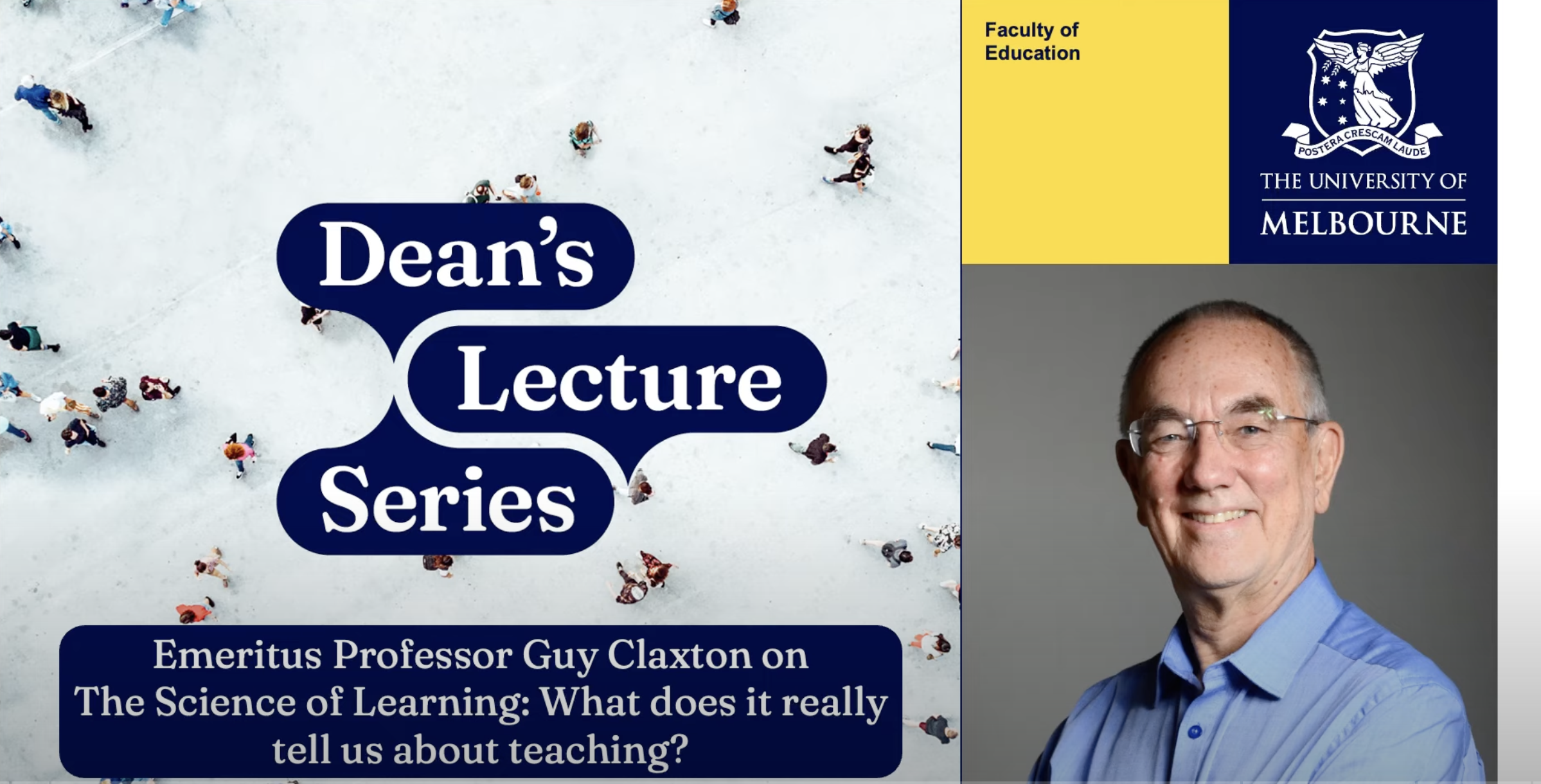
In this talk, Guy Claxton warns against the scientism and epistemic injustice of “The Science of Learning” and proposes instead something very much aligned with our notions of niche construction, toolbelt theory, collaboration, and iteration. These contribute to what Claxton calls “epistemic apprenticeship”.
As Dr. Mary Helen Immordino-Yang states, “We simply are not Frankenstein monsters.” We tend to focus on small mechanisms and parts and pieces of knowledge. Instead, focus on the whole person, not the Frankenstein monster with all the little pieces. Affective neuroscience teaches us new perspectives for understanding and appreciating the importance of the whole person in the educational context.
Similarly, David Perkins warns us against the atomized learning of “element-itis”.
David Perkins talks about the importance of not atomizing learning, not turning it into what he calls the twin diseases of about-ism, always just talking about things rather than learning to do them, and what he refers to as element-itis, that everything has to be built up like Lego from little bricks of knowledge before you can really get to work on them.
Dean’s Lecture Series – Prof Guy Claxton on the Science of Learning – YouTube
Instead of attempting to build Frankenstein children from reductionist parts, let children build their own niches and tool belts in whole, embodied ways compatible with cognitive and somatic liberty. Let them embark on an “epistemic apprenticeship”.
Table of Contents
Selected Quotes from the Talk
[This example of expository teaching] is appropriate because you’re all adults who are free to come, or not, and you’ve come presumably because you think there’s something you think you might find interesting…in being here. That’s not the case of schools, of course…
Dean’s Lecture Series – Prof Guy Claxton on the Science of Learning – YouTube
It’s a big jump to go from the sometimes appropriateness of a group of people sitting quietly and politely being told things by someone else, to assuming that such forms of teaching are somehow the dominant or the mandatory forms of teaching in places of education.
Dean’s Lecture Series – Prof Guy Claxton on the Science of Learning – YouTube
Sciences of learning – plural
- Cognitive neuroscience
- Affective neuroscience
- Social neuroscience
- Al and robotics
- Philosophy
- Sociocultural psychology
- Cognitive anthropology
- Developmental psychology
- Embodied cognition
- Evolutionary psychology
- Information processing psychology
- Instructional psychology
There’s no such thing as THE science of learning.
We are a variety of scholars working on understanding learning.
Dean’s Lecture Series – Prof Guy Claxton on the Science of Learning – YouTube
Sciences of LearningS
- Skill development
- Perceptual learning
- Learning to learn
- Developing attitudes, values and interests
- Identity development
- Information retention and retrieval
- Deep understanding
- A part in a play
- Making and Performing: Dance, Design Technology, Sport
- School maths and science
The sciences of learnings are not exclusively or even principally about school.
Dean’s Lecture Series – Prof Guy Claxton on the Science of Learning – YouTube
Learning happens when someone wishes to learn, not when someone wishes to teach.
Ken Robinson
A properly designed school system needs to focus on cognitive abilities, not scholarly subjects…If we allow students to choose what areas of knowledge they would like to focus on while learning those skills, they would be attentive and interested.
Roger Schank
We humans have created… mechanisms of thought, embodied in our nervous systems, that enable our minds to go further, faster and in different directions than the minds of any other animals… They are passed on to subsequent generations through social learning.
In the future, the cultural inheritance of cognitive mechanisms could be enhanced by formal education. It may be possible to design training programs for use in schools…to improve cognitive skills.
Cecilia Heyes, Cognitive Gadgets
It’s fairly obvious that there is a fundamental mismatch between secondary education and the way kids learn. In school we want kids to start with the small building blocks, to learn the little pieces and start to put those together. But that is not how the human mind grows. It grows by engaging with deep powerful [ideas and questions] and then working backward to inform the meaning you are making…Supporting young people to engage with the complexities of their moral and social lives…is what is deeply, deeply motivating- and it is what grows their brains.
Mary Helen Immordino-Yang
Intelligence is the sum total of our habits of mind.
As long as school focuses mainly on individual forms of competence, on tool-free performance, and on decontextualized skills, educating people to be good learners in school settings alone may not be sufficient to help them become strong out-of-school learners.
Lauren Resnick
Hardly anything we do is done solo. No matter whether you are an athlete, a business person, a scientist, a trash collector, or a clerk, you are almost always coordinating with other people in a complex way. Human endeavor is deeply and intrinsically collective—except in schools.
David Perkins
Much of the recent work on embodied cognition shows beyond a shadow of doubt that forms of higher cognition retain a deep and often quite automatic grounding in the sensorimotor, in the physical, in the actual, in the emotional, in the embodied stuff of our being.
Dean’s Lecture Series – Prof Guy Claxton on the Science of Learning – YouTube
What’s coming out of the laboratory, many of the laboratories, is that there is a bit of a shift from that rather narrow concern only with the rational and the linguistic and the argumentative, to a concern to a revised, renewed concern. It was there in the early days, was there if you read William James, with a concern that the real, the real world of living, of loving, of raising children, what we might now call embodied or warm cognition, a form of cognition that is embroiled with and suffused with emotion, with bodily process, with illness and so on.
Dean’s Lecture Series – Prof Guy Claxton on the Science of Learning – YouTube
Curiosity is the engine, is the driver of learning.
Dean’s Lecture Series – Prof Guy Claxton on the Science of Learning – YouTube
In a state of mindfulness, your own assumptions become visible to you.
And once they become visible, then they can become questionable. And once they become questionable, they become mutable.
Dean’s Lecture Series – Prof Guy Claxton on the Science of Learning – YouTube
Education as an Epistemic Apprenticeship
- School as a place where you go to get good at thinking, learning and knowing
- As in any apprenticeship, you need
- Role models – teachers as ‘master-learners’
- Mates – some a bit further on than you
- Tasks that build competence and confidence
- Feedback on progress
- Appreciation of your (growing) contribution to life
- Escalating responsibility
- Doesn’t it do that already? NO!
Dean’s Lecture Series – Prof Guy Claxton on the Science of Learning – YouTube
Explicit teaching, as it’s become known, is good for relatively short term retentions of relatively exam type knowledge. If that’s your overriding goal, then that’s a reasonable way of teaching. It’s not ineffective, but if you also care about the development of collaboration, of intuition, of imagination, of self-rescuing, of resilience, of curiosity, if those are also on your list of valued outcomes, then it’s far less clear that explicit teaching is the optimal pedagogy.
And so it’s up to us, isn’t it? It’s up to us in terms of what we what we value, to be first very clear about that. And only then start making decisions about the optimal forms of pedagogy.
Dean’s Lecture Series – Prof Guy Claxton on the Science of Learning – YouTube
So what do the learning sciences tell us about teaching?
- The “learning sciences” is a hybrid, multi-perspectival and unfolding discipline. There is no single agreed “science of learning”
- Even if there were, it would not tell us how to teach, without a clear specification of what we are teaching for.
- “Good teaching” involves a constantly changing balance of framing, explaining and exploring. A classroom is a complex adaptive system.
- The development of valued traits such as perseverance, independence and collaboration require escalating levels of challenge, autonomy and exploratory talk. To judge this escalation right you have to know your students well, as a group and individually.
- Learning, thinking and ‘behaving intelligently’ cannot be properly understood apart from matters of personality, emotion, conviviality, the nature of the challenge and the social context.
- Science and maths are not valid prototypes for all school learning.
- Mind is organic and ecological, not computational. Learning naturally grows out from what is already known. Mind is a tree, not a computer.
- The fundamental driver of learning is the urge to derive accurate predictions from experience that will guide future action, not to stockpile explicit knowledge. That is ancillary.
- Cognition is enhanced by culturally derived and socially transmitted ‘upgrades’ – and sometimes reduced by downgrades.
- Predictive processing, social and affective neuroscience and embodied cognition support wider purposes of education, and point towards possible pedagogies that involve emotion, autonomy, inquiry and ‘interthinking’
- School as an epistemic apprenticeship – cultivating positive epistemic upgrades and avoiding downgrades – is a wantable and practicable goal, but it challenges many educational shibboleths and will of course have its opponents.
Dean’s Lecture Series – Prof Guy Claxton on the Science of Learning – YouTube
Reading List
Here are the books mentioned during the talk:
- Future of Teaching: And the Myths That Hold It Back by Guy Claxton
- Teaching Minds: How Cognitive Science Can Save Our Schools by Roger C. Schank
- Cognitive Gadgets: The Cultural Evolution of Thinking by Cecilia Heyes
- Being There: Putting Brain, Body, and World Together Again by Andy Clark
- Emotions, Learning, and the Brain: Exploring the Educational Implications of Affective Neuroscience by Mary Helen Immordino-Yang
- Education and Learning to Think by Lauren B. Resnick
- Making Learning Whole: How Seven Principles of Teaching Can Transform Education by David Perkins


Leave a Reply