

Monotropism seeks to explain autism in terms of attention distribution and interests.
OSF Preprints | Development and Validation of a Novel Self-Report Measure of Monotropism in Autistic and Non-Autistic People: The Monotropism Questionnaire
This map highlights 20 common aspects of monotropic experience.
How many do you experience?
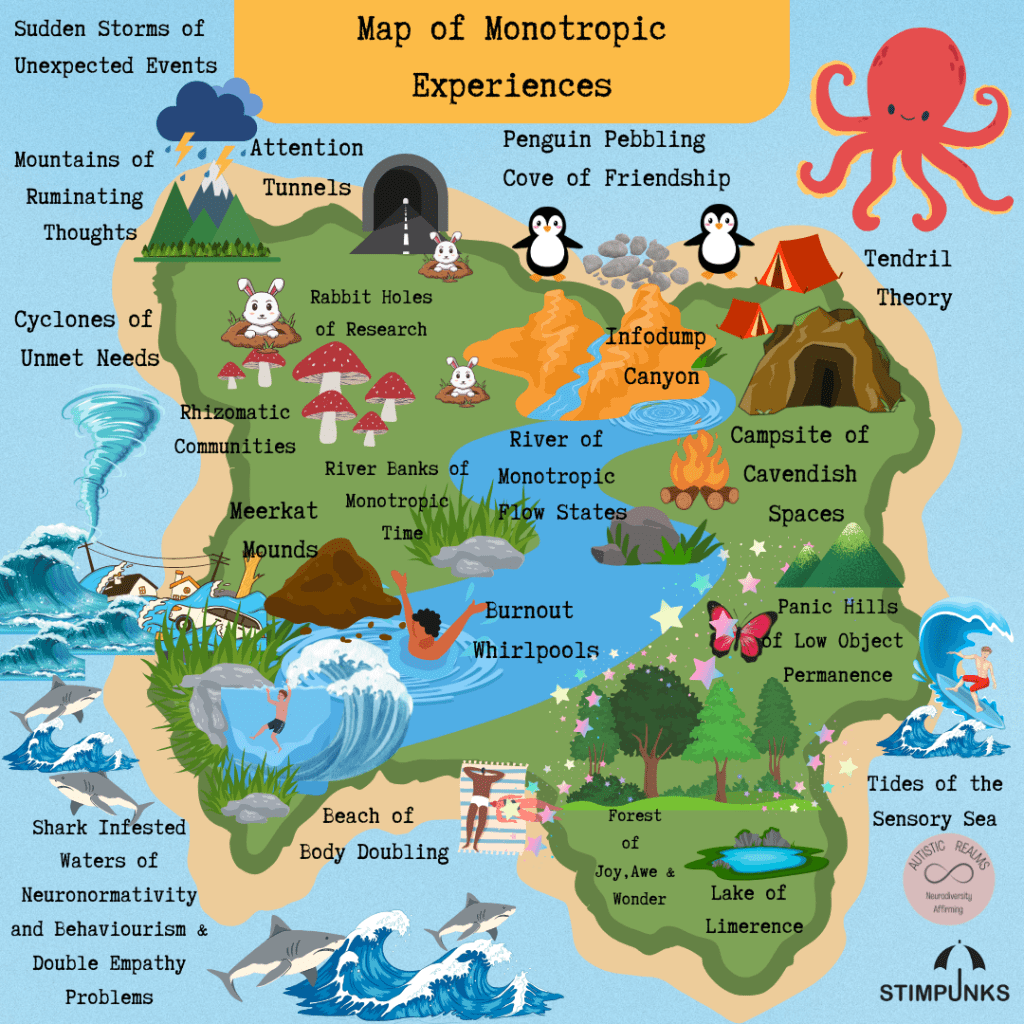
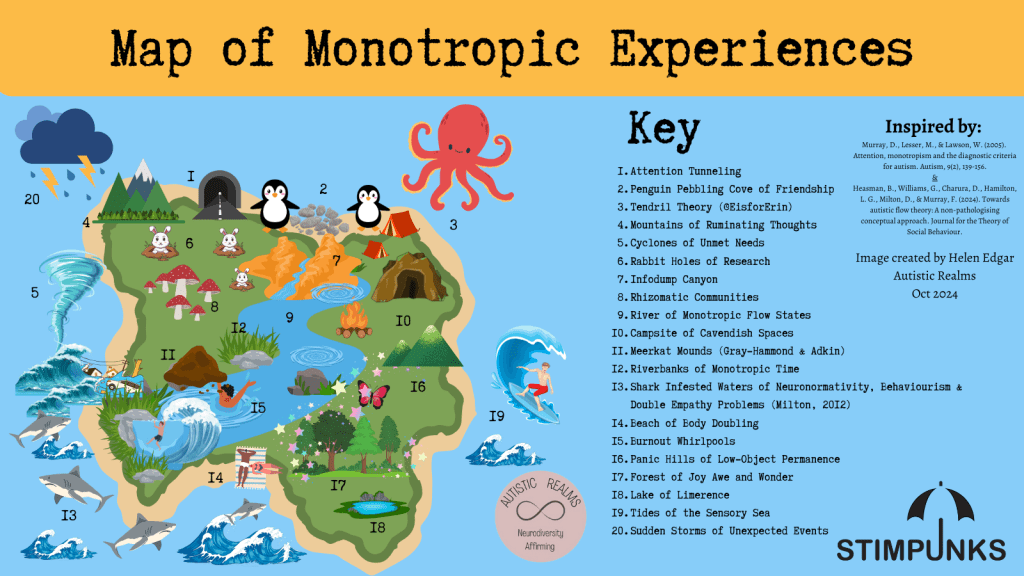
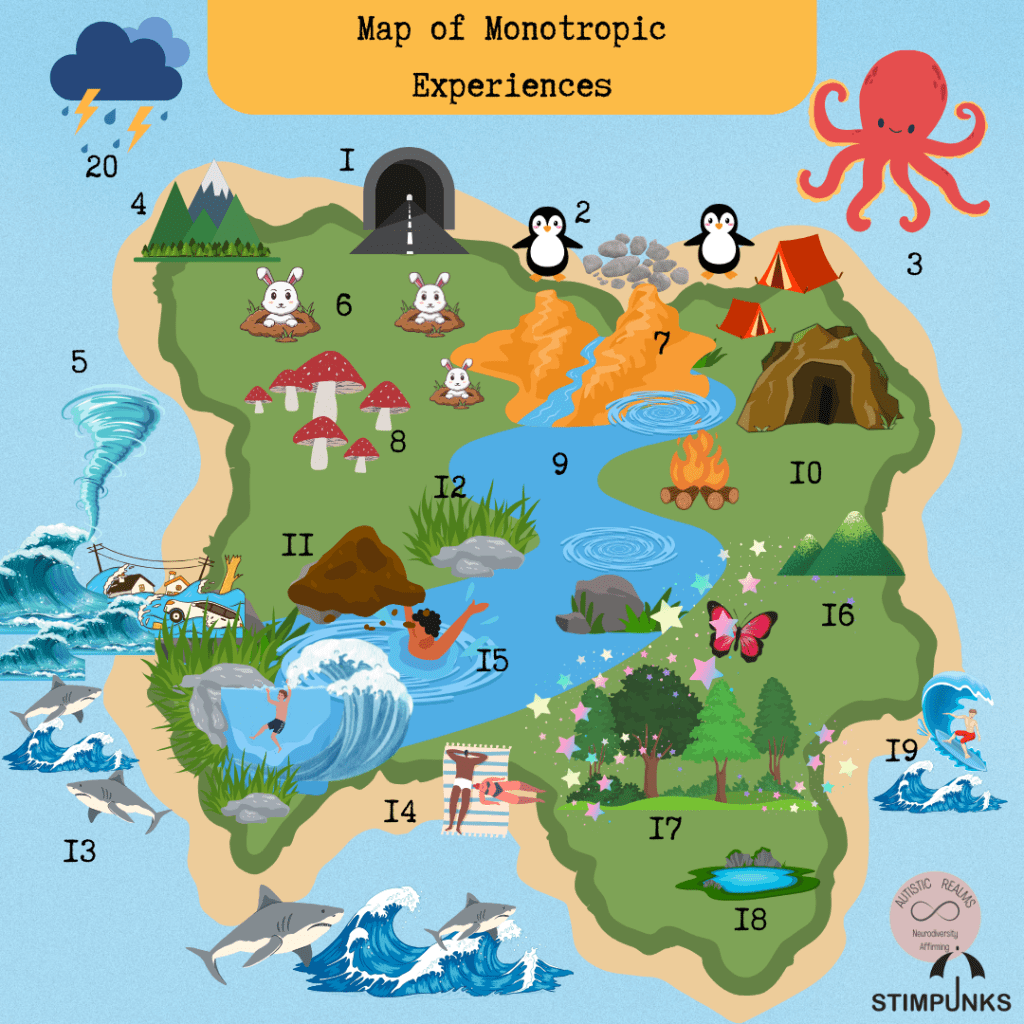
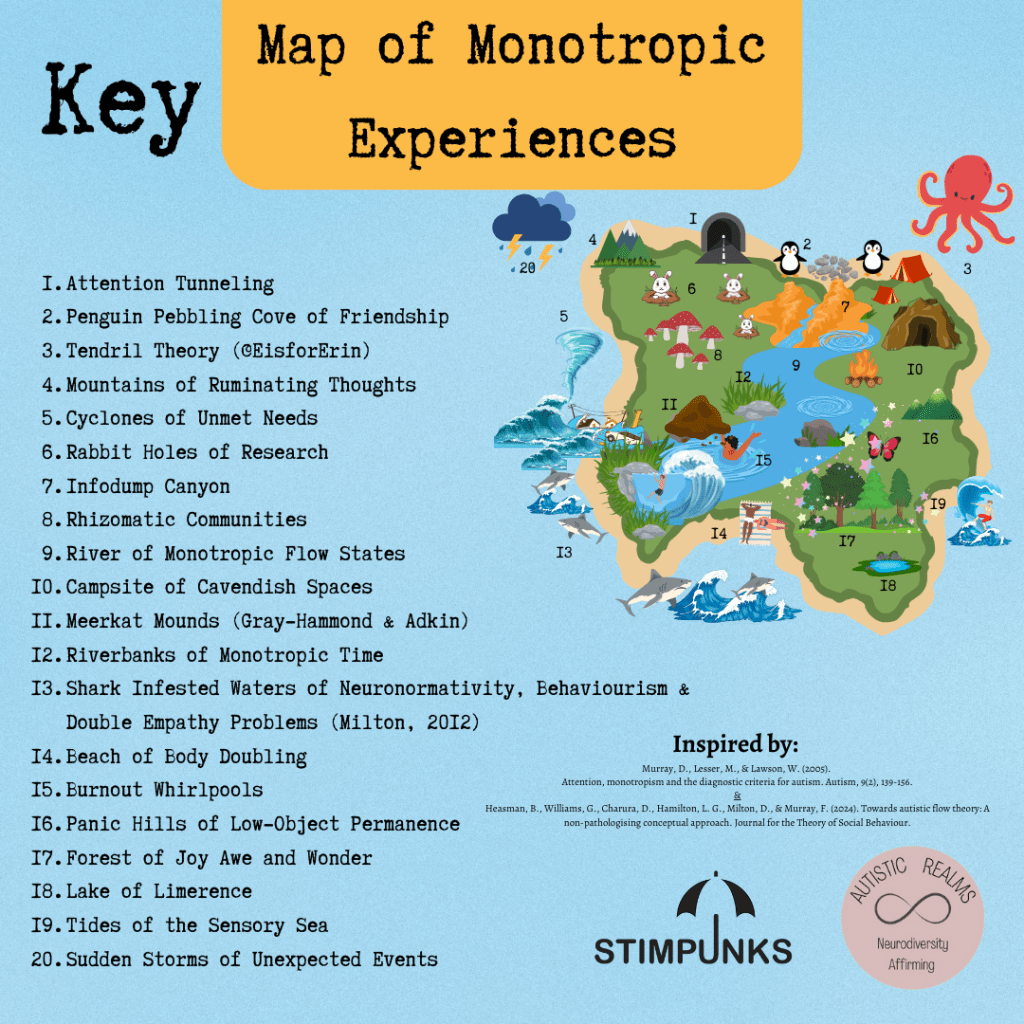
Created by Helen Edgar of Autistic Realms in collaboration with Stimpunks.
Inspired by the fabulous Map of Procrastination by Gemma Correll, I have created a map of monotropic experiences that reflects the main issues that impact my own life.
Curious to know what you would add or take away from this if you are Autistic/ADHD/AuDHD and resonate with this theory.
–Helen Edgar
License: “Map of Monotropic Experiences” by Helen Edgar is licensed under CC BY-SA 4.0
Sticker and Poster
The map is available as a sticker and a poster in our merch store.
The map is available as a digital download in our virtual store if you’d like to print it for yourself. A training presentation to accompany the map is also available. Payment is optional but appreciated.
Areas of the Map
- Attention Tunnels
- Penguin Pebbling Cove of Friendship
- Tendril Theory (@EisforErin)
- Mountains of Ruminating Thoughts
- Cyclones of Unmet Needs
- Rabbit Holes of Research
- Infodump Canyon
- Rhizomatic Communities
- River of Monotropic Flow States
- Campsite of Cavendish Spaces
- Meerkat Mounds (Gray-Hammond & Adkin)
- Riverbanks of Monotropic Time
- Shark Infested Waters of Neuronormativity, Behaviourism & Double Empathy Problems (Milton, 2012)
- Beach of Body Doubling
- Burnout Whirlpools
- Panic Hills of Low-Object Permanence
- Forest of Joy Awe and Wonder
- Lake of Limerence
- Tides of the Sensory Sea
- Sudden Storms of Unexpected Events
Vocabulary of the Map
- Attention Tunnels – Entering flow states – or attention tunnels – is a necessary coping strategy for many of us. Flow states are the pinnacle of intrinsic motivation. (Murray)
- Penguin Pebbling – “Penguin pebbling” is a little exchange between two people to show that they care and want to build a meaningful connection. (Edgar)
- Tendril Theory – When I’m focused on something, my mind sends out a million tendrils of thought, expands into all of the thoughts & feelings. When I need to switch tasks, I must retract all of the tendrils of my mind. This takes some time. (@EisforErin)
- Rumination – When your thoughts are all swirly and you just keep chewing on the same thought over and over and you can’t stop thinking about it and it’s distracting you and sometimes even putting you in a really bad mood or making you irritable. (Chipura)
- Unmet Needs – Mismatch between the areas we actually receive support, compared to the areas we would ideally like support. (Cassidy, et al)
- Rabbit Hole – “Down the rabbit hole” is an English-language idiom or trope which refers to getting deep into something, or ending up somewhere strange. (Wikipedia)
- Infodumping – Talking a lot about a topic in great detail.
- Autistic Rhizome – A growing and evolving network of Autistic communities with no hierarchy or dependence on anothers existence. (Edgar)
- Flow States – Entering flow states – or attention tunnels – is a necessary coping strategy for many of us. Flow states are the pinnacle of intrinsic motivation. (Murray)
- Cavendish Space – Psychologically and sensory safe spaces suited to zone work, flow states, intermittent collaboration, and collaborative niche construction. (Boren)
- Meerkat Mode – Heightened state of vigilance and arousal that involves constantly looking for danger and threat. It is more than hyper-arousal, it is an overwhelmed monotropic person desperately looking for a hook into a monotropic flow-state. (Adkin)
- Monotropic Time – When absorbed in our special interests or passions it can feel like entering a portal. Normal time can feel like it is dissolving, the outside world may feel like it is melting away. This can be really rejuvenating for the sensory system and help to recharge the bodymind. (Edgar)
- Neuronormativity – Neurormativity is a set of norms, standards, expectations and ideals that centre a particular way of functioning as the right way to function. It is the assumption that there is a correct way to exist in this world; a correct way to think, feel, communicate, play, behave and more. (Wise)
- Behaviourism – Behaviorism is a dehumanizing mechanism of learning that reduces human beings to simple inputs and outputs. There is an ever-growing body of research suggesting that behaviorism is not only harmful to how we learn, but is also oppressive, ableist, and racist. (McNutt)
- Double Empathy Problem – The ‘double empathy problem’ refers to the mutual incomprehension that occurs between people of different dispositional outlooks and personal conceptual understandings when attempts are made to communicate meaning. (Milton)
- Body Doubling – A “body double” is a person or even pet who is present with us while we work. This provides a gentle form of accountability — their presence serves as a reminder of what we’re supposed to be doing so we’re less likely to get distracted. (McCabe)
- Burnout – Autistic burnout is a state of physical and mental fatigue, heightened stress, and diminished capacity to manage life skills, sensory input, and/or social interactions, which comes from years of being severely overtaxed by the strain of trying to live up to demands that are out of sync with our needs. (Raymaker)
- Object Permanence – Autistic children have difficulties with their understanding of: what’s here, what’s now, what is permanent, and so on. (Lawson)
- Autistic Joy – Autistic joy is one of our favorite things about being autistic. It can be intense as a meltdown, but filled with overwhelming happiness and excitement. When we experience joy, we feel the excited vibrations throughout our bodies. To release the energy, we do a “happy stim.” We will jump up and down, excitedly flap our hands, sometimes even dance. (Blackwater)
- Limerence – Limerence is a state of involuntary obsession with another person. The experience of limerence is different from love or lust in that it is based on the uncertainty that the person you desire also desires you. (Psychology Today)
- Sensory Experiences – Neurodivergent people are hypersensitive to mindset and environment due to a greater number of neuronal connections. They have both a higher risk for trauma and a large capacity for sensing safety. (Elisabeth)
- Unexpected Events – If an autistic person is pulled out of monotropic flow too quickly, it causes our sensory systems to dysregulate. This in turn triggers us into emotional dysregulation, and we quickly find ourselves in a state ranging from uncomfortable, to grumpy, to angry, or even triggered into a meltdown or a shutdown. (Rose)
Difficulties of Neuronormative Domination
There are many things that impact your ability to succeed in life and that affect your well-being if you are Autistic. This is due to the fact that the world is predominantly set up for the neuromajority of people, not the minority of Autistic/ADHD or other neurodivergent, disabled or marginalised groups. Historically, this has led to Autism research mostly being carried out by non-Autistic people with the aim of trying to fix Autistic people, to make them fit into neurotypical ways of being and to appear more ‘normal’ in society. As Ryan Boren said during a recent Stimpunks discussion, “Neuronormative domination is a public health crisis’, (Boren, 2025). We need to reframe our thinking and practice to ensure we are neurodiversity-affirming so that everyone can succeed and so that no one is left behind or stuck at the edges of society without support.
Outdated and inaccurate research influenced by non-Autistic perspectives has had harmful consequences for Autistic people. Viewing Autism through a deficit lens has led to a denial of autonomy and human rights, as Autistic individuals are perceived as abnormal and in need of correction. This has been reflected by the Shark-Infested Waters of Neuronormativity on the map. This water permeates all of society and seeps through the cracks, so people may not even notice its harm; yet it seeps through and affects families, relationships, work, education, health and social care settings.

We need to move away from deficit-based views of Autism and instead embrace neuro-affirming theories led by Autistic people such as the theory of Monotropism. By embracing neurodiversity and validating the lived experiences of Autistic people and listening to stories shared in community spaces, we can create an ecology of care and equity that supports everyone so we all have a chance to thrive.
Flow States
Monotropism is a neuro-affirming theory of Autism. Everyone benefits from flow states, but for Autistic people, flow is even more important. Everyone has a certain amount of energy and capacity to get through their days. For monotropic people (Autistic/ ADHD), their energy and attention resources are more focused on fewer things at any one time and flow states are essential to help you get through the day and balance your mind and body. Being engaged in a flow state if you are monotropic can feel like your energy is being restored.

We need to embrace flow states and our authentic Autistic identity. This will enable the river of monotropism to run through society, so Autistic people can thrive and not feel like they are constantly trying to swim upstream against the tide.
Really getting to know young monotropic people’s passions and centring their learning around their interests can be hugely beneficial. It enables greater academic progress and supports their bodymind, communication skills and sensory system.
A happy monotropic bodymind = a happy flow state!
Sharing joy about your interests as a monotropic person is more than just sharing your hobby with someone; it can create deeper connections, which also allows your sensory system to become more regulated. A happy mind in a flow state generally means a happier body, and vice versa! Interest-led groups have been shown to be really beneficial for many Autistic people (Wood, 2018)
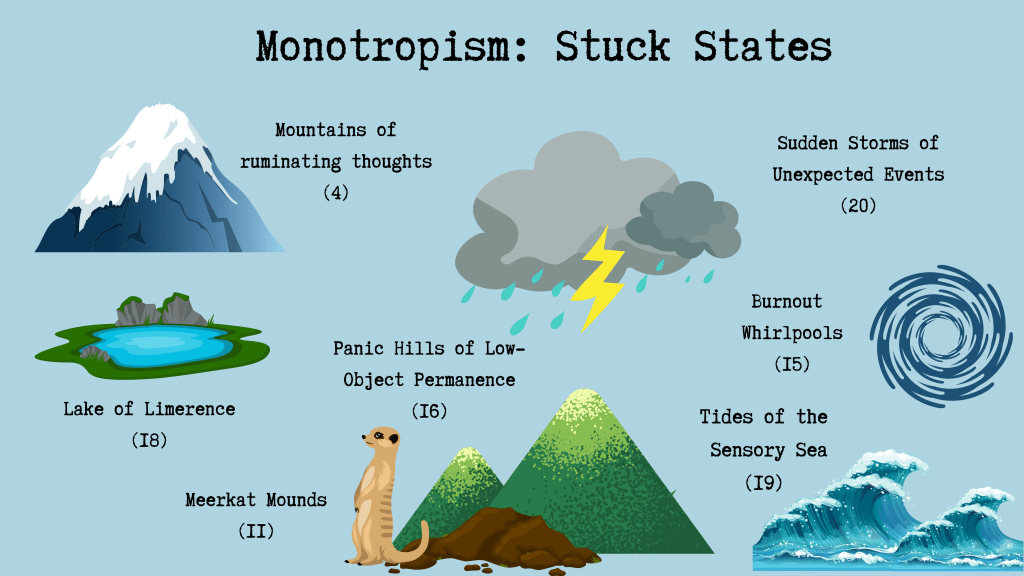
Stuck States
Being a monotropic person in a world that is designed for the benefit of the majority of polytropic people is exhausting. If you can’t access safe spaces, engage in your interests and feel connected, then you are more likely to enter a stuck state.
If you are in a stuck state, it will affect your well-being. A stuck state affects everything, from how you experience and are able to understand and interpret your sensory needs (including interoception) to how well you can function and live the life you want. Stuck states are states of inertia, unable to start or may be unable to stop. You may feel trapped in a constant loop of ruminating thoughts.
Socializing and the Importance of Environment
By making changes to the environment in schools, workplaces, and other settings and providing opportunities that honour authentic ways Autistic people communicate and adaptations that may need to be in place to meet sensory needs it will benefit everyone.

Embracing neurodiversity means embracing and validating the lived experience of everyone, including Autistic/ ADHD and other marginalised people. Enabling flow states and providing an environment where everyone’s well-being is supported will help whole communities to thrive. We need to listen to Autistic/ ADHD people and create a sense of pride around monotropic experiences.
Using the Map
- Where are you on the map?
- Where do you want to be?
- How can you get there?
- What support will you need?
- What is your biggest hurdle ?

What is Monotropism?
Monotropism is a theory of autism developed by autistic people, initially by Dinah Murray and Wenn Lawson.
Read about explanations and applications of the theory, its history, and what’s happening now.
Monotropic minds tend to have their attention pulled more strongly towards a smaller number of interests at any given time, leaving fewer resources for other processes. We argue that this can explain nearly all of the features commonly associated with autism, directly or indirectly. However, you do not need to accept it as a general theory of autism in order for it to be a useful description of common autistic experiences and how to work with them.
If we are right, then monotropism is one of the key ideas required for making sense of autism, along with the double empathy problem and neurodiversity. Monotropism makes sense of many autistic experiences at the individual level. The double empathy problem explains the misunderstandings that occur between people who process the world differently, often mistaken for a lack of empathy on the autistic side. Neurodiversity describes the place of autistic people and other ‘neurominorities’ in society.
Training
Our training builds on the Map of Monotropic Experiences to help reframe how we understand ourselves and Autistic people, not through the deficit-focused lens of traditional autism research, but through lived experience and Autistic voices.
Our open source training offers a radical, affirming reframe of Autism, grounded in the theory of monotropism — a way of understanding the deep, focused attention patterns common among Autistic and ADHD individuals.
Rather than seeing Autistic traits as deficits, monotropism recognises our monotropic “interest-based nervous system” as a natural and meaningful way of engaging with the world.
At the heart of our work is the importance of embracing authentic Autistic identity, not as something broken or needing correction, but as a valuable and vibrant way of being. Building strong community connections and validating lived experiences are central to this journey.
You’ll Learn To:
✅ Understand the theory of monotropism and the importance of flow
✅ Recognise how environments can create “stuck states”
✅ Explore the detrimental impact of neuronormative domination on Autistic well-being
✅ Create flow-supportive environments where ALL minds can thrive
✅ Understand intersectionality and the Double Empathy Problem for deeper inclusion
✅ Celebrate authentic Autistic identity and the strength of community storytelling and shared experiences
Perfect for: schools, healthcare settings, workplaces, and community networks.
A creative tool for reflection, connection, and meaningful change.
Timing and Preparation: The training content is approximately 4,000 words, designed to cover around 45 minutes of presentation time. Delivered live as a workshop with space for discussion and Q&A, it typically runs for 1-2 hours and can be expanded into a full-day session if preferred.


Leave a Reply