

Every day, people are shaped by systems they didn’t build and didn’t consent to — schools, workplaces, medical institutions, policies, design norms, and cultural expectations. These are systems of power: frameworks that decide who belongs, who is excluded, who is visible, and who is erased.
At Stimpunks, we don’t treat systems as neutral backdrops. We name them, we map them, and we learn how they produce harm — especially for neurodivergent and disabled people. This pathway unpacks how power operates, how environments enforce norms, and how people can recognize and challenge those forces.
You won’t find abstract theory here. You’ll find language grounded in lived experience, tools that help you see power in action, and ideas for changing what doesn’t work. This is for people inside systems that forget them — and for allies who want to understand how power shapes every part of our lives.
You Cannot Change a Reality That You Cannot Name
Kimberlé Crenshaw | ‘You Cannot Change a Reality That You Cannot Name’: — FAIR
Our “Systems of Power” learning pathway will help you recognize and name the systems of power.
About Learning Pathways
A learning pathway is a route taken by a learner through a range of pages, modules, lessons, and courses to build knowledge progressively.
Pathways don’t need to be traversed in order. Pick what looks interesting. Choose your own adventure.
Table of Contents
- What the Systems of Power Page Communicates
- Name the systems of power.
- The lens of power can really help us see what’s going on.
- Inequities are primarily power and privilege problems.
- Common Obstacles to Addressing Power and Privilege Problems
- Power Is Structural, Not Personal
- Ableism and Neuronormativity
- Racism, Colonialism, and Disability Are Intertwined
- The Cult of Compliance
- Meritocracy Myths and Sorting Machines
- Carceral Systems: Policing, Prisons, Surveillance
- School as a System of Power
- Work, Capitalism, and Productivity as Worth
- Healthcare, Pathologization, and Medical Authority
- Gatekeeping, Expertise, and Epistemic Injustice
- Design and Infrastructure as Power
- Harm Is Patterned, Not Random
- What Resistance Looks Like at the Edges
- Building Alternative Systems: Interdependence and Mutuality
- Questions to Ask When You Feel Stuck in a System
- Closing Thoughts
- It’s a Flawed Process
What the Systems of Power Page Communicates
The Systems of Power pathway helps people see how big social, economic, and political structures shape who gets to thrive — and who gets left behind. It’s not a list of abstract concepts; it’s a way of understanding how power shows up in everyday life, especially in education, work, policing, healthcare, and access.
Key Ideas
- Power is not evenly distributed. Some bodies and minds are prioritized, while others are devalued.
- Institutions enforce norms. Schools, workplaces, and legal systems often assume one default way of being and label difference as deficiency.
- Marginalization is structural. It’s not about individual bad actors; it’s about rules, cultures, incentives, and histories embedded in systems.
- Understanding systems helps us intervene. Once you see how power operates, you can design alternate pathways, resist harmful practices, and build systems that support diverse needs.
Why It Matters
Seeing systems of power helps people understand why disabled and neurodivergent lives are often treated as peripheral or problems to be fixed. It shifts the frame from “What’s wrong with you?” to “What’s wrong with the system?” and points toward collective strategies for change.
How It’s Structured
The page breaks down different systems — schooling, economics, policing, healthcare, etc. — showing how each enforces compliance and how disabled/neurodivergent people are impacted. It links analysis with resources and alternative practices.
Name the systems of power.
You Cannot Change a Reality That You Cannot Name
Kimberlé Crenshaw | ‘You Cannot Change a Reality That You Cannot Name’: — FAIR
Power works best when it stays unnamed. Systems of power shape who is believed, who is supported, who is punished, and who is expected to adapt. This section is about calling those systems what they are — ableism, racism, patriarchy, capitalism, colonialism, carceral control — so we stop treating harm as accidental or personal. Naming is the first step toward building something different.
We may not know it, and be able to talk about it, because there’s been an agenda to erase our capacity to name that reality. And the clear fact is that you cannot change or transform a reality that you cannot name, you cannot historicize, you cannot conceptualize.
Kimberlé Crenshaw | ‘You Cannot Change a Reality That You Cannot Name’: — FAIR
- Neoliberalism
- Conservatism
- Resentment
- Southern Strategy
- Lost Cause
- Segregationist Discourse
- Meritocracy Myth
- Moral Panic
- Lowering the Bar
- Minority Stress
- Racial Weathering
- Policing
- Toxic Masculinity
- Bodily Autonomy
- Biological Essentialism
- Stigma
- Shame
- Ableism
- Eugenics
- Administrative Burden
- R-Word
- Empire of Normality
- Autism Grievance Parent
- Power
- Privilege
- Precarity
- Oligarchy
- Sadopopulism
- Systems Generated Trauma
- Rot Economy
- Fantasy Economy
- Metric Fixation
- Objectivity
- Tech Ethics
- Ableism
- Neuronormativity
- Empire of Normality
- Pathology Paradigm
- Behaviorism
- Eugenics
- Deficit Ideology
- Sameness-Based Fairness
- ”Better get used to it.”
- Inspiration Exploitation
- School-Induced Anxiety
- Toxic Positivity
- Resilience
- Burnout
- The Road to Neuronormative Domination.
- Education Technology and the New Behaviorism
- We’ve Turned Classrooms Into a Hell for Neurodivergence
- 14 Obstacles to Neurodiversity Affirming Practice
- Double Empathy Problem
- Double Empathy Extreme Problem
- Triple Empathy Problem
- Disability Double-bind
- Performative Neurodiversity (Neurodiversity Lite)
- Pathology Lite
- Empire of Normality
- Harm Reduction Theater
The lens of power can really help us see what’s going on.
The lens of power changes the question. Instead of asking “What’s wrong with this person?” we ask “What forces are shaping this situation?” Power helps us see patterns that individual stories can hide: compliance cultures, deficit narratives, gatekeeping, and exclusion built into institutions. These lens on power listed below make structural reality visible — especially for neurodivergent and disabled people living at the edges of systems.
Lenses on power:
- Intersectionality
- DEI-AB
- Critical Race Theory
- Social Model of Disability
- Biopsychosocial Model
- Structural Ideology
- DisCrit
- Neurodiversity
- Disability Justice
- Design for Real Life
- Equity and Needs-Based Fairness
- Foreground complexity as the baseline.
- Reframe Our Ways of Being
- Interdependence
- Critical Wellness
- Rules of Thumb for Human Systems
- Choosing the Margin: Design is Tested at the Edges
Inequities are primarily power and privilege problems.
Most inequities are not caused by lack of effort or personal weakness. They are produced by uneven access to safety, resources, credibility, and autonomy. Disability and neurodivergence are not the problem; the problem is how systems distribute dignity. This section centers a core Stimpunks truth: inequity is structural, and justice requires changing conditions, not blaming individuals for struggling inside harm.
- Name the systems of power.
- The lens of power can really help us see what’s going on.
- Inequities are primarily power and privilege problems.
- Just remember that your real job is that if you are free, you need to free somebody else. If you have some power, then your job is to empower somebody else.
- Every single one of us has a moral obligation to use whatever resources we have — time, money, knowledge, skills, emotional energy, access to physical resources — … in service of justice, and fighting against injustice and oppression and violence in all of its forms, structural and individual, subtle and overt.
- Inclusivity involves looking at a space and seeing all the ways it’s set up to benefit those in power. And then redesigning and resetting that space to support, affirm, and amplify marginalized folks.
- All struggles are essentially power struggles.
- Do not be the oppressor.
- People suffer, and when they do, it’s for a reason.
Common Obstacles to Addressing Power and Privilege Problems
Talking about power is uncomfortable because it challenges the stories institutions tell about themselves — neutrality, meritocracy, fairness, “equal opportunity.” This section names the common traps: focusing on individual intent instead of outcomes, treating inclusion as a vibe instead of infrastructure, demanding politeness over truth, and avoiding conflict at the cost of accountability. If we want real change, we have to move through these obstacles with clarity, care, and courage.
Obstacles to DEI-AB and Neurodiversity Affirming Practice
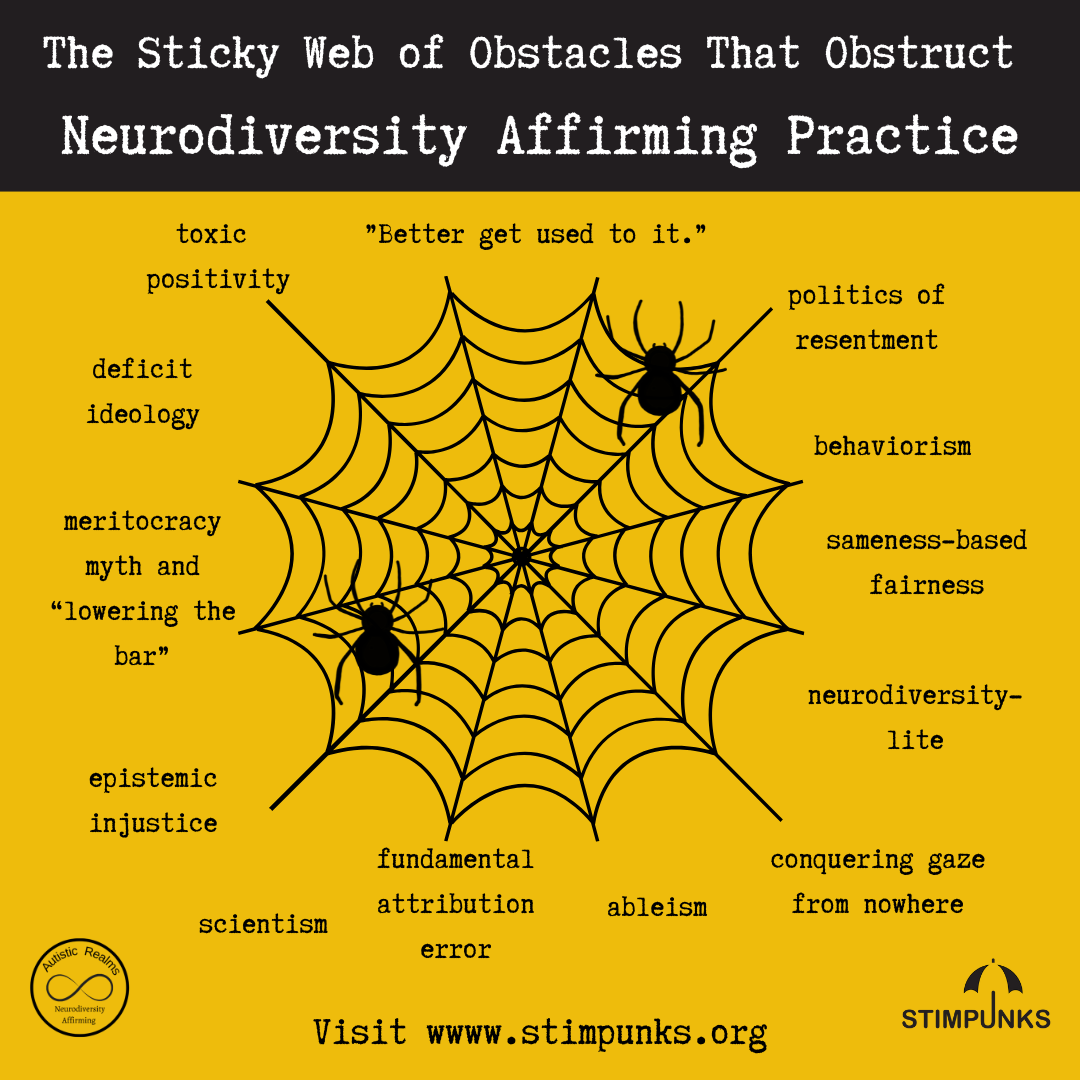
(links are to our glossary, where you can learn much more)
- politics of resentment
- sameness-based fairness
- fundamental attribution error
- conquering gaze from nowhere
- toxic positivity
- neurodiversity-lite
- scientism
- epistemic injustice
- behaviorism
- ableism
- deficit ideology
- ”Better get used to it.”
- meritocracy myth
- “lowering the bar”
politics of resentment = manipulations of status anxiety; organization of interest groups based on perceived deprivation or the threat of deprivation
sameness-based fairness = notion of fairness where everyone gets the same thing rather than each getting what they need
fundamental attribution error = to underestimate the impact of situational factors and to overestimate the role of dispositional factors in controlling behaviour
conquering gaze from nowhere = the interpretation of objectivity as neutral and not allowing for participation or stances; an uninvolved, uninvested approach that claims objectivity to “represent while escaping representation”
toxic positivity = belief that success happens to good people and failure is just a consequence of a bad attitude rather than structural conditions
neurodiversity-lite = using neurodiversity as a buzzword; a way to profit from the appropriation of a human rights movement; a cottage industry for therapists, clinics, and companies to sell their associated products, classes, books, and training to the public without having a clue about neurodiversity
scientism = the belief that science is the only route to useful knowledge
epistemic injustice = where our status as knowers, interpreters, and providers of information, is unduly diminished or stifled in a way that undermines the agent’s agency and dignity
behaviorism = a dehumanizing mechanism of learning that reduces human beings to simple inputs and outputs
ableism = a system of assigning value to people’s bodies and minds based on societally constructed ideas of normalcy, productivity, desirability, intelligence, excellence, and fitness
deficit ideology = a worldview that explains and justifies outcome inequalities by pointing to supposed deficiencies within disenfranchised individuals and communities
better get used to it = preparing people for oppression by oppressing them
meritocracy myth = a widely held but false assertion that individual merit is always rewarded; the myth of meritocracy is one of the longest lasting and most dangerous falsehoods in American life
lowering the bar = a racist, sexist, and ableist narrative with no basis in reality that represents diversifying hiring pipelines, attracting candidates from underrepresented groups, and supporting them in the workplace as “lowering the bar” by hiring less-qualified individuals
Power Is Structural, Not Personal
Power is often misunderstood as something individual: a bully, a bad administrator, a prejudiced teacher. But structural power lives in policies, norms, incentives, histories, and institutional defaults. It determines what counts as “normal,” what counts as “success,” and what kinds of bodies and minds are expected to adapt.
Seeing power structurally is not despair. It is accuracy. Once you understand inequity is produced by systems, you stop demanding individuals solve systemic harm with personal endurance. You start building alternatives.
Stop demanding individuals solve systemic harm with personal endurance.
Ableism and Neuronormativity
Ableism is a system that treats disabled lives as less valuable and disabled needs as optional. Neuronormativity assumes one kind of mind is the default.
This is why so many neurodivergent people are forced into masking. The environment is not built to hold their nervous systems, so survival becomes performance. Stimpunks rejects neuronormativity. Disabled and neurodivergent people have human needs, not special needs.
- The Road to Neuronormative Domination: Thorndike won, Dewey lost. Skinner won, Papert lost. – Stimpunks Foundation
- Empire of Normality: An Important Book Necessary to Our Times – Stimpunks Foundation
- Empire of Normality – Stimpunks Foundation
- Rules of Thumb for Human Systems – Stimpunks Foundation
Racism, Colonialism, and Disability Are Intertwined
Disability justice is inseparable from racial justice. Systems of power were built through colonialism, enslavement, dispossession, and ongoing state violence. Disabled people of color face compounded harm in schools, healthcare, policing, and employment. Intersectionality is necessary, not optional.
The Cult of Compliance
Many systems treat compliance as safety. Noncompliance is often not defiance — it is sensory overload, shutdown, anxiety, communication difference, nervous system reality.
Stimpunks builds alternatives: Cavendish Space, lily pads, mutual accommodation. A humane world does not demand compliance as the price of belonging.
Meritocracy Myths and Sorting Machines
Meritocracy is the story that keeps harmful systems feeling fair. It confuses performance with worth and turns success into moral virtue.
Schools and workplaces become sorting machines instead of spaces for human development. Stimpunks rejects ranking as dignity. A humane world is not a leaderboard. It is a commons.
Carceral Systems: Policing, Prisons, Surveillance
Carceral systems enforce normativity through punishment. Police are trained to interpret noncompliance as threat — and disability often looks like noncompliance. Disabled and neurodivergent people, especially marginalized people, face disproportionate harm.
Safety is not domination. Safety is care, access, community response, and infrastructure that prevents crisis.
School as a System of Power
Schools enforce norms of attention, behavior, and productivity. Disabled learners are too often managed instead of supported. Spiky profiles are punished by linear standards.
Stimpunks wants progressive education: Cavendish Space in learning environments, learner safety, multiple pathways, dignity over sorting.
Work, Capitalism, and Productivity as Worth
Modern systems equate productivity with human value. Disabled people are excluded, underpaid, or punished for fluctuating capacity.
Stimpunks rejects worth-as-output. Contribution is diverse. Rest is human. Interdependence is reality.
Healthcare, Pathologization, and Medical Authority
Healthcare can save lives and also enforce control. Disabled people are often not believed. Difference is pathologized instead of supported.
Stimpunks insists on disability justice in healthcare: consent, credibility, access, relational care, dignity.
Gatekeeping, Expertise, and Epistemic Injustice
Power decides whose knowledge counts. Disabled people are too often treated as objects of study rather than authors of truth.
We practice epistemic justice and pluralism: lived experience is knowledge. Community practice is knowledge. Story is knowledge. This is not anti-science. It is anti-domination.
Design and Infrastructure as Power
Design is never neutral. Infrastructure determines who can enter, rest, regulate, communicate, and belong.
Access is not an add-on. Access is the design. Cavendish Space and lily pads are dignity infrastructure. If dignity is not built into environments, it will be rationed by power.
Harm Is Patterned, Not Random
Systemic harm is not a series of accidents. It is patterned and predictable: compliance culture, sensory punishment, gatekeeping, deficit framing.
Pattern recognition is liberation. Harm is preventable when conditions change.
What Resistance Looks Like at the Edges
Resistance is mutual aid, refusal, redesign, care. It is building Cavendish Space. It is epistemic justice. It is default to open. It is learner safety.
We resist by making the world more livable at the edges — and what we build there becomes a gift to everyone.
Building Alternative Systems: Interdependence and Mutuality
Critique is not the endpoint. The goal is new conditions: mutual accommodation, collaborative niche construction, emergence over control.
We do not need better rankings. We need better conditions. The alternative is a world that holds us.
Questions to Ask When You Feel Stuck in a System
- Who benefits from this norm?
- Who is being asked to adapt?
- What is treated as natural that is constructed?
- What is being measured, and what is being erased?
- Where is the compliance demand?
- What would dignity require here?
- What would mutual accommodation look like?
- Where are the lily pads?
- What is the smallest intervention that reduces harm?
- What alternative system is trying to emerge?
Name the system. Refuse the harm. Build the alternative.
Read Next
- Policing: The Cult of Compliance and the Policing of the Norm
https://stimpunks.org/policing/ - Meritocracy Myths and the Conquering Gaze From Nowhere
https://stimpunks.org/2023/04/01/conquering-gaze-from-nowhere-meritocracy-myths-marked-bodies-and-spoiled-identities/ - Cavendish Space
https://stimpunks.org/space/cavendish/ - Why Cavendish Space
https://stimpunks.org/why/cavendish-space/ - Access
https://stimpunks.org/access/ - Emergence
https://stimpunks.org/glossary/emergence/ - Epistemic Injustice
https://stimpunks.org/glossary/epistemic-injustice/ - Spiky Profile
https://stimpunks.org/glossary/spiky-profile/ - Tenets
https://stimpunks.org/about/tenets/ - Field Guide
https://stimpunks.org/fieldguide/
Closing Thoughts
Power explains what personal blame hides.
Design is where justice becomes real.
We build at the edges until the world can hold us.
It’s a Flawed Process
Flawed process
And it's a flawed process
They play God
And treat us like we objects

It's a flawed process
And it's a flawed process
I was made equal
I know I'm not less
Flawed Process ft. Abstract Rude & J-Live | Mugs and Pockets
We are made equal
Flawed Process ft. Abstract Rude & J-Live | Mugs and Pockets
And so we all blessed


