

Cavendish Space: psychologically and sensory safe spaces suited to zone work, flow states, intermittent collaboration, and collaborative niche construction.
The Life of Henry Cavendish
DESPITE HIS ECCENTRIC COUTURE and the strange totem rising from his backyard, Henry Cavendish was not a wizard. He was, in eighteenth-century terms, a natural philosopher, or what we now call a scientist. (The word scientist wasn’t coined until the nineteenth century, when it was proposed as a counterpart to artist by oceanographer and poet William Whewell.) He was not only one of the most ingenious natural philosophers who ever lived, he was one of the first true scientists in the modern sense.
Silberman, Steve. NeuroTribes: The Legacy of Autism and the Future of Neurodiversity (p. 21). Penguin Publishing Group.
Since reading NeuroTribes, we think of psychologically and sensory safe spaces suited to zone work as “Cavendish bubbles” and “Cavendish space”, after Henry Cavendish, the wizard of Clapham Common and discoverer of hydrogen. The privileges of nobility afforded room for his differences, allowing him the space and opportunity to become “one of the first true scientists in the modern sense.” (Silberman, NeuroTribes, p. 21)
Like Cavendish, we’re autistic. We relate to much of his personal and professional life. He needed his bubble, his cave, his sensory and social cocoon.
Cavendish also needed, occasionally, the company of a small set of his Royal Society peers. The Royal Society Monday Club was his campfire, his place where he could lurk at the edges and collaborate intermittently with a small group on his terms.
The source of this apparent shyness was social anxiety so intense that it nearly immobilized him in certain situations.” (Silberman, NeuroTribes, p. 24) “It is not true, however, that he wanted to remove himself entirely from the company of his peers; he just wanted to stand off to the side, soaking everything in.
Cavendish was very uncomfortable in the public eye. He formed an alliance with Charles Blagden, an extroverted and outgoing Monday Club peer, whereby Blagden introduced Cavendish and his ideas to wider audiences. Blagden brought Cavendish to the creative commons, to the watering holes of science and naturalism.
Together, the two men forged a mutually indispensable alliance. Cavendish became Blagden’s human Google, answering any query that came up in his own work. The elder scientist’s guiding hand was visible in six of the ten papers that Blagden published in Philosophical Transactions. In return, the reclusive lord was able to keep up with the state of his art without having to schmooze his way through the eighteenth-century equivalent of TED conferences. Through Blagden, his life was richly interwoven with the lives and work of a global community of thinkers who were kept at a safe and comfortable distance.
Cavendish’s life illustrates the autistic need for caves, campfires, and watering holes as well as intermittent collaboration.
A Home of Opportunity
Cavendish’s life also illustrates the need for what educator Ira Socol calls “Homes of Opportunity”. (Socol)
A school struggling with the ravages of American poverty has to first be a home — the kind of home the children may not have at home. A place that is relentlessly safe, that is both calming and exciting, that offers unconditional love, and that offers boundless opportunity.
That ‘home’ must be supportive and accepting, loving and encouraging, and it must provide the biggest possible window on to the world, on to the universe.
A home of opportunity.
What does opportunity look like? First, it looks like trust. It looks like freedom. And it looks like choice.
Trust and embodied freedom. Those are the heart of Cavendish Space, Neuroqueer Learning Spaces (NQLS), and homes of opportunity.
If Henry Cavendish hadn’t had a home of opportunity that suited his sensory and social needs, we would have lost him and his world-changing revelations to an asylum. “One of the greatest scientists in history might have ended up on a ward at the Bethlem Royal Hospital (commonly known as “Bedlam”).” (Silberman, NeuroTribes, p. 34)
So too for neurodivergent kids in school today. We are losing so many to school-induced anxiety due to neuronormative environments designed against their neurology, their flow states, their ways of being, and their well-being.
Let’s build homes of opportunity that meet the sensory and social needs of all humans. Cavendish’s life shows us the way. Cavendish’s life shows us how to build a home of opportunity that flows for everyone.
Designing to maximize flow has impacted our work to modernize district facilities. It’s essential to moving teachers away from the dominant teaching wall that defines American‐built schools. We see flow happening in a newly built multiage elementary space designed as a home of opportunity for 120 K–5 learners and six teachers.
He (Cavendish) transformed his whole environment into a playground for his keenly focused senses and intellect.
Silberman, Steve. NeuroTribes: The Legacy of Autism and the Future of Neurodiversity (p. 28). Penguin Publishing Group.
Caves, Campfires, and Watering Holes
What worked for Henry Cavendish works for everyone. Let’s build Cavendish Space for all. Let’s build the caves, campfires, and watering holes that nurtured Henry Cavendish into our learning facilities.

Caves
Spaces for quiet reflection, introspection and self-directed learning.
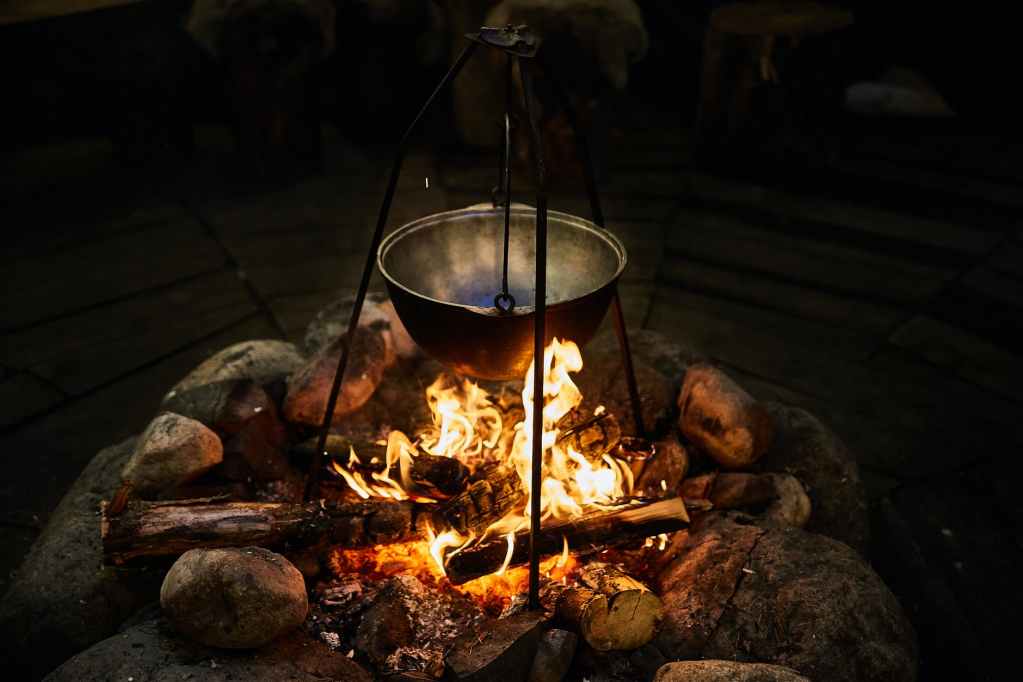
Campfires
Spaces for learning with a storyteller – teacher, mentor, elder, expert.

Watering Holes
Spaces for social learning with peers.
The millions of dollars spent on many new schools will do little to improve educational outcomes if they are built without cave spaces.
(Nair, Prakash. The Language of School Design : Design Patterns for 21st Century Schools)
…it is in solitude that students assimilate, synthesize and internalize learning so that it becomes knowledge and (sometimes) wisdom.
(Nair, Prakash. The Language of School Design : Design Patterns for 21st Century Schools)
Dedicated to Steve Silberman
We are philosophically and practically indebted to Steve Silberman’s work uncovering and telling the story of Henry Cavendish and his autistic ways of being. Cavendish’s story as told by Silberman in NeuroTribes was revelatory to us. It illuminated our own ways of being. We saw ourselves in Cavendish. We recognized his patterns in how we worked and collaborated over the course of our professional careers as teachers and technologists. We dedicate the concept of Cavendish Space to the memory of Steve Silberman, a true ally to our community.
Learn More
The Main Elements of Cavendish Space Are
- caves, campfires, and watering holes
- intermittent collaboration
- niche construction
- flow states
- sensory safety
- psychological safety
- learner safety
- embodiment and regulation
- cognitive liberty
- somatic liberty
- neurological pluralism
What do those mean?
*caves = spaces for quiet reflection, introspection and self-directed learning.
*campfires = spaces for learning with a storyteller – teacher, mentor, elder, expert.
*watering holes = spaces for social learning with peers.
intermittent collaboration = group work punctuated by breaks to think and work by ourselves.
niche construction = directly modifying the environment in such a way that it enhances someone’s chances for success.
flow state = the experience of complete absorption in the present moment.
sensory safety = understanding the sensing and perceptual world (especially for neurodivergent people) and being serious about our sensory needs in every setting.
***psychological safety = a condition in which you feel (1) included, (2) safe to learn, (3) safe to contribute, and (4) safe to challenge the status quo—all without fear of being embarrassed, marginalized, or punished in some way.
***learner safety = safety to engage in the discovery process, ask questions, experiment, and even make mistakes.
embodiment = staying present in our own bodies to sensations, emotions and the external environment without going into dysregulation without going into fight/flight/freeze/fawn.
regulation = tending to and responding to the body’s needs.
**cognitive liberty = the idea that individuals have the right to absolute sovereignty over their own minds and their own cognitive processes.
**somatic liberty = freedom of embodiment, freedom to indulge, adopt, and/or experiment with any styles or quirks of movement and embodiment, whether they come naturally to one or whether one chooses them. the freedom to give bodily expression to one’s neurodivergence.
neurological pluralism = the multiplicity of different bodyminds with diverse and conflicting needs coexisting peaceably and interdependently.
* = Inspired by David Thornburg’s ‘primordial learning metaphors’ from “Campfire to Holodeck” (2013)
** = Inspired by Nick Walker’s “Neuroqueer Heresies” (2021)
*** = Inspired by Timothy R. Clark’s “The 4 Stages of Psychological Safety” (2020)
Cavendish Space is a collaboration between Ryan Boren of Stimpunks and Helen Edgar of Autistic Realms.
Header image credit: Swamburger of Mugs and Pockets


Leave a Reply