
You don’t have to know the answers. The answers come from the people, and when they don’t have any answers, then you have another role, and you find resources.
Myles Horton, The Long Haul, quoted in Nico Slate, “The Answers Come from The People”
In 2022, historian Nico Slate published a study of the Highlander Folk School in History of Education Quarterly. Drawing on more than a hundred hours of audio recordings of civil rights workshops, he argued something the myth had buried: Highlander was never purely student-driven. The famous line — the answers come from the people — is always cut short. The full sentence names a second role. When the people don’t have the answer, you find resources. Highlander blended open discovery with experts, guest speakers, lectures, and staff who intervened. A hybrid. Scholars had missed it.
We read it and recognized our ancestors.
Not because we are them. A residential folk school in segregated Tennessee and a neurodivergent- and disabled-led learning space do not operate at the same scale, against the same oppression, or with the same people. But the method is the same, and the lineage is real. Forgetting is a tool of white supremacy — it keeps us from building on the strategies of our elders and ancestors and tricks us into thinking we must be the first. We are not the first. We build on each other’s work, as good revolutionaries always do.
We build on each other’s work – as good revolutionaries always do.
Forgetting is a tool of white supremacy. It keeps us from building upon prior strategies led by our ancestors and elders. White supremacy also teaches us that we must be the first—the first to confront a particular issue or problem and therefore need to create something new instead of drawing from our rich history of revolutionary work available to us.
Memory.
This page maps that lineage. It is a crosswalk between Highlander’s pedagogies of resistance and the Stimpunks Learning Space — a sibling to our Finland 2045 crosswalk, but read as ancestry rather than parallel discovery. We do not claim their struggle as ours. We honor the ancestors whose method we inherited, and we name the few places where our conditions ask us to extend it.
About the Highlander Folk School
Highlander was founded in 1932 by Myles Horton, who had studied with Reinhold Niebuhr, learned from Jane Addams in Chicago, and visited the folk schools of Denmark before returning to his native Tennessee. The school ran workshops for Appalachia and the labor unions before turning, in the early 1950s, to segregation. Over the next decades it hosted Ella Baker, John Lewis, Martin Luther King Jr., and Rosa Parks, who attended a workshop in the summer of 1955, months before she kept her seat in Montgomery. Septima Clark — fired by the state of South Carolina for her NAACP membership — became its director of workshops. The sociologist Aldon Morris called Highlander a movement “halfway house.” Out of it grew the citizenship schools, which by Clark’s 1965 estimate had enrolled more than twenty-five thousand people and led to at least double that number of registered voters.
The Campfire Was Always There
He understood himself as a middleman between people who have ideas but don’t have roots in the community and people who have roots in the community but who don’t have these big ideas.
Myles Horton, on his role at Highlander workshops
Slate spent his article recovering something we drew as architecture. We hold David Thornburg’s three archetypal learning spaces at the center of Cavendish Space. The campfire is where people gather to learn from an expert — and in our framing, the experts are not only teachers and guest speakers but students empowered to teach their peers. The watering hole is the informal space where everyone is learner and teacher at once. The cave is private, where external knowledge becomes internal belief.
That is Slate’s thesis, stated as design. His “hybrid constructivism” — discovery braided with resource people — is Caves, Campfires, and Watering Holes. He had to excavate it from tape. We named it as a place to be and become.
| Highlander | Stimpunks Learning Space |
|---|---|
| “Resource people” and guest experts | The Campfire |
| Student-driven workshop discussion | The Watering Hole |
| Private reflection; you have to “take it in” yourself | The Cave |
| Hybrid constructivism (Slate) | Caves, Campfires, Watering Holes, Cavendish Space |
The Free Space Was the Curriculum
I found out for the first time in my adult life that this could be a unified society.
Rosa Parks, on her time at Highlander
Horton said Parks never mentioned a thing she learned at Highlander factually. What she found was respect and people she could trust. Her friend Virginia Durr put it most sharply: back home the discrimination got worse and worse to bear after Parks had, for the first time in her life, been free of it at Highlander. The free space was not a supplement to the learning. It was the learning.
This is why we build anti-ableist space — what Anna Stenning describes as psychological and sensory safe spaces. Highlander built a scrap of the world it wanted so the world as it was would not crush the people inside it. We build the same, for bodyminds the state still tries to crush. Broken systems, not broken people.
| Highlander | Stimpunks Learning Space |
|---|---|
| The integrated “beloved community” | Anti-ableist space |
| “Free of it at Highlander” | Psychological & sensory safe space |
| A retreat to reengage with the struggle | Sanctuary / Cavendish Space |
Regulation Is the Floor
There is no tension at all and one can absorb more easily.
Bernice Robinson, citizenship school teacher, on learning at Highlander
This is the alignment that stopped us. Bernice Robinson, describing why Highlander worked, named the absence of tension as the thing that let her absorb. Eleanor Aragon, arriving frayed from organizing in Mississippi, said it took her three days to unwind before she could stay and work instead of cracking up and leaving. They were describing a regulated nervous system as the precondition for learning — without the vocabulary.
We have the vocabulary. A regulated bodymind can learn. A dysregulated one cannot. That recognition is the spine of ARLES, our design method: attention, then the relational and regulatory ground, before anything else can take hold. Highlander felt the affective floor of learning. We named it, and we design for it through co-regulation and trauma-aware practice.
| Highlander | Stimpunks Learning Space |
|---|---|
| “No tension at all… absorb more easily” | Co-regulation |
| “It took me 3 days to unwind” | Regulation before learning (ARLES) |
| The emotional dimensions of learning | Trauma-aware practice |
Presumed Competence
We seldom get an opportunity to hear somebody who knows so much so young.
Myles Horton, on the high school student Florence Singleton
The star of a 1955 segregation workshop was a high school student. Florence Singleton recounted talking a skeptical classmate toward believing he could change his world, and she described her own method without flinching: she would not tell him what to do, because if he did not take it in himself, there was nothing for her to do. A teenager, holding the room. Horton presumed her competence and got out of the way.
We presume competence regardless of age, label, communication style, or station. We refuse to do another person’s cognition for them. Our learners work on distributed, multiage teams precisely because expertise is not the property of the credentialed.
| Highlander | Stimpunks Learning Space |
|---|---|
| A teenager as expert and teacher | Presume competence |
| “If you do not take it in, there’s nothing for me to do” | Self-determination and learner agency |
| Empower regardless of “level of education or skill” | Distributed, multiage teams |
Everyone can contribute. Good ideas can come from anywhere.
Everyone can contribute. – Stimpunks Foundation
Reading the World Before the Word
Literacy is liberation.
Septima Clark
“We must try to give the students an understanding of the world in which we live,” Myles Horton wrote near the inception of the school, “and an idea of the kind of world we would like to have.” In order to expose students to the reality of the world as it was, the school would “throw them into conflict situations where the real nature of our society is projected in all its ugliness.” At the same time, students needed “to be given an inkling of the new society.” Otherwise the harsh realities of the world would be crushing. “By having a type of life that approaches as nearly as possible the desired state,” Horton wrote, “our communal living at the school comes into the picture as an important educational factor.” Highlander would only succeed if the students and staff members could together “live out [their] ideals.”
The citizenship schools taught reading through the things that governed people’s lives: electoral law, social security regulations, the UN Declaration of Human Rights. One arithmetic lesson asked students to total the fines paid by ten people arrested in a sit-in. This is Freire enacted before Freire was translated — reading the world precedes reading the word, and reading the word never stops reading the world.
Reading the world thus precedes reading the word and wríting a new text must be seen as one means of transforming the world.
The Importance of the Act of Reading, Paulo Freire
Reading is not exhausted merely by decoding the written word or written language, but rather anticipated by and extending into knowledge of the world. Reading the world precedes reading the word, and the subsequent reading of the word cannot dispense with continually reading the world. Language and reality are dynamically intertwined. The understanding attained by critical reading of a text implies perceiving the relationship between text and context.
The Importance of the Act of Reading, Paulo Freire
Reading the world always precedes reading the word, and reading the word implies continually reading the world. As I suggested earlier, this movement from the world to the word and from the word to the world is always present; even the spoken word flows from our reading of the world. In a way, however, we can go further, and say that reading the word is not preceded merely by reading the world, but by a certain form of writing it or re-writing it, that is, of transforming it by means of conscious practical work. For me, this dynamic movement is central to the literacy process.
The Importance of the Act of Reading, Paulo Freire
Our Why Sheets, our glossary, our crosswalks are the same act: literacy in the systems, not only in the words. To say broken systems, not broken people is itself a reading of the world — a refusal to mistake the wound for the person.
| Highlander | Stimpunks Learning Space |
|---|---|
| “Literacy is liberation” | Reading the world before the word (Freire) |
| Curriculum rooted in people’s material conditions | Why Sheets |
| Literacy as citizenship and struggle | Broken systems, not broken people |
The Movement Halfway House
A battery of social change resources… and a vision of a future society.
Aldon Morris, on the movement “halfway house”
Morris defined the halfway house as an organization without a mass base that still generates skilled activists, tactical knowledge, workshops, knowledge of past movements, and a vision of a future society. Read it again. It is a job description for what we maintain. The changelogs, the glossary, the design method, the mutual aid and creator grants, the public accountability infrastructure — we are running a halfway house.
The phrase carries a second lineage. In peer support, a halfway house is a community-based, peer-run, non-clinical place to rest between moments of stress — the unlocked door, the warmth, the refusal of lockup. Highlander was both at once. It generated activists, and it was where Rosa Parks was free of it for the first time in her life, where Eleanor Aragon spent three days unwinding before she could go back to Mississippi. We attempt the peer respite model on a small scale — cash and respite, along the lines of Afiya House, which provides its own caves, campfires, and watering holes so people can socialize to the limit of their capacity and no further. A safe place to rest and rebuild, because the nervous system needs one.
| Highlander | Stimpunks Learning Space |
|---|---|
| The movement “halfway house” (Morris) | Stimpunks as movement infrastructure |
| Workshops, tactical knowledge, a vision of the future | Glossary, design method, changelogs |
| Generating skilled activists and resources | Mutual aid & creator grants |
| A place to be “free of it” between rounds of struggle | Peer respite (cash and respite) |
Where the Lineage Asks Us to Extend It
…tended to take over the discussion and intimidate the other people.
Donna Leslie, Gulfport, on a 1965 Highlander workshop
This is not critique. It is inheritance. Highlander crossed racial and geographic borders — the integrated dorm, the international guests, the middle ground between two kinds of distance. We cross neurological and embodied ones. The method of border-crossing transfers intact. The borders do not.
So the modality has to change, and Highlander itself hands us the warning. The two-week residential immersion — singing and dancing in the dorm late into the night, the high-social, high-sensory beloved community — is the very thing that can be inaccessible to many Autistic and disabled people. A watering hole run hot becomes what Stenning calls enforced large group interaction. We keep the warmth and the sanctuary. We redesign the throughput: real caves, not posters of caves; intermittent collaboration instead of mandatory crowding.
Donna Leslie already named the failure mode in 1965: at a workshop steeped in the movement’s democratic ethos, the more articulate took over and intimidated the rest. That is the hierarchy of fluency, and it is the double empathy problem with an old dateline. Our extension is the part Highlander could not reach: multiple modalities of participation, communication access, and asynchronous paths in, so the watering hole does not quietly hand the win to the fastest talker in the room.
Slate ends with a correction worth keeping: the answers did not always come from the people, but if they were to matter, they had to empower the people. Knowledge at Highlander counted when it reached a march, a registration drive, a crowded bus in Montgomery. Ours counts when it reaches the Habitat — community, mutual aid, the world outside the space. Slate draws the shape as an hourglass: wide at the top with many sources, narrowing to the single point of one person’s action, widening again at the base into collective change. It is our shape too.
We name the ancestors on purpose. Memory is the practice. Highlander, the Freedom Schools, the citizenship schools — we build on what they started all those decades ago, and we carry the method to the bodyminds they did not yet have the language for.
The Hourglass
Rather than drawing sharp boundaries between progressive and “traditional” approaches, I suggest a new hybrid model for the pedagogies of resistance within many civil rights organizations, a model that can be visualized as an hourglass. Like the top of an hourglass, the learning process began with a wide range of sources—the ideas and experiences students brought with them, as well as ideas, strategies, and traditions of resistance passed down by more experienced activists and other kinds of “experts.” The goal of the learning process was to empower the individual learner to make sense of these various sources of knowledge in a way that focused—like the center of an hourglass—on a single point: how that individual could contribute to the struggle for racial justice. Such a focus on individual action should not obscure the importance of collective struggle. Indeed, the ultimate goal was to empower each student to contribute to the larger movement and thus, as an hourglass broadens at its base, to create widespread social change. As Daniel Perlstein wrote, “The movement and its schools serve as a reminder that no curricular project can fundamentally transform knowledge and its distribution if it is not part of a process of transforming social relations as well.” Put differently, the answers did not always come from the people but, if they were to be successful, they had to empower the people. Whatever knowledge was generated at Highlander or in a citizenship school mattered to the degree that it was transferred into a protest march, a voter registration drive, or a crowded bus in Montgomery, Alabama.
“The Answers Come from The People”: The Highlander Folk School and the Pedagogies of the Civil Rights Movement | History of Education Quarterly | Cambridge Core
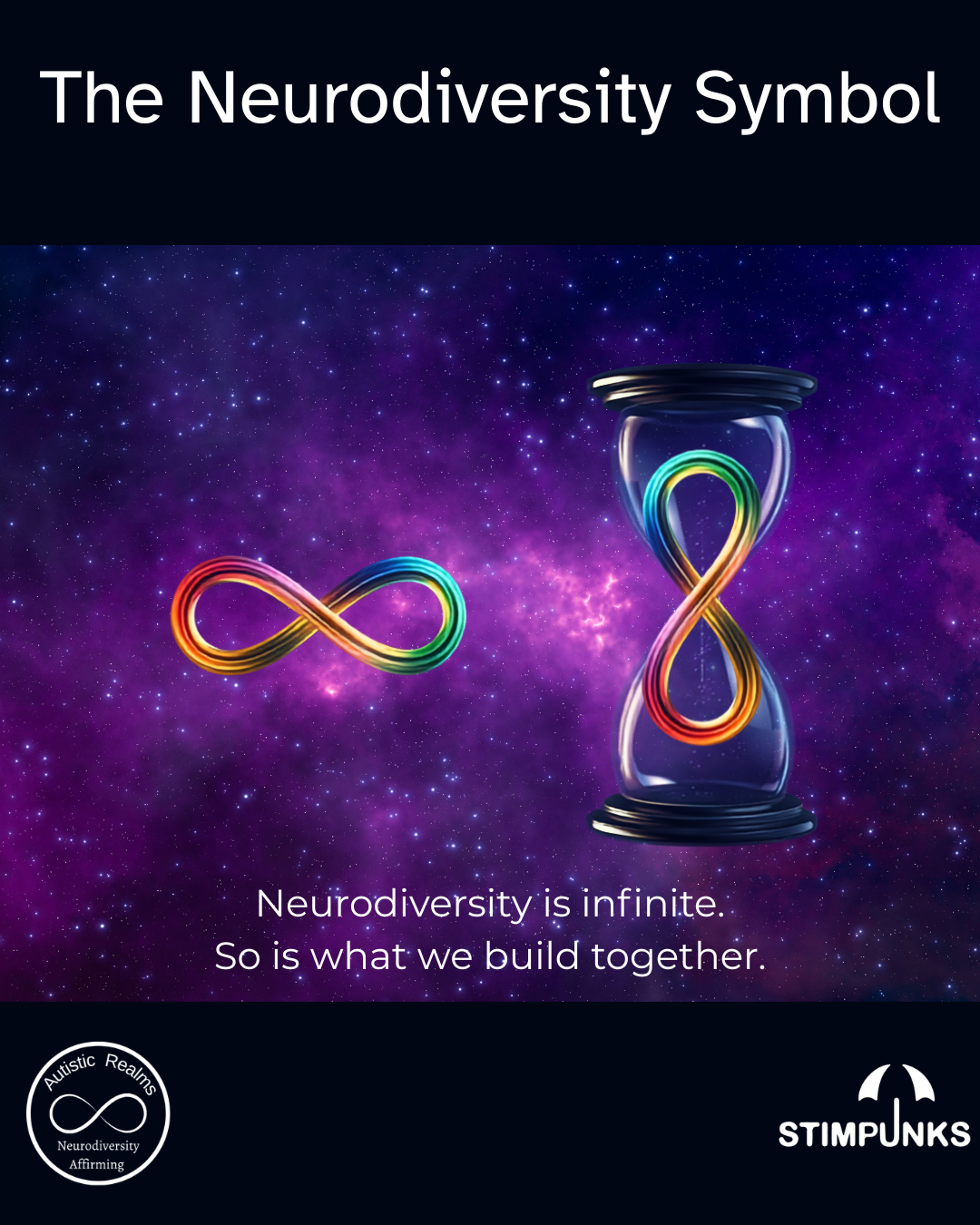
Inspired by this ode to omni-directional learning, we created a rainbow infinity hourglass.

Neurodiversity is infinite and timeless.
Autistic Realms & Stimpunks
So is what we build together.
Read the Article
Nico Slate, “‘The Answers Come from The People’: The Highlander Folk School and the Pedagogies of the Civil Rights Movement,” History of Education Quarterly 62, no. 2 (May 2022): 191–210. Open access under CC BY 4.0.
Lineage. Forgetting is a tool of white supremacy. Memory is the work.
Stimpunks Foundation