
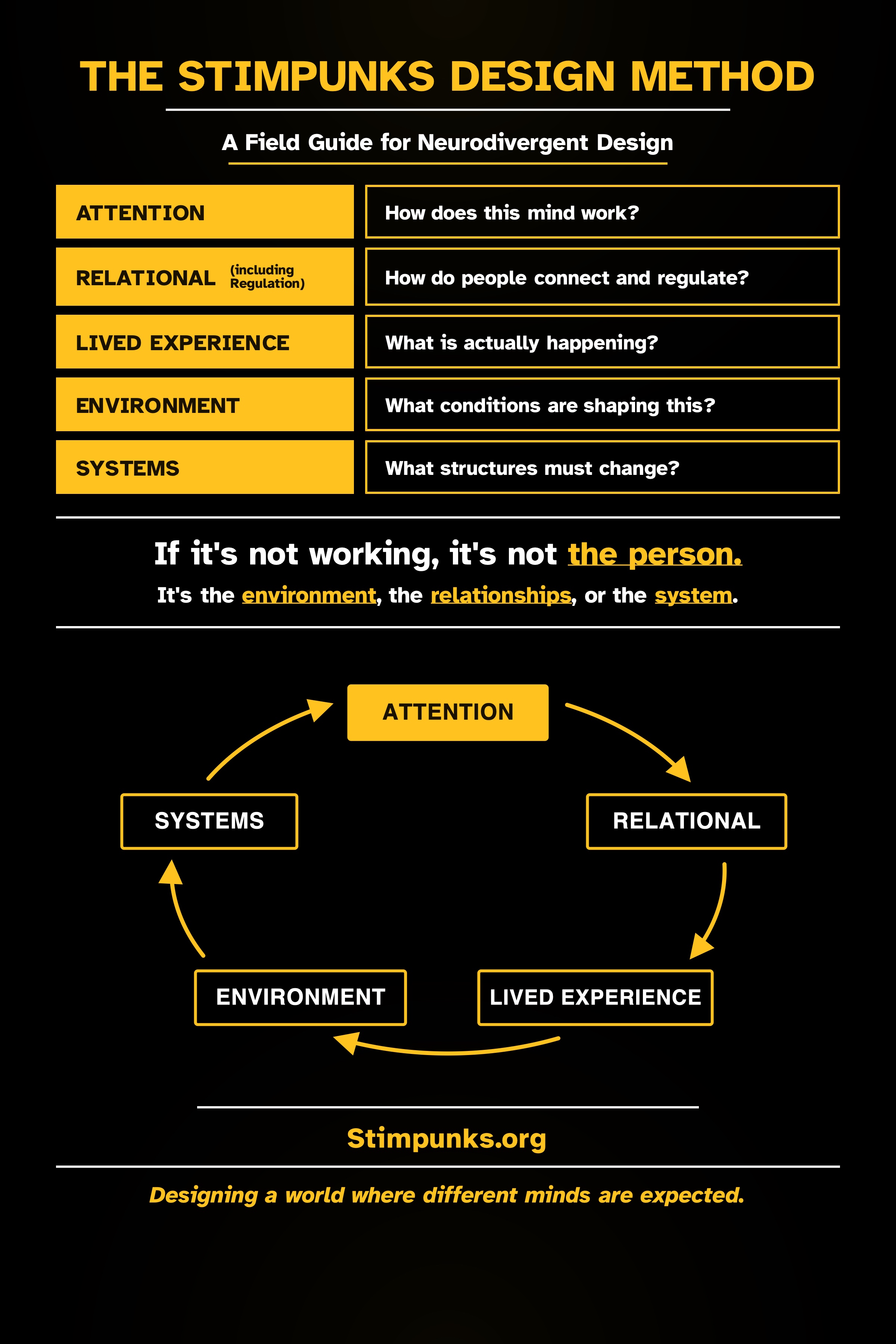
ARLES is the Stimpunks Design Method. It names the five layers through which neurodivergent life is structured, and the order in which environments must be redesigned to support it: Attention → Relational (including Regulation) → Lived Experience → Environment → Systems.
Each layer holds up the one above it. Begin with attention and nervous-system safety. Build shared language and co-regulation. Name what people actually experience. Redesign the environment. Only then move to systems change. Skip the lower layers and systems reform collapses.
The Five Layers
- Attention — How a mind focuses, processes, and forms meaning. Monotropism lives here.
- Relational (incl. Regulation) — Communication, co-regulation, and consent. Regulation is relational and environmental, not an individual skill.
- Lived Experience — The sensory, emotional, and cognitive realities of a day. What it actually feels like to be in the room.
- Environment — The conditions that shape participation. A space either fits a bodymind or fights it.
- Systems — The structures, norms, and institutions that distribute opportunity and constraint.
Read It Two Ways
ARLES is a ladder. Read upward, it is a sequence for design: begin with attention, end with systems. Read downward, it is a sequence for diagnosis: a failing system points down to the environment that produced it, the environment down to the lived experience it ignored, and on down to the attention it never accounted for.
- Upward (design): Attention → Relational → Lived Experience → Environment → Systems
- Downward (diagnosis): Systems → Environment → Lived Experience → Relational → Attention
Why It Starts at the Bottom
Most reform starts at the top. It rewrites policy and then asks people to cope. ARLES refuses that order. Deficit ideology treats the person as the problem; a system that never accounted for attention, regulation, or environment gets called neutral, and everyone it fails gets called deficient. That is backwards. Broken systems, not broken people. ARLES starts where a person actually is and works outward, so the structures we change are answerable to lived experience rather than the other way around.
Language Runs Through Every Layer
Language is not a single layer of the stack. It runs through all of them, giving names to attention, relationships, experience, environments, and systems so that patterns become legible and design becomes possible. ARLES describes how neurodivergent life is structured. Language makes it visible and shareable.
Read the full method at the Stimpunks Design Method. Related: Monotropism, Co-Regulation, Psychological Safety, Deficit Ideology.