
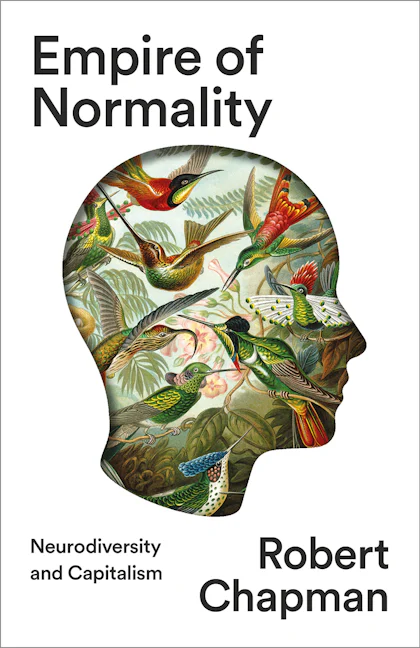
“Empire of Normality” by Robert Chapman is an important book necessary to our times. We live in an age of mass behaviorism, unvarnished eugenics, and neuronormative domination. “Empire of Normality” explains how we got here.
…mass neurodivergent disablement and constant, widespread anxiety, panic, depression, and mental illness, combined with systemic discrimination of neurodivergent people, is a problem specific to the current historical era. Hegemonic neuronormative domination, in other words, is a key problem of our time.
Empire of Normality: Neurodiversity and Capitalism by Robert Chapman
capitalism is so intensely neuronormative, becoming more so with each passing decade.
Empire of Normality: Neurodiversity and Capitalism by Robert Chapman
Capitalism places everyone, neurotypical as well as neurodivergent, in a ’double bind’ of either being valued as a worker and thus exploited, or being categorized as surplus and thus discriminated against.
review empire of normality | Psychiatrie en Filosofie
Below, we collect our favorite passages from the book covering a few key themes.
Bolding added to highlight key phrases and improve skimmability.
Pathology Paradigm
The core assumptions of the pathology paradigm are that mental and cognitive functioning are individual and based on natural abilities, and can be ranked in relation to a statistical norm across the species. And while there were earlier notions of the mean understanding and normal body, I locate Galton as the founder of the pathology paradigm proper. Walker describes the pathology paradigm as being the place where the neurotypical mind became ‘enthroned as the “normal” ideal against which all other types of minds are measured’. And it was also with Galton that this, and mass normalisation, was formalised.
Empire of Normality: Neurodiversity and Capitalism by Robert Chapman
Thus, for me, the key problem is not the pathology paradigm alone, but how capitalist logics and the pathology paradigm mutually reinforce each other, leaving no possibility of neurodivergent liberation without deep systemic change.
Empire of Normality: Neurodiversity and Capitalism by Robert Chapman
since the pathology paradigm is a product of the broader economic system, overcoming it will require more than a revolution in how we think about neurodiversity. It will also require changing much deeper structures in our society, in ways that are usually left unclarified in existing neurodiversity theory.
Empire of Normality: Neurodiversity and Capitalism by Robert Chapman
The rise of capitalism – through its colonial roots and then imperial stages – thus finally brought the modern notion that the mad need to be treated, to ease their suffering and return the idle to the workforce. It was in this new context of viewing the population as a malleable economic resource that we see the emergence of new professional roles that paved the way for early pre-paradigmatic psychiatry and related disciplines such as psychology and psychometrics to emerge. And the new mechanistic understanding of the body and mind, coupled with new conceptions of normality, brought a new way of grounding these projects. As we will see in the next chapter, this would then be combined with the emerging statistical notions of normal functioning to ground not just the rise of eugenics but also the psychiatric paradigm that still exists today – the pathology paradigm.
Empire of Normality: Neurodiversity and Capitalism by Robert Chapman
This provided white, cognitively abled, middle-class people to justify the various hierarchies that had emerged given the rise of capitalism as well as colonialism and imperialism. It also allowed cognitively abled people to begin establishing a monopoly on property and the means of production. As such, the normality concept mirrored contingent social hierarchies while at the same time framing these hierarchies as natural.
Here, then, we see the beginning of what I call the Empire of Normality. This new apparatus, made up of a complex nexus of different carceral systems, legal precedents, institutions, concepts, and practices, led to populations beginning to be systematically ranked in terms of mental and neurological ability, while positing this as part of a timeless natural order. This was not an accident, but was rather built into the logics of capitalism from the beginning. And it was in this context, as we will come to next, that a British polymath named Francis Galton developed the pathology paradigm – the precise paradigm the neurodiversity movement would later arise to name and resist.
Empire of Normality: Neurodiversity and Capitalism by Robert Chapman
It is curious that, despite his influence being acknowledged elsewhere, Galton is barely mentioned in general histories of psychiatry, whether those written by mainstream psychiatrists or anti-psychiatry critics. Yet it is my contention that he was the founder of the pathology paradigm, in the sense that he provided both its metaphysical basis and developed many of the experimental methods that provided blueprints for later researchers. And it was this – Galton’s paradigm – that would then be taken up by Emil Kraepelin, often described as the ‘father’ of modern psychiatry, and other influential clinicians and researchers across the psychological sciences. This would form the basis of the approach that has remained dominant to this very day, and which functions to naturalise and scientifically legitimise the neuronormative domination of capitalism as it continues to develop.
Empire of Normality: Neurodiversity and Capitalism by Robert Chapman
The most fundamental limitation, which I have sought to address in this book, is that neither Walker nor any other neurodiversity theorist until now has provided a historical materialist analysis of the pathology paradigm. But here, by showing how the paradigm arose and caught on specifically because it allowed the individualisation and reification of neurodivergent disablement, we can better understand the significance and power of the pathology paradigm, as well as what it might take to overcome it. Since the pathology paradigm, and the way it naturalises increasingly restricted conceptions of normality, grew precisely to mirror the needs of the capitalist economy, it is these material conditions that need to be changed, not just our thinking. While changing our thinking is vital, we are unlikely to fully supplant the pathology paradigm while the capitalist global economic order remains dominant.
More generally, the key limitation of existing neurodiversity theory and activism is that it is more focused on changing our thinking and attitudes than on changing material conditions.
Empire of Normality: Neurodiversity and Capitalism by Robert Chapman
It is vital to say here that some neurodivergent disablement and illness will always exist, and that imagined worlds where they do not exist at all are fascistic fantasies. But mass neurodivergent disablement and constant, widespread anxiety, panic, depression, and mental illness, combined with systemic discrimination of neurodivergent people, is a problem specific to the current historical era. Hegemonic neuronormative domination, in other words, is a key problem of our time. For the Empire of Normality, and in turn the pathology paradigm, emerged in the context of capitalist logics, but have now become pervasive and partially distinct systems of domination in their own rights.
Empire of Normality: Neurodiversity and Capitalism by Robert Chapman
Neoliberalism and the Shift From Keynesian Economics to Hayekian Economics
The basic idea of neoliberalism, as summarised by David Harvey, was that ‘human well-being can best be advanced by liberating individual entrepreneurial freedoms and skills within an institutional framework characterized by strong private property rights, free markets, and free trade’. In practice this meant privatisation, deregulation, and austerity.
Empire of Normality: Neurodiversity and Capitalism by Robert Chapman
In the summer of 1975, a speaker at the Conservative Research Department in Great Britain was giving a talk on how the British Conservative Party should avoid the extremes of left and right. Instead, he was arguing, they should forge a new ‘middle way’. Suddenly, he was interrupted by a woman who stood up and pulled a book from her briefcase. Brandishing the book so all could see it, she stated ‘This is what we believe’, before banging the book down on the table. The woman who had interrupted the speech was none other than the newly elected leader of the Conservative Party, Margaret Thatcher. And the book she had declared her allegiance to was titled The Constitution of Liberty, written by Thomas Szasz’s idol, the economist Friedrich Hayek.
Four years later, in 1979, Thatcher was elected to be Prime Minister, and began ushering in Hayekian policies to the United Kingdom. Around the same time, Ronald Reagan in the United States also began implementing Hayekian policies. It is to this shift that we now turn. For the shift from Keynesian economics to Hayekian economics is vital for understanding the rising tide of mental health problems and the inability of biological psychiatry to effectively fight it.
The basic idea of neoliberalism, as summarised by David Harvey, was that ‘human well-being can best be advanced by liberating individual entrepreneurial freedoms and skills within an institutional framework characterized by strong private property rights, free markets, and free trade’.1 In practice this meant privatisation, deregulation, and austerity. Following the culture wars and economic recession of the 1970s, Thatcher and Reagan essentially sought to reverse the welfare capitalism of the earlier twentieth century. While Chile, guided by US pressure, had experimented with neoliberal policies several years earlier, it was during the early 1980s that Britain and the United States each began massively rolling back the state and diminishing the welfare system.
In the wake of changes made by Thatcher and Reagan, neoliberalism was quickly enforced across much of the rest of the world. It was globalised through international financial institutions such as the World Trade Organization and International Monetary Fund, and through US imperial pressure. As state communism fell, even Russia and China increasingly liberalised their economies to fit in – to at least some extent, and with mixed success – with the new global system. From around the same time, traditionally left-leaning political parties in liberal democracies, such as the British Labour Party and the Democratic Party in the United States, also shifted to the right. This was largely as organised labour was crushed by neoliberal governments and neoliberal ideology was propagated by the press. In this context, aspirational voters were choosing the ideal of individual freedom offered by neoliberalism over the progressive ideals, and higher taxes, of more collectivist politics.
This was to have profound effects on pretty much every aspect of human life. Indeed, as Harvey writes, neoliberal ideology had since ‘become hegemonic as a mode of discourse’. It has, he goes on, ‘pervasive effects on ways of thought to the point where it has become incorporated into the common-sense way many of us interpret, live in, and understand the world’.2 As we will see below, our experiences and understandings of mental health were far from immune to this more general shift.
Empire of Normality: Neurodiversity and Capitalism by Robert Chapman
Normalisation and The Prison Industrial Complex
Thus, as capitalism further developed and the population grew, its norms hardened, with the abnormal becoming ever-more salient as more of the population fell beyond its new standards of functioning. It was this that necessitated the mass development of these new carceral systems, which, all in their own ways, imprisoned those deemed abnormal.
Empire of Normality: Neurodiversity and Capitalism by Robert Chapman
Cultural practices of normalisation, where the divergent are changed to become more normal, also shifted following the Spitzerian revolution and the rise of neoliberalism. One place we see this regards the prison complex. During this period the numbers of people with psychiatric disabilities and learning disabilities incarcerated in the prison system continued to grow. By the beginning of the twenty-first century over 50% of prison inmates in the United States and the United Kingdom had dyslexia, while around a quarter have ADHD. Moreover ‘Some of the largest mental health centres in the United States currently operate behind bars, and 40 percent of people diagnosed with serious psychiatric disorders face arrest over their lifetimes’.32 Today, people with mental disorder diagnoses, especially Black people, are among the most likely to be arrested, be harassed by the police, or die in police custody.
At the same time, a massively increased use of prison pharmaceuticals has been used alongside electronic tagging and biomedical risk assessment for prison inmates. Sociologist Ryan Hatch describes these as forms of ‘technocorrections’, which aim to reduce costs and subdue prison populations to make them more pliable. Thus by the year 2000 in the United States, for instance, ‘95 percent of maximum/high-security state prisons distributed psychotropics, compared to 88 percent of medium-security prisons and 62 percent of minimum/low-security prisons’.33 Liat Ben-Moshe has also emphasised how conditions in prison tend to make mental health worse and that even talking therapy often serves oppressive functions in prisons.
Empire of Normality: Neurodiversity and Capitalism by Robert Chapman
Indeed, as recent research by the historian Anne Parsons has shown, following the asylum closures, the prison industrial complex began to grow massively. But now it mainly incarcerated not just the (often) white former inmates of asylums. Rather, it grew to incarcerate, in much greater numbers, mad or disabled Black people alongside mad or disabled white people.
Empire of Normality: Neurodiversity and Capitalism by Robert Chapman
Resources
Here are some links to podcasts / interviews/ webinars / articles author Robert Chapman has done regarding “Empire of Normality”.
- Empire of Normality: Neurodiversity and Capitalism by Robert Chapman – The Sociological Review
- The Future of Neurodiversity – Boston Review
- Acid Horizon: The Rise of Anti-Capitalist Neurodiversity: Robert Chapman’s ‘Empire of Normality’ on Apple Podcasts
- An Interview w/ Robert Chapman on Living in an Empire of Normality
- Arts & Ideas – What is normal? – BBC Sounds
- Politicizing Neurodiversity – by P.E. Moskowitz
- A Materialist History of Pathology and Neurodiversity: A Conversation with Robert Chapman
- Dialogues on Disability: Shelley Tremain Interviews Robert Chapman – BIOPOLITICAL PHILOSOPHY
- Philosophy of psychiatry webinar : Robert Chapman talk – YouTube
Further Reading
- Neoliberalism
- Conservatism
- Resentment
- Southern Strategy
- Lost Cause
- Segregationist Discourse
- Meritocracy Myth
- Moral Panic
- Lowering the Bar
- Minority Stress
- Racial Weathering
- Policing
- Toxic Masculinity
- Bodily Autonomy
- Biological Essentialism
- Stigma
- Shame
- Ableism
- Eugenics
- Administrative Burden
- R-Word
- Empire of Normality
- Autism Grievance Parent
- Power
- Privilege
- Precarity
- Oligarchy
- Sadopopulism
- Systems Generated Trauma
- Rot Economy
- Fantasy Economy
- Metric Fixation
- Objectivity
- Tech Ethics
- Ableism
- Neuronormativity
- Empire of Normality
- Pathology Paradigm
- Behaviorism
- Eugenics
- Deficit Ideology
- Sameness-Based Fairness
- ”Better get used to it.”
- Inspiration Exploitation
- School-Induced Anxiety
- Toxic Positivity
- Resilience
- Burnout
- The Road to Neuronormative Domination.
- Education Technology and the New Behaviorism
- We’ve Turned Classrooms Into a Hell for Neurodivergence
- 14 Obstacles to Neurodiversity Affirming Practice
- Double Empathy Problem
- Double Empathy Extreme Problem
- Triple Empathy Problem
- Disability Double-bind
- Performative Neurodiversity (Neurodiversity Lite)
- Pathology Lite
- Empire of Normality
- Harm Reduction Theater


Leave a Reply