
It is a painful truth that many disabled children and their families are being traumatised—not by illness, not by accident, but by the very public services that are meant to help them. This is not a fringe issue. It is not rare. It is not acceptable. It is happening every day, in every corner of our society, and it is breaking people.
Systems Generated Trauma: How disabled children and their families are traumatised by dysfunctional public services when they ask for support
We call it Systems Generated Trauma. And once you see it, you cannot unsee it.
‘Systems Generated Trauma’: the severe harm that disabled children and their families experience through their interactions with public services. The research identifies a persistent pattern of public policies and practices, particularly within health, social care, and education systems, that are complex, dysfunctional and actively harmful. While these harms are generally unintended, they lead to significant distress and negative consequences for already disadvantaged families. The study highlights the urgent need for a fundamental shift in institutional culture and a move beyond superficial policy adjustments to address these systemic issues.
Trauma related practice’ is a phrase increasingly used by public bodies to convey their awareness that many of those with whom they interact have experienced life changing traumas. As a rule, the traumas referred to are ‘other’ – in the sense that they are the result of adverse childhood experiences, domestic violence, mental health difficulties and so on. What is not generally acknowledged, is that many users of public services identify their most traumatising experiences as the way they were treated by the public bodies that they had approached for support.
‘Systems Generated Traumas’ of this kind are a daily experience for many people in contact with the social welfare system, including carers, disabled people, people who are homeless, mothers in dysfunctional maternity units, claimants in the hostile environments created by the DWP, and so on – it is a very long list.
There are a myriad of intersecting examples, but for parents of disabled children these can include: being prosecuted when their disabled child is ‘school refusing’; being refused support by children’s services when in desperate need, but then having their home inspected and their children interviewed for child protection purposes; being accused of fabricating or inducing their child’s illness (FII) because they have requested a second opinion from a health professional; being unable ‘to access justice’ to gain redress for the damage done by behaviour of this kind – and so on.
- The overwhelming message emerging from the over 1,200 responses to the survey is that the system with which parents have to engage in order to obtain support for their disabled child’s needs is itself causing immense trauma. Trauma that in many instances is considered to be far in excess of the trauma families have experienced before coming into contact with the relevant institutions, for example traumas resulting from adverse childhood experiences, domestic violence, mental health difficulties and so on.
- Over 90 percent of the English public sector ‘Trauma Informed’ practice publications analysed in the research fail to acknowledge this very significant source of trauma. These publications describe the cause of ‘service user’ trauma as ‘other’: they locate its source outside the organisation – as generated by the individual’s past life experiences.
- There is a profound lack of accountability in terms of public bodies being held to account for the harm caused by their defective administrative systems.
- Although, in almost all cases, the trauma created by public sector systems was unintended, the failure of governments and other public bodies to take purposeful remedial action when the system defects are identified, renders untenable any assertion of blamelessness: in social harm theory, inaction of this kind is best described as ‘moral indifference’.
The evidence overwhelmingly demonstrates that interactions with social welfare and education systems are a significant source of trauma for disabled children and their families in England: that despite the rhetoric of promoting ‘trauma-informed’ practice, there is a critical failure to acknowledge and address the systemic nature of this harm. Addressing systems-generated trauma requires not just superficial policy adjustments but a fundamental shift in institutional culture, accountability, and the training of professionals to foster trust, listen to lived experience and to work in partnership with families. Without such changes, public services risk continuing to compound the distress of already disadvantaged families, rather than providing the support that they desperately need.
Many parents reported that contact with public services caused more distress than other major life events. Reported impacts included poorer mental and physical health, financial strain, disrupted education, social isolation, and loss of trust. Reported flashpoints included intrusive social care enquiries; school exclusions and attendance enforcement; Carer’s Allowance overpayment recovery; and Fabricated or Induced Illness (FII) allegations (claims that a parent is making a child ill). Parents also raised concerns about safeguarding “flags” or notes remaining on records, even after concerns were found to be unfounded.
Sean Kennedy | LinkedIn
In its document review, the report concludes that most “trauma-informed” publications it analysed did not clearly acknowledge that systems themselves can be a primary source of trauma.
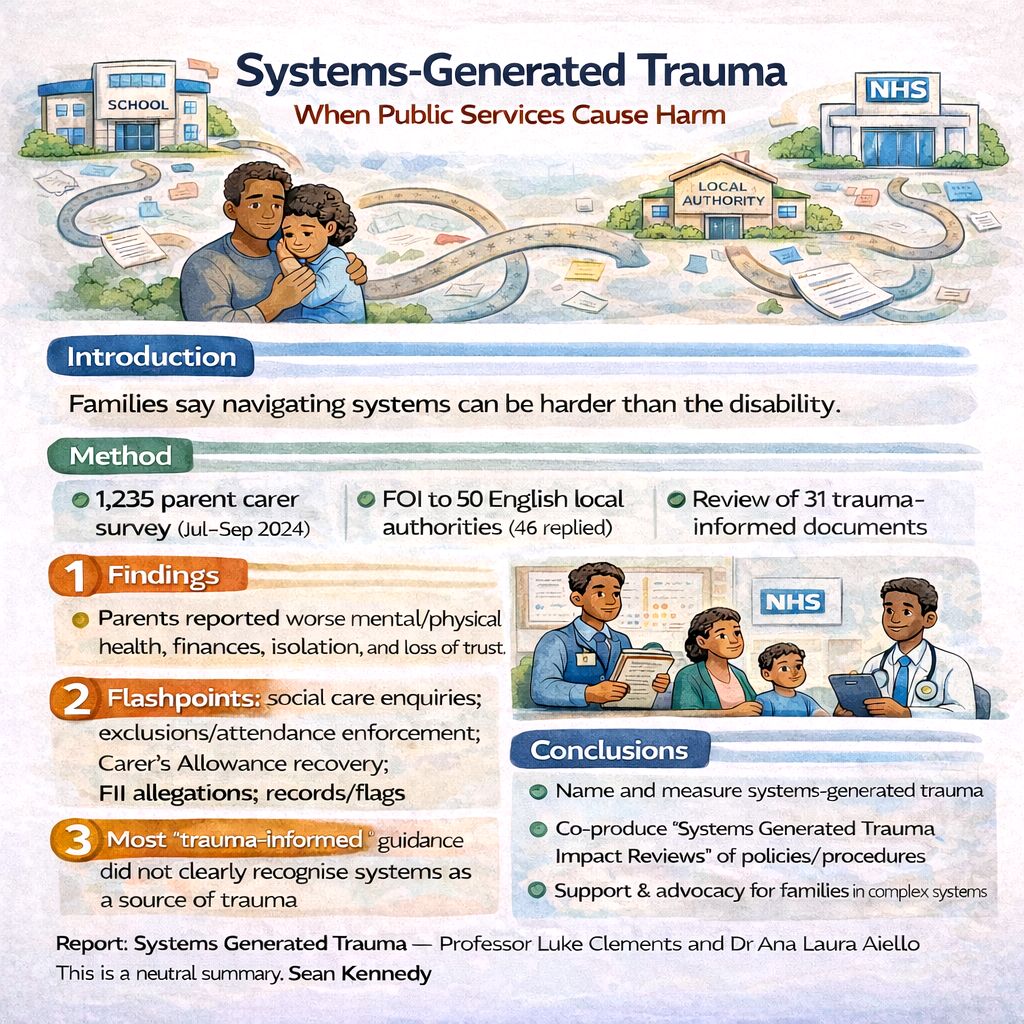
Infographic: Sean Kennedy


