We have autistic children who need us to support them as architects of their own liberation against the schools and clinicians and institutions and police and prosecutorswho would crush and destroy them.
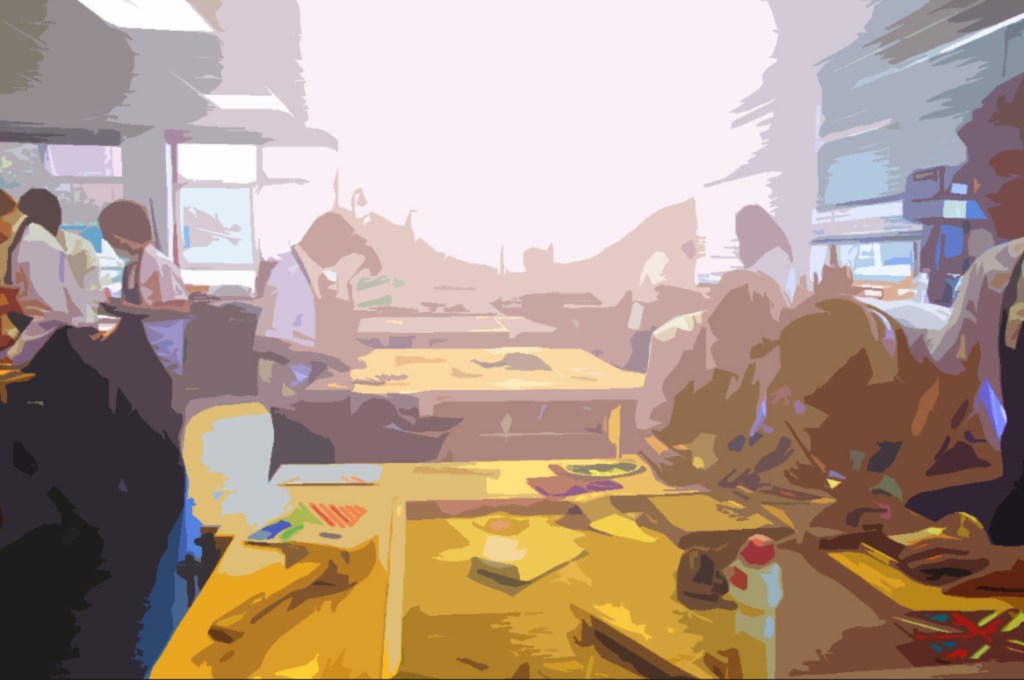
The picture shows a school classroom as I see it, as an autistic person. A kaleidoscope of shape and blinding lighting, with vague outlines which are probably other students. Deafening noise. The stench of different smells. The confusion of many voices, including some heard through walls from neighbouring halls and classes. School uniform that feels like barbed wire on my skin.
In the chaos, a different voice which I have to try to listen to. It’s so hard. My brain doesn’t want to tune the rest of the noise out. Apparently I’ve been asked something, but I miss it. The voice gets more strident, the class turns to look at me. The intense stares overwhelm me. The person next to me jostles me and it feels like an electric shock on my skin. Only six more hours of hell to go…. only six….
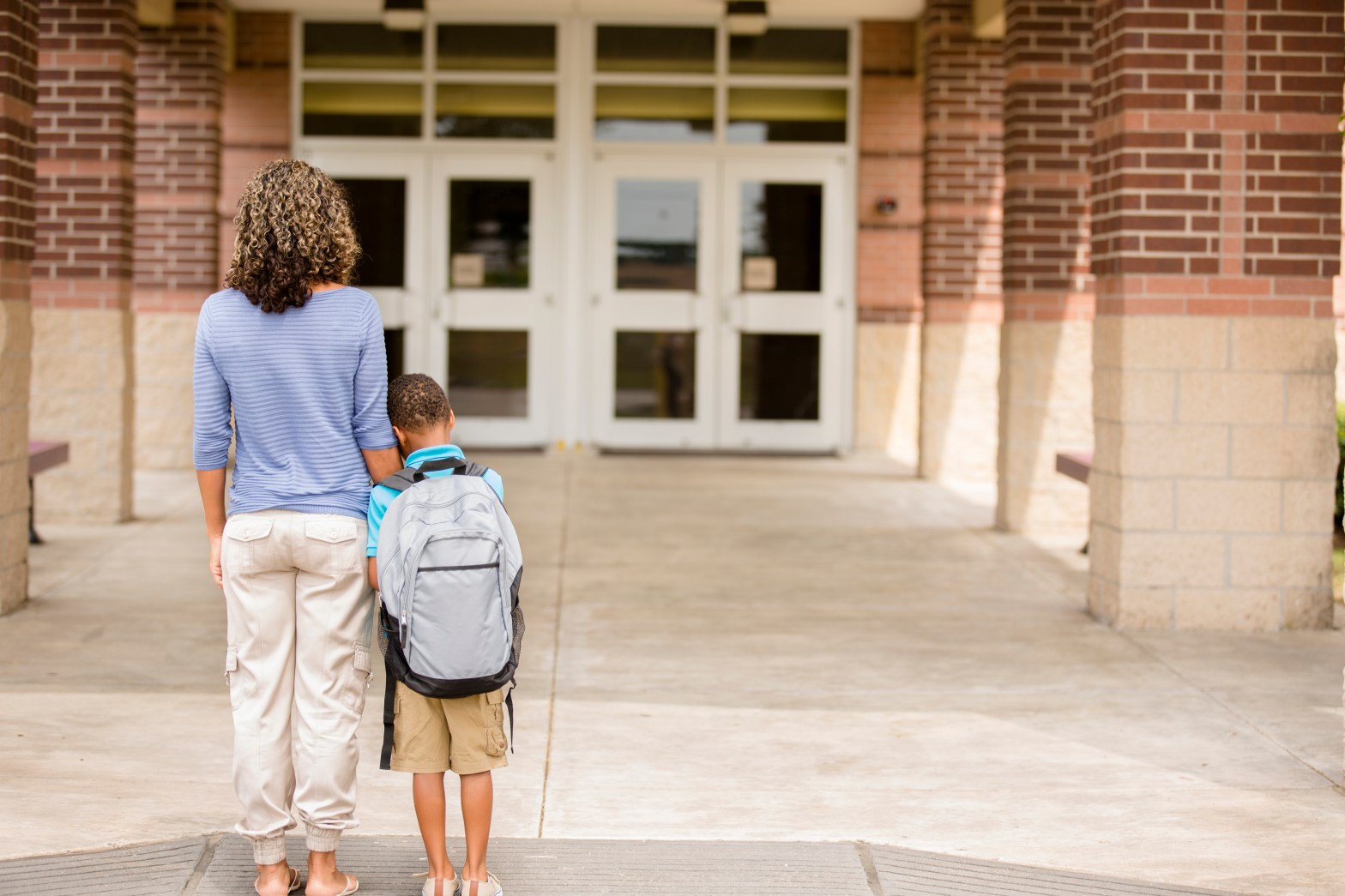
Some of our autistic pupils simply cannot do this alone, without ‘time out’ to recover from the pain and exhaustion during the school day. Not for hour after hour of puzzling painful chaos.
This study’s findings suggest autistic students are routinely overstimulated, overwhelmed, and lack adequate support to overcome sensory barriers in mainstream settings.
Enter many SpEd classrooms, and you’ll see little awareness of neurodiversity and the social model of disability. Students with conflicting sensory needs and accommodations are squished together with no access to cave, campfire, or watering hole zones. This sensory environment feeds the overwhelm -> meltdown -> burnout cycle. Feedback loops cascade. “Mind blind” neurotypical adults call across the room, feeding the overwhelm. They ratchet compliance, feeding the overwhelm. They treat meltdowns as attention-seeking “fits”, feeding the overwhelm. They not only fail to presume competence, they speak about kids as if they aren’t even there, feeding the overwhelm. The familiar yet wrong things are done.
Neurodiversity is an equity imperative and is critical in shifting the culture of teaching and learning.
In 94.3% of cases, school attendance problems were underpinned by significant emotional distress, with often harrowing accounts of this distress provided by parents. While the mean age of the CYP in this sample was 11.6 years (StDev 3.1 years), their School Distress was evident to parents from a much younger age (7.9 years). Notably, 92.1% of CYP currently experiencing School Distress were described as neurodivergent (ND) and 83.4% as autistic. The Odds Ratio of autistic CYP experiencing School Distress was 46.61 95% CI [(24.67, 88.07)]. Autistic CYP displayed School Distress at a significantly earlier age, and it was significantly more enduring.
This powerful video speaks for our community of neurodivergent and disabled people.
Take a Walk in Our Shoes
Walk in My Shoes
This powerful animation reveals that the barriers and solutions lie not within the young person, but in the school environment, its ethos and in peer and teacher relationships and attitudes.
We have turned classrooms into a hell for neurodivergence. Telling young neurodivergent people struggling to attend school to be more resilient is profoundly inappropriate.
Erin’s personal narrative exposes the reality of the anxiety, pain and distress she endured, and that are somehow overlooked, misunderstood or neglected by those around her. Crucially it shows how she perseveres in attending, despite being left alone to navigate the daily assaults on her senses and sense of safety, in the knowledge that it will all repeat tomorrow. This is courageous – but exhausting.
Erin’s experiences shine a light on issues beyond her control that could be resolved by others; by listening and by showing they care. She could not have done more. Telling young autistic people struggling to attend school to be more resilient is profoundly inappropriate, if what you are really asking is for them to keep going under circumstances they should not be asked to endure. We need to change the circumstances.
The term ‘school refusal’ is linguistically weaponised; it implies intent and choice. It swiftly and subtly frames the child as having taken an active, conscious decision to reject school. This misnomer apportions blame and responsibility to the young person while simultaneously diminishing their genuine distress.
So, with refusal emphatically ruled out, what, then, should we call this? ‘Anxiety-based inability to attend school’ is nowhere near as snappy, even though this is much more accurate, and I have insisted on it being written in some of our daughter’s key documents. Much less clunky and equally accurate is ‘school-induced anxiety’, which has gained traction on social media in recent years and is the preference of most young people and their families. Importantly, ‘school-induced anxiety’ shifts the cause of the anxiety to the setting and removes the notion of fault from the young person.
My daughter – one of thousands struggling with school-induced anxiety – has lost half of her precious childhood to experiencing acute and sustained fear on a daily basis and viewing herself as a failure.
When I tell people that I work with children and families who have problems at school, they often nod and look sympathetic. ‘Bullying is terrible’, they say. Yes. It is, but it’s not bullying I hear about most. Here’s what families tell me. (with @_MissingTheMark) 1/
When I tell people that I work with children and families who have problems at school, they often nod and look sympathetic. ‘Bullying is terrible’, they say. Yes. It is, but it’s not bullying I hear about most. Here’s what families tell me. (with @_MissingTheMark) 1/
I talk to mothers whose children tell them every night they don’t want to go to school tomorrow – and when they tell the school, they are told they must keep bringing them in, or else the children will get more anxious & they might be reported for truancy. They feel stuck. 2/
I talk to children who tell me that the noise and smell of the dining hall hurts them, and the chaos of the playground frightens them. They’re doing okay academically and so school says there’s no problem, just keep coming in. 3/
I talk to young people who are furious about rules controlling every part of their lives which have nothing to do with learning – hair styles, silent corridors, black-shoes-not-trainers and wearing a blazer on the way to and from school. If they refuse, they are ‘disruptive’. 4/
Many of these young people keep quiet at school. They only show their anger and frustration when they feel safe, at home. They explode, and their parents don’t know what to do. They wonder if it’s their fault and if school is right and it’s a problem with boundaries. 5/
Families tell me they feel under pressure. Pressure because their child isn’t happy. Worry that they’re going to lose their job because the school calls so often. Pressure from others who say ‘a child of mine would never get away with behaviour like that’. 6/
Pressure to conform to the way that parents are meant to be, so they can get help from the system. Pressure to be compliant, to be calm and positive, in case someone writes ‘mum is anxious and reluctant to let child go’ in their report (this does happen). 7/
Parents tell me what it’s like to be the one taking the walk of shame back across the playground with the child who won’t stay today. They tell me how blamed and judged they feel, and how they avoid other parents in case of questions which just might lead to tears. 8/
They tell me that all the rhetoric about attendance makes it worse, because they are portrayed as feckless parents who can’t be bothered to get their children out of bed, when the reality is that trying to get their children into school takes up every bit of energy they have.9/
I worked with one little girl who told me she felt like school was a cage. She was an animal trying to get out. She ran away, got brought back and then she had in-school suspension, sitting in the headteacher’s office. That didn’t make her feel any better about school.10/
I talked to a young person who had cerebral palsy and who found school very difficult. He was enrolled in an online scheme during covid and was so excited to do maths and English – until the edict came that things must ‘return to normal’ and everyone had to attend in person.11/
The more the pressure piles on, the worse things become. Families start to buckle under the strain – and still the answer is to keep pushing, no matter what the fall out. 12/
This isn’t the fault of schools or teachers. They’re in an impossible situation too, under pressure to get results, to teach the curriculum, to manage behaviour, to maintain full attendance. They too are pressured in all directions. 13/
The problem is the inflexibility of our system, which prizes attendance and test results over emotional wellbeing and flexibility. Which doesn’t start with what each child needs to learn, but with a set of hoops they need to jump through. 14/
We need to put flourishing at the centre of children’s lives. We need to stop asking ‘how do we make this child go to school’ and start asking ‘how do we help this child learn?’. Only then do we have a hope of an education system which works for all. We surely owe them that.15/
As @mum2aspergirl points out, the problem is not centred within the child. For me, it is not the child’s responsibility to sort out the utter mess that the adults have made of their school life by not understanding autism. It is not up to the child to just be ‘more resilient’.
— Ann Memmott PgC MA (Autism) (@AnnMemmott) July 12, 2022
Listening to @mum2aspergirl at #LondonVirtualAutisticConference looking at reframing the narrative around so-called ‘school refusal’ and highlighting what needs to change in the environment in order to make schools a place of safety for autistic learners.
“It’s honestly like a zoo. That’s how crazy it is … I just couldn’t cope.” — Will, student
“There will be people saying, ‘that woman just needs to tell her kids what’s what’. Before it happened to me, I was one of those parents.” — Symone, parent
A growing number of children in Australia are struggling to attend school – many of us know a family affected.
These are children who want to go to school but feel like they can’t because of anxiety and stress.
Four Corners follows families battling the blame, shame and fear of missing out on education — and visits some of the schools doing things differently.
There are so many challenges that I am facing

School, I hate it
School, let's face it
I deal with bullies on an everyday basis
School is the reason I have depression, it has failed me all my life
School makes me feel inadequate and dead inside

Please stop the bullying
Stop punishing me
Stop putting me down
I’m trying my best can’t you see
School makes me not want to be here anymore
I'm told I have to go but what the heck for
I'd rather be dead than go to school
We need to understand autism and change the circumstances.
…any intervention with the aim of school reintegration should be firmly focused on environmental change (Beardon, 2019) until which point the notion of reintegration into a toxic environment (Fisher, 2024) be unthinkable.
What schools need to do is to understand autism. In understanding it, we can help to stop putting the children in pain and exhaustion. It’s actually quite easy. And quite cheap.
Make sure your school is getting really good autism training, from autistic experts and our allies.
Make sure the school are getting really good consultancy advice about children, way before any crisis, from autistic consultants and allies.
Notice I said ‘autistic experts’ and ‘autistic consultants’. People who can detect what’s happening in that environment, using similar sensory systems to the pupil. People who can explain autistic language and culture. Yes, there is a different autistic language, a different autistic culture. In the same way as it’s important to respect the culture of children from different ethnicities, it’s important to know about, and respect, autistic culture and communication style also.
For me, it is not the child’s responsibility to sort out the utter mess that the adults have made of their school life by not understanding autism. It is not up to the child to just be ‘more resilient’.
I have written elsewhere about what I refer to as ‘the golden equation’ – which is:
Autism + environment = outcome
What this means in an anxiety context is that it is the combination of the child and the environment that causes the outcome (anxiety), not ‘just’ being autistic in and of itself. This is both horribly depressing but also a positive. It’s horribly depressing because it demonstrates just how wrong we are currently getting things, but positive in that there are all sorts of things we can do to change environmental situations to subsequently alleviate the anxiety.
In fact, for Liasidou (2012, p.5), the concept of inclusive education, if it is to be meaningful, is necessarily founded on the social model, as it ‘refers to the restructuring of social and, by implication, educational settings in order to meet the needs of all learners irrespective of their diverse biographical, developmental and learning trajectories’. Within this framework, we are not expecting autistic children to change their very being or nature, but are aiming instead to ensure that the buildings, curriculum, classroom layout and teaching styles will be able to accommodate them. Therefore, this issue runs deeper than, say, providing a sensory room or differentiated learning materials, but impacts on all aspects of how an autistic child is perceived, addressed and supported. This approach can be facilitated through ‘universal design’ (Liasidou 2012; Woronko and Killoran 2011), where every aspect of educational provision is planned from scratch to accommodate a diversity of learners. In this way, certain children are not identified as needing adjustments or adaptations, but the core design of the curriculum, classroom layout and buildings means that all learners are more naturally accommodated – idealistic, perhaps, but surely worth a try.
Terzi (2005, p.446), for example, is of the view that the medical model as played out in educational environments results in ‘perspectives emphasising individual limitations’ rather than the ways in which the organisation and design of schools might create those very difficulties in the first instance.
This is a great time for everyone involved in education to understand #neurodiversity and what it means for the classroom, for learning and for inclusion. Launched today is the #LEANSproject handbook, for teaching about neurodiversity at primary school.
We’re at a point where the educational establishment is more and more taking the concept of #neurodiversity seriously. The @gtcs published a professional guide to neurodiversity for teachers in 2020. The message is filtering through, slowly but surely…
Still – the neurodiversity movement goes on picking up momentum. The idea that brains can be different, but okay, is powerful! Assuming everyone thinks much the same never worked very well. People are listening to neurodivergent experiences, and learning.
The more people understand neurodiversity, and learn to appreciate and accommodate it, the less need there will be for things like the @_MissingTheMark podcast and comics… It’s not that kids *refuse* school so much as that schools refuse to understand.
@MxOolong
Making education work for the next generation of neurodivergent pupils (no Q&A)
Self-Directed Learning
At one meeting I attended, one father told us how his eight-year-old son had been declared ineducable, and they had been told that he would have to spend his childhood at a psychiatric day hospital rather than at school. Another told of how his teenage son had hardly left his bedroom for two years, completely refusing to go to school, and had tried to kill himself. One mother told of how her daughter fought each morning not to go to school, scratching and biting them, for over a year.
These children are now members of the self-directed learning community, engaged in a wide range of activities. They are still the same people as before, with the same characteristics, but the pressure has been lifted and so they are able to flourish. Many of these children will have diagnoses. Home-educating parents tell similar stories – children whose behaviour at school was uncontrollable who start to behave differently when they are allowed to follow their interests and are treated with respect.
Something happens when children are in an environment in which they are valued and accepted for who they are. They see themselves as capable and as contributors to their community, and they develop and learn. That’s why the respectful and non-judgemental way that adults relate to children in self-directed environments is important. It doesn’t happen overnight. When you’ve spend years fighting a system, you can’t just forget all the strategies you learnt to survive.
These children are experiencing the shift from a system which sees their personalities as a problem, to one which genuinely accommodates difference. Because when children are really allowed to choose what they do, difference stops being such a problem.
Viewed through the lens of disorder, disruptive behaviour is a symptom. Viewed from a different perspective, it’s a sign that something isn’t right in the world around the child.It’s those children who are considered to be troublemakers, the ‘problem children’, who shine a light into corners which the rest of us might prefer to avoid.
The problem is the inflexibility of our system, which prizes attendance and test results over emotional wellbeing and flexibility.
When I tell people that I work with children and families who have problems at school, they often nod and look sympathetic. ‘Bullying is terrible’, they say. Yes. It is, but it’s not bullying I hear about most. Here’s what families tell me. (with @_MissingTheMark) 1/
I talk to mothers whose children tell them every night they don’t want to go to school tomorrow – and when they tell the school, they are told they must keep bringing them in, or else the children will get more anxious & they might be reported for truancy. They feel stuck. 2/
I talk to children who tell me that the noise and smell of the dining hall hurts them, and the chaos of the playground frightens them. They’re doing okay academically and so school says there’s no problem, just keep coming in. 3/
I talk to young people who are furious about rules controlling every part of their lives which have nothing to do with learning – hair styles, silent corridors, black-shoes-not-trainers and wearing a blazer on the way to and from school. If they refuse, they are ‘disruptive’. 4/
Many of these young people keep quiet at school. They only show their anger and frustration when they feel safe, at home. They explode, and their parents don’t know what to do. They wonder if it’s their fault and if school is right and it’s a problem with boundaries. 5/
Families tell me they feel under pressure. Pressure because their child isn’t happy. Worry that they’re going to lose their job because the school calls so often. Pressure from others who say ‘a child of mine would never get away with behaviour like that’. 6/
Pressure to conform to the way that parents are meant to be, so they can get help from the system. Pressure to be compliant, to be calm and positive, in case someone writes ‘mum is anxious and reluctant to let child go’ in their report (this does happen). 7/
Parents tell me what it’s like to be the one taking the walk of shame back across the playground with the child who won’t stay today. They tell me how blamed and judged they feel, and how they avoid other parents in case of questions which just might lead to tears. 8/
They tell me that all the rhetoric about attendance makes it worse, because they are portrayed as feckless parents who can’t be bothered to get their children out of bed, when the reality is that trying to get their children into school takes up every bit of energy they have.9/
I worked with one little girl who told me she felt like school was a cage. She was an animal trying to get out. She ran away, got brought back and then she had in-school suspension, sitting in the headteacher’s office. That didn’t make her feel any better about school.10/
I talked to a young person who had cerebral palsy and who found school very difficult. He was enrolled in an online scheme during covid and was so excited to do maths and English – until the edict came that things must ‘return to normal’ and everyone had to attend in person.11/
The more the pressure piles on, the worse things become. Families start to buckle under the strain – and still the answer is to keep pushing, no matter what the fall out. 12/
This isn’t the fault of schools or teachers. They’re in an impossible situation too, under pressure to get results, to teach the curriculum, to manage behaviour, to maintain full attendance. They too are pressured in all directions. 13/
The problem is the inflexibility of our system, which prizes attendance and test results over emotional wellbeing and flexibility. Which doesn’t start with what each child needs to learn, but with a set of hoops they need to jump through. 14/
We need to put flourishing at the centre of children’s lives. We need to stop asking ‘how do we make this child go to school’ and start asking ‘how do we help this child learn?’.Only then do we have a hope of an education system which works for all. We surely owe them that.15/
We are marginalized canaries in a social coalmine and Rawlsian barometers of society’s morality. It is deeply subversive to live proudly despite being living embodiments of our culture’s long standing ethical failings.
Our non-compliance is not intended to be rebellious. We simply do not comply with things that harm us. But since a great number of things that harm us are not harmful to most neurotypicals, we are viewed as untamed and in need of straightening up.
Behaviorism is dead. Despite that, behaviorism won.
Behaviorism is the biggest obstacle to understanding autism and changing the circumstances.
Thorndike won, and Dewey lost. I don’t think you can understand the history of education technology without realizing this either. And I’d propose an addendum to this too: you cannot understand the history of education technology in the United States during the twentieth century – and on into the twenty-first – unless you realize that Seymour Papert lost and B. F. Skinner won.
Please complete this simple task
Push the buttons just like we ask
This step first and that step last
Over and over and do it fast
I’m watching everyone, feeling like a simpleton
Why can’t I get it done? I just want to scream and run

I don’t think like you
But I’m the one that’s called abnormal
This construct
Was built by petty tyrants
Am I on the level yet? (Level yet)
How did I do on your little test?
Get my brain to reset (Reset)
'Cause everything you say is static
Do I make a good pet? (Good pet)
Obey the commands or get the back of the hand
'Cause the world wasn’t built for a brain like mine
Change my mind, change my mind, change my mind
This construct Was built and can be dismantled
We stand together We think apart We stand together We think apart
This was important because it meant that Darwinists and policy makers, deprived of widespread support for Galtonian eugenics, now saw a new method for normalising populations. But this time it sought to mimic evolutionary pressures in childhood development rather than through control of hereditary traits across generations. In this context, as Harvard historian Rebecca Lemov has detailed, large American philanthropic organisations such as the Rockefeller Foundation, which had previously funded Nazi eugenics, began lavishly funding new behaviouralist research. Most notably, this included the work of Elton Mayo, who sought to ‘adapt industrial workers to their tasks by deradicalizing them through psychological counselling’. This would formalise and update the kinds of scientific management that had been pioneered on slave plantations to manage the psyches of modern workers.
…mass neurodivergent disablement and constant, widespread anxiety, panic, depression, and mental illness, combined with systemic discrimination of neurodivergent people, is a problem specific to the current historical era. Hegemonic neuronormative domination, in other words, is a key problem of our time.
Behaviorism is everywhere. The All Means All of public education is made meaningless by the bipartisanship of behaviorism.
Behaviorism is deeply-rooted into our political, educational, and parental expectations.
Authors Alfie Kohn and Jonathan Mooney dig deeper into the issues facing neurodivergent students when met with the bipartisanship of behaviorism.
Notable Quote(s) from Alfie Kohn’s “The Myth of the Spoiled Child”
Alfie Kohn on the politics of education and child-rearing:
There’s just one problem with Lakoff’s theory. An awful lot of people who are politically liberal begin to sound like right-wing talk-show hosts as soon as the conversation turns to children and parenting. It was this curious discrepancy, in fact, that inspired the book you are now reading.
I first noticed an inconsistency of this kind in the context of education. Have a look at the unsigned editorials in left-of-center newspapers, or essays by columnists whose politics are mostly progressive. Listen to speeches by liberal public officials. On any of the controversial issues of our day, from tax policy to civil rights, you’ll find approximately what you’d expect. But when it comes to education, almost all of them take a hard-line position very much like what we hear from conservatives. They endorse a top-down, corporate-style version of school reform that includes prescriptive, one-size-fits-all teaching standards and curriculum mandates; weakened job protection for teachers; frequent standardized testing; and a reliance on rewards and punishments to raise scores on those tests and compel compliance on the part of teachers and students.
This widespread adoption of a traditionalist perspective helps us to make sense of the fact that, on topics related to children, even liberals tend to hold positions whose premises are deeply conservative. Perhaps it works the other way around as well: The fact that people on the left and center find themselves largely in agreement with those on the right explains how the traditionalist viewpoint has become the conventional wisdom. Child rearing might be described as a hidden front in the culture wars, except that no one is fighting on the other side.
Notable Quote(s) from Jonathan Mooney’s “Normal Sucks”
Jonathan Mooney on the problem with “No Child Left Behind”:
No Child Left Behind was perhaps the most damaging form of public policy as it pertained to public education and learning diversity that has happened in our history of education policy, and that was a bill that was sponsored by Senator Edward Kennedy. It was a set of practices that was doubled down upon by the Obama administration.
The neurodiversity and disability rights movements well-understand the ubiquity of behaviorism, and its tremendous costs.
Behaviorist education is ableist education.
In a masquerade to create a pedagogy that is entirely objective, the “objectiveness” of it is entirely inequitable.
The techniques of Uncommon Schools and Teach Like a Champion are heavily based off the work of radical behaviorism founder, B.F. Skinner. Most well known for the “Skinner Box”, a lever that animals would pull to be positively rewarded for simple tasks, Skinner spent much of his life devoted to creating a school system which was entirely rote. Vocal TLAC advocates connect his philosophy to much of what they do, and some followers even make more, bluntly dehumanizing, connections
Skinner firmly believed that a society entirely based on positive reinforcement and rote tasks would lead to a utopian life, free of politics. He literally wrote a utopian sci-fi book on it, Walden Two. As Audrey Watters expertly chronicles in Teaching Machines: The History of Personalized Learning, Skinner is a fan favorite of ed-tech companies and school reformers working to make school more “productive.”
Of course, this is the obvious truth that underlies the whole movement toward behaviorism: it is political. In a masquerade to create a pedagogy that is entirely objective, the “objectiveness” of it is entirely inequitable. In the same way that remaining neutral is a political act, remaining neutral and objective toward rote teaching materials is a political act.
When your kid is DXed as autistic, almost all of the professional advice you get from education and healthcare is steeped in deficit ideology and the pathology paradigm.
The message to parents of the neurodiverse kid is that their child is deficient, and that their job is to fix their child. We are in a sort of remediation industrial complex, where there’s all sorts of services and treatments and interventions to make the square peg fit the round hole. Parents are relentlessly told that that’s their job.
Skinner won, and generations of autistic people lost.
We are marginalized canaries in a social coalmine and Rawlsian barometers of society’s morality. It is deeply subversive to live proudly despite being living embodiments of our culture’s long standing ethical failings.
Our non-compliance is not intended to be rebellious. We simply do not comply with things that harm us. But since a great number of things that harm us are not harmful to most neurotypicals, we are viewed as untamed and in need of straightening up.
Behaviorism only looks at observable behavior which can be measured. It doesn’t take into account thoughts, genetics, anxiety, trauma, health, or emotions because those things cannot be measured.
ABA and behaviorism pointedly don’t understand sensory overload, or anything else about autism.
Plenty of policies and programs limit our ability to do right by children. But perhaps the most restrictive virtual straitjacket that educators face is behaviorism — a psychological theory that would have us focus exclusively on what can be seen and measured, that ignores or dismisses inner experience and reduces wholes to parts. It also suggests that everything people do can be explained as a quest for reinforcement — and, by implication, that we can control others by rewarding them selectively.
Allow me, then, to propose this rule of thumb: The value of any book, article, or presentation intended for teachers (or parents) is inversely related to the number of times the word “behavior” appears in it. The more our attention is fixed on the surface, the more we slight students’ underlying motives, values, and needs.
It’s been decades since academic psychology took seriously the orthodox behaviorism of John B. Watson and B.F. Skinner, which by now has shrunk to a cult-like clan of “behavior analysts.” But, alas, its reductionist influence lives on — in classroom (and schoolwide) management programs like PBIS and Class Dojo, in scripted curricula and the reduction of children’s learning to “data,” in grades and rubrics, in “competency”- and “proficiency”-based approaches to instruction, in standardized assessments, in reading incentives and merit pay for teachers.
It’s time we outgrew this limited and limiting psychological theory. That means attending less to students’ behaviors and more to the students themselves.
While parents whose children have received ABA sing its praises and describe it as the therapy that saved their child, the adult autistic community seems to feel differently.
I discovered that autistic adults consider it abusive, and many who were subjected to it as children claim to have been emotionally damaged.
Some preliminary studies even suggest that adults who received ABA as children are at an increased risk of suicide and PTSD.
And quite commonly on Twitter, I’ve seen people call ABA “dog training for children.”
When I see that, I tend to go on Twitter rants in reply to it, because from everything I have read and seen of ABA, it is NOT “dog training” for children.
The specialists that serve this “special” track aren’t so much specialized in the lives and needs of neurodivergent and disabled people (managing sensory overwhelm, avoiding meltdown and burnout, dealing with ableism, connecting with online communities, developing agency and voice through self-advocacy) as they are specialized in deficit and medical models that pathologize difference and identity. Such framing is too limited to see us.
Pretty much everything an autistic child does, says, doesn’t do or doesn’t say is pathologised and made into a way to invent a ‘therapy’ for it.
It’s actually hell to experience.
We should stop doing this and start learning about autism.
Pretty much everything an autistic child does, says, doesn’t do or doesn’t say is pathologised and made into a way to invent a ‘therapy’ for it. It’s actually hell to experience. We should stop doing this and start learning about autism. Thank you for listening.
— Ann Memmott PgC MA (Autism) (@AnnMemmott) July 8, 2018
We have essentially error focused expertise-professionals implementing deficit models. The ‘manufactured ignorance’ prevalent around deficit pathology models is doubling down on the harm to us neurodivergent people. It’s a form of intentional intergenerational trauma.
Assuming for the sake of argument that ABA is effective at changing people’s behavior, it either does so via changing their underlying thought structures or values (“deep change”), or it does not (“superficial change”). If ABA is “successful” by way of deep change, then ABA violates autonomy insofar as it coercively closes off certain paths of identity formation. If ABA is “successful” by way of superficial change, then ABA violates autonomy by coercively modifying children’s patterns of behavior to be misaligned with their preferences, passions, and pursuits. Such superficial change is a pervasive form of interference that compromises children’s present and future autonomy.
In Jan., I posted a detailed critique of #ABA, which trains autistic children as if they were lab animals & lacks evidence of effectiveness: https://is.gd/jzJbxX. Now a prominent bioethics journal features a careful evaluation of ABA’s ethical status…
“Employing ABA violates the principles of justice & nonmaleficence and, most critically, infringes on the autonomy of children and (when pushed aggressively) of parents as well”… The authors offer a dilemma: If ABA changes children’s “underlying thought structures or values…
In passing, the authors also point out that the pronouncement that autistic children “need to learn to talk is really just a declaration that we will not listen to the perfectly good ways they already communicate.”
The underpinnings of that ideology include: a focus only on observable behaviors that can be quantified, a reduction of wholes to parts, the assumption that everything people do can be explained as a quest for reinforcement, and the creation of methods for selectively reinforcing whichever behaviors are preferred by the person with the power. Behaviorists ignore, or actively dismiss, subjective experience – the perceptions, needs, values, and complex motives of the human beings who engage in behaviors.
The late Herb Lovett used to say that there are only two problems with “special education” in America: It’s not special and it sure as hell isn’t education. The field continues to be marinated in behaviorist assumptions and practices despite the fact that numerous resources for teachers, therapists, and parents offer alternatives to behavior control. These alternatives are based on a commitment to care and to understand. By “care,” I mean that our relationship with the child is what matters most. He or she is not a passive object to be manipulated but a subject, a center of experience, a person with agency, with needs and rights. And by “understand,” I mean that we have an obligation to look beneath the behavior, in part by imaginatively trying to adopt that person’s point of view, attempting to understand the whys rather than just tabulating the frequency of the whats. As Norm Kunc and Emma Van der Klift urged us in their Credo for Support: “Be still and listen. What you define as inappropriate may be my attempt to communicate with you in the only way I can….[or] the only way I can exert some control over my life….Do not work on me. Work with me.”
It is nothing short of stunning to learn just how widely and intensely ABA is loathed by autistic adults who are able to describe their experience with it.
PBIS.org focuses only on surface behavior, what one can observe. Whether this is due to lack of understanding of the complexity or an intentional omission is unknown. The focus on surface behavior, without seeming to understand or be concerned about the complexity, or even the simple dichotomy of volitional versus autonomic (stress response) and the use of outdated, compliance based, animal based behaviorism (which has no record of long term benefits) continues to fail our country’s students.
The documents on PBIS.org imply that all behavior is willful. There is no acknowledgement in the PBIS.org literature that behaviors can be stress responses (fight-flight-freeze responses). This is a profound omission that does great harm to children whose brains and bodies have highly sensitive neuroceptionof danger. To be punished for a stress response is harmful and traumatic.
The second concern about teaching replacement behaviors goes back to the lack of distinction between willful behaviors and stress behaviors. Teaching replacement behaviors is not possible for stress responses since they are automatic responses that occur beneath the level of conscious thought.
Our regular reminder that Positive Behaviour Support (PBS) is not to be used for autistic people who do not have an intellectual disability. Source: BILD. CAPBS. Snip is from paper attached, confirming this.
& my reminder that my colleagues & I in @AT_Autism, and wider colleagues/contacts across the autism fields, would prefer it wasn’t used on people with intellectual disabilities either. It’s an outdated & problematic approach. Much better understandings are now available.
…& my reminder that my colleagues & I in @AT_Autism, and wider colleagues/contacts across the autism fields, would prefer it wasn’t used on people with intellectual disabilities either. It’s an outdated & problematic approach. Much better understandings are now available.
— Ann Memmott PgC MA (Autism) (@AnnMemmott) July 8, 2022
With hundreds of votes, this snip showing a poll from 2020 gives the opinion of those autistic people voting: A strong majority ‘no’ to PBS. It’s no use teams claiming autistic people don’t know what’s good for us. They simply shouldn’t be using it any more. pic.twitter.com/kWn4FCrt4K
— Ann Memmott PgC MA (Autism) (@AnnMemmott) July 8, 2022
But the enduring lesson for educators isn’t just that “positive reinforcement” turns out to be anything but positive. It also concerns the conceptual dead-end of behaviorism more generally. Every day, and with every child, we need to keep in mind that behaviors are just the protruding tip of the proverbial iceberg. What matters more than “What?” or “How much?” is “How come?”
My experience with special education and ABA demonstrates how the dichotomy of interventions that are designed to optimize the quality of life for individuals on the spectrum can also adversely impact their mental health, and also their self-acceptance of an autistic identity. This is why so many autistic self-advocates are concerned about behavioral modification programs: because of the long-term effects they can have on autistic people’s mental health. This is why we need to preach autism acceptance, and center self advocates in developing appropriate supports for autistic people. That means we need to take autistic people’s insights, feelings, and desires into account, instead of dismissing them.
Trainers are rejecting behaviorism because it harms animals emotionally and psychologically. What does that say about classrooms that embrace it?
This “science-driven” mantra has been seen before through eugenics.
Therefore, eugenics is an erasure of identity through force, whereas radical behaviorism is an erasure of identity through “correction.” This all assumes a dominant culture that one strives to unquestionably maintain.
We’ve turned classrooms into a hell for autism. Fluorescent lighting. Endless noise. Everywhere, bright patterns and overloading information. Groupwork and social time. Crowded hallways and relentless academic pressure. Autistic children mostly could cope in the quieter schools of decades ago. Not a hope now.
We cannot simply exclude autistic pupils for entering meltdowns. Meltdowns are part of autism for a good number of autistic young people.
Whilst mindful that of course everyone needs to be safe, the way to achieve safety is to stop hurting the autistic children. Punishing them for responding to pain is not something any of us need to do.
The most important thing to understand about autism in shared space is sensory overwhelm. Education and behaviorism, in our experiences as Neurodivergent students and parents, don’t, not in any practical, respectful, first-person way.
Prolonged sensory overwhelm can lead to meltdown. A meltdown is not a tantrum. It is not attention-seeking. It is a response to overwhelm, anxiety, and stress. If I meltdown, the best thing you can do is be present, patient, calm, quiet, and compassionate. Meltdowns are tidal waves of sensory overwhelm. Try not to add to the overwhelm.
Meltdowns are not a “symptom of autism.” Meltdowns aren’t an inevitable part of being autistic. Meltdowns are what happen when autistic people are forced to endure extremely stressful situations.
Meltdowns are not a “symptom of autism.”
Meltdowns aren’t an inevitable part of being autistic.
Meltdowns are what happen when autistic people are forced to endure extremely stressful situations.
Why meltdowns are alarm systems to protect #autistic brains:
“I don’t melt down because I’m Autistic. I melt down because something in my environment is intolerable, & I am having a normal reaction of pain and/or anxiety.” From @UnstrangeMind, at #TPGA:https://t.co/winnbcsgZO
— thinkingautism.bsky.social (@thinkingautism) July 30, 2018
As we know, if someone is in a meltdown or shutdown, something has gone terribly wrong. It is not a ‘challenge’. Changing attitudes of people around us, and changing what they know about autism, sorts out a huge number of such misunderstandings and disasters. Not all. But most.
— Ann Memmott PgC MA (Autism) (@AnnMemmott) April 26, 2019
https://t.co/yT2s7N8i2Z Seen this, @richardmills18 @JackyTowells@JoPavlopoulou ? Relates to #Synergy ethos also. Staff who were calmer, in schools with #autistic young people, found the yp relaxed too, and distress behaviours dropped to zero. Small study but no surprise, eh.
Thank you, @brookewinters33 for explaining this so well. I go into schools and events where the #autistic children are in crisis through awful environment/actions by others, to be told, “It’s their autism”. It’s not. A meltdown or shutdown is a distress/crisis behaviour. https://t.co/COGkSeZw1w
— Ann Memmott PgC MA (Autism) (@AnnMemmott) April 24, 2018
Imagine if for decades, people were ‘treating’ diabetes low blood sugar incidents (and angry/distressed behaviour through them) with ‘challenging behaviour’ courses.. instead of preventing them happening in the first place? That. Meltdowns = distress. Sort the distress. Not hard
— Ann Memmott PgC MA (Autism) (@AnnMemmott) April 26, 2019
Autism. Challenging Behaviour. A thread. I see a lot of people writing about ‘challenging behaviour’ from autistic people. Autism does not cause any ‘challenging behaviour’. Let me explain what I mean by this….
People should know meltdowns only happens when we literally have had more than we can take. We can’t always control them. #ActuallyAutistichttps://t.co/aI1UMtWa6D
— NeuroDivergent Rebel (they/them) 🧠 🏳️🌈 (@NeuroRebel) September 7, 2017
One of the more encouraging developments in the autism field over the last decade or so has been a growing awareness of the significance of sensory issues. Sensory sensitivities are included in the DSM-5 as part part of the diagnostic criteria for autism, and in teacher training materials, such as those provided by the AET. They are also highlighted in campaigns by the National Autistic Society (NAS), for example. But despite these signs of increased understanding, I’m not convinced that in our schools there is a sufficiently nuanced appreciation of this multi-faceted phenomenon, which potentially influences a whole range of physical and perceptual processes (Bogdashina 2016). Indeed, the school environment can present autistic children with a multi-sensory onslaught in terms of sounds, smells, textures and visual impacts that constitutes both a distraction and a source of discomfort (Ashburner, Ziviani and Rodger 2008; Caldwell 2008). There was also clear evidence from my own study that sensory issues, and noise in particular, can be highly exclusionary factors for autistic children in schools.
Everyone looks very strange today All of their faces seem to be washed away Everyone's talking, I can't hear a thing I'm on the moon, why is the sky so green
I think I'm walking up the stairs While I'm sitting right down in my chair I feel so light, but I'm not Everything is gonna go when it's hot
Or am I Freakin out, freakin out, freakin out Freakin out, freakin out, freakin out Freakin out, freakin out, freakin out Freakin out, freakin out, freakin out
But I’m tortured because whilst I don’t want to make a scene or have strangers adding to the overload and overwhelm, I’m simultaneously desperate for someone to give me a massive, firm, bear-hug. To hide me, cocoon me, and shield me from the shock waves that travel from their universe into mine.
After sensory overwhelm, the next most important thing to understand about autism in the classroom is autistic burnout. Many autistic people have identified their first burnouts at around age 6, because school is shattering. Autistic burnout is unknown in the deficit and medical models. To hear about it, you have to go to #ActuallyAutistic people. We live this.
It was 1977 and nobody knew that the whole, horrible scene could have been avoided, all the accusations and recrimination been unnecessary if they’d known what we know now. I was just an inquisitive autistic boy who’d been told off for knowing more than the teacher had bargained for, hadn’t understood what I’d done wrong, and been pushed to a meltdown that could have been easily avoided.
Now it’s 2021. Let’s hope we know better now.
If you saw someone going through Autistic Burnout would you be able to recognise it? Would you even know what it means? Would you know what it meant for yourself if you are an Autistic person? The sad truth is that so many Autistic people, children and adults, go through this with zero comprehension of what is happening to them and with zero support from their friends and families.
If you’re a parent reading this, I can confidently say that I bet that no Professional, from diagnosis, through any support services you’re lucky enough to have been given, will have mentioned Autistic Burnout or explained what it is. If you’re an Autistic person, nobody will have told you about it either, unless you’ve engaged with the Autistic community.
Autistic Burnout is an integral part of the life of an Autistic person that affects us pretty much from the moment we’re born to the day we die, yet nobody, apart from Autistic people really seem to know about it…
Dr Ruth adds that an autistic child who is in school is already being hugely resilient, each and every day, overcoming exhaustion and bewilderment. Powerful slides showing how many were already not coping in Year 1 of school, but persisted for years before burning out.
— Ann Memmott PgC MA (Autism) (@AnnMemmott) July 12, 2022
The reality is, in fact, several hours (including hours which should be for sleeping) of a terrified, ashen, exhausted young person, hiding, fighting or immobile, sobbing, distraught and pleading that they cannot go to school. Flooded with stress hormones, unable to ‘escape’ and with the threat of school remaining ever present, it is not unusual for these children to be so spent that they have fallen asleep as their bodies try to recover before their peers have even sat down for registration.
Yet none of this was overtly visible at school, where she was using all her effort to mask her difficulties and fear, bottling it up until she walked out of the school building and beginning her descent into collapse. Every single day. By Year 2, she was regularly unable to even make it out of the playground at home time before the sheer exertions of her day would tip her into meltdown. But as all of these more problematic, and clearly distressed, behaviours were largely happening at home, we were informed regularly that she was ‘fine in school’.
I know these things—and so many more—because I have found autistic community and the knowledge and support that come with it—and this makes me less alone.
Autistic kids need access to autistic communities. They need access to autistic mentors. They need to know that the problems they go through are actually common for many of us! They need to know they are not alone. They need to know that they matter and people care about them.
They need to see autistic adults out in the world being accommodated and understood and respected. They need to learn how to understand their own alexithymia and their own emotions. They need to be able to recognize themselves in others. They need to be able to breathe.
After autistic students age out of our care, we erase them again as adults. Instead, you should be listening to us.
More children than ever before are being diagnosed with autism. But what about the adults? Some of these individuals have never been diagnosed but have always known they were a bit “different.” Others were diagnosed but did not have the same degree of societal acceptance or the same number of resources available to help them cope with a neurotypical world.
Now this group of adults is the demographic that best understands what people with autism need, whether or not they know how to articulate it in a way the rest of society is able to grasp. But what these men and women have to say about autism is important. These people need to be heard!
The video below encourages adults with autism to get involved in the discussion and asks others to be cognizant of the needs of people with autism and invite them into the conversation. The neurotypical community needs adults with autism to lend their voices and experiences to help make the future brighter for the next generation!
Parents of autistic children: this short video is a great example of the insights you can gain about your children if you listen to the experiences of autistic adults. We can help you understand – if you listen.
Thoughts? – “This Video Demonstrates What It’s Like to Be an Autistic Adult Who Isn’t Being Heard” https://t.co/ODzBy9kT4n
— NeuroDivergent Rebel (they/them) 🧠 🏳️🌈 (@NeuroRebel) May 5, 2018
Autistic kids need access to autistic communities. They need access to autistic mentors. They need to know that the problems they go through are actually common for many of us! They need to know they are not alone. They need to know that they matter and people care about them 1/2 https://t.co/8nCzm8URwh
That study identified, unsurprisingly, that it’s parents & professionals are ones fighting to hang onto ‘special’ but here’s the thing I honestly don’t get – you are depriving the kid of their membership in a big, welcoming, fantastic, supportive community by doing so. Why?
— Gabrielle Peters 👩🏻🦽@mssinenomine.bsky.social (@mssinenomine) August 27, 2018
Parents of autistic children: this short video is a great example of the insights you can gain about your children if you listen to the experiences of autistic adults. We can help you understand – if you listen. https://t.co/rtKX6agQyd
— Dr. Laura Z. Weldon (@neuronaturopath) May 7, 2018
They need to see autistic adults out in the world being accommodated and understood and respected. They need to learn how to understand their own alexithymia and their own emotions. They need to be able to recognize themselves in others. They need to be able to breathe. 2/2
understanding the perspectives and experiences of autistic children and adults in particular was essential. Time and again I found that issues aired say, by teachers, would be completely reframed when the autistic adults discussed the same points.
Being an autistic parent of an autistic child means navigating a world that doesn’t see us as whole while advocating for two people at the same time. Specialists don’t take autistic parents seriously, don’t trust that we know our own needs, let alone a child’s. How can we when we’re in need of special services and accommodations, too?
There is no greater resource for neurotypical parents of Autistic children than the members of their own community. When parents come to me terrified, convinced there is no viable future for their precious children, this is where I send them: to those who not only wait to welcome our children with open arms, but who so willingly guide us as we make our way along this winding, rocky, beautiful path together. They know, like no one else possibly can, of what they speak.
People with differences get services in school, their struggles are recognized, but only if they are willing to pathologize themselves, emphasize their problems, downplay their strengths, and claim differences as deficiencies.
The many forms of difference. Adaptive Behavior Assessment (ABAS-3), Adult ADHD Self-report Scale (ASRS-v1.1), and Behavior Rating Inventory Executive Function (BRIEF 2) forms spread across a wooden table
What you can’t know unless you have #disability is how all the paperwork chips away at your soul.
Every box you tick, every sentence about your “impairment” and “needs” becomes part of the narrative of your identity in a way that doesn’t happen with temporary, one-off injuries.
— Dr Gill Loomes-Quinn (@GillLoomesQuinn) April 9, 2018
What you can’t know unless you have #disability is how all the paperwork chips away at your soul.
Every box you tick, every sentence about your “impairment” and “needs” becomes part of the narrative of your identity in a way that doesn’t happen with temporary, one-off injuries.
Our community lives this system, which is why we really appreciate Albemarle County Public Schools’ Seven Pathways, which states:
No child within the Albemarle County Public Schools should need a label or prescription in order to access the tools of learning or environments they need. Within the constraints of other laws (in particular, copyright) we will offer alternative representations of information, multiple tools, and a variety of instructional strategies to provide access for all learners to acquire lifelong learning competencies and the knowledge and skills specified in curricular standards. We will create classroom cultures that fully embrace differentiation of instruction, student work, and assessment based upon individual learners’ needs and capabilities. We will apply contemporary learning science to create accessible entry points for all students in our learning environments; and which support students in learning how to make technology choices to overcome disabilities and inabilities, and to leverage preferences and capabilities.
They recognize the structural, institutional, and framing problems Jonathan Mooney describes in this great talk on reframing LD and ADHD (which is the source of the title and opening quote in this page you’re reading).
An essential component of my journey was an identity transformation from being a patient to being an agent.
Disability industrial complex is all about what people can’t do. We spend most of our time trying to fix what they can’t do. When all we do is fix people the message we give to them is that they are broken.
We’ve built an entire edifice of intervention that’s about fixing people.
We’ve built this whole infrastructure about fixing folks, about turning people into passive recipients of treatment and service, of turning people into patients. But being a patient is the most disempowered place a human being can be.
You gotta fight against this, you gotta be an advocate, you gotta have a voice in your education.
We need to cultivate a sense of agency in people which is the opposite of patient hood.
The most meaningful interventions, the most meaningful people in my life were people who cultivated a sense of agency.
We have a medical community that’s found a sickness for every single human difference. DSM keeps growing every single year with new ways to be defective, with new ways to be lessened.
When all we do is fix people, the message we give to them is that they are broken. Nobody lives a meaningful life feeling broken.
It’s that narrow definition of intelligence, behavior, and motivation that is really my disability. Not dyslexia, not ADHD.
In many learning environments we think good kids sit still. The good kid is the compliant kid.
Young folks like me are given the identity of being bad.
“What is your problem?” If I had a nickel for every time I heard that word in my life.
I was given this identity that I was a problem because of a norm in the environment that good kids sit still.
We’ve built learning environments based on the myth that appropriate and valuable human behavior is about compliance.
I had overcome not ADHD, but I had overcome the feeling of being the defective person morally because I didn’t comply to the myth that good kids are compliant.
That’s agency. That’s somebody who refuses to negate somebody’s humanity because of a label.
We have autistic children who need us to support them as architects of their own liberation against the schools and clinicians and institutions and police and prosecutors who would crush and destroy them.
Some of our autistic pupils simply cannot do this alone, without ‘time out’ to recover from the pain and exhaustion during the school day. Not for hour after hour of puzzling painful chaos.
Neurodiversity is an equity imperative and is critical in shifting the culture of teaching and learning.
The number of autistic young people who stop attending mainstream schools appears to be rising.
Pupils are not rejecting learning but rejecting a setting that makes it impossible for them to learn.
The term ‘school refusal’ is linguistically weaponised; it implies intent and choice.
‘School-induced anxiety’ shifts the cause of the anxiety to the setting and removes the notion of fault from the young person.
Many of these young people keep quiet at school. They only show their anger and frustration when they feel safe, at home.
The problem is the inflexibility of our system, which prizes attendance and test results over emotional wellbeing and flexibility.
We need to put flourishing at the centre of children’s lives. We need to stop asking ‘how do we make this child go to school’ and start asking ‘how do we help this child learn?’.
It is not the child’s responsibility to sort out the utter mess that the adults have made of their school life by not understanding autism. It is not up to the child to just be ‘more resilient’.
We need to understand autism and change the circumstances.
What schools need to do is to understand autism. Stop putting the children in pain and exhaustion.
Make sure your school is getting really good autism training, from autistic experts and our allies.
It’s important to know about, and respect, autistic culture and communication style also.
The concept of inclusive education, if it is to be meaningful, is necessarily founded on the social model.
We are not expecting autistic children to change their very being or nature, but are aiming instead to ensure that the buildings, curriculum, classroom layout and teaching styles will be able to accommodate them.
Autistic ways of being are human neurological variants that can not be understood without
The medical model as played out in educational environments results in ‘perspectives emphasising individual limitations’ rather than the ways in which the organisation and design of schools might create those very difficulties in the first instance.
The idea that brains can be different, but okay, is powerful! Assuming everyone thinks much the same never worked very well. People are listening to neurodivergent experiences, and learning.
It’s not that kids *refuse* school so much as that schools refuse to understand.
Children whose behaviour at school was uncontrollable who start to behave differently ethey are allowed to follow their interests and are treated with respect.
Something happens when children are in an environment in which they are valued and accepted for who they are. They see themselves as capable and as contributors to their community, and they develop and learn.
Viewed through the lens of disorder, disruptive behaviour is a symptom. Viewed from a different perspective, it’s a sign that something isn’t right in the world around the child.
You cannot understand the history of education technology in the United States during the twentieth century – and on into the twenty-first – unless you realize that Seymour Papert lost and B. F. Skinner won.
Skinner won, and generations of autistic people lost.
Behaviorism is one of the biggest obstacles to understanding autism and changing the circumstances.
Behaviorism encourages lack of care and absence of justice.
There are monsters because there is a lack of care and an absence of justice in the work we do in education and education technology.
We are marginalized canaries in a social coalmine and Rawlsian barometers of society’s morality.
Our non-compliance is not intended to be rebellious. We simply do not comply with things that harm us. But since a great number of things that harm us are not harmful to most neurotypicals, we are viewed as untamed and in need of straightening up.
Trainers are rejecting behaviorism because it harms animals emotionally and psychologically.
Eugenics is an erasure of identity through force, whereas radical behaviorism is an erasure of identity through “correction.” This all assumes a dominant culture that one strives to unquestionably maintain.
Behaviorism is dead.
No Child Left Behind was perhaps the most damaging form of public policy as it pertained to public education and learning diversity that has happened in our history of education policy.
Behaviorist education is ableist education.
The message to parents of the neurodiverse kid is that their child is deficient, and that their job is to fix their child. We are in a sort of remediation industrial complex.
Behaviorism provides a simplistic lens that can’t see beyond itself.
ABA ignores everything we know about autism.
Behaviorism only looks at observable behavior which can be measured
The most restrictive virtual straitjacket that educators face is behaviorism.
The more our attention is fixed on the surface, the more we slight students’ underlying motives, values, and needs.
It’s been decades since academic psychology took seriously the orthodox behaviorism of John B. Watson and B.F. Skinner.
Adults who received ABA as children are at an increased risk of suicide and PTSD.
Pretty much everything an autistic child does, says, doesn’t do or doesn’t say is pathologised and made into a way to invent a ‘therapy’ for it.
We have essentially error focused expertise-professionals implementing deficit models.
The ‘manufactured ignorance’ prevalent around deficit pathology models is doubling down on the harm to us neurodivergent people. It’s a form of intentional intergenerational trauma.
ABA violates autonomy insofar as it coercively closes off certain paths of identity formation.
ABA violates autonomy by coercively modifying children’s patterns of behavior to be misaligned with their preferences, passions, and pursuits.
Such superficial change is a pervasive form of interference that compromises children’s present and future autonomy.
Employing ABA violates the principles of justice & nonmaleficence and, most critically, infringes on the autonomy of children and of parents as well.
Behaviorists ignore, or actively dismiss, subjective experience – the perceptions, needs, values, and complex motives of the human beings who engage in behaviors.
It is nothing short of stunning to learn just how widely and intensely ABA is loathed by autistic adults who are able to describe their experience with it.
The use of outdated, compliance based, animal based behaviorism (which has no record of long term benefits) continues to fail our country’s students.
the use of outdated, compliance based, animal based behaviorism (which has no record of long term benefits) continues to fail our country’s students.
We’ve turned classrooms into a hell for autism.
We cannot simply exclude autistic pupils for entering meltdowns.
Meltdowns are part of autism for a good number of autistic young people.
The most important thing to understand about autism in shared space is sensory overwhelm.
Prolonged sensory overwhelm can lead to meltdown. A meltdown is not a tantrum. It is not attention-seeking. It is a response to overwhelm, anxiety, and stress.
Meltdowns are not a “symptom of autism.” Meltdowns aren’t an inevitable part of being autistic. Meltdowns are what happen when autistic people are forced to endure extremely stressful situations.
The school environment can present autistic children with a multi-sensory onslaught.
Sensory issues, and noise in particular, can be highly exclusionary factors for autistic children in schools.
Autistic Burnout is an integral part of the life of an Autistic person that affects us pretty much from the moment we’re born to the day we die, yet nobody, apart from Autistic people really seem to know about it.
Burnout can happen to anyone at any age, because of the expectation to look neurotypical, to not stim, to be as non-autistic as possible.
Being something that neurologically you are not is exhausting.
Autistic kids need access to autistic communities. They need access to autistic mentors.
Being an autistic parent of an autistic child means navigating a world that doesn’t see us as whole while advocating for two people at the same time.
There is no greater resource for neurotypical parents of Autistic children than the members of their own community.
We Don’t Need Your Mindset Marketing: Education Technology and the New Behaviorism
The irony of turning schools into therapeutic institutions when they generate so much stress and anxiety seems lost on policy-makers who express concern about children’s mental health.