
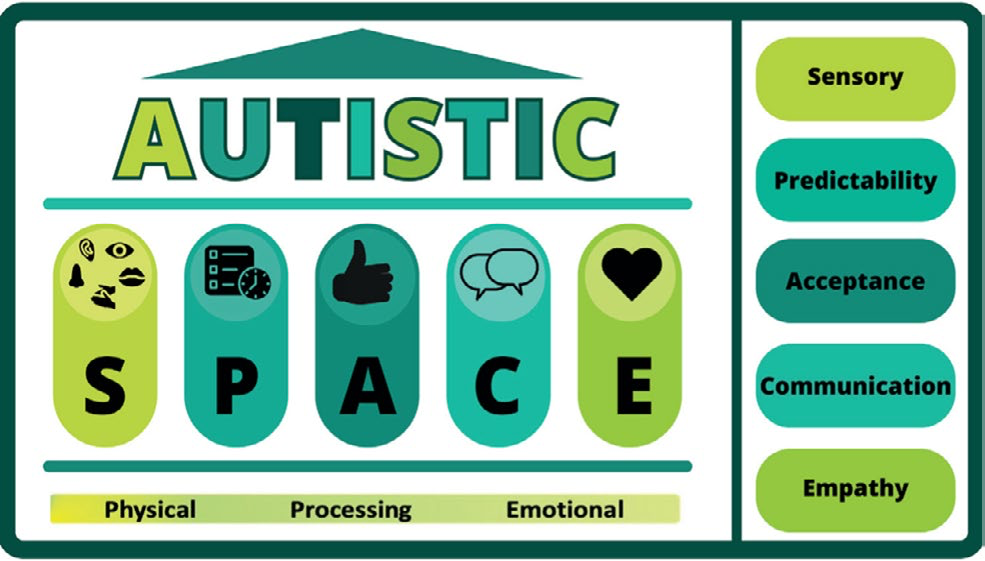
Neurodiverse Connection just published a practical, interactive toolkit for neurodiversity-affirming care and support — and it’s one of the most important resources we’ve seen arrive this year.
NDC is explicit: this is not a rebranded version of Positive Behaviour Support. It is not PBS in softer language. It is a fundamentally different paradigm — one that moves away from external observation, compliance, and behavior modification toward internal experience, co-regulation, relational trust, dignity, and consent.
That’s the line we hold at Stimpunks. “Being with” people, not “doing to” them.
Why This Matters
The toolkit is built on the Autistic SPACE Framework (Doherty, McCowan & Shaw, 2023) — a framework developed by Autistic clinicians who also navigate healthcare as Autistic people. SPACE names what neurodivergent people actually need: Sensory safety, Predictability, Acceptance, Communication, and Empathy, anchored in physical, processing, and emotional space.
That vocabulary maps directly onto what we build at Stimpunks.
Cavendish Space is our answer to what physical and relational space needs to look like for neurodivergent people — decompression, sensory safety, room to exist without masking. The SPACE framework’s “physical space” and “emotional space” dimensions articulate exactly why. Quiet zones. No-touch policies respected. Solitude honored, not pathologized.
Neuroqueer Learning Spaces and SPACE-TIME take the same logic into learning environments. Regulation first. Processing time built in. Interaction pace set by the learner. The toolkit’s “processing space” dimension — allowing silence between questions, providing agendas in advance, offering summaries afterward — is what we mean when we say regulation-first design isn’t an accommodation add-on. It’s the baseline.
None of this is compatible with ABA or PBS. Not partially. Not with modifications. The behaviors those frameworks try to suppress are often adaptive, communicative, regulatory. They are valid messages, not problems to eliminate.
Read the Series
NDC published a lived experience blog series alongside the toolkit as part of their Against PBS & ABA campaign. All of them are worth your time.
SPACE: An Autism-Informed Framework
Lucy Gilbert, NdC’s Lived Experience Lead, reflects on how SPACE-informed practice gives practitioners something tangible — not a checklist of right answers, but a scaffold for curiosity and reflection. There is no one-size-fits-all. That’s the point.
How SPACE Helped My Wellbeing at Work as a Late-Discovered AuDHD Person
Antonia Aluko describes workplace accommodations that weren’t personal to her — a checklist drawn from disability services, not from who she actually is. SPACE gave her a framework for understanding and naming what she genuinely needed. Late discovery is a theme that runs through so much of our community’s experience. This is for them.
The SPACE Framework: How It Changed My Experience of Accessing Mental Health Care
Molly Anderton collected mental health diagnoses for years before an Autism diagnosis. When recommended treatments “didn’t work,” she was told the problem was her. SPACE reframes that entirely. The environment was the problem. The system was the problem. Not her.
SPACE — A Framework for Wellbeing for All
Lucy Gilbert again, with a clear argument: Autism-informed care doesn’t only benefit Autistic people. It reduces barriers for everyone. A Director of Nursing at one of NDC’s Culture of Care events put it simply: “We are all human, and we need to strive to deliver human care and connection.” That’s the whole thing.
The Alignment Is Real
NDC’s framing and Stimpunks’ framing are built from the same foundation: broken systems, not broken people. Regulation as an internal physiological process, not performed calm. Emotions as valid messages. Autistic leadership centered, not consulted. Human rights as the floor, not the ceiling.
The toolkit is a living document. It will evolve. That’s the right relationship to have with this kind of work.
We’re sharing it here because resources like this are too rare, and they need to travel.
Neurodiverse Connection: ndconnection.co.uk
Stimpunks Foundation: stimpunks.org
Stimpunks on Cavendish Space: stimpunks.org/space/
Header image credit: Original graphic by ADI to illustrate the elements of the Autistic SPACE framework