
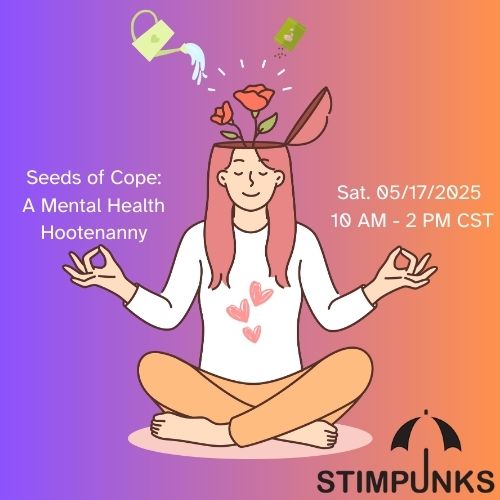
“Seeds of Cope 2025” was a celebration foregrounding mental health and our tools and techniques for coping held on May 17th 2025.
All scheduled time blocks are in CDT — Central Daylight Time (UTC/GMT -5 hours).
- * all scheduled time blocks are in Central Standard Time (CST) *
- Opening Affirmations and Introductions @ 10-10:10 AM
- Finding Ourselves on the Map of Monotropic Experiences @ 10:10-10:35 AM
- Bodymind Break @ 10:35-10:45 AM
- Community Presenter: Betsy S. @ 10:45-11:15 AM
- Bodymind Break @ 11:15-11:30 AM
- Niche Construction and Toolbelt Theory: Developing the Tools and Terroir of Coping @ 11:30 AM-12 PM
- Bodymind Break @ 12-12:10 PM
- Cope & Tell: Fashion, Art, Mobility Device, Coping Tools, etc. show & tell style @ 12:10-12:40 PM
- Community Presenter: Aubrey H. (pre-recorded) @ 12:40-1:10 PM
- Bodymind Break @ 1:10-1:20 PM
- Solidarity Sesh: Space Holding and Storytelling @ 1:20-2 PM
The event is over, but we’d like to leave you with some coping advice.
This is a coping toolkit for getting through hard moments in a hard world. It’s not clinical advice. It’s practical, lived-experience-first support — small interventions that reduce harm, lower load, and help you stay here.
If you need immediate help
If you are in danger, or feel like you might hurt yourself, call your local emergency number.
If you need practical support and resource links right now, go here:
Struggling in unjust conditions is not a personal failure.
You are not broken. The system is.
Quick Coping Actions (Right Now)
Pick one. Do it imperfectly. Tiny is valid.
Lower sensory load
- Dim lights / turn off overheads.
- Put on headphones / earplugs.
- Change your position (sit, lie down, lean, floor).
- Reduce inputs: fewer tabs, fewer voices, fewer tasks.
Breathe & downshift
- In 4 seconds, out 6 seconds — 6 rounds.
- Exhale longer than inhale.
- Hum, sigh, or yawn (vagus nerds know).
- Cold water on face or wrists.
One-body move
- Press hands together hard for 10 seconds.
- Wrap in a blanket / apply deep pressure.
- Rock, pace, flap, stim. Permission granted.
- Stretch jaw, shoulders, hands. Tiny counts.
If you only do one thing: reduce inputs. Lower sensory load first. Everything is harder when your nervous system is on fire.
How to Use This Page Without Getting Lost
- If you’re panicking right now: do Quick Actions + skim Scripts.
- If you’re overloaded: go to Sensory Safety.
- If you’re socially fried: go to Boundaries & exits.
- If you’re spiraling: go to Monotropic Spiral Breaks.
- If you’re post-crash: go to Aftercare.
- If you want deeper resources: use Doors to more help.
The Cope Map
Not everything is psychological. A lot of it is sensory, social, and systemic.
Feeling bad / stuck / flooded?
│
├─ Is this sensory load?
│   → reduce input, change environment, add pressure, step outside
│
├─ Is this transition / task-switching pain?
│   → smaller steps, timers, “good enough,” one task only
│
├─ Is this social strain?
│   → boundaries, scripts, exit cues, written communication
│
├─ Is this fear / shame / trauma activation?
│   → grounding, containment, co-regulation, safe person / safe place
│
└─ Is this a bad system doing what bad systems do?
    → “not broken people,” name the power, ask for support, refuse harm
If you want more on why environments matter, see: Perceptual Worlds and Sensory Trauma and Neuroception and Sensory Load.
Seeds of Cope
These are small, repeatable interventions. You can plant them ahead of time, or grab them in a storm.
1) Sensory Safety
- Change the room. Different chair, different corner, different light.
- Reduce inputs. Fewer sounds, fewer visuals, fewer obligations.
- Make a “quiet exit.” A place you can go without explaining.
- Carry a tiny kit. Earplugs, sunglasses, gum, fidget, water.
- Stim is regulation. Let your body do its job.
More: Burnout & Sensory Safety · Sensory Checklist Gallery
2) Boundaries, Exits, and Social Load
- Permission to leave. You don’t need to justify your nervous system.
- Use written communication. It’s often the great social equalizer.
- Reduce performance. Drop eye contact, drop small talk, drop masking.
- Switch to “parallel presence.” Be together without talking.
- Use a pre-made exit line. (See Scripts.)
More: Communication & Interaction Access
3) Monotropic Spiral Breaks
Sometimes you’re not “overthinking.” You’re stuck in a loop because your attention won’t release and your body won’t downshift.
- Do one tiny physical change. Stand up. Drink water. Open a window.
- Externalize the loop. Write the thought once. Put it on a note. “Park it.”
- Interrupt with rhythm. Walk to a beat. Tap. Rock. Count steps.
- Use a timer. “I will think about this for 7 minutes, then stop.”
- Shift to a safe special interest. A softer focus can re-regulate you.
More: Monotropism & Attention Worlds · Monotropism Questionnaire
4) Body-Based Grounding
- Temperature: cold water, warm drink, heating pad.
- Pressure: weighted blanket, tight hoodie, firm hug (if wanted).
- Orientation: name 5 things you see, 4 you feel, 3 you hear.
- Breath: long exhale, humming, sighing.
- Hands: squeeze a fidget, press palms, rub lotion slowly.
5) When It’s the System
If your life is being squeezed by paperwork, punishment, sorting, surveillance, and “standards,” you may be reacting normally to abnormal conditions.
- Reframe: “This is a mismatch, not a moral failure.”
- Name power: Who benefits from the rule as written?
- Reduce self-blame: “Broken systems, not broken people.”
- Ask for support: You deserve help without humiliation rituals.
- Refuse harm: refusal can be self-protection.
More: Broken Systems, Not Broken People · Justice & Systems: Name the Power
6) Aftercare (Post-crash)
After a meltdown/shutdown/panic spike, your job is gentle recovery — not “getting back to normal.”
- Lower demands. Cancel what you can. Defer what you can.
- Hydrate, eat, rest. Basic care is not optional.
- Quiet + predictability. Routine is medicine.
- Repair shame. “My nervous system did what it had to do.”
- Plan one lily pad. What makes the next transition safer?
Scripts You Can Copy-Paste
Use these as-is. Edit them. Make them yours. The point is to reduce effort in the moment.
Exit / Pause
I need a moment to regulate.
I’ll return when I’m able.
I’m hitting sensory overload.
I’m going to step out.
Support request
I’m not okay right now.
Can you stay nearby and be quiet with me?
I need fewer questions.
Please give me time and space.
Work / school
I work/learn better with breaks.
I’m taking one so I can come back regulated.
Written is easier for me than verbal.
Can we switch to text/email?
Doors to More Help
Follow the doorway that fits the moment you’re in.
- Get Help — fast CTAs and the shortest routes to support.
- Coping Field Guide — resource lists and survival tools.
- Sensory Experience — neuroception, sensory load, regulation.
- Perceptual Worlds — environment + outcome, sensory trauma, reality-testing.
- Burnout & Sensory Safety — reduce harm, protect capacity.
- Human Needs, Not Special Needs — support is normal.
- Broken Systems, Not Broken People — the reframe that stops self-blame.
Read Next
If this page helped, consider sharing it with one person who needs it. Small distribution is care infrastructure.
Part of the Coping Series
- Coping — Practical survival tools.
- Cope Is Not an Insult — Reclaiming coping from shame.
- The Science of Cope — Trauma theory and nervous systems.
Hootenanny Time
“Alright now, hootenanny time.”
Nina Simone – Go Limp (Live At Carnegie Hall, New York, 1964) – YouTube @1:34