

Zoe Williams is a late identified autistic parent, who writes about autistic identity and culture. Find her on Medium and Mastodon.
Home education lends itself particularly well to neuroqueering, as learning at home allows parents to create a bespoke education that is tailored to the child.
However, most adults have themselves been through the school system and have been conditioned to think and behave in certain ways. This needs to be examined and challenged before starting home education to avoid carrying these ways of thinking forward, in a process known as ‘deschooling’.
Unschooling is a form of home education that is highly compatible with neuroqueering, where children are supported to become autonomous learners and develop their own unique educational path. Just as schools enforce neuronormativity, unschooling liberates children from it.
The term ‘home education’ is used on this page and not ‘homeschooling’, to emphasise that the aim is not to recreate school at home.
Table of Contents
Deschooling
What Is Deschooling?
Deschooling means reflecting on unconscious assumptions and biases about learning and education that have developed as a result of societal conditioning and individual experiences in the school system.
Deschooling is:
- Letting go of old ways of thinking
- Challenging societal and cultural conditioning
- Healing from educational trauma
- Questioning what learning and education really means
- Breaking old patterns and thinking habits
- Decolonising the mind
- An ongoing process that will be revisited many times
“It’s not that I feel that school is a good idea gone wrong, but a wrong idea from the word go. It’s a nutty notion that we can have a place where nothing but learning happens, cut off from the rest of life.”
John Holt
“The truth is that schools don’t really teach anything except how to obey orders. “
John Taylor Gatto
“The only thing that interferes with my learning is my education.”
Albert Einstein
“Every time you feel the urge to control a choice, you can ask yourself “why?” and begin to question the assumptions (or fears) about children, parenting, learning and living joyfully that you are holding on to.”
Robyn Coburn – Is this really part of Unschooling?
“It seems unfathomable in our society that a child might delve into a topic for a day, a week, or maybe even years, for the simple reason that they want to.”
Esther Jones – When adults don’t measure the learning… – A PLACE ON A HILL
“Valuing the process of learning itself over the outcome is perhaps one of the biggest deschooling challenges”
Esther Jones – When adults don’t measure the learning… – A PLACE ON A HILL
“To be well-educated is to have the desire as well as the means to make sure that learning never ends.”
Alfie Kohn

Why Is Deschooling Important?
When home educating, it’s important for parents to have a deep understanding of what they are doing and why, and not be governed by unconscious fears and patterns from the past.
For example, if parents decide to home educate because they believe (consciously or subconsciously) that it will help their children get better exam results, or that it will give them a ‘competitive edge’ in the workplace, that is not neuroqueering. The purpose of neuroqueering education at home is not to beat the school system at its own game. Instead, neuroqueering aims to tear up the rulebook.
Children who are coming out of school to home educate will also need a period of time to recover from their experiences in the school system. This will vary according to how long they were at school, whether they had any difficult experiences or school trauma, and how much they have internalised the expectations of the school system.
“Collecting data on human learning based on children’s behavior in school is like collecting data on killer whales based on their behavior at Sea World.”
Carol Black – A Thousand Rivers — Carol Black
Deschooling Questions For Self-Reflection
- Think back over your experiences of learning at school. What worked for you and what didn’t work? Why/why not?
- What impact have your experiences at school had on your adult life – positive or negative?
- What effect does testing have on your learning?
- Who have you learned from in your life? Is it only qualified teachers?
- Is there anything you learned at school that you have had to unlearn as an adult?
- As a child, were you allowed to say no to things or quit things you didn’t enjoy? How did this affect you?
- Think about times when you have learned something for fun, as a hobby or for pure interest. What was that experience of learning like, and how did it differ from your experiences of learning at school?
- Think about your friendships in adult life. Are they all with people who happen to have a similar date of birth to you? Are you always friends with all your work colleagues?
- Do you prefer to be taught or to learn for yourself? Does it depend on the situation?
- Think about the structure of the school system – including elements such as the timetable, curriculum and exams, as well as the physical structure of the buildings and classrooms. Whose benefit is the school system really designed for?
Image by Freepik
“Recognize that unlearning is the highest form of learning.”
Rumi
“The education system isn’t broken. It does exactly what it was designed to do. But the purpose of that design might surprise you.”
Ana Fabrega – The Origin of the Modern School System — Ana Lorena Fabrega
Developing An Educational Philosophy
Before embarking on home education, many parents consider their educational philosophy and may even write a statement. This will include the core values and beliefs of what education should set out to achieve, and the methods they intend to use to achieve it.
Just as deschooling helps to identify what to move away from, an educational philosophy will help identify what to move towards. It will give direction to and strengthen home education provision.
Thing to consider:
- the purpose of education
- how children will learn
- what role adults will play.
As adults gain more experience and understanding of neuroqueering and home education, the educational philosophy may evolve – it is dynamic and can be revisited and updated over time.
“People should be free to find or make for themselves the kinds of educational experience they want their children to have.”
John Holt
“Whatever an education is, it should make you a unique individual, not a conformist; it should furnish you with an original spirit with which to tackle the big challenges; it should allow you to find values which will be your roadmap through life; it should make you spiritually rich, a person who loves whatever you are doing, wherever you are, whomever you are with; it should teach you what is important, how to live and how to die.”
John Taylor Gatto

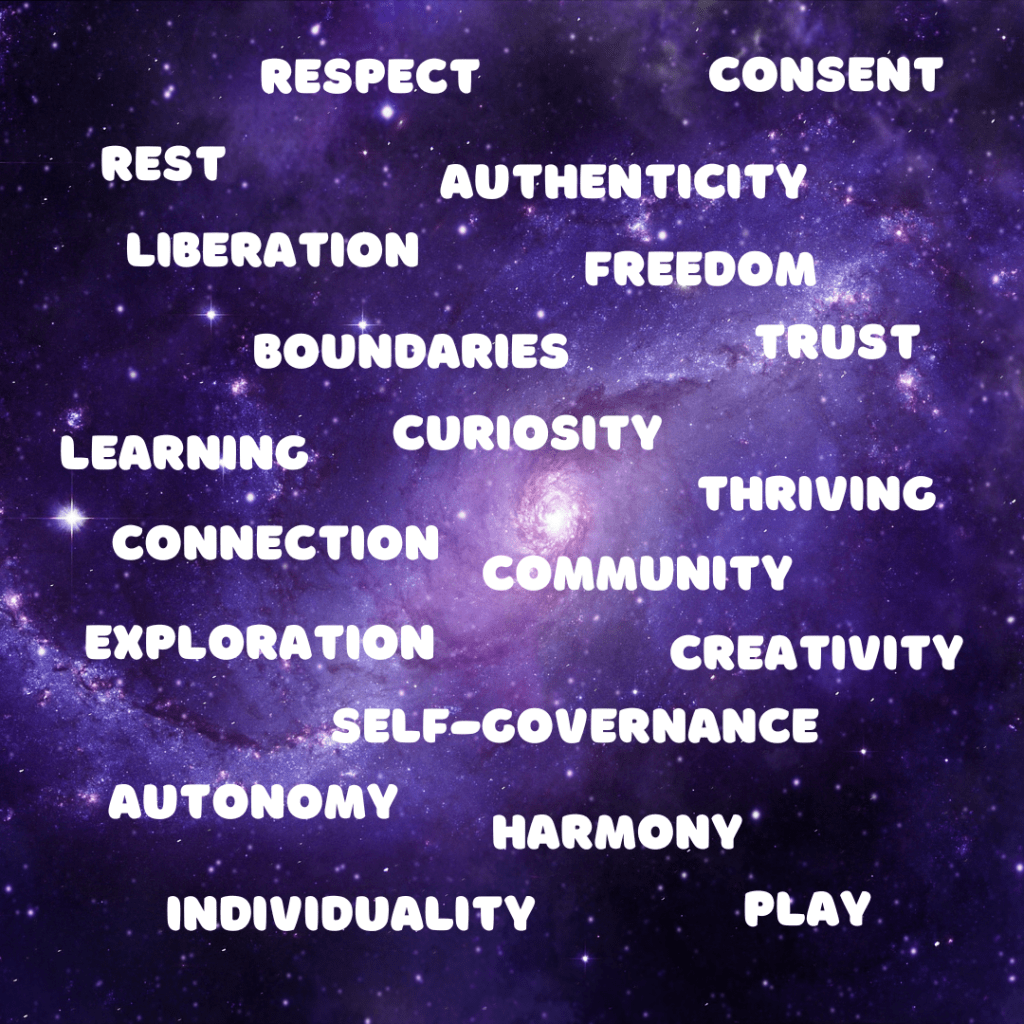
Home Education Core Values and Beliefs
You may like to reflect on these words to see whether and how they fit with your personal educational philosophy.
Unschooling
What Is Unschooling?
Unschooling is a form of self-directed education or autonomous learning, which aims to prepare children for the future by being fully invested in the present.
“Unschooling is a unique process for each family, and for each child.”
John Taylor Gatto
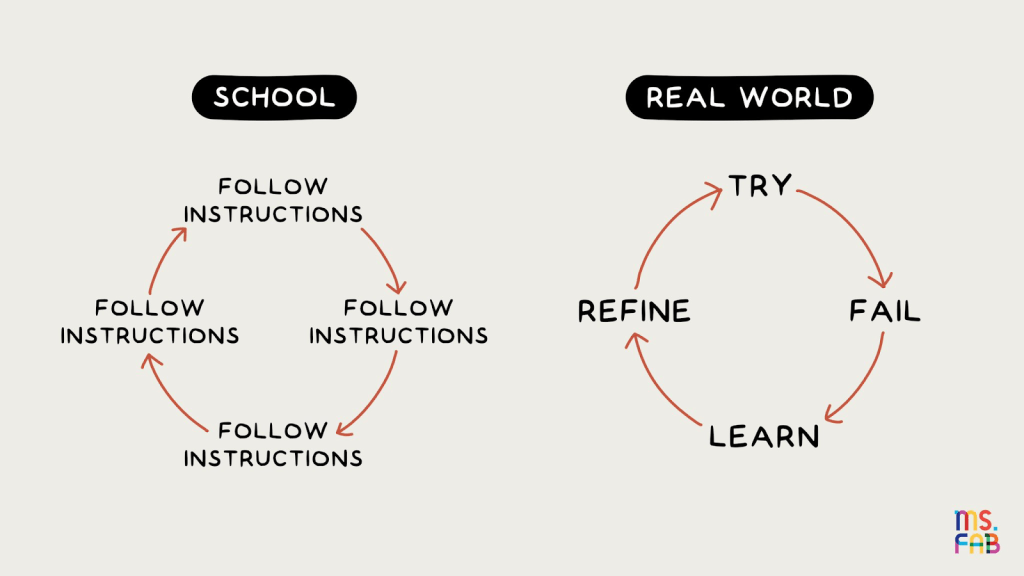
Unschooled children learn how to live in the real world, by living in it. They learn to problem-solve and make decisions by solving real problems and making real decisions, and then experiencing the consequences.
“Children learn how to make good decisions by making decisions, not by following directions.”
Alfie Kohn
The outcomes of unschooling cannot be determined in advance. Instead, unschooling places trust in children, and in the process of learning itself, without the need for coercion and control. By trusting children, they will learn to trust themselves.
How do grown unschoolers turn out?
In 2013, researchers Peter Gray (author of Free to Learn) and Gina Riley (author of Unschooling: Exploring Learning Beyond the Classroom) conducted a survey of adults who had been unschooled for at least part of their childhood. Here are some of the key findings:
- 83% of respondents had pursued some form of higher education
- 33% had completed or were studying for an undergraduate degree.
- The majority of respondents were in paid employment (and those who were not included students and mothers of young children).
- 48% of those in employment were pursuing careers in the creative arts. 53% had started their own business.
- For 77% of those in employment, their childhood interests and activities had directly led into their career.
- The vast majority felt that the advantages of unschooling far outweighed the disadvantages.
A Survey of Grown Unschoolers I: Overview of Findings | Psychology Today United Kingdom

Unschooling does not mean allowing the child to choose which curriculum they would like to follow, or picking which topic they would like to study. Unschooled learners often don’t follow a curriculum at all. Instead, they live their lives and learn as they go. Unschooled children learn what they need to learn, when they need to learn it. This is a much more efficient way to learn because it is useful and relevant to the learner, which also means that the learning is much more likely to be retained.
However, unschooling may include formal education, but only if it is chosen by the child. For example, unschooled children may decide to formally study a subject they are really interested in, or take exams if they need them to access further/higher education or employment, or if they would like to gain official recognition of their skills and abilities by earning a certificate. Without the pressure of being forced to study for tests, they may even decide to do them just for fun.
Perhaps the most radical aspect of unschooling is that children are allowed to say no to things. Unschooling emphasises the importance of respecting our children when they say no to things, when they want to leave, when they want to quit. It is only by allowing children to say no, that they can authentically say yes. This allows them to try things out, knowing that they don’t have to continue with something that isn’t right for them, and it also helps them to learn about setting healthy boundaries.
“Two children reading the same book. One has chosen it, the other knows that they have no choice. From the outside it looks the same, but from inside it’s completely different.”
Naomi Fisher – The Right To Leave – by Dr Naomi Fisher – Think Again
“The goal of unschooling is not education. It is to help a child be who she is and blossom into who she will become. Education happens as a side effect.“
Joyce Fetteroll – Unschooling Philosophy | Joyfully Rejoycing
“All happy adults are unschooling. That’s what they do, they’re following their interests, they’re following their passions. Why don’t we allow that for our children to experience that same kind of happiness?”
Jae Williams – Finding Freedom and Happiness Through Unschooling with Jae Williams | Parenting Decolonized

The Role Of Adults In Unschooling
The adult’s role is to facilitate the child’s needs and interests and to be an equal partner in the learning process. Unschooling is like a dance where the adult is tuned into the child and knows when to lead and when to follow, moving at the child’s pace. A strong connection between adult and child is essential. The relationship itself must be prioritised, in order to build mutual trust and respect.
By observing the learning that is already happening naturally, the adult can offer opportunities and expand the possibilities for the child. Adults can cultivate the environment to suit the child, both in terms of sensory needs and also providing resources for learning. Adults can also work towards building a support network of like minded families to provide social opportunities, friendships and peer support, and appropriate adults who can bring in new ideas, strengths and energy (directly or indirectly).
[Unschooling] is about creating a different kind of learning environment for your children. An environment based on the understanding that humans learn best when they are interested and engaged, and when they are personally involved and motivated.”
Pam Laricchia – What is Unschooling?
“Any child who can spend an hour or two a day, or more if he wants, with adults that he likes, who are interested in the world and like to talk about it, will on most days learn far more from their talk than he would learn in a week of school.”
John Holt
“Taking time to observe and play alongside your own child will give you insight into what they are exploring today, what questions they are asking, what challenges they are setting themselves, and what skills they are developing.“
Heidi Steel – Tree Climbing and Real Life Learning – Live. Play. Learn
The adult supports the child to develop their own learning model and methods, by witnessing and accepting the whole child, just as they are, and holding the space for the child to grow and develop in their own way.
At the foundation of all of this, the adult must work to ensure they keep themselves as regulated as possible, even in the midst of chaos or disappointment. This may mean sourcing support for themselves, in order to be better able to support their child.
“A joyful attitude is your best tool.”
Sandra Dodd – Late Night Learning
“It is time to re-write your child’s life experience. Begin enjoying life and learning. Whatever your child enjoys, do more of that, as frequently and as often as you can.”
Heidi Steel – Unschooling As A Perfect Fit For Neurodiverse Families – Live. Play. Learn
“We can best help children learn, not by deciding what we think they should learn and thinking of ingenious ways to teach it to them, but by making the world, as far as we can, accessible to them, paying serious attention to what they do, answering their questions — if they have any — and helping them explore the things they are most interested in.”
John Holt

Unschooling Is Not…
- Letting the child ‘rule the roost’
- Taking the easy way out
- Letting the child do whatever they want, whenever they want
- Having no boundaries
- Educational neglect
- Missing out
- Leaving kids to fend for themselves without help or guidance
- Always saying yes to everything
- Coddling or spoiling the child
Image by upklyak on Freepik
Unschooling As Neuroqueering
“The whole thing about raising free people is also about, in many ways, challenging societal norms and systems”
Akilah S Richards – We talk about raising free people, unschooling, deschooling and all the other language we have come to know through this podcast, but do we… | Instagram
Unschooling provides cognitive and somatic liberty to children and is an embodied form of education. Freed from the constraints of the classroom environment, children can move and express themselves as they wish, which in turn liberates their cognitive processes. The more time children are unschooled, the more they become divergent from their same-age peers. They are not subject to the same expectations and cultural conditioning as schooled children and have the freedom to develop according to their own needs and wants, rather than according to the demands and norms of the school system.
“So our job as parents is not to make a particular kind of child. Instead, our job is to provide a protected space of love, safety, and stability in which children of many unpredictable kinds can flourish. Our job is not to shape our children’s minds; it’s to let those minds explore all the possibilities that the world allows.”
Alison Gopnik – The Gardener and the Carpenter: What the New Science of Child Development Tells Us About the Relationship Between Parents and Children

Neuroqueering The Home Environment
Education in the home environment provides the freedom and flexibility to create a physical space and family culture that liberates the child (and the whole family) from neuro- and heteronormative expectations of what children ‘should’ be doing and encourages authentic self-expression. There may be practical constraints, and everyone’s needs should be taken into consideration, but parents and carers can explore creative ways to stretch the possibilities. Here are some examples:
- Giving free access to a range of sensory toys, tools and equipment, such as stim toys, wobble boards, plushies, weighted blankets, yoga mats and even indoor swings or gym equipment etc.
- Following the child’s natural rhythms including sleeping, eating, regulating, toileting. For example:
- Going to sleep when they are tired and waking up naturally.
- Eating when hungry and not sticking rigidly to set meal times.
- Going to the toilet whenever they need to.
- Access to drinking water throughout the day.
- Acknowledging that learning will happen naturally when the child is regulated and ready, even if it is not between the hours of 9am and 3pm on weekdays.
- Abandoning arbitrary limits on screen time.
- Letting children dress however they want, whether that is wearing pyjamas all day, sleeping in ‘daytime’ clothes, or diverging from gendered expectations around clothing.
- Encouraging and enabling all types of play throughout the early years and beyond, and recognising the value of play at all ages.
- Having resources and opportunities available that are relevant to the child’s interests and appropriate for their learning and developmental needs.
- Going with the ebb and flow of monotropic ‘flow states’ when possible, minimising unnecessary transitions, and not following an adult-determined timetable.
- Providing as much or as little time outdoors as the child needs. Some children may prefer to be outdoors most of the time, others may be the opposite and prefer not to leave the house for long periods – or anywhere in between.
- Using collaborative approaches to problem solving without coercive methods of reward or punishment.

“Play is often talked about as if it were a relief from serious learning. But for children play is serious learning. Play is really the work of childhood.”
Fred Rogers
“Our children won’t thrive because they have learnt to fit in. They’ll flourish because they have learnt not to.”
Naomi Fisher – Finding the Flex – by Dr Naomi Fisher – Think Again
“What is most important and valuable about the home as a base for children’s growth into the world is not that it is a better school than the schools, but that it isn’t a school at all.”
John Holt
How Adults Can Support Neuroqueering
In addition to cultivating the environment, there are a number of ways adults can support neuroqueering at home:
- Encourage infodumping.
- Leaning into the child’s interests, spending time engaging with them in what they like to do.
- Playing with and alongside the child, including parallel play.
- Open discussion and debate of neuronormative and heteronormative standards in society, and other social justice issues.
- Celebrating and having pride in their own identity.
- Learning about neuroqueering for themselves and role modelling neuroqueering practices.
- Linking up with other neuroqueering families and building community.
- Valuing rest and recovery, and understanding that children are never ‘doing nothing’.
“One of the most important gifts a parent can give a child is the gift of accepting that child’s uniqueness.”
Fred Rogers
“Those who know they’re valued irrespective of their accomplishments often end up accomplishing quite a lot. It’s the experience of being accepted without conditions that helps people develop a healthy confidence in themselves, a belief that it’s safe to take risks and try new things.”
Alfie Kohn
“Contrary to what we’ve been told, children are the most marginalized population… Adult supremacy needs to be dismantled so that we can build up our children to become the next powerful, compassionate, wise, and loving generation.”
Yolanda Williams – Finding Freedom and Happiness Through Unschooling with Jae Williams | Parenting Decolonized



Leave a Reply