

Inclusion must begin where exclusion has been the deepest. This means centering those who have been least served, least studied, and most structurally excluded, specifically, minimally speaking and nonspeaking individuals, BIPOC individuals, and disabled people from the Global South, who are often marginalized by Western technology, language, and policy norms (Grech et al. 2023; Malone et al. 2022; Tan et al. 2025). We are guided by the disability justice and liberation psychology principle that those most impacted often have the clearest insight into pain points: where and how systems fail (Berne 2015; MartinBaró 1994; Crenshaw 1989; Tate et al. 2013). Designing for the intersections of people and contexts that produce high support needs is not a niche exercise. It improves access for everyone. For example, sensory-motor friendly environments, with calming colors, biophilic designs, dedicated quiet (and loud) spaces, clear navigation tools, and ramps benefit everyone, not just people with disabilities (Almaz and Mohamed 2024; Hamraie 2017, Srinivasan 2025a).
Inclusion Must Be Global, Decolonized, Culturally and Linguistically Diverse, and Anti-Normative
Inclusion, when it assumes uniformity, is not inclusion at all.
Inclusion Must Be Global, Decolonized, Culturally and Linguistically Diverse, and Anti-Normative
This study includes a helpful list of recommendations across several areas for creating inclusive environments:
Policy Areas
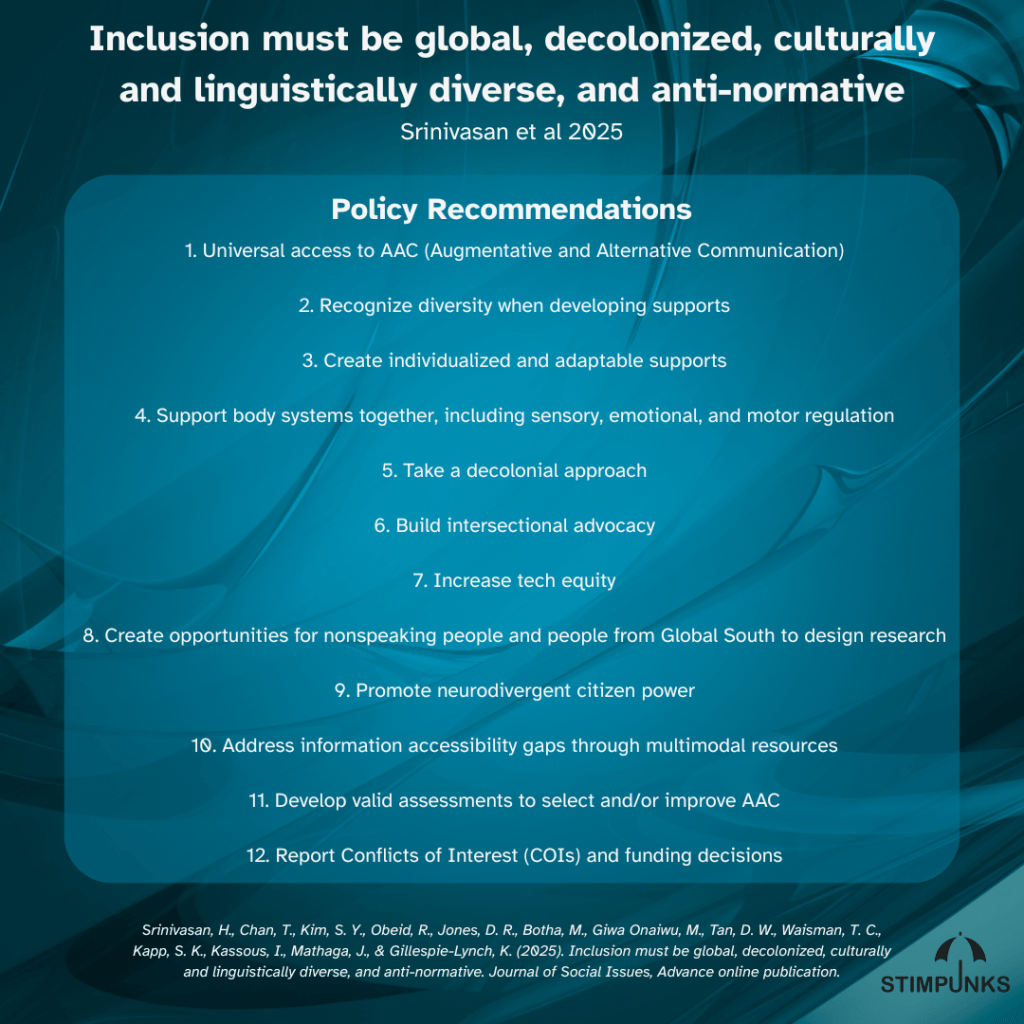
- Universal access to AAC (Augmentative and Alternative Communication)
- Recognize diversity when developing supports
- Create individualized and adaptable supports
- Support body systems together, including sensory, emotional, and motor regulation
- Take a decolonial approach
- Build intersectional advocacy
- Increase tech equity
- Create opportunities for nonspeaking people and people from Global South to design research
- Promote neurodivergent citizen power
- Address information accessibility gaps through multimodal resources
- Develop valid assessments to select and/or improve AAC
- Report Conflicts of Interest (COIs) and funding decisions
Source: Inclusion Must Be Global, Decolonized, Culturally and Linguistically Diverse, and Anti-Normative
Recommendations
- Universal access to AAC
- Authentic inclusion must provide AAC and accommodate diverse communication and sensory needs,
- AAC must be made a protected communication mode.
- Recognize diversity when developing supports
- Collaborate with diverse community members to develop supports (Conti et al. 2025; Marshall et al. 2025; Phan et al. 2025),
- Highlight diversity in guidelines for supports,
- Provide professional development targeting complex communication needs, biases, presuming competence, and promoting mental health (Marshall et al. 2025),
- Include racial/ethnic and socioeconomic information in research papers (Walters 2025).
- Create individualized and adaptable supports
- Center social validity, for example, Autistic people’s goals, in support development and delivery (Marshall et al. 2025; Nthibeli et al. 2025, Phan et al. 2025),
- Make supports adaptive to individual, contextual, and cultural variations in communication styles (Brea and Jackson 2025),
- Include accommodations for sensory needs (Caliman and Berryessa 2025; Nthibeli et al. 2025),
- Conduct ongoing evaluations of cultural responsiveness of supports (Banks and Jackson 2025),
- Take a lifespan approach to supports (Dlott 2025).
- Support body systems in parallel, including sensory, emotional, and motor regulation
- Provide whole-body communication supports,
- Recognize that AAC is not standalone; often requires motor/sensory/regulation accommodations,
- Fund and mandate interdisciplinary communication assessments that include sensory, motor, and emotional regulation domains,
- Help providers link communication targets with other domains,
- Require integration of body systems in education plan,
- Use accountability and feedback mechanisms to make practices increasingly holistic (Marshall et al. 2025).
- Take a decolonial approach
- Reduce gate-keeping to care and integrate care systems (Banks and Jackson 2025; Kamara et al. 2025; Nthibeli et al. 2025; Walters et al. 2025),
- Recognize that terms to convey certain Autistic experiences may not yet exist,
- Avoid imposing Western-centric terminologies/perspectives (Nthibeli et al. 2025),
- Promote multilingual and multimodal access to resources (Kamara et al. 2025), including multilingual AAC,
- Promote critical, culturally sensitive practices through training (Banks and Jackson 2025),
- Prioritize non-transactional relationships with marginalized communities,
- Explore how the meaning of expertise varies across cultures (Caliman and Berryessa 2025),
- Support indigenous knowledge (Mukwezwa-Tapera et al. 2025) and integrate traditional and modern care approaches (Kamara et al., 2025; Nthibeli et al. 2025),
- Increase clinics in redlined urban areas and rural settings (Banks and Jackson 2025; Kamara et al. 2025).
- Build intersectional advocacy
- Promote cross-disability and cross identity alliances, for example, disability and LGTBQIA+ (Dlott 2025),
- Meaningfully include people with high support needs in community activities (Conti et al. 2025),
- Promote positive intergroup contact (Ayaya 2025),
- Increase collective power by increasing the size and diversity of advocacy networks.
- Increase tech equity
- Understand that relationships with technology vary across time and location
- Nothing about us without us: ensure design of technologies and plain language information led by disabled users,
- Include minimal/nonspeaking users in AI training datasets (if they wish to be included),
- Require disability-led ethics review boards for new technologies, transparent audit mechanisms, public disclosure of training data, transparent reporting of and attempts to reduce environmental impacts, and accessibility testing.
- Create opportunities for nonspeaking people and people from the Global South to design research
- Center nonspeaking people and people from the Global South in decision-making,
- Use community-led feedback loops in research development (Conti et al. 2025).
- Transparently report on participatory approaches,
- Enrich UD (Universal Design) with Open Science practices to promote Neurodivergent scholarship (Phan et al. 2025),
- Position multiply marginalized scholars in academic leadership (Banks and Jackson 2025),
- Promote co-production of research, products and public services (Ayaya 2025).
- Promote neurodivergent citizen power
- Dismantle structural barriers and promote cultural safety (Ayaya, 2025; Caliman and Berryessa, 2025, Marshall et al., 2025; Mukwezwa-Tapera et al. 2025),
- Assess diversity, inclusion, equity, and belonging across educational and employment settings (Ayaya 2025),
- Improve support systems in the workplace, including access to AAC (Ayaya 2025; Dlott 2025),
- Integrate comprehensive neurodiversity-informed education into legal training and systems to address systemic biases in sentencing (Caliman and Berryessa 2025),
- Implement intersectional policies that prioritize human stories and have teeth (Dlott 2025; Nthibeli et al. 2025),
- Explore neurodivergent flourishing (Walters 2025).
- Address information accessibility gaps through multimodal resources
- Provide high-quality easy read versions of research, legal resources, and policies in multiple languages (Caliman and Berryessa 2025, Nthibeli et al. 2025, Phan et al. 2025),
- Promote information accessibility through multimodal resources (Ayaya 2025)
- Develop valid assessments to select and/or improve AAC
- Develop and validate unbiased assessments to improve the quality of AAC tools.
- Report Conflicts of Interest (COIs) and funding decisions
- Developers and researchers must report COIs,
- Increase transparency of funding allocation (Nthibeli et al. 2025).
Source: Inclusion Must Be Global, Decolonized, Culturally and Linguistically Diverse, and Anti-Normative
Conclusion
Systems built for the most complex communicators are not niche solutions—they are blueprints for broad accessibility, exposing what existing systems routinely ignore (Hamraie 2017). We do not need more after-the-fact accommodations awkwardly bolted on exclusionary systems. What is required is radical redesign: systems that begin at the margins and work inward, rather than centering an imagined “average” user (Costanza-Chock 2020; Srinivasan 2025a). This means building from the outset for people with intersecting sensory, motor, and communication needs, as well as for those excluded by language, geography, or normative assumptions (Peña 2019; Srinivasan 2025a; Bal et al. 2016)
This has not been a call for one-size-fits-all designs but for adaptive systems that are customizable, flexible, and co-created with the very communities they claim to include. Structural redesign is not about eliminating all accommodations, but embedding them so deeply that they become expected rather than exceptional. For the most marginalized, inclusion will not come from incremental adjustments but from radical solutions and systemic overhauls. It requires collective commitment to radical acceptance—to presuming competence, to trusting diverse ways of knowing and being, to valuing both independence and interdependence, and to designing environments that recognize all people as having dignity and deserving to belong. As disability justice movements have long shown, design that starts at the edges moves everyone forward (Berne 2015; Hamraie 2017; Pineda 2020).
Inclusion Must Be Global, Decolonized, Culturally and Linguistically Diverse, and Anti-Normative
We do not need more after-the-fact accommodations awkwardly bolted on exclusionary systems.
Inclusion Must Be Global, Decolonized, Culturally and Linguistically Diverse, and Anti-Normative


