
You get all sorts of people in the library, and the librarian gets it all.
Terry Pratchett
Knowledge equals power…
The string was important. After a while the Librarian stopped. He concentrated all his powers of librarianship.
Power equals energy…
People were stupid, sometimes. They thought the Library was a dangerous place because of all the magical books, which was true enough, but what made it really one of the most dangerous places there could ever be was the simple fact that it was a library.
Energy equals matter…
He swung into an avenue of shelving that was apparently a few feet long and walked along it briskly for half an hour.
Matter equals mass.
And mass distorts space. It distorts it into polyfractal L-space.
So, while the Dewey system has its fine points, when you’re setting out to look something up in the multidimensional folds of L-space what you really need is a ball of string.
“Guards! Guards!” by Terry Pratchett
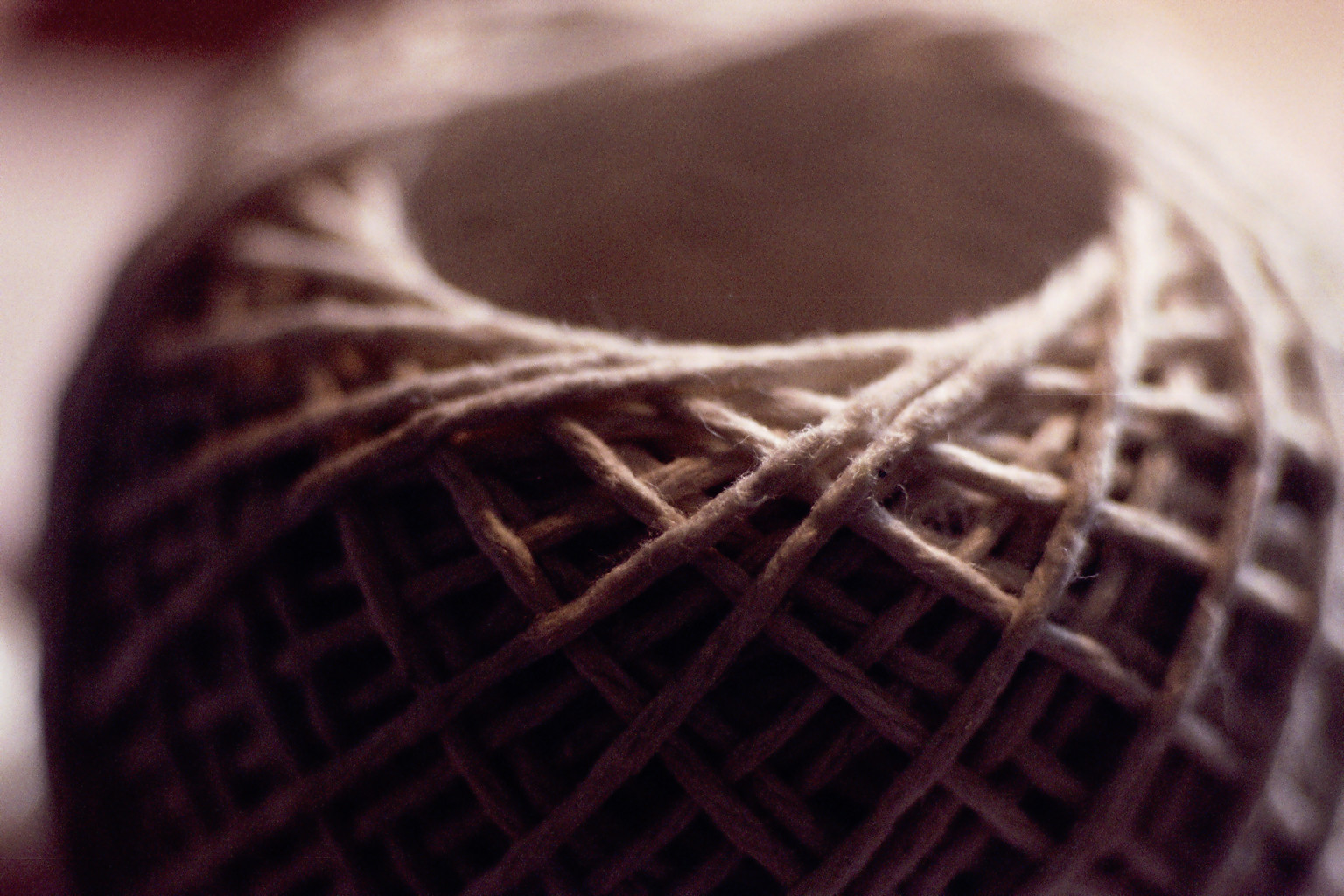
When you’re setting out to look something up in the multidimensional folds of L-space what you really need is a ball of string.
The Librarian of Unseen University
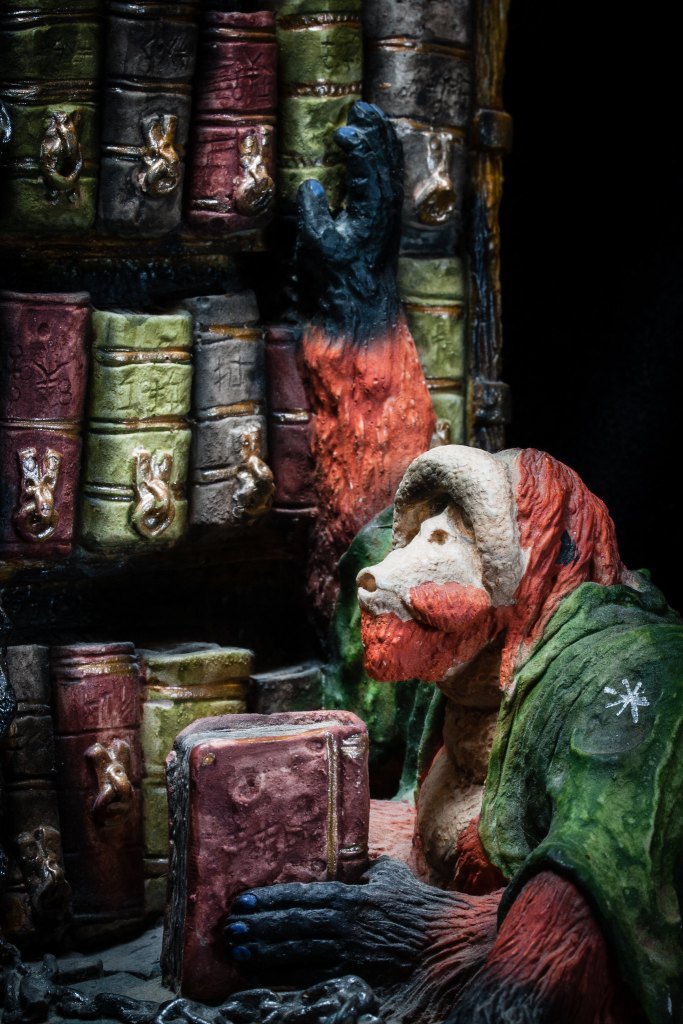
Oook.
The Librarian
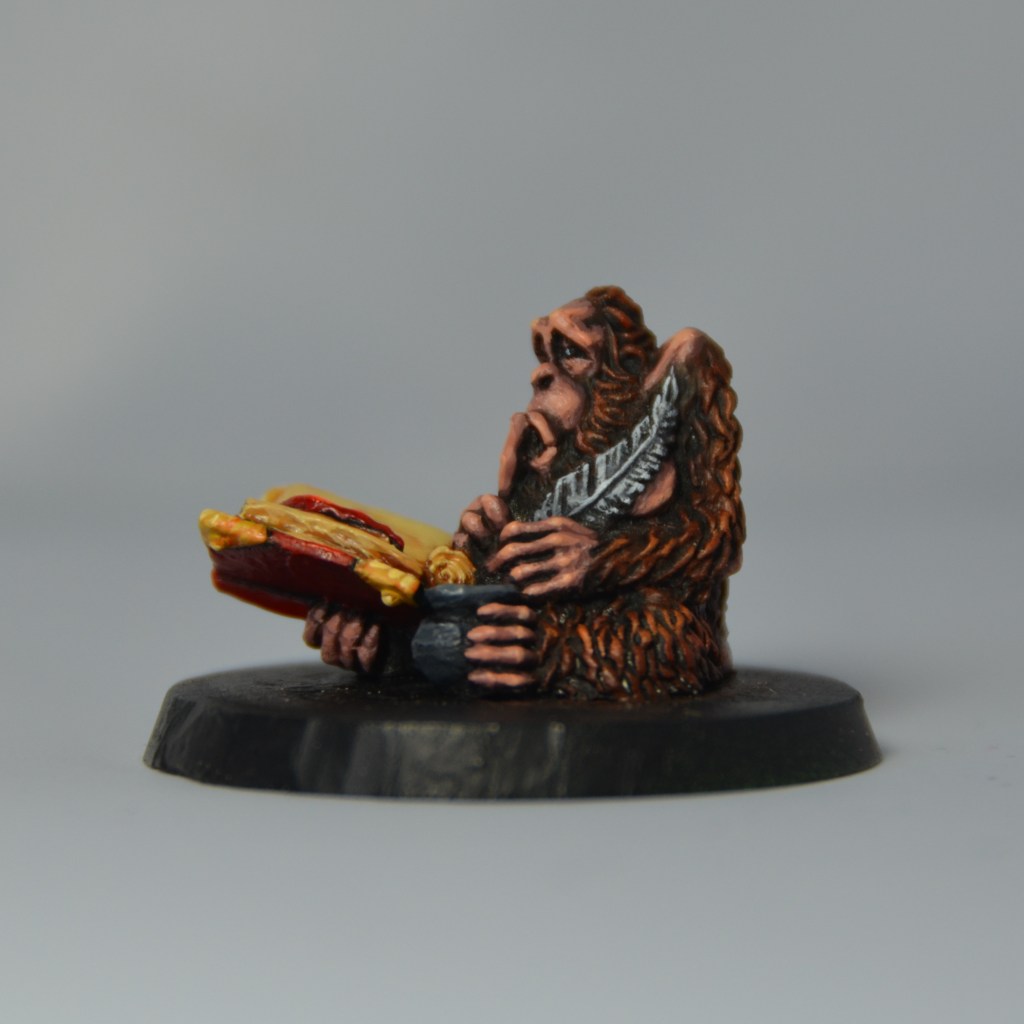
It was the Librarian. Not many people these days remarked upon the fact that he was an ape.
The snoring was coming from underneath it, where a piece of tattered blanket barely covered what looked like a heap of sandbags but was in fact an adult male orangutan.
It was the Librarian.
Not many people these days remarked upon the fact that he was an ape. The change had been brought about by a magical accident, always a possibility where so many powerful books are kept together, and he was considered to have got off lightly. After all, he was still basically the same shape. And he had been allowed to keep his job, which he was rather good at, although “allowed” is not really the right word. It was the way he could roll his upper lip back to reveal more incredibly yellow teeth than any other mouth the University Council had ever seen before that somehow made sure the matter was never really raised.
Pratchett, Terry. Guards! Guards!: A Discworld Novel (pp. 3-4). HarperCollins
The Librarian of Unseen University is a character in Terry Pratchett‘s Discworld series of fantasy novels.
The Librarian | Discworld Wiki | Fandom
The Librarian first appeared in the first novel of the series, The Colour of Magic, and was transformed into an orang-utan in “The Light Fantastic” as the Octavo fired a beam of magic upwards (a sort of systemwide, in this case universe-wide, update intended to save the Eighth Creation Spell (and thus Rincewind) from falling off the disc). Discovering that being an orang-utan has certain advantages for a librarian (climbing the book shelves and using his hands and feet for sorting books being one such advantage), he refused to be transformed back into a human, and has remained an orang-utan ever since. Most of the grimoires are highly dangerous to people, sometimes consuming them, but the Librarian is no person, and no longer requires a ladder to reach those tricky high-up shelves. He retained his position as librarian despite his condition because “he’s the only one who knows where all the books are” (Mort 261).
The Librarian | Discworld Wiki | Fandom
The Librarian is a member of a small elite group of senior librarians, who have the knowledge and ability to travel through L-space. The very strict rules that members of these group are pledged to enforce are:
The Librarian | Discworld Wiki | Fandom
- Silence.
- Books must be returned no later than the date shown.
- Do not meddle with the nature of causality.
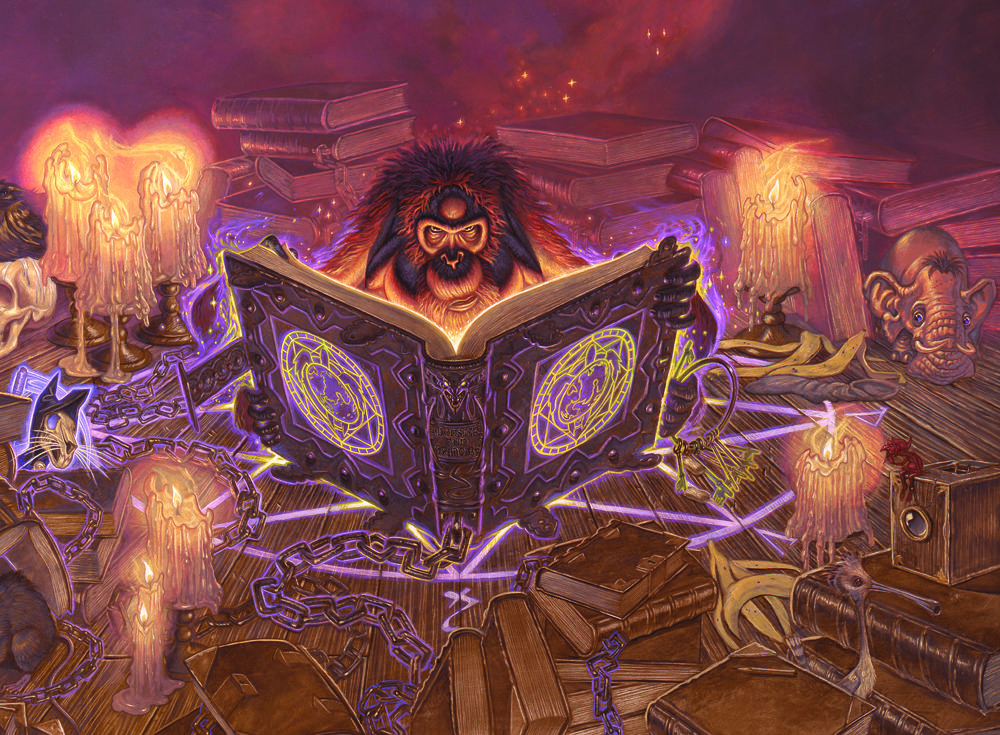
Paul Kidby Paintings
We could, for example, have pointed out that Darwin’s theory of evolution explains how lower lifeforms can evolve into higher ones, which in turn makes it entirely reasonable that a human should evolve into an orangutan (while remaining a librarian, since there is no higher life form than a librarian).
Pratchett, Terry; Stewart, Ian; Cohen, Jack. The Science of Discworld: A Novel (p. 13). Knopf Doubleday Publishing Group.
Table of Contents
- The Librarian of Unseen University
- Our Collections
- Library Joy
- A Third Place and a Safe Space for Possibility
- Have you really read all these?
- We Need a Library Economy: Usufruct, the Irreducible Minimum, and Complementarity
- Libraries are Punk AF
- Librarians Rock
- Palaces for the People
- A Knowledge Commons and a Space of Openness
- Books of the Edges
- NeuroTribes
- The Autism Books by Autistic Authors Project
- Autistic Representation Database
- Autistic Realms eBooks and Infographics
- Further Explorations in L-space
But libraries are essential — to learning, to community, to democracy, and to any hope we have of building a society organized around education and collective care, rather than control.
You Can’t Fight Fascism While Defunding Libraries
Our Collections
- Courses
- Things Library
- Infographics
- Fundamental Texts of Progressive Pedagogy
- Books Every Progressive Educator Should Read
- Silberman Collection: Autism Books For Parents and Clinicians
- Silberman Collection: For Autistic People, by Autistic People
- By the Stimpunks Community
- In Our Own Voices 2022 and 2023
- Autistic Collaboration Trust
- The Autism Books by Autistic Authors Project
- Bookmarks
- Highlights
- Music
- eBooks
- Neurodiversity Affirming Reading Recommendations
Library Joy
There’s so much good at your local library!
Mychal Threets
A Third Place and a Safe Space for Possibility
Libraries are THE third places.
If you’re not at home and you’re not at work or school but you are at a place that provides community without being required to buy stuff, where are you?
You’re in third space.
Quick little “how to” for including autistic people in community events 🥰 #autism #autistic – YouTube
Characteristics of third places:
What Our Cities Are Missing – YouTube
- neutral ground
- leveling place
- conversation space
- open & accessible
- regulars
- low profile
- playful mood
- home away from home
Libraries are safe spaces that nurture possibility.
I’m a writer at least partly because I had access to public libraries.
Octavia Butler
I am also a product of librarians who read stories to groups of avid little kids.
Sitting in the hushed cocoon of the library gave shape and structure to her days. It gave her a role. It gave her purpose.
Whenever Butler felt dispirited — about not having a mentor or a steady income or a clear path forward — she’d remind herself that she always had two things: her desire and access to aisle upon aisle of books.
Octavia Butler’s Science Fiction Predicted the World We Live In – The New York Times

Books bend space and time.
Guards! Guards!: A Novel of Discworld
Have you really read all these?
A good library is comprised in large part by books you haven’t read, making it something you can turn to when you don’t know something. He calls it: the Anti-Library.
The 5-Step Research Method I Used For Tim Ferriss, Robert Greene, and Tucker Max
Someone walks into your house and sees your many books on your many bookshelves. Have you really read all these? they ask. This person does not understand knowledge. A good library is comprised in large part by books you haven’t read, making it something you can turn to when you don’t know something. He calls it: the Anti-Library.
I remember once in college, the pride I felt about being able to write an entire research paper with stuff from my own anti-library. We all have books and papers that we haven’t read yet. Instead of feeling guilty, you should see them as an opportunity: know they’re available to you if you ever need them.
This is the mark you must aim for as a researcher, to not only have enough material - and to know where the rest of what you haven’t read will be located - on hand to do your work. You must build a library and an anti-library now… before you have an emergency presentation or a shot at a popular guest post.
The 5-Step Research Method I Used For Tim Ferriss, Robert Greene, and Tucker Max
Collect books, even if you don’t plan on reading them right away. Nothing is more important than an unread library.
John Waters
We Need a Library Economy: Usufruct, the Irreducible Minimum, and Complementarity
Revolutionaries can engage in building full-fledged library economies based on the commons.
This can take the form of tool libraries, vehicle libraries, clothing libraries, furniture libraries, and more in an effort curb overproduction, end planned obsolescence, and provide access to an irreducible minimum to all.
How We Can Change The World – YouTube
These concepts are foundational to any cooperative, caring, and egalitarian society, but particularly to what Bookchin called ‘organic society,’ which consist of the egalitarian tribal societies that can be found in much of human history.
Beginning with the first essential concept for a library economy, usufruct refers to the freedom of individuals or groups in a community to access and use, but not destroy, common resources to supply their needs.
The second essential concept for a library economy is the irreducible minimum, which is the guaranteed provision of the means necessary to sustain life, the level of living that no one should ever fall below, regardless of the size of their individual contribution to the community.
Complementarity is a way of looking at non-hierarchical differences within a society as something generative, where each person contributes a small part to an outcome greater than the sum of its parts.
We Need A Library Economy – YouTube
We are participating in the library economy with our “Things Library“.
A library economy would require a vast reorientation of our priorities from the centrality of capital and competition to the centrality of humanity and cooperation, which brings us to the final core concept for a library economy: complementarity.
We Need A Library Economy – YouTube
…engage in building full-fledged library economies based on the commons.
How We Can Change The World – YouTube
This can take the form of tool libraries, vehicle libraries, clothing libraries, furniture libraries, and more in an effort curb overproduction, end planned obsolescence, and provide access to an irreducible minimum to all.
Libraries are Punk AF
Five laws of library science – Wikipedia
- Books are for use.
- Every person his or her book.
- Every book its reader.
- Save the time of the reader.
- A library is a growing organism.
We rebuild what you destroy
The Linda Lindas
“Libraries embody everything that we need right now to fight back against fascism,” says Sara Heymann.
When times get truly tough, however, it might be time for librarians to go rogue.
Opinion | Libraries can help end the culture wars. That’s why they’re under fire. – The Washington Post
Librarians Rock

Libraries are the last place in America where you are valued for your personhood, rather than the contents of your wallet. At the library, you are a patron, not a customer.
Librarians are kind of upside-down cops: public employees who are stepping in wherever the rest of our services have failed.
They Want to Kill Libraries. The Last Place in America Where You Are… | by Cory Doctorow | Nov, 2022 | Medium
While on the subject of burning books, I want to congratulate librarians, not famous for their physical strength, their powerful political connections or great wealth, who, all over this country, have staunchly resisted anti-democratic bullies who have tried to remove certain books from their shelves, and destroyed records rather than have to reveal to thought police the names of persons who have checked out those titles.
So the America I loved still exists, if not in the White House, the Supreme Court, the Senate, the House of Representatives, or the media. The America I loved still exists at the front desks of our public libraries.
Kurt Vonnegut, A Man Without a Country
Palaces for the People
In his book “Palaces for the People,” sociologist Eric Klinenberg calls libraries “social infrastructure.” He’s referring to the way these places offer physical shelter and calm, as well as an intangible sense of social stability and community. They are material and psychological spaces that hold us together when we feel lost or curious, lonely or adventurous. Yes, the library might contain propaganda. But it contains the voices of many people, from many historical eras and far-flung places, and those voices wait quietly on the shelves to be heard. That’s because the library is a place of information without coercion.
We need to preserve our libraries and the books they hold, partly to figure out who we are and where we came from. But perhaps more pressingly, we need to preserve them as both a refuge from the culture wars and a template to rebuild a cultural life together when this war is over. Without them, we may have no way to teach our children to share ideas, instead of battling each other forever.
Opinion | Libraries can help end the culture wars. That’s why they’re under fire. – The Washington Post
In the culture war, libraries with free access to a full range of books can light the way toward psychological peace. They provide us with a mental model for a public sphere in which Americans debate each other as equals to reach a resolution or compromise.
Opinion | Libraries can help end the culture wars. That’s why they’re under fire. – The Washington Post
A Knowledge Commons and a Space of Openness
At Stimpunks, we’re building a knowledge commons and a space of openness, at the edges.
For me this space of radical openness is a margin a profound edge. Locating oneself there is difficult yet necessary. It is not a “safe” place. One is always at risk. One needs a community of resistance.
Living as we did on the edge we developed a particular way of seeing reality. We looked both from the outside in and from the inside out. We focused our attention on the centre as well as on the margin. We understood both.
Choosing the Margin as a Space of Radical Openness, bell hooks
Books of the Edges
Innovation comes from adversity. And those of us at the margins have experienced the most
.Tinu Abayomi-Paul
Collected below are some books from the edges and margins we recommend. We provide WorldCat links and embed Amazon previews. The Librarian, visiting us from Discworld via L-space, will guide your journey with the alacrity offered by prehensile hands and feet.
Discovering that being an orang-utan has certain advantages for a librarian (climbing the book shelves and using his hands and feet for sorting books being one such advantage), he refused to be transformed back into a human, and has remained an orang-utan ever since.
The Librarian | Discworld Wiki | Fandom

We’d like to grow our library into something like The Bi Pan Library with synopses, selected quotes, contextualization, and more. Interested in helping?
- Courses
- Things Library
- Infographics
- Fundamental Texts of Progressive Pedagogy
- Books Every Progressive Educator Should Read
- Silberman Collection: Autism Books For Parents and Clinicians
- Silberman Collection: For Autistic People, by Autistic People
- By the Stimpunks Community
- In Our Own Voices 2022 and 2023
- Autistic Collaboration Trust
- The Autism Books by Autistic Authors Project
- Bookmarks
- Highlights
- Music
- eBooks
- Neurodiversity Affirming Reading Recommendations
NeuroTribes
Our community recommends NeuroTribes to everyone. NeuroTribes changed the conversation about what it is to be human. It is a history of the 20th Century through the lens of the dispossessed and misunderstood. It is a trip through anguish and horror and a celebration of the minds that survived to make modernity.
The idea of neurodiversity has inspired the creation of a rapidly growing civil rights movement based on the simple idea that the most astute interpreters of autistic behavior are autistic people themselves rather than their parents or doctors.
The notion that the cure for the most disabling aspects of autism will never be found in a pill, but in supportive communities, is one that parents have been coming to on their own for generations.
NeuroTribes: The Legacy of Autism and the Future of Neurodiversity
Take a trip through the pages of NeuroTribes with this talk from author Steve Silberman.
Build a structure that will enable autistic people and their families to live happier, healthier, more engaged, more productive, more creative, successful lives.
NeuroTribes and the Real History of Autism
2016 Neurodiversity High Tech Conference
The Autism Books by Autistic Authors Project
The Autism Books by Autistic Authors Project is an (ongoing) attempt to catalogue all books—non-fiction and fiction—written about and related to autism by Autistic authors.
The Autism Books by Autistic Authors Project
The Autism Books by Autistic Authors Project is a beautiful example of Autistic collaboration. It has led to an amazingly comprehensive library of books by Autistic authors. To learn about the neurodiversity movement and Autistic culture, we recommend to start with the Autistic Rights and Neurodiversity reading list.
Books | Autistic Collaboration
Autistic Representation Database
The Autistic Representation Database (ARD) is an open access, scholarly resource that indexes appearances of autistic individuals in English-language fiction, autobiographical non-fiction, film, television, and new media. As the autistic scholar Sonya Loftis notes in Imagining Autism, “Cultural stories—whether told by the news media, the literature taught in classrooms, or a television sitcom—matter. They influence the way we think about people with autism, the way we think about disabled people as a cultural minority group, and the way our society regards, values, or disvalues anyone who is different“ (2015, p. 2). Today, there are thousands of autistic characters in a range of genres and media—from young adult fiction to action movies.
Autistic Realms eBooks and Infographics
Carefully selected resources to support neurodivergent individuals, families, and professionals. These featured items reflect my neurodiversity-affirming approach to understanding and embracing Autistic identity.
Further Explorations in L-space
I leaned closer and whispered, “A librarian’s gotta do what a librarian’s gotta do.”
Libriomancer


