
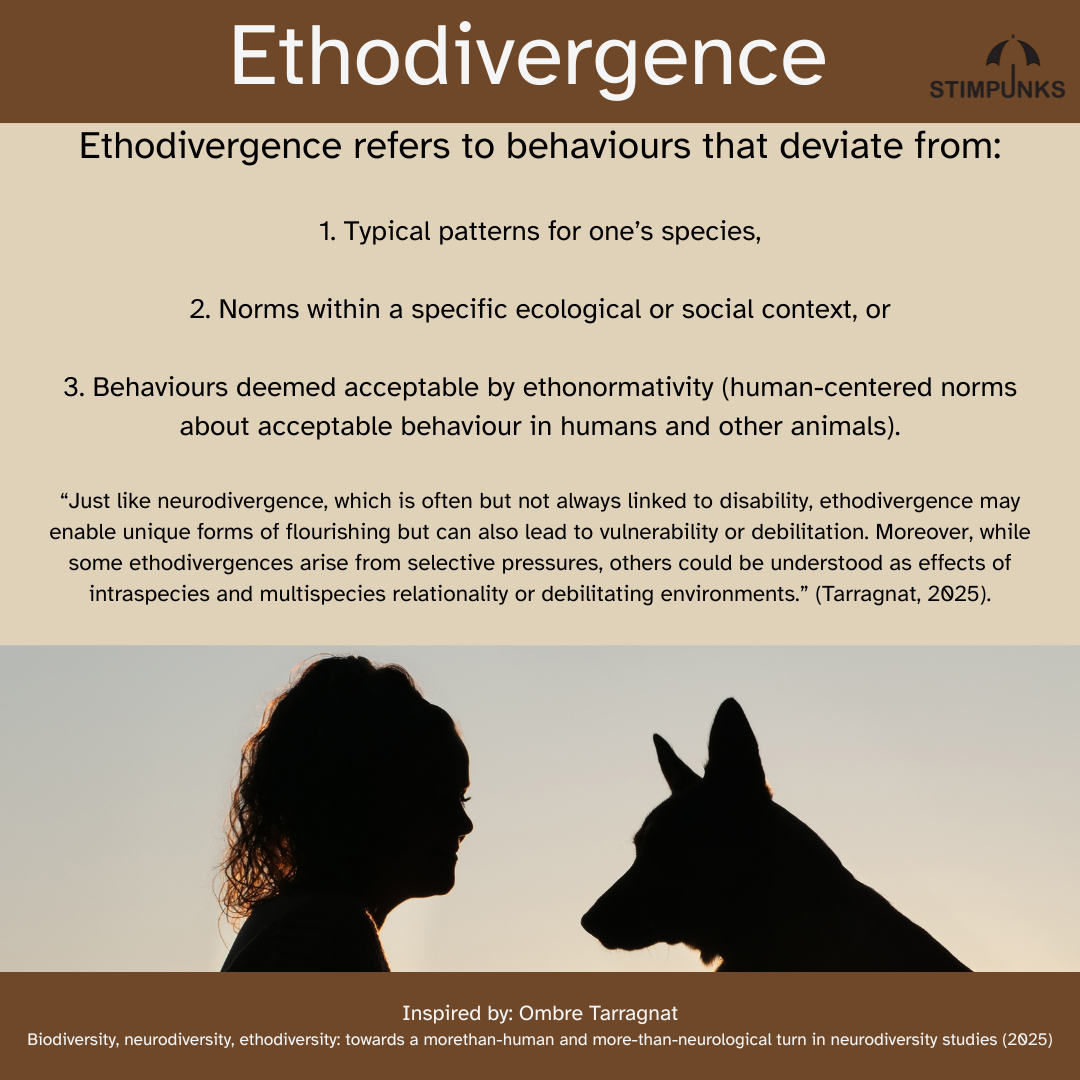
…ethodivergence refers to ways of being and behaving that depart from the behavioural patterns (1) dominant in one’s species, (2) in one’s ecological and social milieu, and/or (3) imposed by anthropocentric ethonormativity – understood as the normative regulation, based on humanist principles, of the behaviours which can (or cannot) be accepted in given animals (human or nonhuman) in specific contexts. Just like neurodivergence, which is often but not always linked to disability, ethodivergence may enable unique forms of flourishing but can also lead to vulnerability or debilitation. Moreover, while some ethodivergences arise from selective pressures, others could be understood as effects of intraspecies and multispecies relationality or debilitating environments.
In a posthuman world filled with multispecies relationality, climate change, habitat destruction, intensive animal farming, and cyborg technoscience, our usual ways of being and behaving are troubled. For some nonhuman animals, this can prove particularly challenging, and ethodivergence is never far away. Just like neurodivergence, which is often but not always linked to disability, ethodivergence may enable unique forms of flourishing but can also lead to vulnerability or debilitation.
Moreover, ethodivergent beings often counter the humanist behavioural norms imposed or expected from one’s species or community in a given context. Consequently, they tend to face ethonormative violence: horses who refuse to obey their riders and depressed or fearful cats who resist being petted and may even attack humans are often abandoned or euthanised.
Ethodivergent politics aim to allow animals to experiment with their potentials and experience positive affects beyond ethonormativity. Neurodivergence and animality are often intersecting and co-constructed: the pathologisation of neurodivergent humans often relies on a form of dehumanisation that assimilates us to animals. Reclaiming our (hum)animality is key to fostering neurodivergent politics for all animals. In a world where ethonormativity meets neuronormativity, I would rather be a divergent animal than a typical human.
Reclaiming (our) animality as a core component of neurodivergence and its lived experience can help us shed new light on what it is, exactly, that differs between neurotypical and neurodivergent people: neurocognitive processes, certainly, but also behavioural and somatic repertoires, affective styles, etc.
Is neurodivergence a typically human thing or a fundamental dimension of animality itself?


