
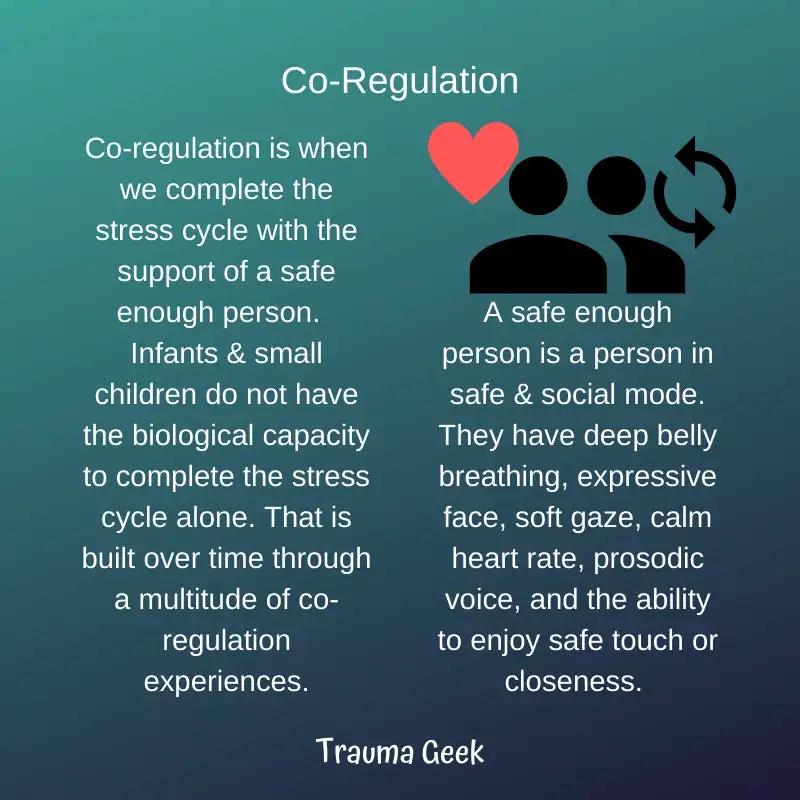
Co-regulation is when we complete the stress cycle with the support of a safe enough person.
The Neuroscience of Community. A set of graphics by Janae Elisabeth… | by Trauma Geek | Age of Awareness | Medium
Infants & small children do not have the biological capacity to complete the stress cycle alone. That is built over time through a multitude of coregulation experiences.
A safe enough person is a person in safe & social mode. They have deep belly breathing, expressive face, soft gaze, calm heart rate, prosodic voice, and the ability to enjoy safe touch or closeness.
External Nervous System
Co-regulation is the act of soothing and helping to calm someone during a moment of dysregulation. No-one is born with the ability to self-soothe; it is a skill we develop over time and with experience. Children need repeated experiences of co-regulation from a regulated adult before they can begin to self-regulate.
We may have to act as “external nervous systems” for children who are constantly in a heightened state. By being nearby and in a state of regulation ourselves, this can help a child’s Nervous System to become regulated.
The importance of co-regulation and self-care
Children need repeated experiences of co-regulation from a regulated adult before they can begin to self-regulate. We may have to act as “external nervous systems” for children who are constantly in a heightened state. They may also not have a toolbox to learn how to regulate by themselves and we may be a key resource to help them create tools that work for them.
As explained above, autistic people may experience a huge amount of difficulties, resulting in high levels of stress/ trauma. The result of this can be that autistic young people are unable to regulate themselves when they are stressed, as they may not have much experience of being able to get themselves to a feeling of safety. When this is managed successfully e.g. leaving a room, they can be punished for it – which sends the message that regulating themselves is not ok.
This means that we often have to act as “external nervous systems” for young people who are in a heightened state. And we may have to support them in creating their own toolbox of regulation techniques.
Through our actions and through co-regulating with young people, we can show that they are safe, and also that we are safe people to go to when they are stressed. Then over time, with repeated experiences where it is ‘ok to not be ok’ and young people are met with support and empathy, they will be able to better regulate themselves over time.
The feelings and behaviour of people around us affect how we feel. This applies to everyone, but can be more important in the case of autistic people, who often have higher emotional sensitivity than others (one of the reasons autistic people can struggle with eye contact, is because eyes are incredibly emotional so they can cause emotional overwhelm). Many autistics emotionally mirror – feeling a nearby person’s emotion as if they are our own.
This means that when young people become upset, they can calm down quicker if the people around them are genuinely calm, and demonstrate how to calm down to them.
Co-regulation is a skill that can be learnt – our guidance on co-regulation can be found here.
Key Principles when supporting autistic people
As explained above, autistic people may experience a huge amount of difficulties, resulting in high levels of stress/ trauma. The result of this can be that autistic young people are unable to regulate themselves when they are stressed, as they may not have much experience of being able to get themselves to a feeling of safety. When this is managed successfully e.g. leaving a room, they can be punished for it – which sends the message that regulating themselves is not ok.
This means that we often have to act as “external nervous systems” for young people who are in a heightened state. Through our actions and through co-regulating with young people, we can show that they are safe, and also that we are safe people to go to when they are stressed. Then over time, with repeated experiences where it is ‘ok to not be ok’ and young people are met with support and empathy, they will be able to better regulate themselves over time.
The feelings and behaviour of people around us, affect how we feel. This applies to everyone, but can be more important in the case of autistic people, who often have higher emotional sensitivity than others (one of the reasons autistic people can struggle with eye contact, is because eyes are incredibly emotional so they can cause emotional overwhelm).
This means that when young people become upset, they can calm down quicker if the people around them appear calm, and demonstrate how to calm down to them.
Co-regulation is the ability to regulate emotions and stress related behaviours, with the support and direction of a connecting individual. The connecting individual supports regulation through the use of a variety of strategies to soothe or respond in times of stress. This includes looking at external stressors, but also internal thoughts and feelings.
Co-regulation is about “showing young people the ropes” of calming their internal and external systems. Then over time, young people will gain the skills to be able to do this for themselves.
The importance of coregulation and selfcare
Polyvagal Theory
Let’s look at the actual core concepts of PVT: Hierarchy, Neuroception, and Co-regulation.
Hierarchy refers to the order in which our bodies activate the 3 neural circuits of the Autonomic Nervous System (the ventral vagus complex, the sympathetic adrenal system, and the dorsal vagus nerve complex). Neuroception is the body’s ability to sense danger or safety in our environment and cue the activation of the 3 neural circuits. Co-regulation is the ultimate safety signal wherein resonance with another nervous system allows us to engage the ventral vagus nerve complex.
Evolution of a Theory: Polyvagal is Not Dead — Trauma Geek
Embodiment and Being With
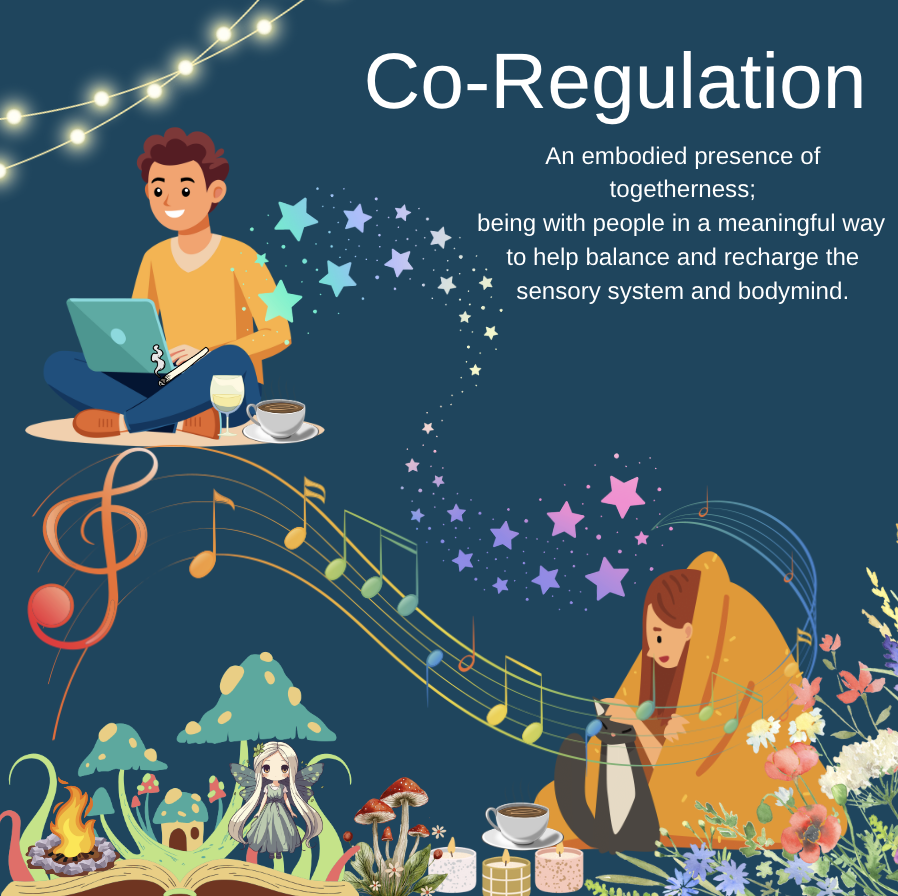
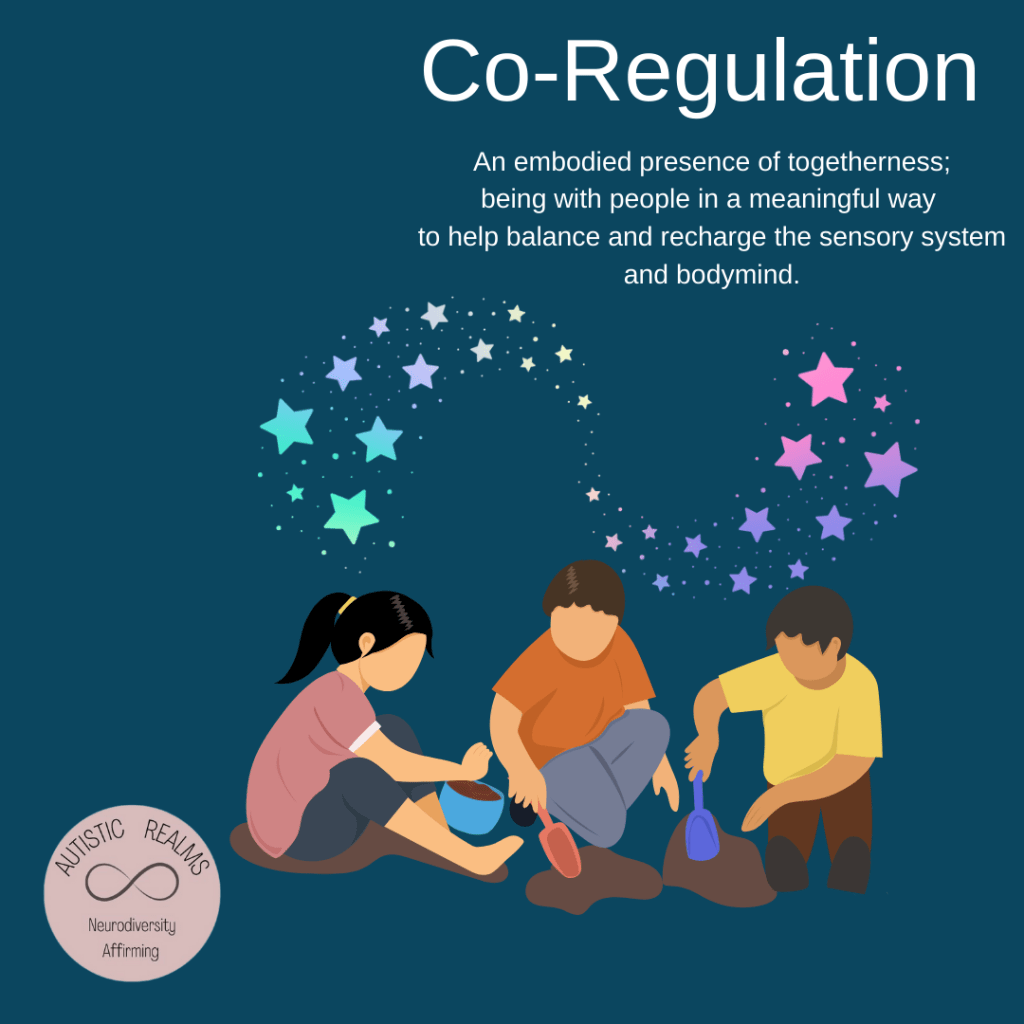
For people who may be feeling dysregulated, co-regulating needs adults to be a ‘space holder’ Aldred (2023) for their children. Offer space and time for them to be with you in a way that works for them. Being with people may have a different meaning for neurodivergent people to a neurotypical understanding of what ‘being with’ someone means. For neurodivergent people, ‘being with’ may not mean actually being with that person in a shared space; it may not mean playdates, meals out, or organised activities together. Being with someone may be more of a felt presence that some one ‘gets them’ rather than an actual activity for some people. Co-regulating with people means being with people in ways that work for their physical, social and sensory needs. It may be more a shared knowing and understanding that another person is ‘with them’ although not necessarily next to them as that may be overwhelming for some people. For example, joining an online game, sharing music in a chat room or knowing you are each happy being in your own dens/spaces in your house can all be meaningful ways of co-regulating. For other people and younger children joining in alongside one of their favourite activites, TV programmes, sensory play activities can be really helpful. Being with people is about understanding people’s true needs for their own time and space and each person knowing they are there for each other.
Co-regulation needs to happen throughout the day and not be used as a behaviour management strategy only when a person is in crisis. Co-regulation is not just about adults being calm around children who are dysregulated, although that certainly helps! As adults, we need to try and offer moments of being with children in ways that are meaningful for them throughout the day to increase togetherness time, which will support regulation, reduce crisis and also bring some glimmers and joy into the day!
Neurodivergent Co-Regulation
Parallel Play
Parallel play and joining in an activity alongside another person (child or adult) can be a really nice low-demand way of showing an interest in another person’s activities. Parallel play and sharing penguin pebbles can create a sense of belonging, mutual understanding and love. Sharing things that bring you joy and sharing things that you know also bring another person joy is a way of connecting. Examples of penguin pebbling include finding little things that bring you joy to share with someone else. This can be anything from twigs or stones that you come across on your walk to listening to music together, sharing memes online or creating time for your child to share their junk model creations or to watch their new gymnastics or dance shows. Creating little bubbles of co-regulation in the day together can help restore and rebalance everyone’s sensory system and energy levels and support regulation.
Neurodivergent Co-Regulation
Embodied People + Environment = Regulated Outcome & Potential to Thrive
Embodied People + Environment = Regulated Outcome & Potential to Thrive
Beardon’s (2017) famous equation, ‘Autism + Environment = Outcome, ‘ is really important to consider when working specifically with autistic people but I think a version of this can be applied to everyone. If people are embodied and their environment meets needs there is a better chance of people being regulated and being able to thrive. Offering spaces and bubbles of co-regulation throughout the day in ways that work for and with people can help create a sense of safety and belonging. Being regulated and feeling connected is a human need we all have and deserve so we can thrive.
Neurodivergent Co-Regulation


