
Neurodivergent and disabled speakers, notably Lydia X. Z. Brown and Jonathan Mooney, preface their presentations with an access note and a bodymind affirmation. They encourage people, be it in an auditorium or a group video chat, to move around and get comfortable.
I believe we should all move in our space in whatever way is most comfortable for our bodyminds.
Please use this space as you need or prefer.
Sit in chairs or on the floor, pace, lie on the floor, rock, flap, spin, move around, come in and out of the room.
This is an invitation for you to consider what your bodymind needs to be as comfortable as possible in this moment
This is an invitation to remind yourself to remember and to affirm that your bodymind has needs and that those needs deserve to be met, that your bodymind is valuable and worthy, that you deserve to be here, …, to belong.
Against Ableism & White Supremacy: Disability Justice is Our Liberation – YouTube
I know that I myself could not sit still in a room like this for even 15 seconds. So if you are like me and you need to take a break during my presentation, that’s all good. You need to go to the back of the room and pace back and forth, I won’t be offended. You need to leave the room, it’s all good. I myself may wander off in the middle of my presentation, and you all will be accepting, inclusive, and accommodating of that for sure. (Laughter) But, hey, you know what, this is your time.
Lab School Lecture Series – Jonathan Mooney – YouTube
Reminder: Please do what is most comfortable for your body/mind!
Let us know if we can all do something that helps you be more comfortable in this space.
Let’s make space for each other!
I invite you to do whatever your bodies and minds need to be more comfortable and safe.
You can lie down, take notes, don’t take notes, get some water, stretch.
Check in with yourself right now and what you need, whatever helps your body and mind in this moment, in this space
I also welcome any requests for anything we can do to help you be more comfortable in this space.
Collective Community Care: Dreaming of Futures in Autistic Mutual Aid – YouTube
Let’s make space for each other!
Collective Community Care: Dreaming of Futures in Autistic Mutual Aid
We Stimpunks really like and appreciate these affirmations and need the access and understanding they offer, both online and in physical space. We bring our whole bodyminds — stims, senses, perceptual worlds, and all — to every learning experience.
Though autistic people live in the same physical world and deal with the same ‘raw material’, their perceptual world turns out to be strikingly different from that of non-autistic people.
Sensory Perceptual Issues in Autism and Asperger Syndrome, Second Edition: Different Sensory Experiences – Different Perceptual Worlds eBook: Bogdashina, Olga, Casanova, Manuel
Where disability comes into the picture is thinking about how someone’s body or mind might function best in an environment, a built environment or an emotional or communicative environment or infrastructure that perhaps wasn’t designed to begin with with that particular person’s bodily capacity or neurodivergence in mind.
Making Work Accessible, Wherever it Happens – Distributed.blog
Flexibility makes a big difference in inclusion. Small changes have big impact.
Small changes that can easily be made to accommodate autism really do add up and can transform a young person’s experience of being in hospital. It really can make all the difference.
Autism + environment = outcome
“It’s Not Rocket Science” – NDTi
Our community, by necessity, near constantly advocates and negotiates for these small changes. Small changes go a long way to bringing the access promised in access notes and bodymind affirmations. Two suggestions we often make are:
- Make cameras optional
- Provide backchannels
Make Cameras Optional
For example, making cameras optional during video classes is a small change that makes a huge difference for us.
So I repeat my one small but crucial piece of advice (more than advice: it’s an admonition): Make cameras optional.
We should treat video presence in our online Fall emergency distance education courses in the way we treat all accessibility, building in digital accommodations in the way one would physical. If you or your institution requires presence, offer alternative forms for students for whom presence means disenfranchisement, hardship, shame, or lack of participation (ie. bandwidth–I had to turn off my video yesterday at our FI staff meeting in order that we could hear better). This is an opportunity for digital literacy and for demonstrating your concern for learning. What are your system’s capacities? Perhaps, if a student doesn’t want to be seen or cannot be, subtitles are the answer. Maybe chat. Maybe blogs before class or texting. There one that matters most: how can you, as an educator, find an open, equitable way to help students learn what you most want to offer them.
Cameras Optional, Please! Remembering Student Lives As We Plan Our Online Syllabus | HASTAC
To fight Zoom fatigue, give people the freedom to turn their cameras off.
@AdamMGrant
New experiment: videos off reduces exhaustion and boosts engagement—especially for women and newcomers.
Cameras off doesn’t reflect disengagement. It helps to prevent burnout and promote attention.
A “cameras on” policy for classes and presentations, especially when the camera is used to enforce neurotypical notions of attention, is ableist and exclusionary.
Wanting people to have their #Zoom camera on is #ableist. You do not need to see my face. If a person is uncomfortable with a camera in their face, then they shouldn’t have to have it on. Period. #Neurotypicals, deal with it.
@OtherBodhiGirl
For those of us with stims deemed anti-social, like nose-picking and scalp-gouging, turning off the camera allows us to stim and regulate without judgment, stigma, or distracting others. Stimming is an adaptive coping mechanism necessary to managing sensory overwhelm and attention. Making us sit still, in frame, on camera, suppressing stims is no way to learn.
A hostile learning environment, whether at home, school, or work, is a place where fear elicits the self-censoring instinct and shuts down the learning process.
Learners rarely put forth the effort to learn unless learner safety is in place. It’s a “build it and they will come” principle. If you don’t build it, they may still come, but they won’t learn.
Source: The 4 Stages of Psychological Safety (pp. 44-47)
Provide Backchannels
In addition to allowing cameras off, complementing video chats with a text backchannel makes all the difference to including us. Before retiring, I had difficulties navigating the rise of video conferencing. Like Vint Cerf, I found it to be a huge challenge.
Around 1971, Ray Tomlinson developed the idea of networked electronic mail, which was hugely attractive to me because it replaced uncertain voice calls with the clarity of text. The development of the Internet was undertaken in the context of heavy use of email.
The rise of video conferencing has actually been a huge challenge for me as it reintroduces some of the uncertainty of voice calling and I look forward to real-time, automatic captioning to overcome the limitations that medium poses for me.
Vint Cerf on accessibility, the cello and noisy hearing aids
Luckily, at the time, I was on a team that appreciated neurodiversity, differentiated instruction, and accessibility. We alternated meetings between video and text, allowed cameras off, and used a backchannel so I could type instead of talk during video sessions. Situational mutism marked my childhood and strikes me still, especially on group video.
And that’s not even touching on the ways this kind of technology supports the shy user, the user with speech issues, the user having trouble with the English Language, the user who’d rather be able to think through and even edit a statement or question before asking it.
SpeEdChange: Bringing the “Back Channel” Forward
Don’t Force Us into Non-Compliance
Let us stim. Let us move. Let us be kinetic. Let us turn off the camera. Let us type to talk. Don’t force us into non-compliance to meet our needs.
Our non-compliance is not intended to be rebellious. We simply do not comply with things that harm us. But since a great number of things that harm us are not harmful to most neurotypicals, we are viewed as untamed and in need of straightening up.
THINKING PERSON’S GUIDE TO AUTISM: On Hans Asperger, the Nazis, and Autism: A Conversation Across Neurologies
Make the small changes now, and affirm our divergent bodyminds as valid and belonging and not in need of straightening up.
Foster inclusion and belonging with an access note and bodymind affirmation at the beginning of your class, meeting, or presentation.
We use Lydia X. Z. Brown’s affirmation as a template:
I believe we should all move in our space in whatever way is most comfortable for our bodyminds.
Please use this space as you need or prefer.
Sit in chairs or on the floor, pace, lie on the floor, rock, flap, spin, move around, come in and out of the room.
This is an invitation for you to consider what your bodymind needs to be as comfortable as possible in this moment
This is an invitation to remind yourself to remember and to affirm that your bodymind has needs and that those needs deserve to be met, that your bodymind is valuable and worthy, that you deserve to be here, …, to belong.
Against Ableism & White Supremacy: Disability Justice is Our Liberation – YouTube
🌊 Bodymind Break
Let’s take a bodymind break.
bodymind = a term used to challenge the idea the body and mind are experienced separately
The swells and textures of nature follow patterns that resonate with the human body through its ability to hear sound. Enjoy a sonic tribute to one of nature’s most wonderful experiences, the sound of the ocean’s waves. The swells are specially timed to encourage the body to breathe more slowly and more deeply. The sound spectrum is full and is matched to the powerful release of deep sound energy of the Earth’s beautiful shores.
Take a moment to breathe. Take a moment to affirm your bodymind.
Some ways to affirm your bodymind and support nervous system regulation:
- stretch
- flap
- fidget
- meditate
- stim dance
- body scan
- eat
- drink
- pee
In practical terms, supporting nervous system regulation means tending to and responding to the body’s needs first and foremost. This means prioritising physiological needs. Things like taking rest breaks, keeping warm, cooling down, regularly hydrating, moving when the body feels it needs to, and going to the toilet as soon as you need to.
Embodied Education: Creating Safe Space for Learning, Facilitating and Sharing
Press play for ocean waves.
We’re not minds riding around in bodies, we’re bodyminds.
We’re not minds riding around in bodies, we’re bodyminds.
Toward a Neuroqueer Future: An Interview with Nick Walker | Autism in Adulthood
Neurodiversity, simply put, is the diversity among human minds. For 15 years or so after the term was coined, it was common for people to speak of neurodiversity as ‘‘diversity among brains.’’ There still are plenty of people who talk about it that way. I think this is a mistake; it’’s an overly reductionist and essentialist definition that’s decades behind present-day understandings of how human bodyminds work.
Mind is an embodied phenomenon. The mind is encoded in the brain as ever-changing webs of neural connectivity. The brain is part of the body, interconnected with the rest of the body by a vast network of nerves. The activity of the mind and body creates changes in the brain; changes in the brain affect both mind and embodiment. Mind, brain, and embodiment are intricately entwined in a single complex system. We’re not minds riding around in bodies, we’re bodyminds.
A lot of people hear neuro and they think, brain. But the prefix neuro doesn’t mean brain, it means nerve. The neuro in neurodiversity is most usefully understood as a convenient shorthand for the functionality of the whole bodymind and the way the nervous system weaves together cognition and embodiment. So neurodiversity refers to the diversity among minds, or among bodyminds.
Toward a Neuroqueer Future: An Interview with Nick Walker | Autism in Adulthood
So much of my perception of my autistic self is embodied.
As indicated by the title, the first essential term for this book is bodymind. Bodymind is a materialist feminist disability studies concept from Margaret Price that refers to the enmeshment of the mind and body, which are typically understood as interacting and connected, yet distinct entities due to the Cartesian dualism of Western philosophy (“The Bodymind Problem and the Possibilities of Pain” 270). The term bodymind insists on the inextricability of mind and body and highlights how processes within our being impact one another in such a way that the notion of a physical versus mental process is difficult, if not impossible to clearly discern in most cases (269). Price argues that bodymind cannot be simply a rhetorical stand-in for the phrase “mind and body”; rather, it must do theoretical work as a disability studies term. Bodymind is an essential concept in chapter 3 in my discussion of hyperempathy, a nonrealist disability that is both mental and physical in origin and manifestation. Bodymind generally, however, is an important and theoretically useful term to use in analyzing speculative fiction as the nonrealist possibilities of human and nonhuman subjects, such as the werewolves discussed in chapter 4, often highlight the imbrication of mind and body, sometimes in extreme or explicitly apparent ways that do not exist in our reality.
In addition to the utility of the term bodymind in discussions of speculative fiction, I also use this term because of its theoretical utility in discussions of race and (dis)ability. For example, bodymind is particularly useful in discussing the toll racism takes on people of color. As more research reveals the ways experiences and histories of oppression impact us mentally, physically, and even on a cellular level, the term bodymind can help highlight the relationship of nonphysical experiences of oppression—psychic stress—and overall well-being. While this research is emergent, people of color and women have long challenged their association with pure embodiment and the degradation of the body as unable to produce knowledge through a rejection of the mind/body divide. Bodymind provides, therefore, a politically and theoretically useful term in discussing (dis)ability in black women’s speculative fiction and more.
Bodyminds Reimagined: (Dis)ability, Race, and Gender in Black Women’s Speculative Fiction – Dr. Sami Schalk
We urgently need a society that’s better at letting people get the rest they need.
We urgently need a society that’s better at letting people get the rest they need.
Fergus Murray
Nothing in this culture wants us to have rest. Wants us to have ease. Wants us to have care. The softness was stolen. Our dreamspace has been stolen. Our space to just be has been stolen.
Tricia Hersey, founder of The Nap Ministry.
Our collective rest will save us.
Tricia Hersey
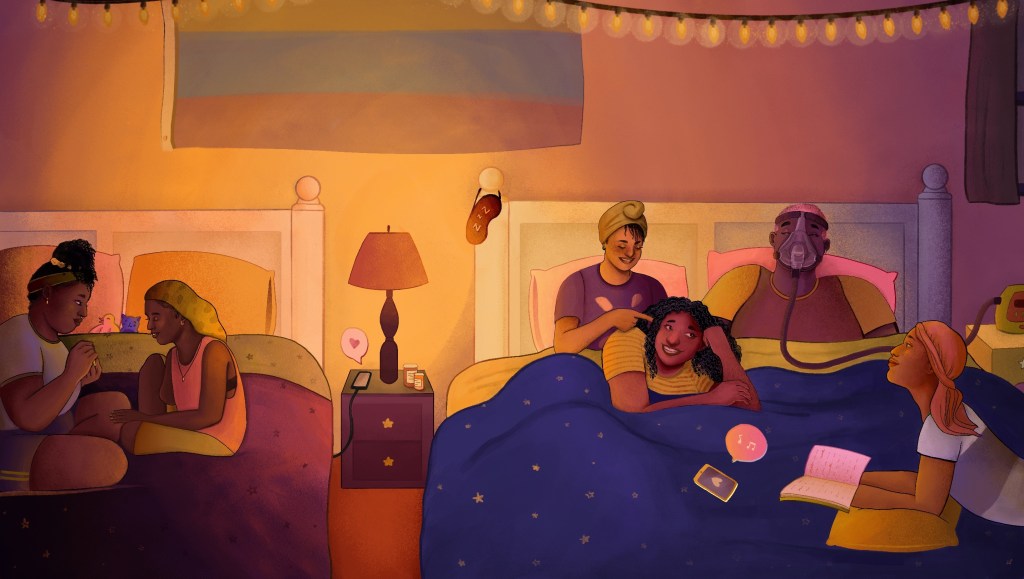
Credit: Jonathan Soren Davidson for Disabled And Here
Naps help you wake up.
The Nap Ministry

Credit: Jonathan Soren Davidson for Disabled And Here.
Bodymind Affirmation
I believe we should all move in our space in whatever way is most comfortable for our bodyminds.
Please use this space as you need or prefer.
Sit in chairs or on the floor, pace, lie on the floor, rock, flap, spin, move around, come in and out of the room.
This is an invitation for you to consider what your bodymind needs to be as comfortable as possible in this moment
This is an invitation to remind yourself to remember and to affirm that your bodymind has needs and that those needs deserve to be met, that your bodymind is valuable and worthy, that you deserve to be here, …, to belong.
Against Ableism & White Supremacy: Disability Justice is Our Liberation – YouTube
I know that I myself could not sit still in a room like this for even 15 seconds. So if you are like me and you need to take a break during my presentation, that’s all good. You need to go to the back of the room and pace back and forth, I won’t be offended. You need to leave the room, it’s all good. I myself may wander off in the middle of my presentation, and you all will be accepting, inclusive, and accommodating of that for sure. (Laughter) But, hey, you know what, this is your time.
Lab School Lecture Series – Jonathan Mooney – YouTube
Reminder: Please do what is most comfortable for your body/mind!
Let us know if we can all do something that helps you be more comfortable in this space.
Let’s make space for each other!
I invite you to do whatever your bodies and minds need to be more comfortable and safe.
You can lie down, take notes, don’t take notes, get some water, stretch.
Check in with yourself right now and what you need, whatever helps your body and mind in this moment, in this space
I also welcome any requests for anything we can do to help you be more comfortable in this space.
Collective Community Care: Dreaming of Futures in Autistic Mutual Aid – YouTube
Let’s make space for each other!
Collective Community Care: Dreaming of Futures in Autistic Mutual Aid
Somatic Liberty
Q: How does your training in somatics (both as a therapeutic orientation and your aikido background) factor into your work in the Neurodiversity Movement?
I see cognitive liberty as a core value of the Neurodiversity Movement.
The term cognitive liberty was coined by Wrye Sententia and Richard Glen Boire, the founders of the Center for Cognitive Liberty and Ethics. Cognitive liberty as an ethical value boils down to the idea that individuals have the right to absolute sovereignty over their own brains and their own cognitive processes. Advocates of cognitive liberty often break this idea down into two fundamental guiding ethical principles (originally inspired by the two “commandments” offered by Timothy Leary in The Politics of Ecstasy):
- Individuals have the right to not have their brains and cognitive processes tampered with non-consensually.
- Individuals have the right to tamper with their own brains and cognitive processes, or to voluntarily have them tampered with, in any way they choose.
Those of us who are deeply involved in transformative somatic practices or in the field of Somatic Psychology understand that the psyche is somatically organized, which means that each individual’s distinctive neurocognitive processes are intimately entwined with that individual’s style of movement and embodiment. Changes in movement and embodiment create changes in cognition.
This means that to tamper with a person’s unique individual style of movement and embodiment (for instance, through the behaviorist techniques that are frequently used to make autistic children suppress the outward signs of autism) is to tamper with that person’s cognition, and thus to violate their cognitive liberty.
In other words, freedom of embodiment—that is, the freedom to indulge, adopt, and/or experiment with any styles or quirks of movement and embodiment, whether they come naturally to one or whether one chooses them—is an essential element of cognitive liberty, and thus an essential area of focus for the Neurodiversity Movement. The freedom to be autistic necessarily includes the freedom to give bodily expression to one’s neurodivergence.
Walker, Nick. Neuroqueer Heresies: Notes on the Neurodiversity Paradigm, Autistic Empowerment, and Postnormal Possibilities (pp. 142-143). Autonomous Press.
For somatically-oriented psychotherapists, one important implication of all this is that autistic clients will often have acquired habitual unconscious tensions (what Wilhelm Reich referred to as character armor) that prevent them from giving full expression to the movement style that is natural and optimal for them. These tensions will tend to be especially severe and deep-rooted in clients who, in childhood, were frequently shamed or otherwise abused for their physical expressions of neurodivergence, or who were subjected to behaviorist “therapies” or other forms of coerced physical conformity.
An integration of the neurodiversity paradigm into the field of Somatic Psychology would include the recognition of these habitual tensions as somatic manifestations of internalized oppression. And it seems to me that somatically-oriented psychotherapists, once they have embraced the neurodiversity paradigm, are uniquely qualified to assist autistic clients in the task of liberating themselves from the bonds of such tensions, and thus recovering their capacity for giving full expression to their unique potentials.
Walker, Nick. Neuroqueer Heresies: Notes on the Neurodiversity Paradigm, Autistic Empowerment, and Postnormal Possibilities (p. 143). Autonomous Press..
Somatic Rudder
Sensing and labeling our internal sensations allows them to function more efficiently as our somatic rudder, steering a nimble course through the many decisions of our days. But does the body really have anything to contribute to our thinking—to processes we usually regard as taking place solely in our heads? It does. In fact, recent research suggests a rather astonishing possibility: the body can be more rational than the brain.
Paul, Annie Murphy. The Extended Mind: The Power of Thinking Outside the Brain (p. 29). HarperCollins.
What we discovered was that these regions are visceral somatomotor cortex, they are the feeling and regulation of the state of your guts and viscera. When people experience deep emotionally engaged thinking about complex issues, they are literally playing out that thinking process, our data would suggest and now many other sources of data would suggest, on the substrate of the cortisone cortical regions that literally also are feeling your guts.
Poets have had it right all along.
Keynote: Dr. Mary Helen Immordino-Yang | Solving the Frankenstein Problem – YouTube
“Nonconscious information acquisition,” as Lewicki calls it, along with the ensuing application of such information, is happening in our lives all the time. As we navigate a new situation, we’re scrolling through our mental archive of stored patterns from the past, checking for ones that apply to our current circumstances. We’re not aware that these searches are under way; as Lewicki observes, “The human cognitive system is not equipped to handle such tasks on the consciously controlled level.” He adds, “Our conscious thinking needs to rely on notes and flowcharts and lists of ‘if-then’ statements—or on computers—to do the same job which our non-consciously operating processing algorithms can do without external help, and instantly.”
But—if our knowledge of these patterns is not conscious, how then can we make use of it? The answer is that, when a potentially relevant pattern is detected, it’s our interoceptive faculty that tips us off: with a shiver or a sigh, a quickening of the breath or a tensing of the muscles. The body is rung like a bell to alert us to this useful and otherwise inaccessible information. Though we typically think of the brain as telling the body what to do, just as much does the body guide the brain with an array of subtle nudges and prods. (One psychologist has called this guide our “somatic rudder.”) Researchers have even captured the body in mid-nudge, as it alerts its inhabitant to the appearance of a pattern that she may not have known she was looking for.
Paul, Annie Murphy. The Extended Mind: The Power of Thinking Outside the Brain (p. 25). HarperCollins.
Let’s normalize the concept of bodymind breaks. Take them when you need them. Take them in the bathroom. Take them in the library. Take them outside. Take them when you need to pee. Take them when you are overwhelmed. Take them when you need to cry. Take them when you need to scream. Take them whenever you need to regulate. “At the most basic level, humans need to be regulated.”


