
Getting human-centered, neurodiversity affirming, progressive practices into education, healthcare, and other systems is a battle, a grueling and grinding battle through bad narratives and bad framing.
framing = mental structures that shape the way we see the world
Our community of neurodivergent and disabled people encounters the following narratives over-and-over with dreadful regularity. They are fundamental contributors to the Double Empathy Extreme Problem (DEEP) we neurodivergent and disabled people must attempt to bridge. We make the attempt in hope that, once we do all the work of building the bridge, you will endeavor to meet us halfway.
Get over the bridge by recognizing these frames in your own thinking.
Obstacles to DEI-AB and Neurodiversity Affirming Practice
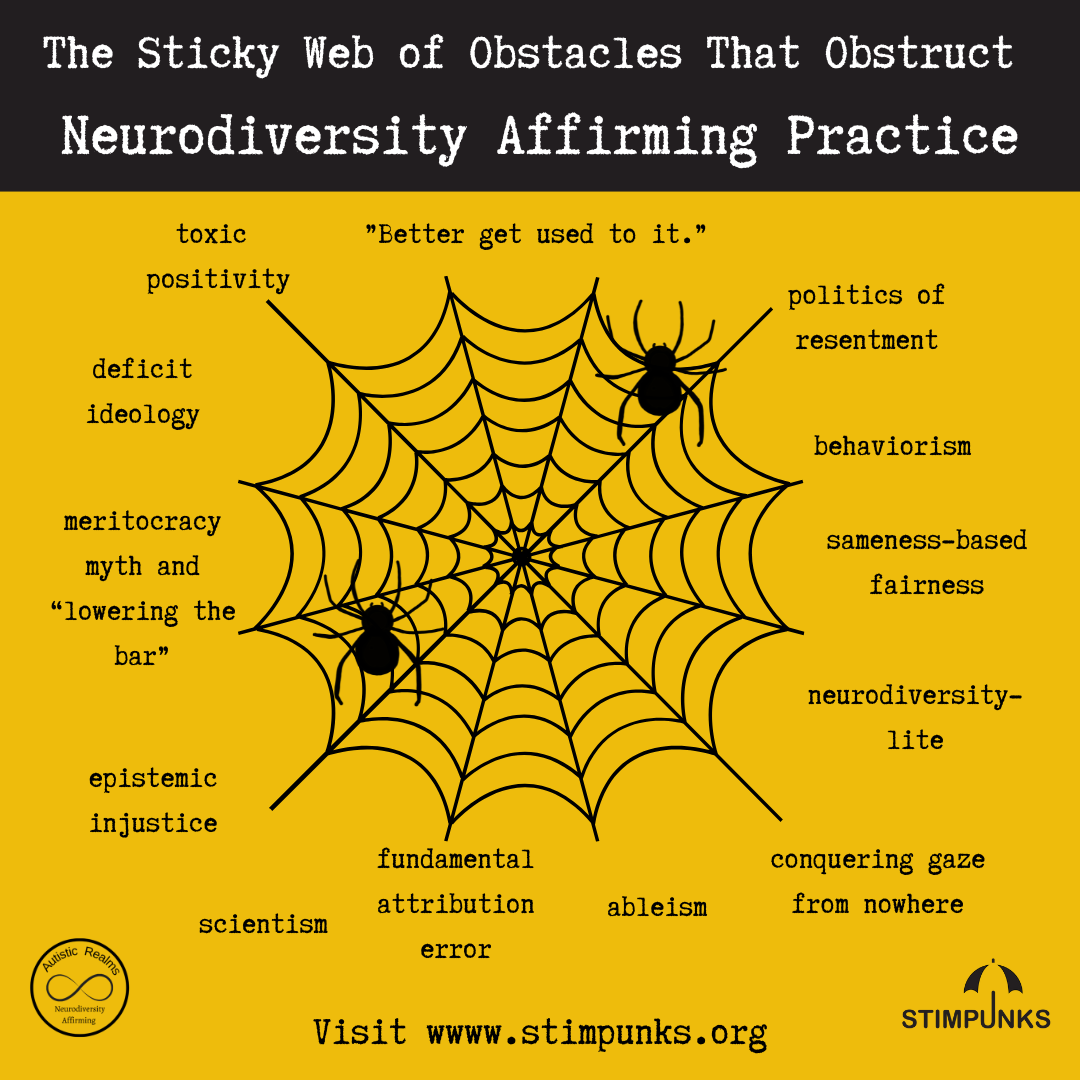
(links are to our glossary, where you can learn much more)
- politics of resentment
- sameness-based fairness
- fundamental attribution error
- conquering gaze from nowhere
- toxic positivity
- neurodiversity-lite
- scientism
- epistemic injustice
- behaviorism
- ableism
- deficit ideology
- ”Better get used to it.”
- meritocracy myth
- “lowering the bar”
politics of resentment = manipulations of status anxiety; organization of interest groups based on perceived deprivation or the threat of deprivation
sameness-based fairness = notion of fairness where everyone gets the same thing rather than each getting what they need
fundamental attribution error = to underestimate the impact of situational factors and to overestimate the role of dispositional factors in controlling behaviour
conquering gaze from nowhere = the interpretation of objectivity as neutral and not allowing for participation or stances; an uninvolved, uninvested approach that claims objectivity to “represent while escaping representation”
toxic positivity = belief that success happens to good people and failure is just a consequence of a bad attitude rather than structural conditions
neurodiversity-lite = using neurodiversity as a buzzword; a way to profit from the appropriation of a human rights movement; a cottage industry for therapists, clinics, and companies to sell their associated products, classes, books, and training to the public without having a clue about neurodiversity
scientism = the belief that science is the only route to useful knowledge
epistemic injustice = where our status as knowers, interpreters, and providers of information, is unduly diminished or stifled in a way that undermines the agent’s agency and dignity
behaviorism = a dehumanizing mechanism of learning that reduces human beings to simple inputs and outputs
ableism = a system of assigning value to people’s bodies and minds based on societally constructed ideas of normalcy, productivity, desirability, intelligence, excellence, and fitness
deficit ideology = a worldview that explains and justifies outcome inequalities by pointing to supposed deficiencies within disenfranchised individuals and communities
better get used to it = preparing people for oppression by oppressing them
meritocracy myth = a widely held but false assertion that individual merit is always rewarded; the myth of meritocracy is one of the longest lasting and most dangerous falsehoods in American life
lowering the bar = a racist, sexist, and ableist narrative with no basis in reality that represents diversifying hiring pipelines, attracting candidates from underrepresented groups, and supporting them in the workplace as “lowering the bar” by hiring less-qualified individuals
The logistics of disability and difference in a structurally ableist and inaccessible world poisoned by bad framing are exhausting, often impossible. We are perpetual hackers, mappers, and testers of our systems by necessity of survival.
We need your help. We need you to help us bridge the Double Empathy Extreme Problem (DEEP). To do that, we all must change our framing. You cannot be an ally to us until you perceive beyond the framing listed above.
double empathy problem = the mutual incomprehension that occurs between people of different dispositional outlooks (Milton 2013); when people with very different experiences of the world interact with one another, they will struggle to empathise with each other (Milton, 2018)
double empathy extreme problem (DEEP) = mass societal disconnect from each other, our own bodyminds, and nature that obstructs empathizing across cultural, sexual, political, religious, neurodivergent, and any other cross-section of differences (Edgar, 2024)
Meanwhile, we are being ground down. We are fundamentally marked by the system.
We have turned classrooms into a hell for neurodivergence.
Education Access: We’ve Turned Classrooms Into a Hell for Neurodivergence – Stimpunks Foundation
“Sea Glass Survivors” is one of the most beautifully powerful pieces of research we have ever read about the autistic experience of unmet needs in the education system.
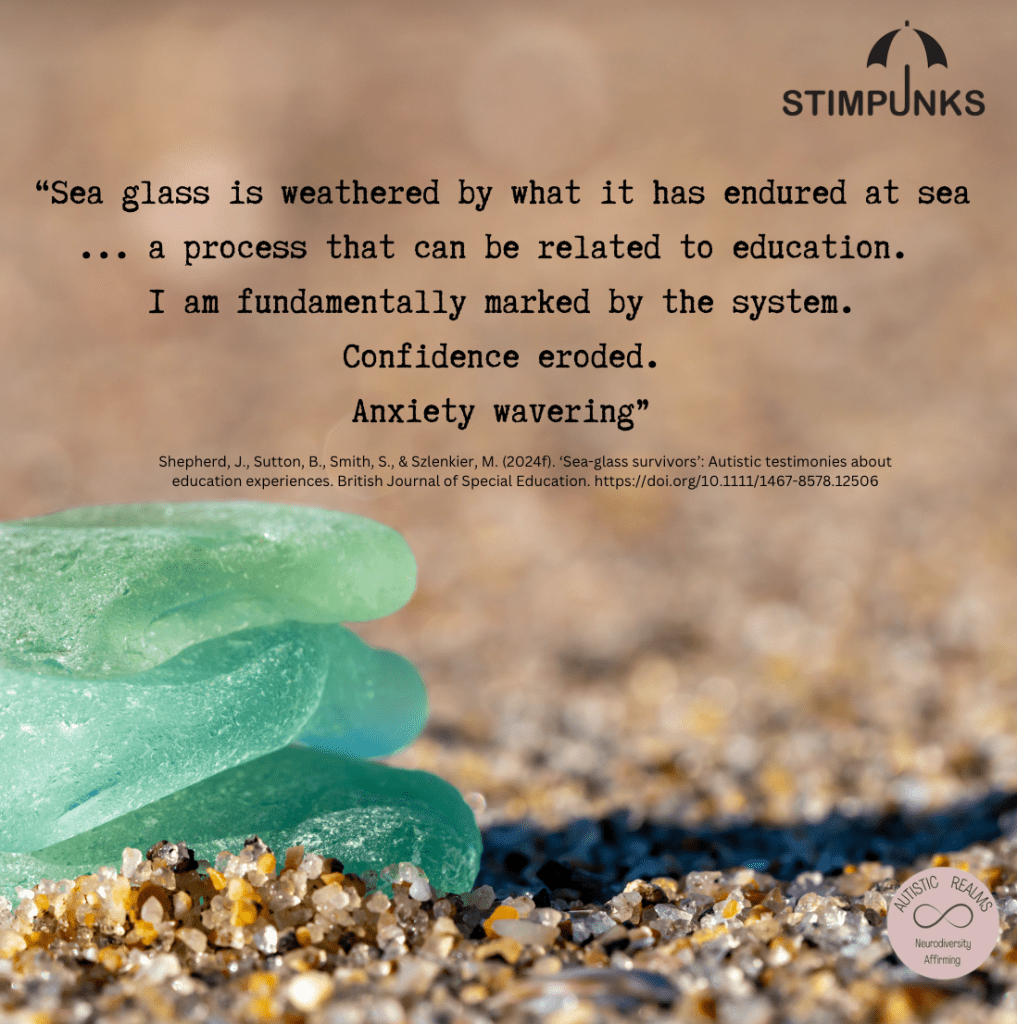
Sea glass is weathered by what it has endured at sea (Figure 2), a process that can be related to education. I am fundamentally marked by the system. Confidence eroded. Anxiety wavering. Now, overcompensation is a form of self-preservation, taking breaks is still unnatural and achievements come with a little sense of pride. Just as sea glass is ground down by every knock, its eventual form is a sum of its aquatic endurance.
Positive memories of education have been flooded by the negative. Instead, I course through the ocean propelled to defy the lack of expectations imposed on me, but also by defiance, to disprove those who wrote me off.
However, a life tussling with the tide-against the odds— has also left its mark more positively. The researcher, practitioner, colleague and peer I am today refuses to entertain ideas or set up environments that make some people (neurominority) feel less intelligent, inadequate or inferior, than others (neuromajority), just as my secondary school English teacher and other curious individuals did. In many ways, these moments anchor my practice.
‘Sea‐glass survivors’: Autistic testimonies about education experiences – Shepherd – British Journal of Special Education – Wiley Online Library


Leave a Reply