Given the entwined nature of queer liberation and neurodivergent liberation, I’ll take this opportunity to remind you that Gwen Nelson, the original creator of Autistic Pride Day, is a trans woman.
Members of the neurodiversity movement adopt a position of diversity that encompasses a kaleidoscope of identities that intersects with the queer kaleidoscope.
Members of the neurodiversity movement adopt a position of diversity that encompasses a kaleidoscope of identities that intersects with the LGBTQIA+ kaleidoscope by recognising neurodivergent traits – including but not limited to ADHD, Autism, Dyscalculia, Dyslexia, Dyspraxia, Synesthesia, Tourette’s Syndrome – as natural variations of cognition, motivations, and patterns of behaviour within the human species.
LGBTQI+ people with an Autistic diagnosis have two separate rainbows — and two separate coming out stories.
LGBTQI+ people with an Autistic diagnosis have two separate rainbows — and two separate coming out stories. There are times when an autistic will not come out as LGBTQI+, and vice-versa. The challenges for each minority group are great, and being a double-social minority can be especially tough. Education and peer support goes a long way in helping to navigate these challenges, and make for a smoother trip on the social highway.
The impulse to repress transgender people from expressing their true identity is rooted in the same impulse that makes people want to stop Autistic people from flapping.
In many ways, the impulse to repress transgender people from expressing their true identity is rooted in the same impulse that makes people want to stop #ActuallyAutistic people from flapping their hands.
Autistic individuals can offer novel insights into gender as a social process.
Due both to their ability to denaturalize social norms and to their neurological differences, autistic individuals can offer novel insights into gender as a social process. Examining gender from an autistic perspective highlights some elements as socially constructed that may otherwise seem natural and supports an understanding of gender as fluid and multidimensional.
Plenty of autistic people are queer and experience a double portion of discrimination.
…plenty of autistic people are LGBTQ and experience a double portion of discrimination. The desire to eliminate the traits that make autistic people unique is rooted in the same impulse to suppress people from affirming their gender identity or sexuality.
A brief thread about why the fates of LGBTQ+ and #ActuallyAutistic people are intertwined (to say nothing of LGBTQ+ autistic people). This right here is Ole Ivar Lovaas, the father of modern-day Applied Behavioral Analysis.
For the first week of #Pride2022: a brief thread about why the fates of LGBTQ+ and #ActuallyAutistic people are intertwined (to say nothing of LGBTQ+ autistic people). This right here is Ole Ivar Lovaas, the father of modern-day Applied Behavioral Analysis. 1/
Lovaas ran a clinic at UCLA, where autistic children were slapped, administered shock therapy. LIFE Magazine profiled his practices in 1965, showing how one girl was taken to a “shock room” when she made little progress.
When children behaved well, they were given food and affection. Children were initially not given regular meals and only spoonfuls of food at first.
Lovaas had an extremely low opinion of his autistic patients. In a 1974 interview, he demeaned autistic people stimming (which we now know is a means of soothing). He also called them “little monsters.”
But Lovaas’s practice did not just end when it came to autistic children. As @stevesilberman wrote in his book #NeuroTribes, he also assisted with UCLA’s Feminine Boy Project, which sought to cure boys of atypical sexuality, including homosexuality.
Lovaas collaborated with a researcher named George Rekers and co-authored four papers on homosexuality and other behaviors. One of their main test subjects was a boy named Kirk Murphy, whom they called “Craig.”
Lovaas and Rekers’ practices bore stunning similarities to Lovaas’s practices on autistic children. Poor Kirk’s parents were instructed to use poker chips. Blue poker chips were used as a reward to get candy while red chips meant he would be spanked.
CW suicide: The red poker chips were given when he displayed feminine behavior. The whippings were so unbearable that Kirk’s brother would hide the red chips. Kirk later joined the US Armed forced before he later died from suicide.
All the while, Rekers and Lovaas’s research was used to show that conversion therapy worked. Rekers would co-found the Family Research Council, which opposes LGBTQ+ rights. More on Kirk’s tragic end here.
Poor Kirk Murphy and Pamela, the girl who was subjected to shock therapy shared a similar fate because the adults in charge of them punished them for who were.
People might wonder why I, a cisgender heterosexual from the suburbs of Southern California, included queer history in a book about autism. THIS is why. The same people who want to stop queer kids from being themselves are the same ones who want to stop me from flapping my hands
Conversely, when I first moved to Washington, the gay community openly embraced me and getting to know gay people helped me shed my own homophobia AND my internalized ableism. It’s why transphobia also bugs me so much.
Learning about the shared DNA of gay conversion therapy and ABA reaffirmed what Martin Luther King wrote in 1963 “We are caught in an inescapable network of mutuality, tied in a single garment of destiny.”
Why the ‘treatment’ of autism is a form of conversion therapy. The only government-funded therapy for autistic children is called Applied Behaviour Analysis, an approach developed in tandem with discredited anti-LGBTQ2S+ practises.
Both gay conversion therapy and ABA were built on behaviourism—the scientific belief that human behaviour is determined by conditioning from our immediate environments, and should be controlled through manipulating those environments. Behaviourist psychology has always seen queer and autistic identities as deviant, and so the pathologies around both were constructed at the same time, and from the same body of research. This is why many autistics today argue that ABA is actually its own form of conversion therapy.
New and old ABA share the same goal, and the same end result: converting autistic traits. And in doing so, ABA also acts as a form of queer conversion, says Negrazis, because “[autistic] genders and sexualities are inherently pathologized as abnormal.” This means ABA sees nonconforming autistic children as being socially confused about appropriate dress or play styles, and aims to condition them toward their assigned gender.
“It’s all about policing unruly bodies,” says Negrazis. “Lovaas actively constructed gender and sexual divergence as disabled, which created an inherent disableism in the emergence of queer identities.”
Lovaas himself made this comparison in his writings on the Feminine Boy Project, calling gay or gendernonconforming males “socially handicapped individuals.” He spoke of queerness and transness having “serious disabling consequences for adults … [that] may range from interference with normal heterosexual relationships, to a continuing sense of shame and fear.”
Just like queer and trans people, autistics do not have a disease that needs to be treated. Instead, says Negrazis, “[autistics] need supports to help them identify how trauma has impacted them in their learning, relationships, ability to work and even their self-concept.”
“The psych industry has done so much harm to both [autistic and queer] people,” they say. “The very foundations of psychology and counselling need to be dismantled and rebuilt by queer and autistic people themselves.”
In line with a disability justice approach, one of the more positive recent developments is the theory and praxis of neuroqueering. Stemming from the work of Nick Walker and Remi Yergeau, neuroqueering focuses on embracing weird potentials within one’s neurocognitive space, and turning everyday comportment and behaviour into forms of resistance. This has provided a new tool for combatting neuronormativity from within the constraints imposed by history and current material conditions. By queering the social world, new possibilities are carved out for the future, helping us not just challenge aspects of the current order but to start collectively imagining what a different world could be like.
Queer and neurodivergent liberation are connected.
LGBTQI+ individuals with autism have unique experiences.
Repressing transgender people and stopping autistic individuals from expressing themselves are rooted in the same impulse.
Autistic individuals can provide insights into gender as a social process.
Autistic people often face discrimination and double discrimination if they are also queer.
Prolonged Adaptation Stress Syndrome occurs when someone pretends to be someone they’re not.
The closet can only hide someone, it doesn’t remove shame.
The treatment of autism is compared to conversion therapy.
Applied Behavior Analysis, the government-funded therapy for autistic children, is associated with discredited anti-LGBTQ2S+ practices.
Neuroqueering, based on the work of Nick Walker and Remi Yergeau, embraces unique neurocognitive abilities and turns everyday behavior into resistance.
By queering the social world, new possibilities are created for a different future.
Embrace our weird potentials and be proud of who we are.
One Paragraph Summary
Queer and neurodivergent liberation are closely connected, forming a double rainbow of identities. The neurodiversity movement recognizes neurodivergent traits, such as ADHD, Autism, Dyslexia, and Tourette’s Syndrome, as natural variations of cognition, motivations, and behavior. LGBTQIA+ individuals with an Autistic diagnosis face unique challenges and have separate coming out stories. Repressing transgender individuals and stopping Autistic people from stimming are rooted in the same impulse to suppress self-expression. Autistic individuals offer valuable insights into gender as a social process, highlighting its fluidity and multidimensionality. Autistic people who are queer experience discrimination from both communities. Pretending to be something one is not on a daily basis leads to Prolonged Adaptation Stress Syndrome, contributing to mental illness in the trans community and autistic burnout. The history of LGBTQ+ conversion therapy and Applied Behavioral Analysis for autism are intertwined, demonstrating the interconnectedness of these marginalized communities. Embracing neuroqueering and queering the social world opens up new possibilities for resistance and collective imagination. It is important to be proud of our weird potentials and embrace ourselves for who we are.
Six Paragraph Summary
Queer and neurodivergent liberation are connected. It’s like seeing a double rainbow.
Members of the neurodiversity movement believe in embracing diversity, including a range of identities that intersect with the queer community. LGBTQI+ individuals who are also Autistic have two separate experiences of coming out. The same impulse to suppress transgender people from expressing their true selves also exists in trying to stop Autistic people from engaging in behaviors like flapping. Autistic individuals can offer unique insights into gender as a social process. Many Autistic people also face discrimination for being queer, which means they experience a double dose of discrimination.
Prolonged Adaptation Stress Syndrome is what happens when someone pretends to be something they’re not every day. It’s important to understand that the closet can only hide someone, it can’t protect them from feeling shame.
The “treatment” of autism is similar to conversion therapy. The only government-funded therapy for autistic children is called Applied Behavior Analysis, which was developed alongside discredited anti-LGBTQ2S+ practices.
In line with a disability justice approach, there’s a positive development called neuroqueering. It focuses on embracing the unique potentials within one’s neurocognitive space and using everyday behavior as a form of resistance. By challenging neuronormativity and queering the social world, we can imagine a different future.
Embrace our unique potentials and be proud of who we are. We’re weird, and that’s something to celebrate. Being weird is just embracing ourselves.
AI Disclosure: The summaries above were created with the help of Elephas AI Assistant.
Here comes the sun It's shining right through you On everyone It hits so hard with all the colors that there are You hit so hard with all the colors that there are
So much fun talking with Weirdschooling about books, libraries… and the beauty of weird! ☺️💚 ⬇️ weirdschooling.com/2230136/13886867-episode-10-libraries-and-books-are-for-everyone-and-so-is-mychal-threets #BookTok#LibraryTikTok#Storytime
Autistic Pride is inconceivable without weird pride, and it’s hard to be proud of any kind of neurodivergence without it. A lot of neurodivergent kids learn early on that they’re ‘weird’. The lucky ones learn to embrace it before they’re forced to internalise the implied shame.
Creativity is driven by divergent perspectives, and squashed by demands for conformity. That doesn’t stop people bullying those they see as weird, trying to hammer them into something resembling normality. But weirdness is rarely a choice. It can be hidden but not opted out of.
There is a lot of stigma attached to the concept of weirdness, and a lot of effort is spent chasing some idea of ‘normal’. This is harmful for everyone who’s perceived as weird, and that often includes immigrants, disabled people, queer and trans people and those with minority religious and ethical beliefs. It also includes just about everyone who’s neurodivergent, be they autistic, dyspraxic, dyslexic, ADHD, or otherwise different of brain. Weirdmisia — hatred of the weird — is the enemy of diversity.
I see Weird Pride as a necessary counter to the prevailing negativity about weirdness, so I’m inviting all weirdos and even non-weirdos* to write, talk, tweet and make art about how they’re weird, and why that’s okay.
We’ve been there playing our part and contributing to the mix since the year dot. We’re an old potential, baked into the template of all our genomes that will survive even the most brutal eugenicists and fundamentalists. We’re here to stay folks.
Other than the obvious eugenics, I think one of the reasons acknowledging that neurodivergence is actually a normal part of humanity is that it has led to people questioning everything from ableism to child rearing practices to education and even how society functions as a whole.
I stand on a line that goes back
That goes back to the dawn of my kind before that
Before that, to the dawn of all time
That extends, that extends
To the end of it all, where it begins again
I stand on the line that goes back
That goes back to the dawn of my kind
Before that
Before that
To the dawn of all time
Going in, going in
To the end where it all begins
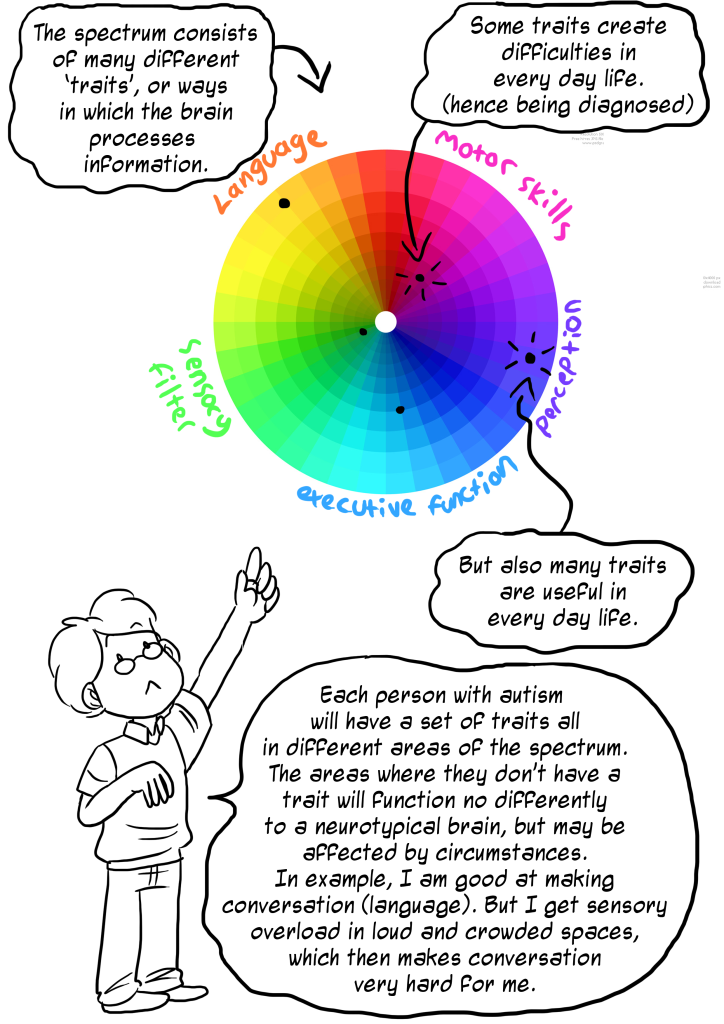
If you are looking to contact me about my “Understanding The Spectrum” comic, please find a print-quality PDF of the comic at this link here. No need to email me to ask for permission to use it, I have always intended for the comic to be completely free to use in whatever you like, be it in presentations or for translating. When you do use it though, please credit me for the image and let me know that you’ve used it, because I love to know that this old comic is still doing much good in the world!
Emergent strategy is a way that all of us can begin to see the world in life-code—awakening us to the sacred systems of life all around us. Many of us have been and are becoming students of these systems of life, wondering if in fact we can unlock some crucial understanding about our own humanity if we pay closer attention to this place we are from, the bodies we are in.
The ones who need to learn are not those who think and live outside the box of “normality”, but those who are “well adjusted”, and those who don’t yet see the internalised ableism they have absorbed. As Nora Bateson reiterates, ecologies of care are complex living systems that transcend our individual and capabilities and limitations. The collective path that humanity finds itself on is a transdisciplinary, tanscontextual journey of omni-directional learning. We are (re)discovering and (re)learning the sacred language of life.
When we speak of systemic change, we need to be fractal. Fractals—a way to speak of the patterns we see—move from the micro to macro level. The same spirals on sea shells can be found in the shape of galaxies. We must create patterns that cycle upwards. We are microsystems.
Emergence is our inheritance as a part of this universe; it is how we change. Emergent strategy is how we intentionally change in ways that grow our capacity to embody the just and liberated worlds we long for.
Emergence is the way complex systems and patterns arise out of a multiplicity of relatively simple interactions.
But emergence notices the way small actions and connections create complex systems, patterns that become ecosystems and societies. Emergence is our inheritance as a part of this universe; it is how we change. Emergent strategy is how we intentionally change in ways that grow our capacity to embody the just and liberated worlds we long for.
What is Emergent Strategy? “Emergence is the way complex systems and patterns arise out of a multiplicity of relatively simple interactions”—I will repeat these words from Nick Obolenksy throughout this book because they are the clearest articulation of emergence that I have come across. In the framework of emergence, the whole is a mirror of the parts. Existence is fractal—the health of the cell is the health of the species and the planet.
Octavia wrote novels with young Black women protagonists meeting aliens, surviving apocalypse, evolving into vampires, becoming telepathic networks, time traveling to reckon with slave-owning ancestors. Woven throughout her work are two things: 1) a coherent visionary exploration of humanity and 2) emergent strategies for being better humans.
The idea of interdependence is that we can meet each other’s needs in a variety of ways, that we can truly lean on others and they can lean on us. It means we have to decentralize our idea of where solutions and decisions happen, where ideas come from. We have to embrace our complexity. We are complex.
I was looking for language and frameworks to use when exploring the kind of leadership Butler’s protagonists practiced, and found them in conversations with ill and Grace about emergence—interdependence, iteration, being in relationship with constantly changing conditions, fractals.
fractals: the relationship between small and large

A fractal is a never-ending pattern. Fractals are infinitely complex patterns that are self-similar across different scales. They are created by repeating a simple process over and over in an ongoing feedback loop.
Octavia was concerned with scale—understanding that what happens at the interpersonal level is a way to understand the whole of society. In many of her books, she shows us how radical ideas spread through conversation, questions, one to one interactions. Social movements right now are also fractal, practicing at a small scale what we most want to see at the universal level. No more growth or scaling up before actually learning through experience.
Rather than narrowing into one path forward, Octavia’s leaders were creating more and more possibilities. Not one perfect path forward, but an abundance of futures, of ways to manage resources together, to be brilliant together.
Fractals are one form of redundancy that has attracted particular attention from scientists. A fractal pattern is one in which the same motif is repeated at differing scales. Picture the frond of a fern, for example: each segment, from the largest at the base of the plant to the tiniest at its tip, is essentially the same shape. Such “self-similar” organization is found not only in plants but also in clouds and flames, sand dunes and mountain ranges, ocean waves and rock formations, the contours of coastlines and the gaps in tree canopies. All these phenomena are structured as forms built of smaller forms built of still smaller forms, an order underlying nature’s apparently casual disarray.
Fractal patterns are much more common in nature than in man-made environments. Moreover, nature’s fractals are of a distinctive kind. Mathematicians rank fractal patterns according to their complexity on a scale from 0 to 3; fractals found in nature tend to fall in a middle range, with a value of between 1.3 and 1.5. Research shows that, when presented with computer-generated fractal patterns, people prefer mid-range fractals to those that are more or less complex. Studies have also demonstrated that looking at these patterns has a soothing effect on the human nervous system; measures of skin conductance reveal a dip in physiological arousal when subjects are shown mid-range fractals. Likewise, people whose brain activity is being recorded with EEG equipment enter a state that researchers call “wakefully relaxed”—simultaneously alert and at ease—when viewing fractals like those found in nature.
There is even evidence that our ability to think clearly and solve problems is enhanced by encounters with these nature-like fractals.
Queer and neurodivergent people are biological facts.
We are stable parts of the human genome.
If you believe in a Maker, Maker built us in.
Look to Maker and behold the Spectrum!
If you don’t subscribe to a Maker, look to Nature and behold the Spectrum!
Spectrums and fractals are all around us and within us.
We are emergent!
We are not limited to binary desires, identities, and ideals.
Let it be complicated and hard to understand.
Make them uncomfortable and challenge their ideals.
We are bigger than a hexadecimal.
Emergent strategy helps us see the world as life-code.
We are (re)discovering and (re)learning the sacred language of life.
We need to be fractal when speaking of systemic change.
Emergence is how we change and intentionally grow.
Small actions and connections create complex systems.
The health of the cell is the health of the species and the planet.
Octavia Butler’s work explores emergent strategies for being better humans.
Interdependence means meeting each other’s needs and embracing complexity.
Fractals are never-ending patterns found in nature.
Radical ideas spread through conversation and interactions.
Social movements are fractal and practice what we want to see at a larger scale.
Octavia’s leaders created possibilities and managed resources together.
Fractals are common in nature and have a soothing effect on humans.
Our ability to think clearly and solve problems is enhanced by encounters with nature-like fractals.
True colors are beautiful, like a rainbow.
Neurodiversity is one of the most powerful ideas of our generation.
One Paragraph Summary
Queer and neurodivergent people are biological facts and stable parts of the human genome. Whether you believe in a Maker or not, we are a part of the Spectrum. The Spectrum is all around us, represented by spectrums and fractals. It is a glorious and complex concept that captures our diverse and spiky profiles. We are emergent beings, shaped by the systems and patterns of life. We must embrace our complexity and understand that small actions and connections can create complex systems and societies. Octavia Butler’s work explores emergent strategies for being better humans and understanding the interconnectedness of all things. Fractals, which are self-similar patterns repeated at different scales, are found in nature and have a soothing effect on us. Our ability to think clearly and solve problems is enhanced by encounters with these nature-like fractals. The true colors of individuals, their diversity and uniqueness, should be celebrated and embraced. Pluralism and neurodiversity are powerful ideas that can transform toxic cultures into collaborative and inclusive ones.
Five Paragraph Summary
Queer and neurodivergent people are a natural and essential part of human genetics. Whether you believe in a higher power or not, it is clear that we are meant to exist. We can look to nature and see the diverse spectrum of identities and experiences that exist. Spectrums and fractals are all around us, showing us the beauty and complexity of life. We are not limited to binary desires or identities. We are complex and undefined, and we should embrace and celebrate our uniqueness.
Emergent strategy is a way of understanding and navigating the world. It teaches us that small actions and connections can create complex systems and patterns. We can intentionally change and grow to embody the just and liberated worlds we long for. It is about embracing our complexity and understanding that we are interconnected and interdependent. We can learn from the patterns we see in nature, from the micro to the macro level, and apply them to create positive change.
Octavia Butler, a visionary writer, explored emergent strategies in her novels. She showed us that radical ideas can spread through conversation and small interactions. Social movements today are also practicing emergent strategies, creating possibilities and abundance of futures. We should not focus on one perfect path forward, but rather embrace the diversity of ideas and ways to manage resources together.
Fractals are patterns that repeat at different scales, and they are found everywhere in nature. They are a form of redundancy and are more common in natural environments than man-made ones. Looking at fractal patterns has a soothing effect on our nervous system and can enhance our ability to think clearly and solve problems. True colors are beautiful, just like a rainbow. We should not be afraid to let our true colors show.
In summary, queer and neurodivergent people are an integral part of human genetics. We can look to nature and see the diverse spectrum of identities and experiences. Emergent strategy teaches us to embrace our complexity and interdependence. We can learn from the patterns in nature and apply them to create positive change. Fractals are everywhere in nature and have a calming effect on us. We should embrace our true colors and celebrate our uniqueness.
AI Disclosure: The summaries above were created with the help of Elephas AI Assistant.
But I see your true colors
Shining through
I see your true colors
And that's why I love you
So don't be afraid to let them show
Your true colors
True colors are beautiful
Like a rainbow
From our creed: I know that pluralism is our reality. I know that Neurodiversity is one of the most powerful ideas of our generation, and that Neurodiversity friendly forms of collaboration hold the potential to transform pathologically competitive and toxic teams and cultures.
I know you think I'm not something you're afraid of
'Cause you think that you've seen what I'm made of
Well I am even more than the two of them!
Everything they care about is what I am!
I am their fury, I am their patience
I am a conversation!
I am made o-o-o-o-of
Lo-o-o-o-ove, o-o-o-o-ove
And it's stronger than you
Lo-o-o-o-ove, lo-o-o-o-ove, lo-o-o-o-ove
And it's stronger than you
Lo-o-o-o-ove, lo-o-o-o-ove, lo-o-o-o-ove
And it's stronger than you
Lo-o-o-o-ove, lo-o-o-o-ove, lo-o-o-o-ove
We can take turns taking the reins Lean on each other when we need some extra strength We’ll never cave or we’ll never waver And we’ll always become braver and braver
We’ll dance like nobody’s there Wе’ll dance without any cares We’ll talk 'bout problеms we share We’ll talk 'bout things that ain’t fair We’ll sing 'bout things we don’t know We’ll sing to people and show What it means to be young and growing up
Let love conquer your mind Warrior, warrior Just reach out for the light Warrior, warrior I am a warrior-ior-ior-ior-ior Warrior, warrior I am a warrior-ior-ior-ior-ior Warrior, warrior of love
Underneath darkened skies There's a light kept alive
Let love conquer your mind Warrior, warrior Just reach out for the light Warrior, warrior I am a warrior-ior-ior-ior-ior Warrior, warrior I am a warrior-ior-ior-ior-ior Warrior, warrior of love Warrior of love Warrior of love
Hostility is not the road The proper basic human code Chauvinist intolerance is what we loathe Let's embrace diversity By first rejecting bigotry There’s no more room left in society for animosity
We refuse to look away And ignore issues at bay We will conquer the hurdles in our way (We are warriors) (We are warriors) We won't take shit anymore A pebble cuts right to the core All these excuses, what are they for? (We are warriors) We are warriors
We are warriors We are warriors We are warriors We are warriors We are warriors
In addition to speaking different languages, we have different neurotypes with different communication styles and norms of sociality. In the case of misunderstanding, assume good intention.
Tell your truth in such a way that you’re allowing others to tell their truths, too.
Maintain learner safety and remember what it is like to be a new contributor.
You can’t just open the door; you have to put out a welcome mat.
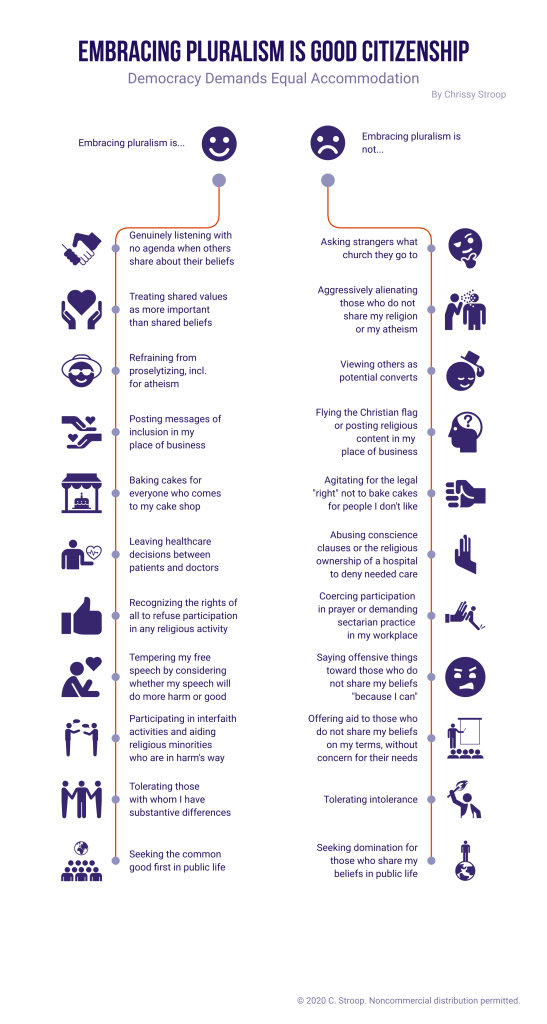
Pluralism refers to people of diverse and conflicting beliefs coexisting peaceably, linked by their adherence to a shared social contract which commits members of different groups to treating others fairly and accommodating them equally in the public square.
I recently called for liberals and non-believers to take the navigation of pluralism seriously, to embrace pluralism as a liberal value, and to engage in discussions of how to fairly and meaningfully achieve equal accommodation in the public square. To do so, to my mind, requires an understanding emphasized by modern social contract theorists like Karl Popper that the toleration of intolerance must have limits, lest the intolerant use the machinery of a tolerant society to take power and end tolerance…
Remind yourself that shared values, rather than shared beliefs, are what matter when it comes to interacting with others, and that there is no replacement for doing the hard work of making yourself better.






Leave a Reply