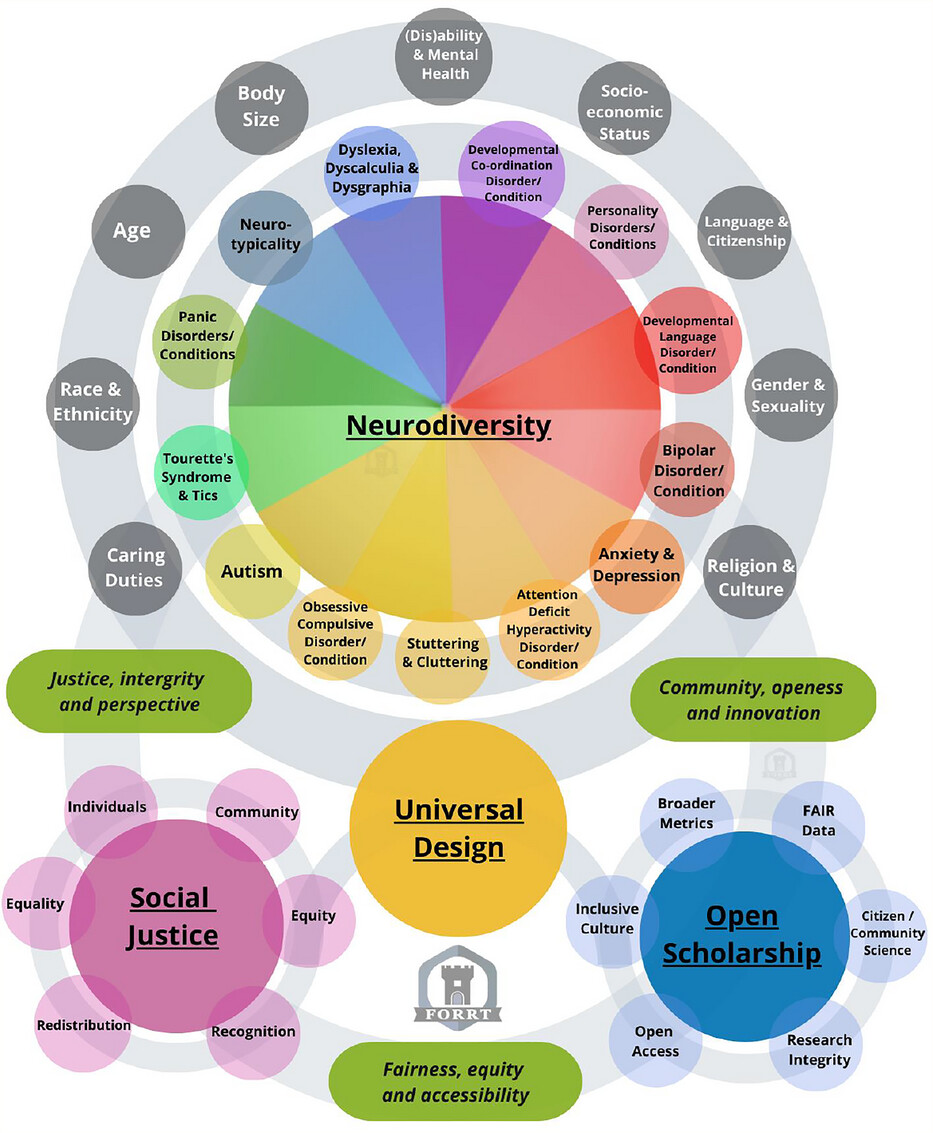
The nested intersecting spheres of neurodiversity, Open Scholarship (OSch), Social Justice, and Universal Design for Learning are shown as four large circles with their examples as smaller circles, all linked by interlocking gray rings labeled with shared values. The top circle is the largest and is labeled neurodiversity and has 12 equal sectors covering the rainbow colors. The smaller spheres of Open Scholarship and Social Justice show key pillars and their interactions with each other. The six pillars in the social justice sphere are adapted from North (2006). The smaller spheres in the neurodiversity sphere illustrate examples of neurodiversity. Examples of neurodiversity are displayed as 13 smaller circles overlapping the neurodiversity circle. The neurodiversity examples listed are Developmental Co-ordination Disorder/Condition, Personality Disorders/Conditions, Developmental Language Disorder/Condition, Bipolar Disorder/Condition, Anxiety and Depression, Attention Deficit Hyperactivity Disorder, Obsessive Compulsive Disorder/Condition, Autism Spectrum Disorder/Condition, Stuttering and Cluttering, Tourette's syndrome and Tics, Panic Disorders/Conditions, Neurotypicality, Dyslexia, Dysgraphia and Dyscalculia. The outermost ring of the neurodiversity sphere indicates other identities (e.g., socio-economic status) that intersect with being neurodivergent/neurotypical and each other. The outermost ring of the neurodiversity circle has nine circles providing examples of identities which can intersect. They read (dis)ability and mental health, socio-economic status, language and citizenship, gender and sexuality, religion and culture, caring duties, race and ethnicity, age, and body size. The outer ring connecting neurodiversity, OSch, and social justice shows the shared values between them, with Universal Design being at the intersection of these values. The neurodiversity circle is linked by a ring to two other circles, social justice, and OSch. The social justice circle is pink and has six central tenets shown as smaller circles labeled as individuals, community, equity, equality, recognition, and redistribution. The shared values of social justice and neurodiversity are labeled as justice, integrity, and perspective. The OSch circle is blue and has six examples shown as broader perspectives, FAIR data, citizen/community science, research integrity, open access, and inclusive culture. The shared values of OSch with neurodiversity are community, openness, and innovation. The shared values of social justice and OSch are fairness, equity, and accessibility. Universal design is shown as a yellow circle linked to social justice and OSch and overlapping with the outer identity ring. Note that our examples of neurodivergence and intersecting identities are not exhaustive. Colour figure can be viewed at wileyonlinelibrary.com

The Nested Intersecting Spheres of Neurodiversity
🗺️

Home/Philosophy / The Nested Intersecting Spheres of Neurodiversity

▶ Table of Contents

The Nested Intersecting Spheres of Neurodiversity

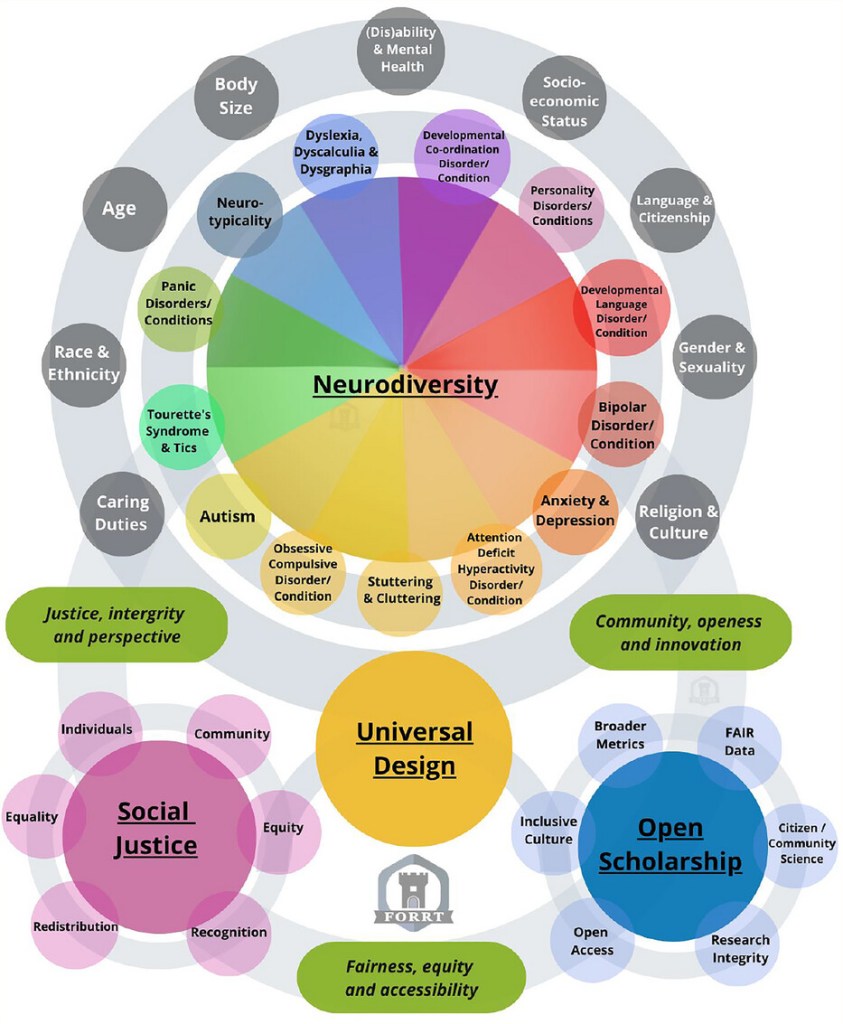
The nested intersecting spheres of neurodiversity, Open Scholarship (OSch), Social Justice, and Universal Design for Learning are shown as four large circles with their examples as smaller circles, all linked by interlocking gray rings labeled with shared values. The top circle is the largest and is labeled neurodiversity and has 12 equal sectors covering the rainbow colors. The smaller spheres of Open Scholarship and Social Justice show key pillars and their interactions with each other. The six pillars in the social justice sphere are adapted from North (2006). The smaller spheres in the neurodiversity sphere illustrate examples of neurodiversity. Examples of neurodiversity are displayed as 13 smaller circles overlapping the neurodiversity circle. The neurodiversity examples listed are Developmental Co-ordination Disorder/Condition, Personality Disorders/Conditions, Developmental Language Disorder/Condition, Bipolar Disorder/Condition, Anxiety and Depression, Attention Deficit Hyperactivity Disorder, Obsessive Compulsive Disorder/Condition, Autism Spectrum Disorder/Condition, Stuttering and Cluttering, Tourette's syndrome and Tics, Panic Disorders/Conditions, Neurotypicality, Dyslexia, Dysgraphia and Dyscalculia. The outermost ring of the neurodiversity sphere indicates other identities (e.g., socio-economic status) that intersect with being neurodivergent/neurotypical and each other. The outermost ring of the neurodiversity circle has nine circles providing examples of identities which can intersect. They read (dis)ability and mental health, socio-economic status, language and citizenship, gender and sexuality, religion and culture, caring duties, race and ethnicity, age, and body size. The outer ring connecting neurodiversity, OSch, and social justice shows the shared values between them, with Universal Design being at the intersection of these values. The neurodiversity circle is linked by a ring to two other circles, social justice, and OSch. The social justice circle is pink and has six central tenets shown as smaller circles labeled as individuals, community, equity, equality, recognition, and redistribution. The shared values of social justice and neurodiversity are labeled as justice, integrity, and perspective. The OSch circle is blue and has six examples shown as broader perspectives, FAIR data, citizen/community science, research integrity, open access, and inclusive culture. The shared values of OSch with neurodiversity are community, openness, and innovation. The shared values of social justice and OSch are fairness, equity, and accessibility. Universal design is shown as a yellow circle linked to social justice and OSch and overlapping with the outer identity ring. Note that our examples of neurodivergence and intersecting identities are not exhaustive. Colour figure can be viewed at wileyonlinelibrary.com
Bridging Neurodiversity and Open Scholarship: How Shared Values Can Guide Best Practices for Research Integrity, Social Justice, and Principled Education – Phan – 2025 – Journal of Social Issues – Wiley Online Library
About the Spheres

The nested intersecting spheres of neurodiversity, Open Scholarship (OSch), Social Justice, and Universal Design for Learning are shown as four large circles with their examples as smaller circles, all linked by interlocking gray rings labeled with shared values. The top circle is the largest and is labeled neurodiversity and has 12 equal sectors covering the rainbow colors. The smaller spheres of Open Scholarship and Social Justice show key pillars and their interactions with each other. The six pillars in the social justice sphere are adapted from North (2006). The smaller spheres in the neurodiversity sphere illustrate examples of neurodiversity. Examples of neurodiversity are displayed as 13 smaller circles overlapping the neurodiversity circle. The neurodiversity examples listed are Developmental Co-ordination Disorder/Condition, Personality Disorders/Conditions, Developmental Language Disorder/Condition, Bipolar Disorder/Condition, Anxiety and Depression, Attention Deficit Hyperactivity Disorder, Obsessive Compulsive Disorder/Condition, Autism Spectrum Disorder/Condition, Stuttering and Cluttering, Tourette’s syndrome and Tics, Panic Disorders/Conditions, Neurotypicality, Dyslexia, Dysgraphia and Dyscalculia. The outermost ring of the neurodiversity sphere indicates other identities (e.g., socio-economic status) that intersect with being neurodivergent/neurotypical and each other. The outermost ring of the neurodiversity circle has nine circles providing examples of identities which can intersect. They read (dis)ability and mental health, socio-economic status, language and citizenship, gender and sexuality, religion and culture, caring duties, race and ethnicity, age, and body size. The outer ring connecting neurodiversity, OSch, and social justice shows the shared values between them, with Universal Design being at the intersection of these values. The neurodiversity circle is linked by a ring to two other circles, social justice, and OSch. The social justice circle is pink and has six central tenets shown as smaller circles labeled as individuals, community, equity, equality, recognition, and redistribution. The shared values of social justice and neurodiversity are labeled as justice, integrity, and perspective. The OSch circle is blue and has six examples shown as broader perspectives, FAIR data, citizen/community science, research integrity, open access, and inclusive culture. The shared values of OSch with neurodiversity are community, openness, and innovation. The shared values of social justice and OSch are fairness, equity, and accessibility. Universal design is shown as a yellow circle linked to social justice and OSch and overlapping with the outer identity ring. Note that our examples of neurodivergence and intersecting identities are not exhaustive. Colour figure can be viewed at wileyonlinelibrary.com

▶ Table of Contents