
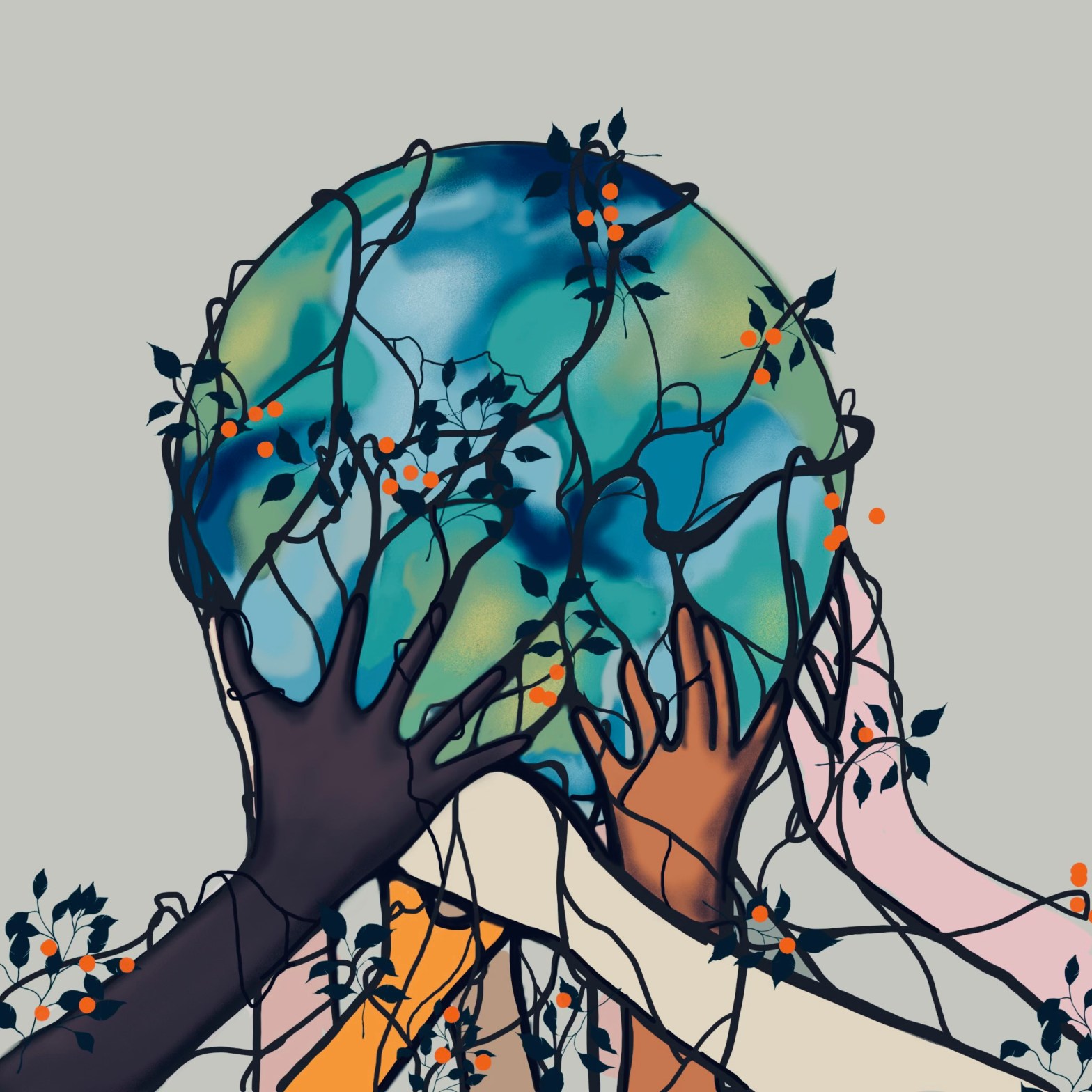
The notion of disability in our society is underscored by a bizarre conception of “independence”.
The Myth of Independence: How The Social Model of Disability Exposes Society’s Double Standards » NeuroClastic
It is time to celebrate our interdependence!
Collaboration allows us to create genuinely safe spaces for autistic and otherwise neurodivergent people.
Interdependence acknowledges that our survival is bound up together, that we are interconnected and what you do impacts others. If this pandemic has done nothing else, it has illuminated how horrible our society is at valuing and practicing interdependence.
You Are Not Entitled To Our Deaths: COVID, Abled Supremacy & Interdependence
Interdependence is the only way out of most of the most pressing issues we face today. If we do not understand that we are interdependent with the planet we as a species will not survive.
To face the challenges of the future, we’ll need the problem-solving abilities of different types of minds working together.
The Best Autism Books, recommended by Steve Silberman

We Are Woven Together
It is time to celebrate our interdependence!
The Myth of Independence: How The Social Model of Disability Exposes Society’s Double Standards » NeuroClastic

This swatch of rainbow woven cloth evokes our biopsychosocial complexity, our diversity, and our interdependence. It evokes the adaptive interdependence of body, mind, nature, and society.
evoke = to make someone remember something or feel an emotion
biopsychosocial = biological + psychological + social = to understand a person’s medical condition it is not simply the biological factors to consider, but also the psychological and social factors
interdependence = our survival is bound up together, we are interconnected, and what we do impacts others
Because we need stronger bonds – to hold each other together, and to keep the world from falling apart. Our mutual entwinement must be careful, spacious and supple, with no single knot tied too tight. In this macramé of loving design, we might find the wisdom, purpose and strength we need, to weave new worlds.
Rosa, Sophie K. Radical Intimacy (pp. 172-173). Pluto Press.
What would it mean to weave a colorful, durable cloth of individuals’ and communities’ relationships, knowledge and skills?
We take the analogy of weaving cloth to highlight the properties and valuable variations of effective educational systems.
PsyArXiv Preprints | Weaving a colorful cloth: Centering education on humans’ emergent developmental potentials
Envisioning humans and their contexts as mutually constitutive threads in a cloth, we ask, how can we most productively approach the interwoven micro- and macro-adaptations in the systems that make up the individual and context? How can we conceptualize and follow the humanistic threads and patterns that individuals and groups dynamically weave through educational environments and processes, in order to most strategically redesign educational systems to support the emergence of diverse human potentials and contributions? What would it mean to weave a colorful, durable cloth of individuals’ and communities’ relationships, knowledge and skills, designing educational systems that center equity and dignity, and attend to variability of experience? How could education systems be designed to enrich human capacities to invent and sustain vibrant and meaningful lives in a vibrant and healthy society?
PsyArXiv Preprints | Weaving a colorful cloth: Centering education on humans’ emergent developmental potentials
In this sense, examining learning and its contexts is like examining the weaving of a cloth—the twists and knots of different threads are interwoven, and distinct patterns, textures and colors are discernable depending on how the observer zooms in or looks from afar. At one distance, threads can represent people in community, holding each other in place in the weave; further magnified, threads could be composed of the fibers of an individual’s skills and experiences, twisted together across the threads of others as they extend through time. The fibers, patterns, and weaves of various cloths will vary substantially according to available resources, needs and aesthetics, from thick wool blankets or rugs, to flowing silk scarves, to sturdy nets or straps. Weaving itself is dynamic: it generates out of disparate parts a unified set of patterns, stronger together as a whole. Cloth also needs repair due to its day-to-day use as well as to unpredictable accidents and tears. Inevitably, new threads and new patterns will take hold. Thinking of education as supporting the weaving of fibers and also as tending to the condition of the whole cloth underscores the shared features of healthy learning communities with well- designed systems and structures, as well as the substantial and valuable variation that will emerge within and across contexts.
PsyArXiv Preprints | Weaving a colorful cloth: Centering education on humans’ emergent developmental potentials
Through their ideas and intentions as well as their actions, communities of individuals continually renew, together, the socio-cultural context in which they are living, including the beliefs, the norms, and the patterns of relationships that organize society’s social fabric—the cloth they are weaving.
PsyArXiv Preprints | Weaving a colorful cloth: Centering education on humans’ emergent developmental potentials
The cloth can be strengthened and enriched, new patterns can be collaboratively generated, and holes and tears repaired.
PsyArXiv Preprints | Weaving a colorful cloth: Centering education on humans’ emergent developmental potentials
Effective education does not simply produce a standardized, predetermined product. It is instead about weaving a colorful cloth that reflects community members’ rich skills and relationships, with generative patterns that integrate complex knowledge and ideas, and that can look different in different contexts.
PsyArXiv Preprints | Weaving a colorful cloth: Centering education on humans’ emergent developmental potentials
Pluralism is our reality.
- Embracing pluralism is good citizenship. Democracy demands equal accommodation.
- Fostering healthy pluralism, which democracy demands, means confronting intolerance.
- Pluralism is our reality.


I intended to represent ND as I made it. I wanted the colors to be the illuminates of the greater intricate whole crystal. I wanted to make something beautiful and detailed with the colors representing myself, and you, and all the people who would want to be those colored sections. Even though the homogeneous black sections are the majority, they are not the entire body. The entire bodymind includes us, with our wounds, our flaws and our sometimes uncharacterizable spiky profiles.
Adriel Jeremiah Wool
I am fighting for an interdependence that embraces need and tells the truth: no one does it on their own and the myth of independence is just that, a myth.
Interdependence acknowledges that our survival is bound up together, that we are interconnected and what you do impacts others. If this pandemic has done nothing else, it has illuminated how horrible our society is at valuing and practicing interdependence. Interdependence is the only way out of most of the most pressing issues we face today. If we do not understand that we are interdependent with the planet we as a species will not survive.
You Are Not Entitled To Our Deaths: COVID, Abled Supremacy & Interdependence
Abled culture teaches you to act as if you are independent, to buy into the myth of independence. Reject this. Embrace interdependence and know it is the only way we will be able to end this pandemic. Know that if we center disabled people, first and foremost those who are high risk, it will help everyone.
You Are Not Entitled To Our Deaths: COVID, Abled Supremacy & Interdependence
This work is about shifting how we understand access, moving away from the individualized and independence-framed notions of access put forth by the disability rights movement and, instead, working to view access as collective and interdependent.
With disability justice, we want to move away from the“myth of independence,” that everyone can and should be able to do everything on their own. I am not fighting for independence, as much of the disability rights movement rallies behind. I am fighting for an interdependence that embraces need and tells the truth: no one does it on their own and the myth of independence is just that, a myth.
Changing the Framework: Disability Justice | Leaving Evidence
It is from being disabled that I heave learned about the dangerous and privileged “myth of independence” and embraced the power of interdependence. The myth of independence being of course, that somehow we can and should be able to do everything on our own without any help from anyone. This requires such a high level of privilege and even then, it is still a myth. Whose oppression and exploitation must exist for your “independence?”
We believe and swallow ableist notions that people should be “independent,” that we would never want to have to have a nurse, or not be able to drive, or not be able to see, or hear. We believe that we should be able to do things on our own and push our selves (and the law) hard to ensure that we can. We believe ableist heteronormative ideas that families should function as independent little spheres. That I should just focus on MY family and make sure MY family is fed, clothed and provided for; that MY family inherits MY wealth; that families should not be dependent on the state or anyone else; that they should be “able-bodied,” essentially. We believe the ableist heteronormative racist classist myth that marriage, “independence” as sanctified through the state, is what we want because it allows us to be more “independent,” more “equal” to those who operate as if they are independent—That somehow, this makes us more “able.”
And to be clear, I do not desire independence, as much of the disability rights movement rallies behind. I am not fighting for independence. I desire community and movements that are collectively interdependent.
Interdependence (exerpts from several talks) | Leaving Evidence
Self-care is birthed by and through community care.
Self-care is birthed by and through community care.
Talila A. Lewis
What is mutual aid?
“Solidarity, not charity.”
Collective Community Care: Dreaming of Futures in Autistic Mutual Aid
- Interdependence, understanding and support
- Gives opportunity to help & care for other in on our own terms and within our own capacities
- Direct support in a community within a community
- It’s much easier to practice asking, offering, receiving, and declining among people who “get it”!
Moving from a rights-based perspective to a justice-based one necessitates a look at our care systems and re-envisioning how our communities function to ensure no one is left behind.
Collective Community Care: Dreaming of Futures in Autistic Mutual Aid, Autscape: 2020 Presentations
Interdependence, real interdependence can be the difference between making the best of a bad situation and spiraling into isolation, burnout and or mental illness. As such, the advice I tend to give new and prospective grad students is focus on building relationships, seek relationships, invest in relationships, lean on your relationships, because no matter how much you think you can just will yourself into focusing on your work, at some point the work is going to suck. Or maybe it won’t. I don’t know. Are you willing to bet your mental wellness?
Remember it’s interdependence, not just dependance. If you have the time and energy, see if you can pay it forward. It’s definitely a lot of work, but it can be a really rewarding to see yourself actually contribute to another person’s wellbeing. Try it sometime!
How to Survive Grad School (and Other Toxic Jobs) – YouTube
Multiple participants discussed how self-determination co-existed with meaningful relationships and partnerships, including family and parenting responsibilities. Although Kyle affirmed the value of freedom in making choices and decisions, he also acknowledged that interdependence is important because “having a group to lift you up or care for you is important for health and wellness.”
Frontiers | Toward understanding and enhancing self-determination: a qualitative exploration with autistic adults without co-occurring intellectual disability
Access intimacy is interdependence in action.
Access intimacy is one of the main ways that I have been building interdependence in my life. I have been pushing myself to grow it and not just subsist on the little I have been able to find, most significantly with my partner, as is the case for many disabled folks. Engaging in building any kind of interdependence will always be a risk, for everyone involved; and the risk will always be greater for those who are more oppressed and have less access to privilege. In an ableist world where disabled people are understood as disposable, it can be especially hard to build interdependence with people you need in order to survive, but who don’t need you in order to survive. In an ableist context, interdependence will always get framed as “burden,†and disability will always get framed as “inferior.†To actively work to build something that is thought of as undeniably undesirable and to try and reframe it to others as liberatory, is no small task.
Especially as disabled people, we know what it means to live interdependent lives and it does not always feel revolutionary or enjoyable.
The power of access intimacy is that it reorients our approach from one where disabled people are expected to squeeze into able bodied people’s world, and instead calls upon able bodied people to inhabit our world.
In my life, access intimacy continues to be a game-changer, a way to queer access into a tool we can use to get free. It has been a way to shift and queer how I and others understand disability and ableism. And because of the inherent interdependence of access intimacy—the “we†of access intimacy—it has transformed the kinds of conversations I am able to have with some of the able bodied people in my life.
Access Intimacy, Interdependence and Disability Justice | Leaving Evidence
Mia Mingus in Hamraie and Fritsch (2019) describe access intimacy as a “crip relational practice produced when interdependence informs the making of access” (p.14). As such, interdependent ways of languaging, like augmented speech, do not appeal to many abled people. For example, as Mackay’s (2003) work with aphasia patients showed, the patients were viewed as incompetent because of their voicelessness. Given an acceptance of interdependence and care work in languaging via crip time, the patients would be viewed as competent (Rossetti et al., 2008).
Unsettling Languages, Unruly Bodyminds: A Crip Linguistics Manifesto | Journal of Critical Study of Communication and Disability
Hamraie (2013) asks us to think about the politics of access through the framework of interdependence. Languaging, as an important site of access—to the world, to politics, to belonging, to citizenship—thus demands that we think about this through the lens of collective access and care. Rejecting monolingualism and mono-modality are two beginning steps. Embracing time, space, and material environments in meaning-making are also preliminary steps. Interdependence also asks us to think about our built environments and how that impacts access (Hamraie, 2013), and in our case, language. Hamraie (2017) also instigates us to consider how discrimination is built into the structures around us, the buildings, the foundations, the frameworks, and theories, and so on. When in the process of crippling linguistics, we question how modality chauvinism has been built into the various language focused fields and the perspectives of what language is and what is good languaging. Hamraie and Fritsch’s (2019) practices of “interdependence, access intimacy, and collective access can be understood as alternative political technologies through Crip technoscience” (p.13). Crip technoscience is “critique, alteration, and reinvention” (p.2). It is how disabled people alter and reinvent the world in order to make access happen. The relationship between science, technology, and language is such that the dismissal of disabled ways of languaging has resulted in inaccessible technologies.
Unsettling Languages, Unruly Bodyminds: A Crip Linguistics Manifesto | Journal of Critical Study of Communication and Disability
One lesson from crip languaging is the idea of interdependence and forms of access intimacy through the discourse process.
View of Unsettling Languages, Unruly Bodyminds: A Crip Linguistics Manifesto
These and other material practices describe a crip technoscientific sensibility wherein disabled interdependence also enables what Mingus (2017) calls “access intimacy,” a crip relational practice produced when interdependence informs the making of access.
Crip Technoscience Manifesto
If, as Kafer argues, disabled people have often uneasy or “ambivalent relationships to technology” (2013, p. 119), our practices of interdependence, access intimacy, and collective access can be understood as alternative political technologies: “disabled people,” she writes, “are not cyborgs…because of our bodies (e.g., our use of prosthetics, ventilators, or attendants), but because of our political practices” (p. 120). Crip technoscience offers interdependence as a central analytic for disability–technology relations, recognizing that in disability culture, community, and knower-maker practices, interdependence acts as a political technology for materializing better worlds.
Crip Technoscience Manifesto
Everyone is causally interconnected with, interdependent with, and fundamentally the same as all other humans.
…the eco-system arises from and responds to the multiple ways in which everyone is causally interconnected with, interdependent with, and fundamentally the same as all other humans, and literary representations of these various types of solidarity, their inherence in human nature, and their benefits to people who recognize and embrace them can help students incorporate these principles into their mental models of human nature and thus both recognize and enact them more productively in their personal, professional, and civic lives.
The most obviously systemic form of interconnectedness is existential: we all depend on other humans for our very existence and survival—that is, for the production and distribution of our food, clothing, and shelter, not to mention the complex technologies that we in the postindustrial world have come to rely on. We are dependent on the work of countless other individuals at every moment in our lives, and we simply could not exist without their direct and indirect contributions to our lives.
Literature, Social Wisdom, and Global Justice: Developing Systems Thinking
‘Rebellion’ is not enough. We need to build new systems from the ground up, right now.
Escaping extinction through paradigm shift
And it means grounding this effort in completely new frame of orientation, one in which human beings are inherently interconnected, and inter-embedded within the earth; where we are not atomistically separated from the reality in which we find ourselves as technocratic overlords, but are co-creators of that reality as individuated parts of a continuum of being.
We need a counterculture of care.
Putting care—not just care work, but care—at the center of our economy, our politics, is to orient ourselves around our interdependence.
The Year That Broke Care Work
The philosophers Joan Tronto and Berenice Fisher lay out five key elements of care…virtues to be developed if you wanted to APPLY an ethics of care to things in your life. Think of this as a sort of HOW TO manual for moral maturity UNDER an ethics of care. These virtues IN ORDER are:
Episode #168 – Introduction to an Ethics of Care — Philosophize This!
- Attentiveness
- Responsibility
- Competence
- Responsiveness
- Plurality
Episode #168 -Transcript — Philosophize This!
“An ethic of justice focuses on questions of fairness, equality, individual rights, abstract principles and the consistent application of them. An ethic of care focuses on attentiveness, trust, responsiveness to need, narrative nuance and cultivating caring relations.”
The Ethics of Care as Moral Theory | The Ethics of Care: Personal, Political, and Global | Oxford Academic
- Care work makes all other work possible.
- Putting care—not just care work, but care—at the center of our economy, our politics, is to orient ourselves around our interdependence.
- Care is an organizational structure needed to keep our nation running. It’s, by definition, infrastructure.
- Health is at the center of the human experience.
- We need a counterculture of care.
- I feel that that the fundamental property of humanness is to fill those spaces where humanity has been abandoned with love. Those who would change the system have to begin with love, and with the vision to build geographies of care built from that love.
- Reframing is self-care and social change.
- Those who are the most sensitive and traumatised and have not lost the ability to extend trust constitute an enormously rich and diverse repository of insights and hold many of the keys needed for co-creating ecologies of care.
- Create more anti-ableist spaces. Let’s act to hold ALL spaces accountable for providing care and access to disabled folks with all types of bodies and minds.
- We can start building more accessible, care-centered communities now. We can combat ableism now. We can lay the groundwork for a world that works better for all of us.
Care is not charity or kindness. Care is the deeply fraught, complex, abolitionist, political work of protecting one another and the planet, meeting everyone’s needs in balance with the collective good, and keeping our communities safe without the use of policing.
Freedom requires care because freedom is not just a right—it is also a responsibility. Freedom means getting to be our whole selves, in community with other whole selves, without any threat to or assault on our well-being. Freedom means an experience of daily life in which each of us is fully seen and affirmed, treated with unconditional dignity and care, and embraced as an invaluable person of immeasurable worth. Freedom, then, sets an incredibly high standard for community life. It requires that every member of the collective work toward the goals of protection, safety, and unconditional care for all people and for the natural world.
Are We Teaching Care or Control?
The activities that constitute care are crucial for human life. We defined care in this way: Care is “a species activity that includes everything that we do to maintain, continue, and repair our “world’ so that we can live in it as well as possible. That world includes our bodies, our selves, and our environment, all of which we seek to interweave in a complex, life-sustaining web” (Fisher and Tronto, 1990, p. 40).
Several aspects of this definition of care are noteworthy: First, we describe care as a “species activity,” a philosophical term we use because it suggests that how people care for one another is one of the features that make people human. Second, we describe care as an action, as a practice, not as a set of principles or rules. Third, our notion of care contains a standard, but a flexible one: We care so that we can live in the world as well as possible. The understanding of what will be good care depends upon the way of life, the set of values and conditions, of the people engaged in the caring practice.
Furthermore, caring is a process that can occur in a variety of institutions and settings.
Care is found in the household, in services and goods sold in the market, in the workings of bureaucratic organizations in contemporary life. Care is not restricted to the traditional realm of mother’s work, to welfare agencies, or to hired domestic servants but is found in all of these realms. Indeed, concerns about care permeate our daily lives, the institutions in the modern marketplace, the corridors of government. Because we tend to follow the traditional division of the world into public and private spheres and to think of caring as an aspect of private life, care is usually associated with activities of the household. As a result, caring is greatly undervalued in our culture- in the assumption that caring is somehow “women’s work,” in perceptions of caring occupations, in the wages and salaries paid to workers engaged in provision of care, in the assumption that care is menial. One of the central tasks for people interested in care is to change the overall public value associated with care. When our public values and priorities reflect the role that care actually plays in our lives, our world will be organized quite differently.
An Ethic of Care on JSTOR
Let's organize our lives around love and care
Let's write each other letters and call it prayer
Let's congregate in the place that isn't anywhere
At the temple of broken dreams
All the systems of oppression are woven together and our work to get free will only succeed when we are woven together.
find your place on deck
The parts we need to survive are scattered All amongst us.
Tinu Abayomi-Paul
For nothing is fixed,
forever, forever, forever,
it is not fixed;
the earth is always shifting,
the light is always changing,
the sea does not cease to grind down rock.
Generations do not cease to be born,
and we are responsible to them
because we are the only witnesses they have.
The sea rises, the light fails,
lovers cling to each other,
and children cling to us.
The moment we cease to hold each other,
the moment we break faith with one another,
the sea engulfs us and the light goes out.

James Baldwin
Interdependence acknowledges that our survival is bound up together, that we are interconnected and what you do impacts others. Interdependence is the only way out of most of the most pressing issues we face today. If we do not understand that we are interdependent with the planet we as a species will not survive.
You Are Not Entitled To Our Deaths: COVID, Abled Supremacy & Interdependence | Leaving Evidence
The great philosopher Ernst Bloch insisted that hope taps into our deepest experiences and that without it reason and justice cannot prevail.
Henry Giroux – Critical Pedagogy in a Time of Fascist Tyranny | Human Restoration Project | Podcast
In The Fire Next Time, James Baldwin, my favorite novelist, adds a call for compassion and social responsibility to this notion of hope, one that is indebted to those who follow us. He writes, “Generations do not cease to be born, and we are responsible to them. The moment we break with one another, the sea engulfs us and the lights go out.”
My friend, the late Howard Zinn, rightly insisted that hope is the willingness, “to sustain, even in times of pessimism, the possibility of surprise.” In addition to that eloquent appeal, I would say that history is open. It’s time to think differently in order to act differently.

If we do not now dare everything, the fulfillment of that prophecy, re-created from the Bible in song by a slave, is upon us: God gave Noah the rainbow sign, No more water, the fire next time!
And here we are, at the center of the arc, trapped in the gaudiest, most valuable, and most improbable water wheel the world has ever seen. Everything now, we must assume, is in our hands; we have no right to assume otherwise. If we—and now I mean the relatively conscious whites and the relatively conscious blacks, who must, like lovers, insist on, or create, the consciousness of the others—do not falter in our duty now, we may be able, handful that we are, to end the racial nightmare, and achieve our country, and change the history of the world. If we do not now dare everything, the fulfillment of that prophecy, re-created from the Bible in song by a slave, is upon us: God gave Noah the rainbow sign, No more water, the fire next time!
The Fire Next Time by James Baldwin
In order for this to happen, your entire frame of reference will have to change, and you will be forced to surrender many things that you now scarcely know you have.
The Fire Next Time by James Baldwin
The glorification of one race and the consequent debasement of another—or others—always has been and always will be a recipe for murder. There is no way around this. If one is permitted to treat any group of people with special disfavor because of their race or the color of their skin, there is no limit to what one will force them to endure, and, since the entire race has been mysteriously indicted, no reason not to attempt to destroy it root and branch. This is precisely what the Nazis attempted. Their only originality lay in the means they used.
The Fire Next Time by James Baldwin
Whoever de-bases others is debasing himself. That is not a mystical statement but a most realistic one, which is proved by the eyes of any Alabama sheriff.
The Fire Next Time by James Baldwin
Please try to remember that what they believe, as well as what they do and cause you to endure, does not testify to your inferiority but to their inhumanity and fear.
The Fire Next Time by James Baldwin
We are caught in an inescapable network of mutuality, tied in a single garment of destiny.
Letter from Birmingham Jail, Dr. Martin Luther King, Jr.
Header art: “Interdependence” by Heike Blakley is licensed under CC BY-SA 4.0


