
Human cognitive diversity exists for a reason; our differences are the genius – and the conscience – of our species.
A Thousand Rivers
Queer and neurodivergent people are biological facts.
We are stable parts of the human genome.
If you believe in a Maker, Maker built us in.
Look to Maker and behold the Spectrum!
If you don’t subscribe to a Maker,
Look to Nature and behold the Spectrum!
Spectrums and fractals are all around us and within us.
We are emergent!
How Glorious!
We’ve been there playing our part and contributing to the mix since the year dot. We’re an old potential, baked into the template of all our genomes that will survive even the most brutal eugenicists and fundamentalists. We’re here to stay folks.
Autism Might NOT Be What You THINK It Is: The 3rd Paradigm – YouTube

Other than the obvious eugenics, I think one of the reasons acknowledging that neurodivergence is actually a normal part of humanity is that it has led to people questioning everything from ableism to child rearing practices to education and even how society functions as a whole.
Post by @monsterteatime.bsky.social — Bluesky
I stand on a line that goes back
That goes back to the dawn of my kind before that
Before that, to the dawn of all time
That extends, that extends
To the end of it all, where it begins again
I stand on the line that goes back
That goes back to the dawn of my kind
Before that
Before that
To the dawn of all time
Going in, going in
To the end where it all begins
Understanding the Spectrum
“Understanding the Spectrum” by Rebecca Burgess is a popular re-conceptualization of the autism spectrum from a line to a color wheel. A color wheel better captures our spiky profiles. Thank you, Rebecca, for giving this to the world.
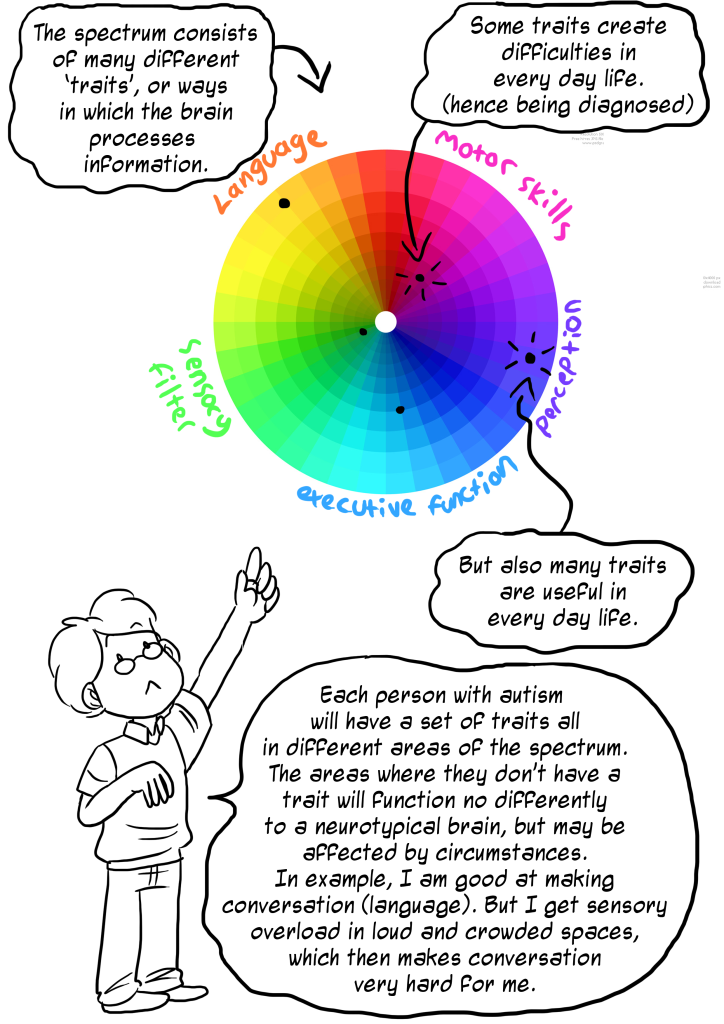
Read the full comic on “Understanding the Spectrum”.
If you are looking to contact me about my “Understanding The Spectrum” comic, please find a print-quality PDF of the comic at this link here. No need to email me to ask for permission to use it, I have always intended for the comic to be completely free to use in whatever you like, be it in presentations or for translating. When you do use it though, please credit me for the image and let me know that you’ve used it, because I love to know that this old comic is still doing much good in the world!
contact | rebecca-burgess
You are not a computer
You are complex and undefined
So why let yourself be limited to binary desires?

To binary identities and binary ideals
Like switching on or switching off
Choosing a bow tie or high heels

But the world tells us (01 01 01 01 01)
No we are not (01 01 01 01 01)
Body or head not (01 01 01 01 01)
Capacity for love not (01 01 01 01 01)

So let it be complicated
And hard to understand
You know they would envy you
If they got their heads out of the sand

So make them uncomfortable
And challenge their ideals
Because those antiquated notions
Are blinding what is real

I am bigger than a hexadecimal
I am bigger than a hexadecimal
I am bigger than a hexadecimal
Binary by The Spook School
Emergence
Emergent strategy is a way that all of us can begin to see the world in life-code—awakening us to the sacred systems of life all around us. Many of us have been and are becoming students of these systems of life, wondering if in fact we can unlock some crucial understanding about our own humanity if we pay closer attention to this place we are from, the bodies we are in.
Emergent Strategy: Shaping Change, Changing Worlds
The ones who need to learn are not those who think and live outside the box of “normality”, but those who are “well adjusted”, and those who don’t yet see the internalised ableism they have absorbed. As Nora Bateson reiterates, ecologies of care are complex living systems that transcend our individual and capabilities and limitations. The collective path that humanity finds itself on is a transdisciplinary, tanscontextual journey of omni-directional learning. We are (re)discovering and (re)learning the sacred language of life.
Life in the compost heap of the industrialised mono-cult | Autistic Collaboration
When we speak of systemic change, we need to be fractal. Fractals—a way to speak of the patterns we see—move from the micro to macro level. The same spirals on sea shells can be found in the shape of galaxies. We must create patterns that cycle upwards. We are microsystems.
Emergent Strategy: Shaping Change, Changing Worlds

Emergence is our inheritance as a part of this universe; it is how we change. Emergent strategy is how we intentionally change in ways that grow our capacity to embody the just and liberated worlds we long for.
Emergence is the way complex systems and patterns arise out of a multiplicity of relatively simple interactions.
Emergent Strategy: Shaping Change, Changing Worlds
But emergence notices the way small actions and connections create complex systems, patterns that become ecosystems and societies. Emergence is our inheritance as a part of this universe; it is how we change. Emergent strategy is how we intentionally change in ways that grow our capacity to embody the just and liberated worlds we long for.
Emergent Strategy: Shaping Change, Changing Worlds
What is Emergent Strategy? “Emergence is the way complex systems and patterns arise out of a multiplicity of relatively simple interactions”—I will repeat these words from Nick Obolenksy throughout this book because they are the clearest articulation of emergence that I have come across. In the framework of emergence, the whole is a mirror of the parts. Existence is fractal—the health of the cell is the health of the species and the planet.
Emergent Strategy: Shaping Change, Changing Worlds
Octavia wrote novels with young Black women protagonists meeting aliens, surviving apocalypse, evolving into vampires, becoming telepathic networks, time traveling to reckon with slave-owning ancestors. Woven throughout her work are two things: 1) a coherent visionary exploration of humanity and 2) emergent strategies for being better humans.
Emergent Strategy: Shaping Change, Changing Worlds
The idea of interdependence is that we can meet each other’s needs in a variety of ways, that we can truly lean on others and they can lean on us. It means we have to decentralize our idea of where solutions and decisions happen, where ideas come from.
Emergent Strategy: Shaping Change, Changing Worlds
We have to embrace our complexity. We are complex.
I was looking for language and frameworks to use when exploring the kind of leadership Butler’s protagonists practiced, and found them in conversations with ill and Grace about emergence—interdependence, iteration, being in relationship with constantly changing conditions, fractals.
Emergent Strategy: Shaping Change, Changing Worlds
fractals: the relationship between small and large
A fractal is a never-ending pattern. Fractals are infinitely complex patterns that are self-similar across different scales. They are created by repeating a simple process over and over in an ongoing feedback loop.
Emergent Strategy: Shaping Change, Changing Worlds
Rather than narrowing into one path forward, Octavia’s leaders were creating more and more possibilities. Not one perfect path forward, but an abundance of futures, of ways to manage resources together, to be brilliant together.
Emergent Strategy: Shaping Change, Changing Worlds
Fractals are one form of redundancy that has attracted particular attention from scientists. A fractal pattern is one in which the same motif is repeated at differing scales. Picture the frond of a fern, for example: each segment, from the largest at the base of the plant to the tiniest at its tip, is essentially the same shape. Such “self-similar” organization is found not only in plants but also in clouds and flames, sand dunes and mountain ranges, ocean waves and rock formations, the contours of coastlines and the gaps in tree canopies. All these phenomena are structured as forms built of smaller forms built of still smaller forms, an order underlying nature’s apparently casual disarray.
Fractal patterns are much more common in nature than in man-made environments. Moreover, nature’s fractals are of a distinctive kind. Mathematicians rank fractal patterns according to their complexity on a scale from 0 to 3; fractals found in nature tend to fall in a middle range, with a value of between 1.3 and 1.5. Research shows that, when presented with computer-generated fractal patterns, people prefer mid-range fractals to those that are more or less complex. Studies have also demonstrated that looking at these patterns has a soothing effect on the human nervous system; measures of skin conductance reveal a dip in physiological arousal when subjects are shown mid-range fractals. Likewise, people whose brain activity is being recorded with EEG equipment enter a state that researchers call “wakefully relaxed”—simultaneously alert and at ease—when viewing fractals like those found in nature.
There is even evidence that our ability to think clearly and solve problems is enhanced by encounters with these nature-like fractals.
The Extended Mind – Annie Murphy Paul
In other words…
One Idea Per Line
- Queer and neurodivergent people are biological facts.
- We are stable parts of the human genome.
- If you believe in a Maker, Maker built us in.
- Look to Maker and behold the Spectrum!
- If you don’t subscribe to a Maker, look to Nature and behold the Spectrum!
- Spectrums and fractals are all around us and within us.
- We are emergent!
- We are not limited to binary desires, identities, and ideals.
- Let it be complicated and hard to understand.
- Make them uncomfortable and challenge their ideals.
- We are bigger than a hexadecimal.
- Emergent strategy helps us see the world as life-code.
- We are (re)discovering and (re)learning the sacred language of life.
- We need to be fractal when speaking of systemic change.
- Emergence is how we change and intentionally grow.
- Small actions and connections create complex systems.
- The health of the cell is the health of the species and the planet.
- Octavia Butler’s work explores emergent strategies for being better humans.
- Interdependence means meeting each other’s needs and embracing complexity.
- Fractals are never-ending patterns found in nature.
- Radical ideas spread through conversation and interactions.
- Social movements are fractal and practice what we want to see at a larger scale.
- Octavia’s leaders created possibilities and managed resources together.
- Fractals are common in nature and have a soothing effect on humans.
- Our ability to think clearly and solve problems is enhanced by encounters with nature-like fractals.
- True colors are beautiful, like a rainbow.
- Neurodiversity is one of the most powerful ideas of our generation.
One Paragraph Summary
Queer and neurodivergent people are biological facts and stable parts of the human genome. Whether you believe in a Maker or not, we are a part of the Spectrum. The Spectrum is all around us, represented by spectrums and fractals. It is a glorious and complex concept that captures our diverse and spiky profiles. We are emergent beings, shaped by the systems and patterns of life. We must embrace our complexity and understand that small actions and connections can create complex systems and societies. Octavia Butler’s work explores emergent strategies for being better humans and understanding the interconnectedness of all things. Fractals, which are self-similar patterns repeated at different scales, are found in nature and have a soothing effect on us. Our ability to think clearly and solve problems is enhanced by encounters with these nature-like fractals. The true colors of individuals, their diversity and uniqueness, should be celebrated and embraced. Pluralism and neurodiversity are powerful ideas that can transform toxic cultures into collaborative and inclusive ones.
Five Paragraph Summary
Queer and neurodivergent people are a natural and essential part of human genetics. Whether you believe in a higher power or not, it is clear that we are meant to exist. We can look to nature and see the diverse spectrum of identities and experiences that exist. Spectrums and fractals are all around us, showing us the beauty and complexity of life. We are not limited to binary desires or identities. We are complex and undefined, and we should embrace and celebrate our uniqueness.
Emergent strategy is a way of understanding and navigating the world. It teaches us that small actions and connections can create complex systems and patterns. We can intentionally change and grow to embody the just and liberated worlds we long for. It is about embracing our complexity and understanding that we are interconnected and interdependent. We can learn from the patterns we see in nature, from the micro to the macro level, and apply them to create positive change.
Octavia Butler, a visionary writer, explored emergent strategies in her novels. She showed us that radical ideas can spread through conversation and small interactions. Social movements today are also practicing emergent strategies, creating possibilities and abundance of futures. We should not focus on one perfect path forward, but rather embrace the diversity of ideas and ways to manage resources together.
Fractals are patterns that repeat at different scales, and they are found everywhere in nature. They are a form of redundancy and are more common in natural environments than man-made ones. Looking at fractal patterns has a soothing effect on our nervous system and can enhance our ability to think clearly and solve problems. True colors are beautiful, just like a rainbow. We should not be afraid to let our true colors show.
In summary, queer and neurodivergent people are an integral part of human genetics. We can look to nature and see the diverse spectrum of identities and experiences. Emergent strategy teaches us to embrace our complexity and interdependence. We can learn from the patterns in nature and apply them to create positive change. Fractals are everywhere in nature and have a calming effect on us. We should embrace our true colors and celebrate our uniqueness.
AI Disclosure: The summaries above were created with the help of Elephas AI Assistant.
True Colors
But I see your true colors
Shining through
I see your true colors
And that's why I love you
So don't be afraid to let them show
Your true colors
True colors are beautiful
Like a rainbow
And that’s where I discovered—at least in this very simple operation of counting—the great difference in what goes on in a head when people think they’re doing the same thing.
Fun To Imagine – Richard Feynman


