
The Triskelion: Our Symbol for Timeless Patterns in Primordial Spaces
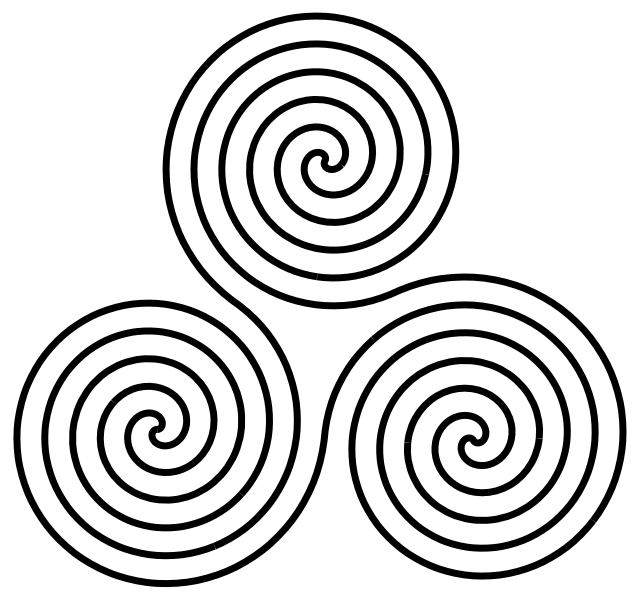
This artwork embodies the timeless beauty and significance of the Neolithic Triple Spiral, a symbol that has been revered in various cultures throughout history. The Triskele is an ancient symbol with profound meaning, associated in many cultures with themes such as growth, change, and spiritual development. Its repeating curves symbolize a journey from the outer world to the inner and back again – a representation of the life cycle and the interconnectedness of all things in the universe.
Veskor Cassiopeia
We like the triskelion as a symbol for “Timeless Patterns in Primordial Spaces”. We reclaim it from historical bad actors and restore its timeless humanity. For us, it symbolizes flowing seamlessly between our spaces while staying connected. It symbolizes monotropism, flow states, intermittent collaboration, caves+campfires+watering holes, and more. It is a celebration of the constant flux and fluidity of movement in the world and the possibilities that emerge from spaces between things and connections. The triskelion embraces diversity and difference, seeing the world as a spiral of constantly unfolding newness and potential.
These constantly evolving spirals of feedback and emergence reflect the expanding nature of learning and collaboration.
Perpetual Expanding Spiral of Support and Knowledge
When we speak of systemic change, we need to be fractal. Fractals—a way to speak of the patterns we see—move from the micro to macro level. The same spirals on sea shells can be found in the shape of galaxies. We must create patterns that cycle upwards. We are microsystems.
Emergent Strategy: Shaping Change, Changing Worlds

Emergence is our inheritance as a part of this universe; it is how we change. Emergent strategy is how we intentionally change in ways that grow our capacity to embody the just and liberated worlds we long for.
Emergence is the way complex systems and patterns arise out of a multiplicity of relatively simple interactions.
Emergent Strategy: Shaping Change, Changing Worlds
But emergence notices the way small actions and connections create complex systems, patterns that become ecosystems and societies. Emergence is our inheritance as a part of this universe; it is how we change. Emergent strategy is how we intentionally change in ways that grow our capacity to embody the just and liberated worlds we long for.
Emergent Strategy: Shaping Change, Changing Worlds
What is Emergent Strategy? “Emergence is the way complex systems and patterns arise out of a multiplicity of relatively simple interactions”—I will repeat these words from Nick Obolenksy throughout this book because they are the clearest articulation of emergence that I have come across. In the framework of emergence, the whole is a mirror of the parts. Existence is fractal—the health of the cell is the health of the species and the planet.
Emergent Strategy: Shaping Change, Changing Worlds
Octavia wrote novels with young Black women protagonists meeting aliens, surviving apocalypse, evolving into vampires, becoming telepathic networks, time traveling to reckon with slave-owning ancestors. Woven throughout her work are two things: 1) a coherent visionary exploration of humanity and 2) emergent strategies for being better humans.
Emergent Strategy: Shaping Change, Changing Worlds
The idea of interdependence is that we can meet each other’s needs in a variety of ways, that we can truly lean on others and they can lean on us. It means we have to decentralize our idea of where solutions and decisions happen, where ideas come from.
Emergent Strategy: Shaping Change, Changing Worlds
We have to embrace our complexity. We are complex.
I was looking for language and frameworks to use when exploring the kind of leadership Butler’s protagonists practiced, and found them in conversations with ill and Grace about emergence—interdependence, iteration, being in relationship with constantly changing conditions, fractals.
Emergent Strategy: Shaping Change, Changing Worlds
fractals: the relationship between small and large
A fractal is a never-ending pattern. Fractals are infinitely complex patterns that are self-similar across different scales. They are created by repeating a simple process over and over in an ongoing feedback loop.
Emergent Strategy: Shaping Change, Changing Worlds
Rather than narrowing into one path forward, Octavia’s leaders were creating more and more possibilities. Not one perfect path forward, but an abundance of futures, of ways to manage resources together, to be brilliant together.
Emergent Strategy: Shaping Change, Changing Worlds
Fractals are one form of redundancy that has attracted particular attention from scientists. A fractal pattern is one in which the same motif is repeated at differing scales. Picture the frond of a fern, for example: each segment, from the largest at the base of the plant to the tiniest at its tip, is essentially the same shape. Such “self-similar” organization is found not only in plants but also in clouds and flames, sand dunes and mountain ranges, ocean waves and rock formations, the contours of coastlines and the gaps in tree canopies. All these phenomena are structured as forms built of smaller forms built of still smaller forms, an order underlying nature’s apparently casual disarray.
Fractal patterns are much more common in nature than in man-made environments. Moreover, nature’s fractals are of a distinctive kind. Mathematicians rank fractal patterns according to their complexity on a scale from 0 to 3; fractals found in nature tend to fall in a middle range, with a value of between 1.3 and 1.5. Research shows that, when presented with computer-generated fractal patterns, people prefer mid-range fractals to those that are more or less complex. Studies have also demonstrated that looking at these patterns has a soothing effect on the human nervous system; measures of skin conductance reveal a dip in physiological arousal when subjects are shown mid-range fractals. Likewise, people whose brain activity is being recorded with EEG equipment enter a state that researchers call “wakefully relaxed”—simultaneously alert and at ease—when viewing fractals like those found in nature.
There is even evidence that our ability to think clearly and solve problems is enhanced by encounters with these nature-like fractals.
The Extended Mind – Annie Murphy Paul
The ancient Irish swore their oaths by the “Three Realms” of land, sea, and sky;[21] Celtic reconstructionists use the triple spiral, An Thríbhís Mhòr, to symbolize the three realms.[20] Many also view acts of daily life as a form of ritual, performing daily rites of purification and protection accompanied with traditional prayers and songs from sources such as the Scottish GaelicCarmina Gadelica or manuscript collections of ancient Irish or Welsh poetry.[22] They also believe that mystical, ecstatic practices are a necessary balance to scholarship and a vital part of their religion.[22]
Celtic neopaganism – Wikipedia


