
Caring for myself is not self-indulgence, it is self-preservation, and that is an act of political warfare.
Audre Lorde, A Burst of Light (Firebrand Books, 1988), p. 131.
Self-care is birthed by and through community care.
Talila A. Lewis
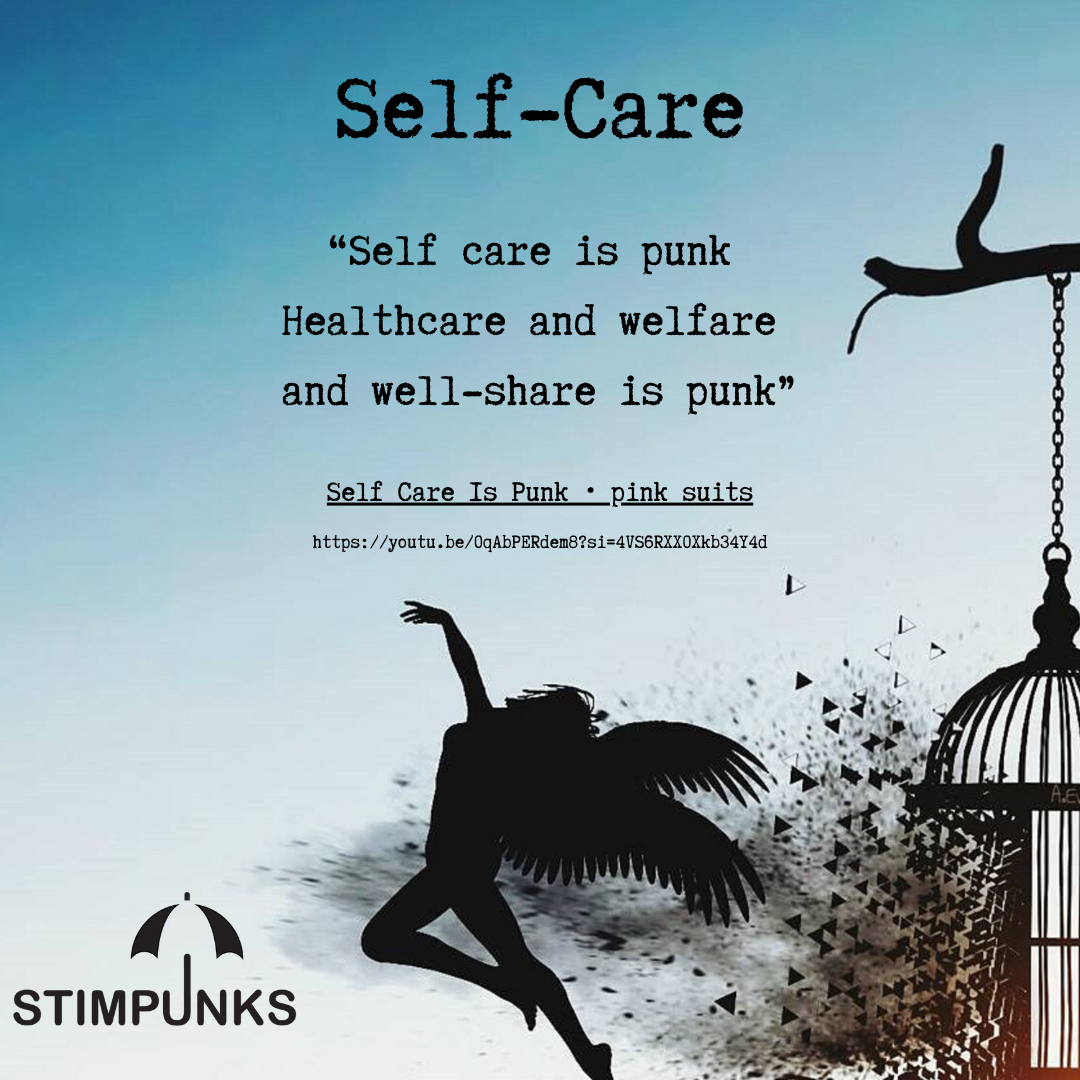
Self Care Is Punk
Hold your friend some more
Reach out for moral support
We know, we know the score
From the lives that came before
Hold on to your best friend’s hand
Lay out your sun in the sand
This life may be unplanned
But its yours you’re in command
Let’s make sure we’re okay
As we try to pave the way
Rest when you need to
You can live to fight another day
We need to take some time
To look after our self
Look after our mental health
And try to love yourself

Self care is punk
Self care is punk
Healthcare and welfare and well-share is punk
Self care is punk
Self care is punk
Healthcare and welfare and well-share is punk
Table of Contents
Stress
Autistic people can react differently to stress than non-autistic people. Research has found that autistic children release higher amounts of the stress hormone cortisol than non-autistic children. Additionally, the levels of cortisol last longer in their bodies, even after the thing that caused the stress has gone (Spratt et al. 2012).
Autistic people can perceive danger from many everyday parts of life, even when there’s no real danger present. We can hold onto our stress long after the stressor is gone. We may feel the urge to run out of a supermarket (flight) when the intercom blares out and bright lights glare. We may feel like shouting out loud (fight) when we can’t get our heads around a piece of paperwork. We may feel like hiding under blankets (flight) when we have too many demands on us. We may shut down (freeze) and be unable to think, or talk, after a social situation that required so much effort that we feel drained, exhausted, and unsafe.
A study published in 2015 (Bishop-Fitzpatrick et al. 2015) found that autistic adults without intellectual disability experienced substantially higher levels of stress than non-autistic adults. Not only that, but when stress levels increased, autistic adults’ social functioning went down significantly.
Looking After Your Autistic Self | Jessica Kingsley Publishers – UK
Stress can have a direct and immediate impact on any one of the skills we use for executive function. If we are stressed, it can shut down our ability to plan, make us unable to initiate a task, reduce our flexible thinking, decrease our time management skills, make finishing a task impossible, and can make it difficult to manage our emotional regulation through a task.
Looking After Your Autistic Self | Jessica Kingsley Publishers – UK
Triggers
I now know that I never panic for no reason; there’s always a trigger that can either be explained by my autism, or by something in my past emotional development.
Looking After Your Autistic Self | Jessica Kingsley Publishers – UK
Learning what triggers you to feel overwhelmed is vital to learn how to look after yourself. It allows you to get comfortable with why you react the way you do, and allows you to put plans in place to support yourself.
Looking After Your Autistic Self | Jessica Kingsley Publishers – UK
Many Autistic people experience life in survival mode, trying to avoid and deflect the too-muchness of the world. When you’re Autistic, it’s as if your nervous system exists on the outside of your body, fully absorbing every single sensory input, social interaction, and piece of information.
The Five Steps to Managing Triggers
- The Detective Habit: Identifying your triggers.
- Coping Strategies: Learn to manage your triggers.
- Rationing: Spread out your triggers.
- Recovery: Plan your recovery time between triggers, and after triggers.
- Quick Calm Strategies: These are strategies to help you calm down quickly. As developing immediate calming strategies is a huge topic, this will be dealt with in the next chapter.
Sensory Regulation
Self-Care for Autistic People includes information on how to work with your sensory and nervous systems, find practices to help you self-advocate, and discover ways to limit burnout. Starting a self-care practice may seem overwhelming, so take your time and focus on the chapters that resonate with you. You can also start by implementing a few practices at a time. Here are just some of the dozens of practices you’ll find in this book:
- Manage Your Sensory Needs
- Unwind Tension in Your Muscles
- Support Your Gut Health
- Put Your Mind to Sleep
- Drop Unnecessary Demands
- Identify Red Flags and Green Flags in Friendship
Your first steps will involve learning to listen to what you need, improving your communication with your body, working through past traumas, and learning to take your needs (and pleasure) seriously.
For most Autistic people, sensory regulation is the fundamental building block of self-care—it’s like the foundation of a house. The entire structure will fall apart if the foundation is off. If you lack sensory regulation, all your other systems will be off, and you might experience anxiety, irritability, or meltdowns. You might also struggle to focus when your sensory system goes haywire.
Sensory self-care refers to the intentional practice of managing and meeting your sensory needs.


