

Neurodivergent people are hypersensitive to mindset and environment due to a greater number of neuronal connections. They have both a higher risk for trauma and a large capacity for sensing safety.
Neuroception and the 3 Part Brain
Your senses are not distractions — they are your interface with the world. What many systems label as “over-sensitivity” is often a nervous system responding honestly to real input. If spaces are designed without regard for sensory experience, people don’t just feel uncomfortable — they are harmed.
This page treats sensory experience as central to access, not optional or secondary. We explore how lighting, sound, texture, movement, pacing, and social stimuli shape whether a space is livable or injurious for different bodies and minds. Sensory difference is not a personal deficit. It’s a human variation interacting with environment — and the environment is designed.
We share tools and practices that go beyond “tolerance” and toward sensory safety: how to recognize harmful load, how to reduce unpredictable stressors, and how to build environments where people can regulate, engage, and belong. This is access as infrastructure — not an afterthought.
Your nervous system is real. Your experience matters.
We don’t accommodate people into harm.
We design spaces that stop punishing difference.
Table of Contents
- 🫀🧠💥 Neuroception and Sensory Load
- Fight-Flight-Freeze-Tend-Befriend
- Sensory Hell
- Meerkat Mode
- 👋 Stimming
- 🤢 In Our Own Words: The Complex Sensory Experiences of Autistic Adults
- 🎪 Sensory Environment Checklist
- 🧰 Adapting the Environment
- 🌈 Checklist for Autism-Friendly Environments
- 📞 Anything but the Phone!
- 🚀 It’s Not Rocket Science
- Resources
- Main Takeaways
- Perceptual Worlds and Sensory Trauma
A Brief Review of the Senses: We Have Five External Senses and Three Internal Senses
We have five external senses:
- Taste
- Smell
- Touch
- Sight
- Hearing
And three internal senses:
- Proprioception
- Vestibular
- Interoception
We engage those senses with stimming for a few reasons:
- Self-regulation
- Sensory seeking
- Expression
We have five external senses and three internal senses. All must be processed at the same time and therefore add to the ‘sensory load’.
Understanding the sensing and perceptual world of autistic people is central to understanding autism.
Autism is viewed as a sensory processing difference. Information from all of the senses can become overwhelming and can take more time to process. This can cause meltdown or shutdown.
“It’s Not Rocket Science” – NDTi
Autistic sensory differences
| Sensation | Considerations |
|---|---|
| Sight | Visual sensitivities are common. Bright lighting (particularly fluorescent) is a common challenge. Visual stimuli which may go unnoticed by non-autistic people, such as the flickering of fluorescent lighting or computer screens, an overhead rotary fan, or highly patterned surfaces, may all cause sensory stress |
| Sound | Autistic people experience auditory sensitivities and auditory processing differences. Environmental noise can cause intense distress, particularly when sudden or unexpected. Sounds unnoticed by non-autistic people, such as the humming of electrical equipment, may be perceived by autistic people without ‘fade’ (where inconsequential sounds are no longer noticed over time). Autistic people may not filter out environmental sounds and therefore may struggle to hear a conversation in a noisy room |
| Smell | Autistic people are often highly sensitive to smell and may perceive olfactory stimuli that others do not. Common and usually inoffensive smells may be perceived as highly noxious. In contrast, some autistic people are hyposensitive to smell and may enjoy smelling pungent objects |
| Taste | Autistic people may be hypo- or hyper-sensitive to taste, needing either highly flavoured or very bland food. Food texture is important, as is predictability (see below). Autistic people commonly enjoy colloquially termed ‘same foods’, which may explain a limited diet and negative reactions to a change of brand or recipe for a known brand of food |
| Touch | Tactile sensitivities range from inability to tolerate the sensation of certain fabrics to an inability to be touched, particularly by strangers. This leads to predictable challenges in a medical consultation where physical examination is required. Knowing the tactile sensitivity profile of a patient is helpful because difficulties commonly arise with light touch, whereas a strong deep touch may be more acceptable |
| Temperature | Thermal sensitivity is common and may lead to apparently inappropriate or out of season clothing. The range of tolerated temperatures is likely to be person-specific |
| Proprioception | Proprioception appears different for autistic people. Some may need lots of proprioceptive input leading to a tendency to climb, swing, rock or jump. Others will avoid such movements and may experience balance difficulties during day-to-day activities |
| Interoception and pain | A particular challenge for some autistic people is accurately interpreting internal bodily sensations. This can lead to difficulties noticing hunger, thirst, tiredness, or a need to urinate or defaecate. Difficulties with pain perception can lead to unrecognised injuries but it must be emphasised that while reduced pain sensitivity occurs for some, others experience increased pain sensitivity, and this should never result in under-treatment of pain for autistic patients |
Recommendations for supporting Autistic SPACE in practice
Autistic SPACE: a novel framework for meeting the needs of autistic people in healthcare settings | British Journal of Hospital Medicine
- Sensory needs.
- Predictability.
- Acceptance.
- Communication.
- Empathy.
| SPACE framework aspect | Recommendations for implementation | |
|---|---|---|
| Sensory | Sight | Turn off or turn down artificial lights |
| Remove flickering or oscillating environmental features | ||
| Avoid highly stimulating decor | ||
| Promote the use of sunglasses | ||
| Sound | Consider environmental sounds | |
| Reduce auditory clutter | ||
| Avoid conversation in noisy environment | ||
| Promote the use of noise-cancelling headphones and/or ear plugs | ||
| Smell | Avoid wearing perfume or highly scented cosmetics or toiletries | |
| Avoid aerosols or chemical ‘air fresheners’ | ||
| Avoid highly scented cleaning products | ||
| Consider ventilation, open windows where possible | ||
| Taste | Respect sensory preferences when considering nutrition | |
| Consider taste and texture of medications | ||
| Consider non-standard medication formulations where necessary | ||
| Touch | Ascertain tactile preferences and modify examination technique | |
| Avoid casual touch | ||
| Promote sensory-friendly clothing choices | ||
| Sensory aids such as weighted blankets may be helpful | ||
| Temperature | Consider environmental temperature | |
| Adjust temperature where required | ||
| Proprioception | Understand the need for proprioceptive input | |
| Avoid making inferences from unusual body posture | ||
| Interoception and pain | Ask directly about internal sensations but understand that answering may be difficult | |
| Pay attention to verbal reports of pain where possible | ||
| Be aware that non-verbal expression of pain may be different | ||
| Consider the need for adapted pain scales | ||
| Predictability | Give realistic information in advance | |
| Ensure clear and accurate directional signage in physical spaces | ||
| Provide photographs or videos of the physical environment and staff | ||
| Allow waiting in a familiar environment (eg a patient’s own car or outside) | ||
| Ensure care is provided by staff familiar to the patient where possible | ||
| Acceptance | Neurodiversity-affirmative approach beneficial | |
| Understand autistic stimming and monotropic thinking patterns | ||
| Facilitate need for detailed factual information | ||
| Understand distress behaviour | ||
| Communication | Understand autistic verbal and non-verbal communication differences | |
| Know that communication ability is reduced by anxiety and sensory stress | ||
| Clear unambiguous communication required | ||
| Avoid phone-based appointment systems | ||
| Promote use of augmentative and alternative communication (AAC) | ||
| Empathy | Recognise that autistic people feel empathy but may display it differently | |
| Empathy towards autistic patients may be more challenging for non-autistic healthcare providers | ||
| Physical space | Expect a need for increased personal space | |
| Avoid proximity to other people where possible | ||
| Temporal space | Allow increased time to respond to questions | |
| Allow increased time for decision making | ||
| Emotional space | Expect differences in emotional expression | |
| Allow restorative solitude to recover (without additional input) if distressed | ||
Autism + environment = outcome
I have written elsewhere about what I refer to as ‘the golden equation’ – which is:
Autism + environment = outcome
What this means in an anxiety context is that it is the combination of the child and the environment that causes the outcome (anxiety), not ‘just’ being autistic in and of itself. This is both horribly depressing but also a positive. It’s horribly depressing because it demonstrates just how wrong we are currently getting things, but positive in that there are all sorts of things we can do to change environmental situations to subsequently alleviate the anxiety.
Avoiding Anxiety in Autistic Children: A Guide for Autistic Wellbeing, Dr Luke Beardon
🫀🧠💥 Neuroception and Sensory Load
Our nervous systems are constantly scanning for safety, even when we’re not consciously aware of it. This is neuroception: the body’s automatic detection of threat or comfort. Sensory load builds when input—sound, light, movement, social demands—stacks faster than we can process. This section explains why sensory overwhelm is not drama or preference, but real nervous system strain shaped by environment.
Autistic People Have Significant Barriers to Accessing Safety
Hyper-plasticity predisposes us to have strong associative reactions to trauma. Our threat-response learning system is turned to high alert. The flip side of this hyper-plasticity is that we also adapt quickly to environments that are truly safe for our nervous system.
The stereotypes of meltdowns and self-harm in autism come from the fact that we frequently have stress responses to things that others do not perceive as distressing. Because our unique safety needs are not widely understood, growing up with extensive trauma has become our default.
Discovering a Trauma-Informed Positive Autistic Identity
Part of our neuroception is genetic. Neurodivergent people have heightened neuroception from birth or before birth.
Danger cues that are very painful to a neurodivergent person may be neutral or pleasant to someone else.
How to Use the Polyvagal Ladder. A set of graphics
Neurodivergent people are hypersensitive to mindset and environment due to a greater number of neuronal connections. They have both a higher risk for trauma and a large capacity for sensing safety.
Neuroception and the 3 Part Brain
Psychological safety is increasingly recognised as central to mental health & wellbeing. The polyvagal theory offers a ‘Science of Safety’ which can help inform clinical practice to promote wellbeing, resilience & post-traumatic growth, whilst mitigating trauma.
Developing a standardised measure of psychological safety.
Small changes would have made a big difference.
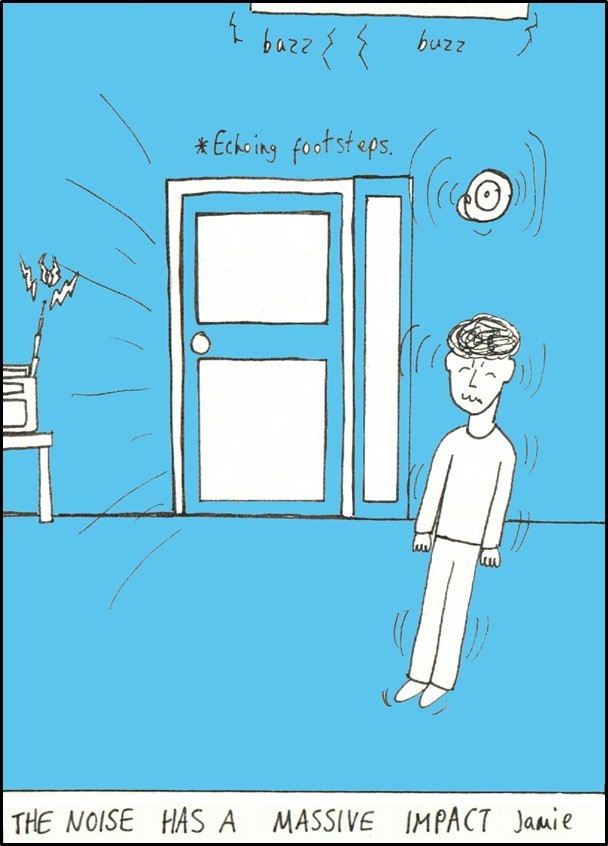
To have my needs met as an autistic person would have transformed my experience in hospital. The sensory input added to my emotional dysregulation. I couldn’t engage with all the therapy on offer because of the added distress. Small changes would have made a big difference.
Emily
Image credit: Sam Chown-Ahern
Get a Sensory Assessment
If someone is autistic, they should get a sensory assessment. It was so important for me to understand myself and how I regulate.
Charli
Image credit: Sam Chown-Ahern

This happens way, way too often.
Autistic kid: *states a need*
Adult: Says it’s not a need
Autistic kid: *states need again*
Adult: Ignores need
Autistic kid: Has meltdown
Adult: Why are they so upset? Must be a behavioral/discipline issue.
Our non-compliance is not intended to be rebellious. We simply do not comply with things that harm us. But since a great number of things that harm us are not harmful to most neurotypicals, we are viewed as untamed and in need of straightening up.
THINKING PERSON’S GUIDE TO AUTISM: On Hans Asperger, the Nazis, and Autism: A Conversation Across Neurologies
The picture shows a school classroom as I see it, as an autistic person. A kaleidoscope of shape and blinding lighting, with vague outlines which are probably other students. Deafening noise. The stench of different smells. The confusion of many voices, including some heard through walls from neighbouring halls and classes. School uniform that feels like barbed wire on my skin.
In the chaos, a different voice which I have to try to listen to. It’s so hard. My brain doesn’t want to tune the rest of the noise out. Apparently I’ve been asked something, but I miss it. The voice gets more strident, the class turns to look at me. The intense stares overwhelm me. The person next to me jostles me and it feels like an electric shock on my skin. Only six more hours of hell to go…. only six….
Some of our autistic pupils simply cannot do this alone, without ‘time out’ to recover from the pain and exhaustion during the school day. Not for hour after hour of puzzling painful chaos.
We’ve turned classrooms into a hell for autism. Autistic children mostly could cope in the quieter schools of decades ago. Not a hope now.
Ann’s Autism Blog: Autism, School, Exclusion. What’s fair?
what if hating school wasn’t so much about the learning disabilities and more the act of forcing me to visit the worst sensory environment I could imagine in order to do it and then punching me in the report card when I could not
@laurenancona
What schools need to do is to understand autism. In understanding it, we can help to stop putting the children in pain and exhaustion. It’s actually quite easy. And quite cheap.
Make sure your school is getting really good autism training, from autistic experts and our allies.
Notice I said ‘autistic experts”… People who can detect what’s happening in that environment, using similar sensory systems to the pupil. People who can explain autistic language and culture. Yes, there is a different autistic language, a different autistic culture. In the same way as it’s important to respect the culture of children from different ethnicities, it’s important to know about, and respect, autistic culture and communication style also.
Ann’s Autism Blog: Autism, School, Exclusion. What’s fair?
Sensory Accommodations
Sensory Challenges
Fight-Flight-Freeze-Tend-Befriend
When sensory load rises, the body shifts into survival responses. Fight, flight, freeze, tend, and befriend are not choices—they are protective nervous system patterns. This section helps reframe “behavior” as physiology: what looks like shutdown, agitation, or withdrawal is often a body trying to stay safe in an unsafe sensory world.
This makes seemingly benign noises a threat to my well-being and quite possibly real physical danger to my physiology. Benign noises become painful, and if left unchecked, enough to trigger a system reaction reserved for severe dangers. This is what days can become like on a regular basis for myself and many on the spectrum.
“Let me stick a hot poker in your hand, ok? Now I want you to remain calm.”
That is the real rub of the experience of sensory meltdowns.
Autistic Traits and Experiences in “Love and Mercy” The Brian Wilson Story – The Peripheral Minds of Autism
Sensory Hell
Some environments are not mildly uncomfortable—they are actively injurious. Sensory hell is what happens when noise, brightness, crowds, unpredictability, and demand become unbearable. This section names the reality that many public spaces are designed without sensory safety, turning everyday life into endurance.
Needless to say, the dining hall, as well as being busy, crowded and a source of multiple odours, was also very noisy, as trays were picked up and clattered back down, cutlery jangled, and metal serving dishes clanged against metal hot plates. Meanwhile, the children, squeezed into rows of tiny seats bolted on to collapsible dining tables, grew louder and louder to make themselves heard over the racket. Indeed, the lunch queue alone can be the place where sensory problems ‘can turn into a nightmare’ (Sainsbury 2009, p.99). Perhaps unsurprisingly, therefore, all of the child contributors to this book – Grace, James, Rose and Zack – identified noise and crowds as being the most difficult aspects of school from a sensory point of view.
Inclusive Education for Autistic Children: Helping Children and Young People to Learn and Flourish in the Classroom
Indeed, the school environment can present autistic children with a multi-sensory onslaught in terms of sounds, smells, textures and visual impacts that constitutes both a distraction and a source of discomfort (Ashburner, Ziviani and Rodger 2008; Caldwell 2008). There was also clear evidence from my own study that sensory issues, and noise in particular, can be highly exclusionary factors for autistic children in schools.
Inclusive Education for Autistic Children: Helping Children and Young People to Learn and Flourish in the Classroom
Autistic participants, who reported significantly higher sensory processing scores than Control participants, consistently reported higher levels of discomfort in both their home and workplace environments, feeling more overwhelming, stressed, and distracted, and less safe than the Control group in both environments. Though shopping malls, supermarkets, other retail and medical buildings are all essential buildings that people need to frequent to meet material needs and stay healthy, they all caused greater discomfort and distress for Autistic participants, who also avoided them more often. The odds of an Autistic participant avoiding buildings was 8.8 times greater than the Control group. Higher discomfort and distress reported by Autistic participants in office buildings may affects the low employment rates in this population.
People and People Noise were the IEQ factors that, across multiple environments, were rated as highest as a cause of discomfort and avoidance and had the largest difference between Autistic and Control participants, followed by Glare and Electric Light. Meanwhile, Temperature was rated equally highly by both groups, having a large effect but no difference between groups, with a similar trend seen in Air Quality and Air Movement.
The Impact of Indoor Environment Quality on People on the Autism Spectrum
Meerkat Mode

Meerkat mode is hypervigilance: constant scanning, bracing, and monitoring for the next sensory hit. It’s exhausting, and it often looks invisible from the outside. This section describes what it’s like to live in a state of perpetual alertness—and why regulation requires environments that allow the nervous system to stand down.
In the wrong sensory environment with no monotropic outlet for achieving flow states, we can go into meerkat mode.
Lovingly dubbed “meerkat mode” by Tanya due to the heightened state of vigilance and arousal it presents, it involves constantly looking for danger and threat. It is more than hyper-arousal, Tanya believes that it is actually an overwhelmed monotropic person desperately looking for a hook into a monotropic flow-state.This is not just sensory hyper-arousal, it is the tendency of monotropic [AuDHD] minds to seek out a natural and consuming flow-state to aid recovery from burnout and/or monotropic split. Because of the heightened sensory-arousal and adrenal response that comes with it, monotropic flow becomes difficult to access, leading into monotropic spiral.”
Adkin & Gray-Hammond (2023)
What is meerkat mode?
What is meerkat mode and how does it relate to AuDHD? – Emergent Divergence
- Hypervigilance
- Seeking a monotropic flow-state (Hyperfocus)
- Increased Sensory Dysregulation
- May be unable to stop or rest
What atypical burnout can look like is being stuck in a hyper-aroused state, Tanya often affectionately dubs this as “meerkat-mode”, she describes a meerkat-type nervousness, constantly on the look out for danger, unable to focus and self-regulate creating the need for constant co-regulation with another person, and a fear of being left alone. This is sometimes misinterpreted as attachment disorder because of the childs perceived over-attachment to a parent or safe person. We often see this type of response from children and young people in traumatic school environments for extended periods of time.
Creating Autistic Suffering: What is Atypical Burnout? – Emergent Divergence
Lovingly dubbed “meerkat mode” by Tanya due to the heightened state of vigilance and arousal it presents, it involves constantly looking for danger and threat. It is more than hyper-arousal, Tanya believes that it is actually an overwhelmed monotropic person desperately looking for a hook into a monotropic flow-state.This is not just sensory hyper-arousal, it is the tendency of monotropic minds to seek out a natural and consuming flow-state to aid recovery from burnout and/or monotropic split. Because of the heightened sensory-arousal and adrenal response that comes with it, monotropic flow becomes difficult to access, leading into monotropic spiral.
Creating Autistic Suffering: The AuDHD Burnout to Psychosis Cycle- A deeper look – Emergent Divergence
👋 Stimming
Stims are anything which is repetitive, stimulatory, and soothing and comforting. They can help us deal with sensory overload.
Stimming is self-regulation. It is how many neurodivergent people manage sensory input, emotion, attention, and stress. This section rejects the idea that stimming is disruption or something to suppress. Stimming is care. It is the body keeping itself together.
The Predictability, Pattern and Routine of Stimming | Judy Endow
Most of us stim because it calms us and helps alleviate our high levels of anxiety.
Siena Castellon
I can’t picture things in my head sitting still. I like to walk around and think.
Autistic Student

We’re Autistic. Here’s what We’d like you to know.
We inherited a “mind on the hoof,” in the phrase of philosopher Andy Clark—but in today’s classrooms and offices, the vigorous clatter of hoofs has come to an eerie halt.
The Extended Mind – Annie Murphy Paul
What this attitude overlooks is that the capacity to regulate our attention and our behavior is a limited resource, and some of it is used up by suppressing the very natural urge to move.
We have five external senses and three internal senses. All must be processed at the same time and therefore add to the ‘sensory load’.
Understanding the sensing and perceptual world of autistic people is central to understanding autism.
Autism is viewed as a sensory processing difference. Information from all of the senses can become overwhelming and can take more time to process. This can cause meltdown or shutdown.
“IT’S NOT ROCKET SCIENCE” – NDTI
🤢 In Our Own Words: The Complex Sensory Experiences of Autistic Adults
Sensory experience is not a checklist—it is lived reality. This section centers autistic voices describing the complexity of sensory trauma, sensory joy, sensory overwhelm, and sensory difference. Lived experience is evidence, and it belongs at the center of access work.
“Bright lights such as ceiling lights are unbearable and make me feel very stressed.”
SE007
“In a crowded place I need to put my hands over my ears. I feel sick and can’t focus on anything.”
SE027
“I’m easily startled by sound or touch, sounds physically hurt me.”
SE017
“Smelling a strong smell is like being tortured, time stops and I’m nearly sick.”
SE008
“I never go into supermarkets because of visual overload…”
SE048
“Going to grocery-store is the worst. The lights are always very bright and there are so many details to see. I cannot go in there without sunglasses and a baseball cap. Generally being outside when the sun is out is also hard. That is why I always have my sunglasses with me.”
SE032
“I am very sensitive to all noise, including electrics being on in the bedroom at night i.e., hum of electricity going to the alarm clock. I turn off everything possible and spend time in my quiet bedroom when life gets too noisy.”
SE029
“I seek comfort in small things (such as nice textures, I currently have a coin that I keep in my pocket to hold when I’m nervous) so that I can filter the sensory environment. It helps distract me from what is happening around me so that when I seek that input, I can avoid more intense or unpleasant inputs.”
SE018
“I can become overwhelmed in busy, crowded places. Often in these situations I will feel like everything around me is moving faster and feel a kind of disconnect (maybe even dissociation?) from it all.”
SE037
“Sunlight is overwhelming in the summer and I can’t stand being out for too long… I also can’t stand bright overhead lighting in shops and tend to leave as quickly as possible. Lower overhead lighting is worse and fluorescent is unbearable…”
SE029
“A busy visual field causes overload and causes agitation and stimming. I struggle to focus on specific components and take in the entire field, being aware of every movement.”
SE016
“With multiple conversations… my experience is similar to listening to a radio station that then blends into the other one, so you’re constantly hearing every other word of the radio station, until at some point the streams completely overlap, but somehow in complete clarity. This, along with all the loud environmental noise (which may seem like nothing to most people – air conditioning humming, projector buzzing, lights buzzing, plates clinking in a restaurant kitchen), can drive me into a shutdown. And then every sound is utterly overwhelming.”
SE040
“I have to check the texture of fabrics when I’m clothes shopping. Anything rough or crunchy I can’t wear. I also need soft and stretchy fabrics.”
SE038
“I don’t like unexpected touch from other people. I prefer firm touch to light touch.”
SE011
“I’m touch sensitive. I hate other people touching me. My skin crawls, I sweat excessively, and I feel nausea. Especially if it’s bare skin. Makes intimacy nigh on impossible.”
SE030
“I am very particular about tastes. I only like quite bland foods and can’t stand any kind of spice. I will find a food unbearably spicy that others say has no spice to it at all. I used to find fizzy drinks too intense when I was younger.”
SE011
“I have had to quit jobs and refuse assignments due to my being hyperreactive to scents… My aversion to strong, unpleasant scents is so strong that it triggers my gag reflex, can make me throw up, makes me cry, and makes me escape the environment. I have tried but have no control over it. Changing nappies for my kids was challenging. Usually my husband did it. If my kids vomited, the smell made me vomit.”
SE031
“There are numerous occasions where I was looking for an item which was in plain sight however I it took a long time to find it.”
SE003
“I can get lost in visual patterns. When I was little one of the churches, we sometimes attended had a patterned coving and I would spend the whole service visually following the infinite line that formed the pattern.”
SE010
“Music calms me down when I’m stressed. Tend to listen to the same song on repeat for hours at a time.”
SE022
“Fluffy textures calm me. I have a fluffy blanket in the car to help manage my anxiety on car journeys and one I carry in my bag to calm me on other occasions.”
SE016
“It is extremely difficult to provide me with enough, let alone too much, deep pressure. Sometimes I will ask my husband for a tight hug and even the tightest hug he can provide is insufficient to satisfy me. Often, I need him to lie on top of me to provide added pressure.”
SE046
PsyArXiv Preprints | In our own words: The complex sensory experiences of autistic adults
🎪 Sensory Environment Checklist
Sensory access is practical. This checklist helps you notice the things environments often ignore: lighting, sound, smell, crowding, temperature, textures, and unpredictability. This section offers concrete ways to assess whether a space supports regulation or creates harm.

We believe that autistic people are uniquely qualified to review environments for themselves or for other autistic people as they live in an ‘alternate sensory reality’ (Grandin and Panek 2016) to the neurotypical population.
This checklist is intended to support improvements to the sensory environment.
Wherever possible, we encourage the involvement of autistic people in reviewing sensory environments. We believe that autistic people are uniquely qualified to review environments for themselves or for other autistic people as they live in an ‘alternate sensory reality’ (Grandin and Panek 2016) to the neurotypical population.
It is possible to use parts of this document but not others, depending on individual sensory needs. It is possible that not all parts will be relevant to everyone, please feel free to use the parts that are helpful.
We identify common sensory challenges as well as some suggested solutions.
We recommend considering all senses in every space – including entrances. Slow down, walk through, pause in each space, what do you notice?
We explain these elements in more detail in the report, please read this for further information. This checklist is intended as a practical summary to support those considering and reviewing environments.
Considering and meeting the sensory needs of autistic people in housing | Local Government Association
Below are our recommendations for small changes that can be made to an environment to improve the sensory experiences and wellbeing of autistic people.
👁 Sight

“Light and colour can provide stimulation and joy – for instance, stained glass can be used for small windows receiving direct sunlight.”
Angela
Visual stimulation can be a source of comfort and joy and can also lead to sensory overwhelm. The good news about this is that there is a solution – or rather, a range of solutions.
Our sight impacts our ability to process, interact and communicate with the world around us. Visual input is a key consideration for most of the people who contributed to Considering and meeting the sensory needs of autistic people in housing – it was one of the most dominant senses. Visual stimulation can be a source of comfort and joy and can also lead to sensory overwhelm. The good news about this is that there is a solution – or rather, a range of solutions.
Sight | Local Government Association
Lighting plays a crucial role in the sensory experience of Neurodivergent individuals, as many are sensitive to bright, fluorescent, or flickering lights, which can trigger discomfort, headaches, or sensory overload.
| Challenging sensory stimuli | Suggested alternatives |
| Fluorescent lighting (flickers) | Tungsten (halogen, incandescent) or LED. |
| Dimmable lighting (flickers) | Not dimmable. |
| Direct lighting (uncovered bulbs) | Diffuse – using a shade. Or use lamps as an alternative source. |
| No natural light | Getting the lighting right where there is no natural light is important. This space should have limited use. |
| Windows obstructed (eg covered in non-transparent film) | Uncover windows where possible – even partial visibility helps. |
| No covering for windows, or transparent curtains | Blackout blinds or curtains that can be fully controlled, particularly in bedrooms. These can be fitted within the window or press studs or Velcro fastenings could be considered if needed. |
| Significant light changes between rooms or areas. | Consider additional blinds, lighting or windows within doors to reduce the change in lighting levels. |
| Strong shadows, moving shadows (eg from trees) | Additional lighting sources or diffused light can reduce shadows. |
| Reflective surfaces eg flooring or walls | Consider a matt finish. |
| Limited visibility between spaces | Increased visibility between spaces can ease transitions – transparent panels in doors. |
| Bright colours | Swap for neutral, natural and pastel colours. |
| Bright posters, murals and wall designs | Limit this in small spaces and entrances. Involve people in choosing the detail of design if desired. |
| Patterns on floors, carpets and soft furnishings | Plain materials in neutral colours. |
Source: Sight | Local Government Association
One of the most powerful features of a multisensory room is the ability to control the lighting.
Multiple Multisensory Rooms: Myth Busting the Magic
🦻 Sound

Many autistic people process one thing at a time and can’t ‘tune out’ inputs. Every noise will continue to be heard, will be a distraction and will take ‘bandwidth’.
Many neurotypical people can ‘block out’ noise, but some autistic people struggle to do this and hear every sound, including things that might not be audible to others such as outside noises like cars and aeroplanes.
Autistic people may also be able to hear sounds from inside the building – such as voices or noises from other rooms, or water in pipes and electricity in the walls. A decibel meter can be useful to support this work (now available as a phone app for those in need).
Sound | Local Government Association
Sound can significantly impact Neurodivergent individuals, who may have heightened sensitivity to noise. Excessive or unpredictable sound, such as loud announcements or background music, can cause sensory overload, leading to distress or an inability to focus.
| Challenging sensory stimuli | Suggested alternatives |
| Outside noise – traffic, schools, airplanes (consider different times of day) | An important consideration in location as there are limited options to reduce this noise. Double glazing or acoustic glass may help. |
| Hard floors and walls, adds to noise (eg footsteps) and creates echo | Soft furnishings (carpets, curtains, furniture) absorb noise.Acoustic vinyl is often a better option than laminate where carpet isn’t appropriate. Sound absorbing panels could also be considered. |
| Curved and angled walls and ceilings – affects how sound moves in the space and can be disorientating for those with proprioceptive issues. | Straight walls and ‘flat’ ceilings.Soft furnishings and sound absorbing panels can reduce the impact of this where change is not possible. |
| High ceilings | Where these are present soft furnishings and sound absorbing panels can help. |
| Electrical buzzing | Can items be turned off or moved? |
| Forced air, heating or air conditioning humming | Is it possible to control this? Can it be turned off? Can it be serviced to reduce the noise? |
| Heating noises | Is it possible to control this? Servicing may reduce the noise volume. |
| Fan heaters or fan assisted radiators | Swap for panel radiators or underfloor heating. Large low temperature radiators may be safer than smaller higher temperature alternatives. |
| Water pipes including from toilets, appliances and pipes | Are they noisy in all areas or are there quieter spaces? Is it constant? Can it be controlled or managed?Limit use of spaces where it is particularly noisy. |
| Washing machine and clothes dryer | Consider agreeing timings of use. Some people find this sound comforting and helpful to self- regulate. |
Source: Sound | Local Government Association
👃 Smell and Taste

Certain smells can really help to calm and soothe me. On the contrary other smells can make me feel quite unwell. For some autistic people the sense of smell can be so strong that it feels like you are being force fed.
Carly
Smell is pervasive – it is not possible to close our nostrils as we can close our eyes.
As many autistic people do not ‘habituate’, a smell will remain distinct and present, though neurotypical people might only notice a smell when they initially experience it, for example when entering a room.
Smell | Local Government Association
Strong scents, such as perfumes or cleaning products, can cause
distress and illness in Neurodivergent individuals with heightened
olfactory sensitivity. Providing fragrance-free environments and
maintaining neutral air quality ensures accessibility.
| Challenging sensory stimuli | Suggested alternatives |
| Outside smells | This can be very difficult to control, so may be an important consideration when choosing location. |
| Paint smells | Use low odour paint. Consider timing of use. |
| Cleaning products – including air freshener, toilet cistern blocks, bleach, surface wipes, floor cleaner. | Use unscented. Involve the person in choosing the product where possible. Consistency may help. Many eco products are less smelly. |
| Laundry powder and conditioners | This is often scented, though some unscented varieties are available. Choice and consistency may help. Involve the person in choosing the product where possible. Limit changes to products used. |
| Washed clothing often smells stronger wet than when dry | Where will clothing be dried? Is there a separate area? Avoid drying clothes in bedrooms, and where possible also avoid drying clothes in living areas. |
| Household smells Consider how smells can be contained if areas are not separated. | Shut doors between rooms to limit smells drifting. |
| People smells | Limit use of perfumes and aftershave. Consider personal smells including smoke |
| Dining room / eating locations | Many autistic people prefer to eat alone. Are there choices for where to eat? Could there be? |
Source: Smell | Local Government Association
👆 Touch
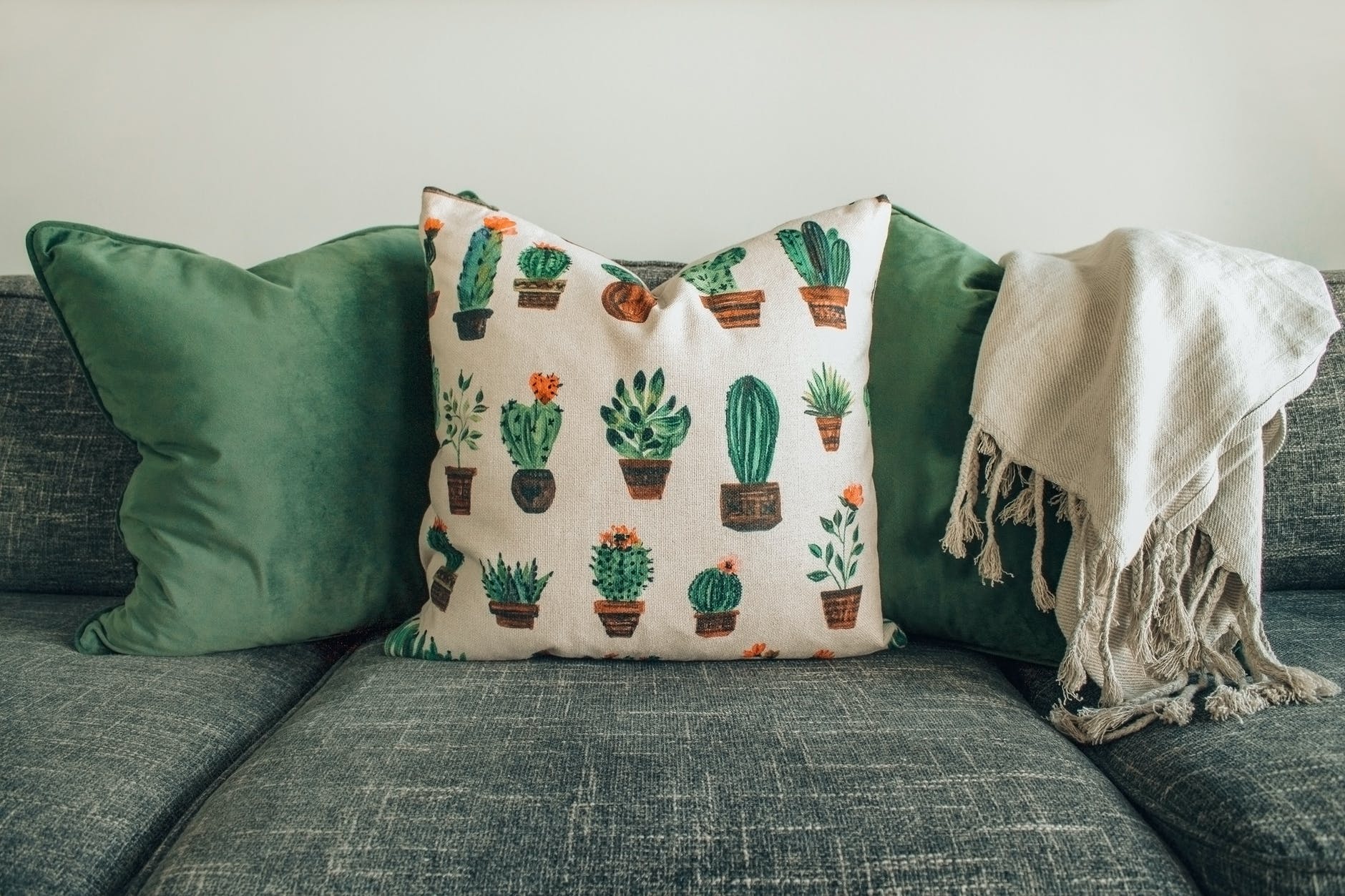
Soft furnishings and furniture can have a positive impact on the soundscape and on the comfort in the room.
Temperature, texture and pressure (from touch as well as from atmospheric pressure) can all add to the sensory load.
Touch | Local Government Association
For Neurodivergent attendees, access to tactile tools, like stress balls or fidget spinners, can support focus and reduce stress. Normalising the availability of these items helps create an inclusive setting where individuals can self-regulate without feeling singled out.
Furnishings directly influence comfort and accessibility for Neurodivergent attendees. Flexible seating arrangements and options for standing or movement accommodate diverse needs, promoting inclusion for individuals with varying sensory, physical, or attentional requirements.
| Challenging sensory stimuli | Suggested alternatives |
| Carpets and rugs | Change or remove these if needed. Try swapping for calmer colours and different textures. |
| Bedding – including low quality materials that can be ‘scratchy’ | Choice of bedding. Soft, quiet materials. Many people feel more comfortable with 100 per cent cotton and a high thread count. |
| Mattresses and pillows | Choice of pillows – including soft, quiet pillows. Avoid using plastic mattresses wherever possible – could a mattress protector work instead? |
| Metal door handles (can shock with unexpected coldness) | Alternative materials including wood and plastic can be more predictable |
| Shower or bath | A choice is helpful. Bathroom temperature A predictable and consistent temperature can be helpful. |
| Clothing | The material, style, fit and texture can all be important depending on personal preference and need. |
| Leather or imitation leather (plastic) furniture | Both can be noisy and cold to touch. Fabric alternatives or a soft throw can improve this. |
| Unsupportive furniture | Supportive furniture – occupational therapist input may be helpful. |
🧰 Adapting the Environment

Just listen. It’s not rocket science, just listen.
The burden should not be on disabled people to endure. Adapt the environment. This section focuses on low-cost, high-impact changes that reduce sensory load and increase safety: quieter zones, predictable layouts, flexible seating, reduced glare, and permission to move and rest.
“It’s Not Rocket Science” – NDTi
- The sensory environment
Does the individual have a place to work where they feel comfortable? Are the ambient sounds, smells, and visuals tolerable? Is the lighting suitable? What about uncomfortable tactile stimuli? Has room layout been considered? Can ear defenders, computer screen filters or room dividers be used to create a more comfortable work environment? Do people working with them have information about what might be a problem – e.g. strong perfume – and do they understand why this matters?- The timely environment
Has appropriate time been allowed for tasks? Allowing time to reflect upon tasks and address them accordingly will maximise success. Are time scales realistic? Have they been discussed? Are there explicit procedures if tasks are finished early or require additional time? Are requests to do things quickly kept to a minimum with the option to opt out of having to respond rapidly?- The explicit environment
Is everything required made explicit? Are some tasks based upon implicit understanding which draw upon social norms or typical expectations? Is it clear which tasks should be prioritised over others? Avoid being patronising but checking that everything has been made explicit will reduce confusion later. Is there an explicit procedure for asking questions should they arise (e.g. a named person (a mentor) to ask in the first instance)?- The predictable environment
How predictable is the environment? Is it possible to maximise predictability? Uncertainty can be anxiety provoking and a predictable environment can help in reducing this and enable greater task focus. Can regular meetings be set up? Is it possible that meetings may have to be cancelled in the future? Are
“It’s Not Rocket Science” Page 124 procedures clear for when expected events (such as meetings) are cancelled, with a rationale for any alterations? Can resources and materials be sent in advance?- The social environment
Does the workplace have social occasions and is the individual keen / reluctant to participate? Are there essential social occasions? Can group activities be adjusted to enable the staff member / student to take part – e.g. issuing a clear invitation to a specific, time-bound event. Do staff in the workplace recognise that a reluctance to engage socially does not imply dislike or rudeness? Would the person benefit from having a traffic-light system (e.g. green, yellow or red post-it notes) to signal their willingness to interact and / or current stress level?
By thinking of ‘Workplace Adjustment STEPS’, you can consider the extent to which the environment is Sensory, Timely, Explicit, Predictable, and Social. Supporting the individual is on the next page.
🌈 Checklist for Autism-Friendly Environments
Autism-friendly environments are not about perfection—they are about respect and design. This section provides practical guidance for creating spaces where autistic people can participate without masking, overload, or punishment. The goal is dignity, not “tolerance.”
💥 Sensory
👁 Sight/visual
Some people who have autism can struggle with visual stimulus that can be offensive. This could be at best distracting causing a lack of focus and concentration. At worse this could cause a person to avoid environments completely. One case example was where a young lady on the spectrum could not speak at a conference because the carpet leading to the stage was too patterned and she could not walk on it.
Checklist for Autism-Friendly Environments
- Have you considered if the colours in the environment are low arousal such as cream and pastel shades rather than vibrant Shades?
- Have you considered if the environment is too cluttered with furniture?
- “It has been suggested that people with Autism find it helpful if furniture is kept to the sides of a room and the central space is kept clear”(Nguyen, 2006)
- Does the environment have overly patterned shapes and surfaces that could be visually offensive?
- Have you also considered any curtains, blinds etc. that could be visually offensive?
- Have you considered whether any clothing or jewellery could be visually offensive?
- Have you considered if the environment has fluorescent or harsh lighting?
- Have you considered the effect of sunlight from windows or skylights, where the light is at different times of the day and reflective surfaces?
👃 Smell/olfactory
If you have ever walked through a perfume department in a store, then you may have experienced the effect on your senses. It can be offensive if you are hypersensitive to smell and can have significant physical responses such as headache and nausea. It is therefore important to minimize this distress.
Checklist for Autism-Friendly Environments
- Have you considered the toxicity/acute smells of paint or wallpaper pastes used to decorate the environment?
- Have you considered the smells of cleaning materials used? E.g. polish, air fresheners, bleach
- Have you considered the smells of individuals (including pets) using the environment? (E.g. Deodorants, perfumes and aftershaves)
- Do ‘offensive’ smells drift around the building from room to room and have you considered how you might isolate them?
🦻 Hearing/auditory
Many people with autism seem to be hypersensitive to acute or high-pitched noise that they cannot control. This can feel like sharp pain and people either cover their ears with fingers or earphones/defenders. The other alternative is to hide the offensive sound by masking it with ‘white noise’. Sometimes the slightest inconspicuous sound can be irritating and distracting such as a ‘hum’ or a ‘ticking’
Checklist for Autism-Friendly Environments
- Have you considered the general noise level in the environment?
- Have you considered hypersensitive hearing and looked at specific noises that may irritate such as clocks ticking, humming from lights, road noises or building/gardening work in the distance?
- Is there noise from flooring and can this be deadened if needed?
- Have you considered noise levels at different times of the day?
- Have you thought about when people are in the environment at the same and the possible mix of sensory needs?
- Have you any specific quiet and louder areas that people can choose from?
- Have you considered the pitch of noises as well as the level?
👣 Bodyawareness/proprioception
Checklist for Autism-Friendly Environments
- Is the environment free of unnecessary obstructions?
- Have rooms been made easier to navigate? E.g. using colours to distinguish floors, walls and furniture, as well as from room to room)
- Have you considered differing heights that individuals may need to navigate such as steps, stairs and kerbs?
- Have you considered adjustments for those people who have fine motor difficulties? (E.g. locks, cutlery, door handles)
👆 Touch/tactile
Some people with autism have sensory differences with regards to touch. This can be complicated with wanting and seeking touch to avoiding it completely. This touch can vary in pressure and to different parts of the body. Whilst some can prefer only light or no touch others will be calmed by firm pressure even being squeezed tightly into clothes or a corner of a room. Getting it wrong and being touched incorrectly can cause great stress and acute reactions.
Checklist for Autism-Friendly Environments
- Are there sensory materials available for individuals to explore touch in the environment? E.g. sand, water play, textiles
- Do you have a variety of materials and enough needed for each individual who seeks sensory stimulation?
- Are there opportunities for soft play/rough and tumble for individuals to access if appropriate and needed?
- Is there massage available to individuals, if needed? (Consider how often, by whom)
- Have you considered using a body map where individuals can indicate areas they like/dislike to be touched?
- If no body map can you determine where someone likes/dislikes to be touched?
- Are there small tight spaces where individuals can squeeze into if they wish to calm using firm pressure?
- Are there indicators to point out where hot surfaces are?
- Have you considered safety for people who are hypo sensitive to touch and how to manage this?
👅 Taste/Gustatory
People with autism can be ‘fussy eaters’? This may be unfair as it indicates that it is always a conscious choice. However, if your taste sensations are effected for example you are hypersensitive to flavours or under sensitive i.e. cannot taste any bland food then you are limited. For those who cannot communicate this such as people with a learning disability it may be important to understand this better.
Checklist for Autism-Friendly Environments
- Do you have a wide range of foods available of different textures and temperatures?
- Are there options to intensify the flavour of foods by adding seasoning or spices?
- Is there clear guidance on what to do when someone is mouthing or eating inedible food?
- Have you considered whether people prefer any foodstuffs not to touch each other?
- Have you considered whether people prefer certain coloured foods or acute tastes?
⚖️ Balance/Vestibular
Certain movements that cause a self-soothing effect can help stress levels. Many children (and adults) with autism will use a trampoline to calm themselves. To restrict movement especially for people who are used to it can itself cause anxiety.
Checklist for Autism-Friendly Environments
- Is the environment suitable for people who seek movement for example needing lots of space, soft play areas, swings or a trampoline?
- Are there opportunities for people to move from indoors to out?
- Have you considered how restrictions on movement effect individuals?
- Is the environment suitable for people who are oversensitive to movement for example using support equipment to helpwith balance?
- Are routines flexible to those who struggle with movement disorders for example enough time given for movement in the day?
💬 Communication Systems
In all walks of life effective communication is vital. For people on the autism spectrum this is perhaps essential. Clear unambiguous indicators in all forms can prevent stress. Like much of the general population there is a definite preference for sameness, for appropriate language and for an absence of sudden change.
- Does the environment have clear signs to indicate the use of each room? If appropriate, are there directional signs to each area?
- If appropriate, are there directional signs to each area?
- Have you considered to what extent are communication systems supported by the use of symbols, pictures, photos or objects?
- If rooms do not have one purpose only can you indicate when it is used for different functions to avoid confusion?
- Are there photographs used to aid recognition of people (Staff/unfamiliar) if needed?
- Do you plan for changes e.g. to routines, staff leaving and building work?
- Have you considered the use of ‘literal’ meanings when designing your environment?
␛ Escape/Leave
This is particularly important when there is an unfriendly environment that is difficult to change. People on the autism spectrum are thought to suffer higher levels of stress than the general population due to the condition. It is important therefore to indicate to someone that they can leave a stressful situation and where they can go that is calmer.
- Is there a system to know when a person with autism needs to escape/leave from an environment?
- Is there a space / room to escape to?
- Is this room /space used solely for this purpose?
- Have you considered to what extent is this room/space low stimuli and safe?
- Is there an alternative to the escape room/space (E.g. the garden)
💭 Awareness
It is important that everyone in an organisation has some basic knowledge of autism and is up to date with their training needs. To be aware of the barriers to change can also be a catalyst for effective problem solving and solutions.
- Are you able to make changes to the Core sensory environment? (E.g. are there practical or financial restraints.)
- Have you considered to what extent is the environment primarily ‘safe’ for people with autism?
- Are you up to date with Autism Awareness training to support this checklist?
- Have you considered to what extent are you fully aware of each individuals’ sensory difficulties? (See the sensory profile devised by Bogdashina, 2016)
- Are you able to make changes to the sensory environment for example are there practical or financial restraints?
- Have you considered to what extent is the environment ‘safe’ for people with autism?
- Are you up to date with enhanced Autism training to support this checklist?
Source: Checklist for Autism-Friendly Environments
📞 Anything but the Phone!
Phones are very stressful. ‘Call if you have a problem’ is an inaccessible gauntlet for me and many others. If you work with neurodivergent kids, keep in mind that their parents are likely neurodivergent too. Most of the autistic parents “you encounter will not be diagnosed, and may indeed be oblivious to their own social and communication difficulties. By making your systems and processes more adapted to the needs of autistic mothers, you will be supporting not only undiagnosed mothers (and fathers) but other adults with additional needs.“
Phones are sensory and cognitive landmines for many people: unpredictable timing, high social demand, auditory processing strain, no visual context. This section validates that “just call” is not universally accessible and offers alternatives that support communication autonomy.
Considering that autism professionals must know how we autistics struggle with verbal communications, it is troubling how few willingly offer alternatives. My life, and my ability to advocate for my son, has been immeasurably improved through the use of email.
If you do one thing to improve your service, please provide your email address and show willing to communicate in this format. I can think of no reason to withhold email addresses, and am not sure what’s stopping you.
When AMASE conducted a survey about the mental health of autistic people around Scotland, we found that many had been excluded by such simple things as practices insisting on telephone contact
Source: Fergus Murray: Why ‘nothing about us without us’ should be an Autism policy principle | CommonSpace
There’s a lot of misunderstanding about autistic people, and phone calls.
Many autistic people are not always able to speak, or may not be able to speak at all.
Unfortunately, not a lot of people know this. So there can be major difficulties with people misunderstanding what’s happening.
Lots of autistic people can only sometimes use phones. It’s a major barrier to healthcare, to job success, to getting basic services and basic human rights. It’s great when companies and organisations know the law, want to work with us, and create different ways to interact. Text. Email. Webchat. Timed called with a known person. Anything that works for us as individuals.
Source: Ann’s Autism Blog: Autistic people and phone calls
Quantitative data indicated that email ranked highly when accessing services, seeking customer support and communicating about research. When communicating with family, friends, in employment and in education, both face-to-face and written modes (email or text message) were preferred. In the qualitative data, four main themes were identified: Not the Phone, Written Communication, Masking versus Autistic Communication and Avoiding Communication. There is a clear message that mode of communication can be either enabling or disabling for autistic people. A reliance on phone calls can create barriers to access, yet the option to adopt written forms of communication can improve accessibility. For known connections, the preference for face-to-face communication is dependent upon how close and accepting the relationship is.
When contacting unknown people or organisations, we found that generally email was preferred, and phone calls were very unpopular. However, for friends, family and people they felt comfortable with, they preferred both face-to-face and written forms of communication (e.g. email and text message).
Implications for practice, research or policy
The findings suggest that services should move away from a reliance on phone calls for communication. They should make sure that access to support is not dependent on the phone, and instead offer written options such as email and live messaging which are more accessible. Future research should investigate the impact of COVID-19 on autistic people’s communication preferences, as video calling has become much more commonly used and potentially combines benefits and challenges of other modes discussed in this article.
The sound of the phone ringing can immediately evoke anxiety for some people, especially for autistic people and people with anxiety. If the call hasn’t been agreed in advance, many of us find ourselves simply unable to answer it and let it go to voicemail. Why is this?
Source: Why Phone Calls Can be Incredibly Difficult for Autistic People and People with Anxiety
🚀 It’s Not Rocket Science
Ensure there is quiet space and outdoor space that people can access at any time.
It’s Not Rocket Science: Considering and Meeting the Sensory Needs of Autistic Children and Young People
Access is often framed as complicated, but many changes are simple once you care to notice. This section is a reminder: sensory safety is not a luxury project. It’s basic human design. Small shifts can radically reduce harm.
Outside space. Many people find being outside and in natural very calming. Space to move away from other people, internal noises and distractions can be a good way to self-regulate.
“I think things that are useful for autistic people would be beneficial for everyone. It would have stopped a lot of distress for a lot of people if they can take themselves away and calm down.”
EmilyA sensory room or de-stress room. Easy access to a quiet space to de-stress can be an enormously helpful tool for people to be able to self-manage. Ideally, this room will be away from areas where there is heavy footfall or other outside noise. Many people find neutral spaces beneficial, with the option of lights and other sensory stimulus.
“I think you should just be able to walk into the sensory room instead of asking staff and waiting for them to unlock it.”
It’s Not Rocket Science: Considering and meeting the sensory needs of autistic children and young people
Jamie
Just listen. It’s not rocket science, just listen.
Daisy
Resources
You don’t have to reinvent this alone. This section collects further reading, tools, checklists, and community knowledge for sensory access, autistic experience, regulation, and environment-first design.
- An Introduction to Sensory Processing Difficulties
- Embodiment and Sensory Systems
- Kelly Mahler’s Interoception Training: Boost Body Awareness
- Autistic SPACE: a novel framework for meeting the needs of autistic people in healthcare settings | British Journal of Hospital Medicine
- Sensory Processing | AutisticSLT
- Epic Autism Resources: A collection of the best visuals and links! (Scroll to the Sensory sections)
- Interoception and Regulation: Teaching Skills of Body Awareness and Supporting Connection with Others
Main Takeaways
Sensory access is dignity infrastructure. This section summarizes the core truths: sensory difference is real, overwhelm is physiological, environments cause harm, and access is built through design—not through demanding endurance or compliance.
- Neurodivergent people are hypersensitive to mindset and environment due to a greater number of neuronal connections. They have both a higher risk for trauma and a large capacity for sensing safety.
- Hyper-plasticity predisposes us to have strong associative reactions to trauma. Our threat-response learning system is turned to high alert. The flip side of this hyper-plasticity is that we also adapt quickly to environments that are truly safe for our nervous system.
- Part of our neuroception is genetic. Neurodivergent people have heightened neuroception from birth or before birth.
- Danger cues that are very painful to a neurodivergent person may be neutral or pleasant to someone else.
- Because of our different bio-social responses to stimulus, autistic people have significant barriers to accessing safety.
- Psychological safety is increasingly recognised as central to mental health & wellbeing.
- The polyvagal theory offers a ‘Science of Safety’ which can help inform clinical practice to promote wellbeing, resilience & post-traumatic growth, whilst mitigating trauma.
- Since a great number of things that harm us are not harmful to most neurotypicals, we are viewed as untamed and in need of straightening up.
- We’ve turned classrooms into a hell for autism. Autistic children mostly could cope in the quieter schools of decades ago. Not a hope now.
- Make sure your school is getting really good autism training, from autistic experts and our allies.
- Stimming is a necessary part of sensory regulation.
- The school environment can present autistic children with a multi-sensory onslaught in terms of sounds, smells, textures and visual impacts that constitutes both a distraction and a source of discomfort.
- Sensory issues, and noise in particular, can be highly exclusionary factors for autistic children in schools.
- Sensory hyperreactivity can greatly impact quality of life and has been found to correlate with clinically elevated levels of anxiety in both autistic children and adults.
- Aversive sensory environments have been suggested to be a barrier for autistic adults engaging in spaces, both public and occupational.
- Understanding the complexities of sensory experiences has important implications for autistic people’s physical and mental wellness, social inclusion, and future prospects
- Autistic people are uniquely qualified to review environments for ourselves or for other autistic people as we live in an ‘alternate sensory reality’.
- We encourage the involvement of autistic people in reviewing sensory environments.
- We recommend considering all senses in every space – including entrances. Slow down, walk through, pause in each space, what do you notice?
- Visual stimulation can be a source of comfort and joy and can also lead to sensory overwhelm.
- Many autistic people process one thing at a time and can’t ‘tune out’ inputs. Every noise will continue to be heard, will be a distraction and will take ‘bandwidth’.
- For some autistic people the sense of smell can be so strong that it feels like you are being force fed.
- Soft furnishings and furniture can have a positive impact on the soundscape and on the comfort in the room.
- Phones are very stressful. ‘Call if you have a problem’ is an inaccessible gauntlet for many.
- If you work with neurodivergent kids, keep in mind that their parents are likely neurodivergent too.
- Lots of autistic people can only sometimes use phones. It’s a major barrier to healthcare, to job success, to getting basic services and basic human rights.
- There is a clear message that mode of communication can be either enabling or disabling for autistic people. A reliance on phone calls can create barriers to access, yet the option to adopt written forms of communication can improve accessibility.
- Services should move away from a reliance on phone calls for communication. They should make sure that access to support is not dependent on the phone, and instead offer written options such as email and live messaging which are more accessible.
- Ensure there is quiet space and outdoor space that people can access at any time.
- Just listen. It’s not rocket science, just listen.
Perceptual Worlds and Sensory Trauma
Perceptual Worlds explores how different minds and bodies experience the same environment in radically different ways — and why access begins with sensory reality, not assumptions. Learn how perception shapes safety, overload, and belonging, and how better design makes spaces livable for more people.


