

Peyton Belunek is a disabled and AuDHD writer, nature based spiritual contemplative, death doula, naturalist, herbalist, and energy worker. She is dedicated to advocacy and activism around autism and disability rights, environmental and social justice, and Non Violent Communication as a way of being in the world. She has an undergraduate degree in social work from NYU and experience as a grassroots community organizer. She is a graduate of the University of Vermont’s End of Life Doula Program and is passionate about education, advocacy, autonomy, and companioning through all stages of death, dying, grief, and earth grief. She is committed to opening and normalizing conversations about these matters. You can connect with her at http://druidhealing.com.
I was on my daily walk this morning, early to avoid the heat of the day and the roar of lawnmowers and the rumble and cacophony of the trash truck. Per usual, I was adorned with my noise canceling headphones with an audiobook keeping me gentle company. Frances Weller’s words in his esteemed work The Wild Edge of Sorrow were dancing through my ears and mind, holding me tenderly in the earth grief I have felt near constantly these last years.
Then, suddenly, the vinyl record of my morning flow skips a beat and I feel a screeching dissonance touch into my body’s every cell. I have to press the rewind button and then press it again and then again. In his chapter on the “Five Gates of Grief,” Frances Weller describes the Third Gate as “the Sorrows of the World” and he talks about humanity becoming less in touch with the natural world. Here, he quotes philosopher Thomas Berry to illustrate this loss of connectedness with the world, “We have become autistic to the world and have ceased to register the songs and moods of the singing planet.” Pain sears through me – while this is decidedly a reality playing out in the world, it is not being driven by autistics. Quite the contrary! Autistics seem to, if anything, connect and feel the losses we are experiencing on our planet more deeply and we appear more likely to take up actions for ecological and social justice and change.
Famous autistic social and environmental activists, systems thinkers, and philosophers abound. Greta Thunberg is not dedicated, driven, and impactful in the sphere of climate crisis in spite of her autism, but rather because of it. Stephen Harrod Buhner (an herbalist, “vegetalista,” and philosophical generalist) was not able to write and lay precise language to open heart centered connection with the land and the tissues deep grief of climate crisis in lieu of his autism but upon the canvas of it… his synasthetic connectedness and outside the box perspective allowed him a soft and poetic space that sent him deeper into relationship with the living earth than many can imagine going. John Michael Greer (author, eco-spiritualist, and Grand Archdruid Emeritus of the Ancient Order of Druids in America) has been able to inspire and create community for so many feeling the deep loss of climate change because of his autism rather than despite it. These are only three examples but there are many, many more changemakers whose dedication to truth and justice spring out of their autism and their monotropic persistence in addressing the dire circumstances we are facing today.
In The Wild Edge of Sorrow, Frances Weller also talks at length about mourning the loss of languages in the world as a loss of, “a nuanced imagination of a people rooted to the place.” As autistics, we know that no matter how far things have come with acceptance of autism in the world, a heavy bias exists and pervades that the opinions and the weight of thoughts of people with the ability to speak have more value, carry more weight, and are accepted with a heightened validity. I would argue that there are losses far deeper and more telling than those of language (and this is coming from someone whose most enduring special interest is for languages). In many cases, language can mask emotion, take the place of feeling, take the edge off of the intensity of experience and expression. I would hardly say that language is the metric of connection with the earth and I think autistics have a lot to offer and teach on this subject. The real truth is that climate change impacts every person on this planet and absolutely everyone has a right to expression on this topic.
It is a common talking point in autistic culture that so very many of us connect more easily with the natural world than with fellow humans. We love and develop deep relationships with animals, plants, and nature. We are likely to have extremely deep and nuanced relationships with pets, wild birds in our gardens or places in nature, plants we tend or simply admire in the world. Research shows we benefit from and crave nature connection. We feel healthier and more joyful when that core human need is met. It may be too soon to say that we have a higher need for time in nature than do neurotypicals but it would not be altogether surprising if that turned out to be the case.
Studies and Findings
The findings of this systematic review and meta-analysis suggested an association of NBIs (Nature Based Interventions) in group-based recreational therapy with experiential learning with positive short-term outcomes on sensory, social, and behavioral functioning for children with ASD.
Nature-Based Interventions for Autistic Children: A Systematic Review and Meta-Analysis – PMC
“In the natural world, the nervous system has a chance to decompress and restore itself,” said Michelle Brans, who directs Counting Butterflies, a therapy center for children near Toronto. “That’s especially important for autistic kids, because their sensory system can get overloaded a lot quicker.”
Nature as a Salve for Children With Autism, New York Times
Ecological loss is at its core a social justice issue and disenfranchised groups are much more likely to be impacted by pollution, habitat loss, and earth grief.
According to the University of Colorado, “Those who are most affected and have the fewest resources to adapt to climate change are also the least responsible for the greenhouse gas emissions—both globally and within the United States.”
Those people – most often indigenous, Black, brown, and low-income communities – are hit the hardest by effects of the climate crisis. That is climate injustice.
The Climate Justice Movement: Injustice Issues & Examples – The Solutions Project
Let’s Talk About Grief!
The Impact of Grief
In a time when we have a man sitting on Death Row in the United States for the sole crime of not expressing grief in a way anticipated by medical workers, the police, or the court system; these conversations become increasingly critical to have. For those of you following the story, I am referring here to the unfortunate incarceration of Robert Roberson, an autistic man who has been on Death Row for his two year old daughter’s death (which he only ever fought to prevent) back in 2002. His circumstances beg the following questions (and so many more):
- What does a healthy spectrum of grief and mourning look like?
- Does healthy autistic grief have different faces and features than that of neurotypical grief?
- Is there a far wider range of healthy manifestations of grief to be explored by society?
- What are the implications of ongoing and chronic earth grief in the context of an acute loss and the subsequent grief?
It is time to talk about grief and to normalize the full spectrum of ways humans grieve and express grief!
Events that Might Inspire Grief
- Losing a loved one
- Losing a pet
- Loss of favorite character in a book, comic, movie, or TV show
- Loss of a routine or ritual
- Moving to a new place
- The end of a relationship or friendship, yours or someone close to you
- Loss of a beloved item
- Illness or chronic illness
- Loss of a role you have held in life (at work, in your family, in community)
Some of these examples are so uniquely autistic and they can carry an added sting when other people in our lives express not understanding our unique grief or ways of mourning. People may not fully understand the real and true grief we feel when a favorite character dies in a storyline or how that loss might be comparable to the loss of a friend or family member. They may not understand that the death of a musician who really made us feel heard and seen might make the world feel definitively “less” for their absence, might make us feel more alone for their passing. Our ways of mourning too may not make sense if not viewed within the context of how deeply our special interests are knitted into our sense of identity in the world and how profoundly they may impact our engagement with the world. Fandom culture is very much neurodivergent culture and the comfort and pure joy that adorning ourselves in regalia of storylines that have touched our hearts creates a language all its own with which to tell others about the ways we connect and relate.
Any change to living or work arrangements, roles, schedules, or the people we regularly encounter can cause a deep and true sense of loss. These all represent touchstones of stability and predictability and their loss is felt palpably. A new mailman, a substitute teacher, a change in scheduling of employees at a cafe or shop, the demolition of a building we pass regularly or remember from an era of our lives … these may not set off grief for neurotypicals but each of these events carries the potential to create an occasion for grief and require a period of mourning and integration for autistics.
What does grief look like for autistics?
Grief is a natural response to loss. When grief shows up in our lives, it may have many signs that we or those who know us may recognize. We use the word “signs” here as opposed to “symptoms” because grief is not a medical condition, it is a natural process. There is a big difference between grief and depression, even though the signs may appear similar at times.
I tried to research available PubMeds for studies on expressions of grief common to autistics and what I found was rather disappointing. What I did not find were articles about grief as experienced by autistics. What I did find were outdated and culturally insensitive studies on the experiences of parents of autistics. To put it very lightly, autistic grief is a “growing edge” for research and I would love any studies or articles you may encounter on the topic. I will share here factors and considerations that I feel are worth taking into account as the world begins to look at the wider spectrum of healthy grief.
Potential Grief Factors and Considerations Related to Autism
- Slower processing time
- Heightened alexithymia
- Emotional overwhelm
- Episodes of selective mutism
- Increased social isolation
- Masking/avoidance of grief
- More frequent shutdowns
- More frequent meltdowns
- Episodes of burnout
- Enhanced autistic traits
- Heightened difficulty with self care
- Lowered executive function capacity
- Experience of disassociation
- Changes in sleep habits – sleeping more or sleeping less
- Experiencing nightmares
- Ruminations or mental replaying of events
- Needing more time alone
- Needing more support
- Difficulty naming and meeting needs
How is earth grief different?
Earth grief is unique in that it is a chronic grief. It is a grief that continues to unfold and compound with no end date. It is a big systems loss as well as all of the individual losses that make up the big system. There is a profound mourning of the species we are losing and there is a sense of fear at the unpredictability of weather patterns and natural disasters that are playing out within the context of climate crisis. All of this can be made worse by the dismissive attitude promoted by corporations and the media. It is very common to hear people express doubt about climate change and climate crisis.
Earth grief may be a response to …
- Loss of a tree in your neighborhood
- Seeing land cleared for “development”
- Hearing about a new species which has become endangered or extinct
- Seeing a news story about a natural disaster or about climate crisis
- Hearing someone express their opinion that climate change is not occurring or that belittles climate crisis
- Watching a nature show and feeling a rising anticipatory grief (see below)
What is anticipatory grief?
Anticipatory grief is a feeling of sadness, and sometimes anxiety, that wells up in response to a future loss that feels likely to occur. Anticipatory grief is a very real and valid reaction. Anticipatory grief can be worsened when we hear news stories or opinions expressed by others that contradict science as this can make us feel more isolated in our grief or as if our grief is being attacked or invalidated. Because autistic minds can be good at spotting patterns, we may be more prone to anticipatory grief.
A personal example – where earth grief and anticipatory grief converge
I am a lover of monarch butterflies, as so many are, and their escalating dwindling causes me to wonder if one day when I tell my grandchildren of this love and the beautiful companioning I have felt with them my whole life, if they will giggle to each other that “grandma believes in fairies.” And it is not just the monarchs, it is countless and nearly inconceivable numbers of other species. I feel this loss every day. This is a chronic grief rather than an acute one, as earth grief often is. This is a personal example of my own earth grief and also of my anticipatory grief. Every year, I receive emails telling me about the monarch butterfly count in southern Mexico, the loss of land coverage of native milkweed species which are the only host plant for monarch larvae and caterpillars, and the shrinking wild spaces for nectaring along their migration route. I mourn the decreasing number of monarchs that I see and I feel anticipatory grief for their possible future extinction. I also mourn the potential loss of the inspiring natural phenomenon that is their incredible annual migration across three countries and back again.
Ways to Support and Be Supported in Grief
When you are experiencing grief of any kind, it can feel very hard to lay words on specific ways someone could help, even if a trusted person steps forward and offers. Many times offers to help are very vague – something along the lines of, “Hey – let me know if you need any help with anything!” As autistics, we may really be struggling to name or find strategies for our own needs while we are in active grief. Here are some ideas of how to support a friend in grief:
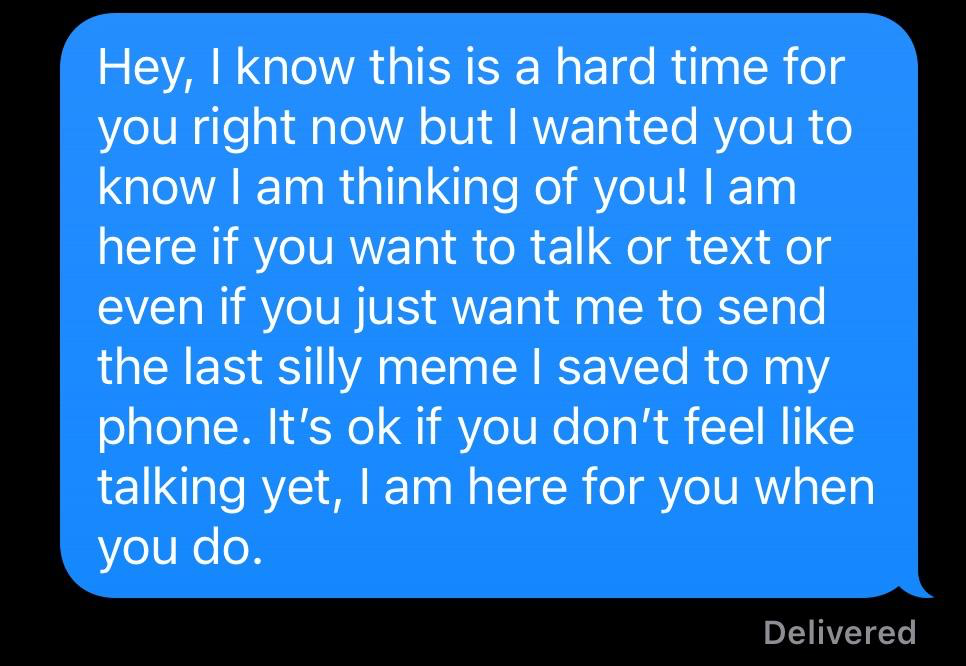
- Reach out. Sometimes when someone is going through a grief process, the people around them either feel too uncomfortable to reach out or make a judgment that the person needs “space” during this difficult time. Giving them a call or sending a text can make them feel less isolated – even if they don’t respond or let it go to voicemail. Always try to leave an out for them in every contact – something like: Hey, I know this is a hard time for you right now but I wanted you to know I am thinking of you! I am here if you want to talk or text or even if you just want me to send the last silly meme I saved to my phone. It’s ok if you don’t feel like talking yet, I am here for you when you do.
- Make time to listen and refrain from offering advice. If the drive to offer advice rises up in you, take a deep breath instead of speaking. It is ok and sometimes preferable to leave room for silence – try not to think of this as an “awkward pause” but rather as leaving room for the other person to formulate what they need to say. One popular acronym that can help in moments like this is “W.A.I.T. – “Why Am I Talking?” Open ended questions may better meet the needs of your grieving friend than advice.
- Make specific offers of ways to be a help. Better yet, make a kind of menu for the one grieving so they can pick and choose or modify ideas! 4. Focus on the needs you are hearing rather than feelings. Feelings can be really hard to pin down and may carry the burden of feelings of judgment or past trauma.
- make you a comfort meal
- walk your dog
- water your houseplants
- sit and watch a movie together
- listen without giving advice
- Focus on the needs you are hearing rather than feelings. Feelings can be really hard to pin down and may carry the burden of feelings of judgment or past trauma.

Grief Resources
- Grief Share griefshare.org Resource for locating free online and in person grief support groups
- Good Grief https://goodgriefnetwork.org/ Peer support for people experiencing eco distress and collective trauma around social and climate injustice
- Cancer Care https://www.cancercare.org/tagged/grief_and_loss Free support services for those who have lost a loved one to cancer
- Autism and Grief Project https://www.autismandgrief.org/ Autism specific information
- We are the Great Turning Podcast (Joanna Macy) https://resources.soundstrue.com/we-are-the-great-turning-podcast/
- EcoAnxious Stories https://ecoanxious.ca/ A resource for using storytelling for healing and to make a difference during climate crisis
- Generation Dread https://unthinkable.substack.com/ “Finding Purpose in an Age of Climate Anxiety”
- The Solution Project https://thesolutionsproject.org/info/environmental-climate-justice/
- Letters to Pushkin https://www.letterstopushkin.com/ A gentle space for sharing photos and memories of beloved companion animals
- Association for Pet Loss and Bereavement https://www.aplb.org/support/ Support options, education, and resources
Books
- Stephen Harrod Buner, Becoming Vegetalista.
- Stephen Harrod Buhner, Earth Grief.
- John Michael Greer, The Druidry Handbook: Spiritual Practice Rooted in the Living Earth.
- Joanna Macy, Active Hope: How to Face the Mess We’re In with Unexpected Resilience and Creative Power.
- Joanna Macy, Coming Back to Life: The Updated Guide to the Work that Reconnects.
- Doug Tallamy, Nature’s Best Hope.
- Greta Thunberg, The Climate Book: The Facts and the Solutions.
- Frances Weller, The Wild Edge of Sorrow.
Bibliography
- https://pmc.ncbi.nlm.nih.gov/articles/PMC10704280/
- https://pubmed.ncbi.nlm.nih.gov/30503683/
- https://www.nytimes.com/2021/07/15/well/family/nature-autism-children.html
- https://www.autism.org.uk/advice-and-guidance/professional-practice/wellbeing-in-nature-how-being-outside-can-help-aut
- Stephen Harrod Buner, Becoming Vegetalista.
- Stephen Harrod Buhner, Earth Grief.
- Greta Thunberg, The Climate Book: The Facts and the Solutions.
- Frances Weller, The Wild Edge of Sorrow.
- The Innocence Project https://innocenceproject.org/cases/robert-roberson/
- The Solution Project https://thesolutionsproject.org/info/environmental-climate-justice/


Leave a Reply