“Being autistic has always given me a strong sense of justice and fairness, and a burning drive to do the right thing and to fight for it, even when it seems like struggling against the weight of the world. This seems very related to my extreme empathy, which is also tied to my experience of being autistic.” “Knowing that injustice or violence exist anywhere is deeply painful for me, whether it directly targets me or not, and I believe that I must do anything within my capacity to work for a world where none of us have to be afraid anymore. If I were not autistic, I am certain I would not have the same drive as I do now.”
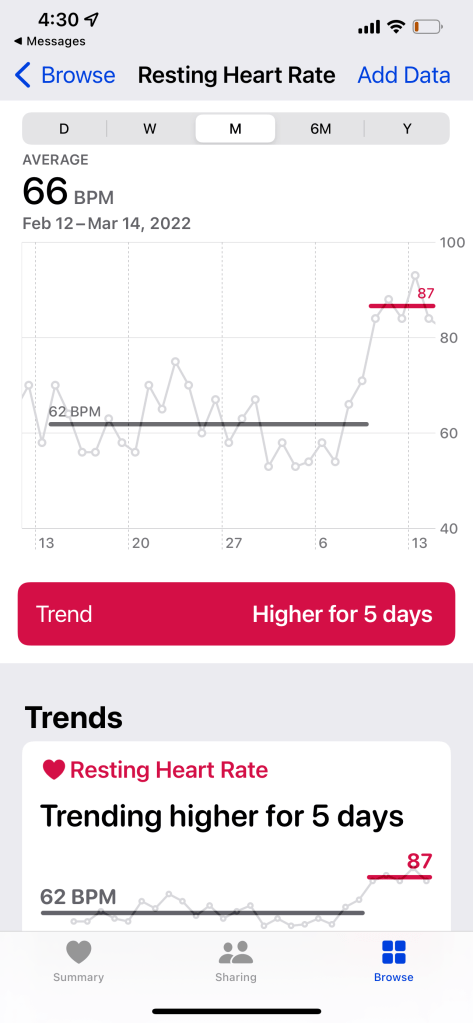
This heart rate graph shows my average resting heart rate before and after confronting injustice. My heart rate trends higher by 25bpm for 5 days on this graph. The trend continued after the confrontation concluded.
This is a hyper empathic autistic’s heart under the stress of injustice. My resting heart rate rises for days and weeks at a time, contributing to meltdown and autistic burnout. I started trending higher the day I knew I had to confront injustice and start writing and organizing against it. This is constant adrenaline poisoning that goes for long periods. I feel it all through me from the moment I wake to the moment I finally pass out from exhaustion and into my stress dreams while sleeping. It’s a hell.
“A state of pervasive exhaustion, loss of function, increase in autistic traits, and withdrawal from life that results from continuously expending more resources than one has coping with activities and environments ill-suited to one’s abilities and needs.” In other words, autistic burnout is the result of being asked to continuously do more than one is capable of without sufficient means for recovery.
But that’s okay, our intensity can be a positive thing too: Neurodivergents can be more creative and more passionate. That creativity and passion can drive us to take action where others may not, and our cognitive rigidity can give us a strong sense of morals. These features combined make us more susceptible to a variety of sensitivities, including justice sensitivity.
For example, in 2015, researchers found that participants with ADHD reported significantly higher justice sensitivity and greater perceptions of injustice than those without ADHD.
That same year, Schäfer & Kraneburg did an interesting study in search of a deeper understanding of why neurodivergents are prone to Justice Sensitivity, which is what I will discuss here.
According to Baumert & Schmitt, “justice-sensitive people’s information processing should be guided in a way that raises their probability of experiencing injustice compared with less justice-sensitive people,” and their “emotional reactions to injustice should be stronger the more justice is endorsed as a fundamental value.”
In other words, people who experience high justice sensitivity have a stronger tendency to notice and identify wrongdoing and have more intense cognitive, emotional, and behavioural reactions to perceived injustice.
Additionally, “justice-sensitive people should ruminate longer and more intensively about experienced injustice than less justice-sensitive people” and should have an “inclination to restore justice and undo injustice”.
Those of us with justice sensitivity have a harder time letting these things go and have a strong desire to make right that which we feel is unfair or morally wrong.
Neurodivergents are more likely to experience justice sensitivity, in particular children, but adults as well.
“Kids with ADHD tend to have a strong sense of justice, sensitivity, and of course, energy. When they feel wronged, disempowered, or unheard, they can become quite mad.”
Results: Participants with ADHD produced higher values in observer and profiteer sensitivity than the control group. There were no differences in perpetrator sensitivity. Questionnaire results reveal that the inattentive subtype exhibited higher justice sensitivity than the hyperactive/impulsive and combined subtypes and the control group on all dimensions.
Conclusion: The results confirm that justice sensitivity is indeed more pronounced in people with ADHD, particularly in the inattentive subtype. It is suggested that pronounced justice sensitivity may be a coping strategy for inferring appropriate social behavior.
I know I've ruined a night or two
I couldn't hold back my views
Family dinner turned off the news
Stuck in a silent room
And I'd rather die by the truth
And hide away feeling shades of blue
I've ruined a night or two

'Cause it's hard being hardcore
I'll cut the lights and cry in the dark more
If you don't feel, then what the hell is a heart for?
'Cause it's hard being hardcore
Everybody's got the same blank face
Tough roughing up the place
When you're not putting up a front
Now you're the crazy one
Leather jackets line up at the bar
Good at hiding who they are
Everybody's got the same blank face

So I'd rather die by the truth
And hide away feeling shades of blue
You want tears, I've shed a few

'Cause it's hard being hardcore
I'll cut the lights and cry in the dark more
If you don't feel, then what the hell is a heart for?
'Cause it's hard being hardcore

Hardcore by Allison Ponthier



Leave a Reply