
ADHD or what I prefer to call Kinetic Cognitive Style (KCS) is another good example. (Nick Walker coined this alternative term.) The name ADHD implies that Kinetics like me have a deficit of attention, which could be the case as seen from a certain perspective. On the other hand, a better, more invariantly consistent perspective is that Kinetics distribute their attention differently. New research seems to point out that KCS was present at least as far back as the days in which humans lived in hunter-gatherer societies. In a sense, being a Kinetic in the days that humans were nomads would have been a great advantage. As hunters they would have noticed any changes in their surroundings more easily, and they would have been more active and ready for the hunt. In modern society it is seen as a disorder, but this again is more of a value judgment than a scientific fact.
Bias: From Normalization to Neurodiversity – Neurodivergencia Latina
I’m not a fan of the “ADHD” label because it stands for “Attention Deficit Hyperactivity Disorder,” and the terms “deficit” and “disorder” absolutely reek of the pathology paradigm. I’ve frequently suggested replacing it with the term Kinetic Cognitive Style, or KCS; whether that particular suggestion ever catches on or not, I certainly hope that the ADHD label ends up getting replaced with something less pathologizing.
Toward a Neuroqueer Future: An Interview with Nick Walker | Autism in Adulthood
We here at Stimpunks long for an alternative label for ADHD to catch on. Kinetic Cognitive Style is a needed reframing.
Reframe these states of being that have been labelled deficiencies or pathologies as human differences.
Normal Sucks: Author Jonathan Mooney on How Schools Fail Kids with Learning Differences
The “Kinetic” in “Kinetic Cognitive Style” is about more than hyperactivity. It encompasses all types of ADHD: Hyperactive/Impulsive, Inattentive, Combined.
“Kinetic” makes a better descriptor for the “ADHD” cognitive style for a few important reasons:
- Kinetic captures the energy of a cognitive style driven by attention, interest, fascination, novelty, challenge, and urgency.
- Kinetic captures the inertia and omnipotential of hyperfocus and flow states, which can be read as inattentive and daydreamy from the outside.
- Kinetic captures the need for plenty of large muscle movement and fidgeting for hyperactive Kinetics.
KCS reconceptualizes cognitive difference in a manner that allows Kinetics to live authentically.
I seek a reconceptualization of cognitive difference, to the end that those who bear now-stigmatizing labels of “deviance,” “disorder” and “syndrome,” may live and manifest their individuality, distinctive interests, gifts and capacities with integrity, in a manner that comes naturally to them, free of pressure to become people they are not, free of the automatic assignation of inferior status; and that they may enjoy the respect of their fellow citizens, rather than disdain and exclusion.
neurodiversity.com | the autistic distinction
Not everyone relates to the term KCS. Another popular reframing is DREAD: Difficulty Regulating Emotion and Attention Divergence.
“Kinetic Cognitive Style” and DREAD are new ways of thinking about ADHD. No matter your preferred nomenclature, this guide will help you understand Kinetic/ADHD/DREAD ways of being.
Table of Contents
- Change Our Framing
- ADHD: Reframing the criteria from deficit based to differences based.
- Attention and Interest
- Hyperfocus, Omnipotential, and Flow States
- Performance, Mood, and Energy
- All the Feels
- School and Second-Hand Importance
- Rejection Sensitive Dysphoria
- The ADHD Nervous System: An explanation of why we act the way we do.
- Medication
- Medication Access
- Climbing Your Wall of Awful
- I Spend, Protect My Energy, Currency
- Further Reading
Change Our Framing
Almost every one of my patients wants to drop the term Attention Deficit Hyperactivity Disorder, because it describes the opposite of what they experience every moment of their lives. It is hard to call something a disorder when it imparts many positives. ADHD is not a damaged or defective nervous system. It is a nervous system that works well using its own set of rules.
Secrets of the ADHD Brain: Why we think, act, and feel the way we do.
Several individuals and families in our community relate to the stories in this mini-documentary by Rachel Lense. The scene where she piles up the forms her family had to fill out over the years is a powerfully relatable one.

What you can’t know unless you have #disability is how all the paperwork chips away at your soul.
@GillLoomesQuinn
Every box you tick, every sentence about your “impairment” and “needs” becomes part of the narrative of your identity in a way that doesn’t happen with temporary, one-off injuries.
Let’s change that narrative by changing our framing.
ADHD: Reframing the criteria from deficit based to differences based.
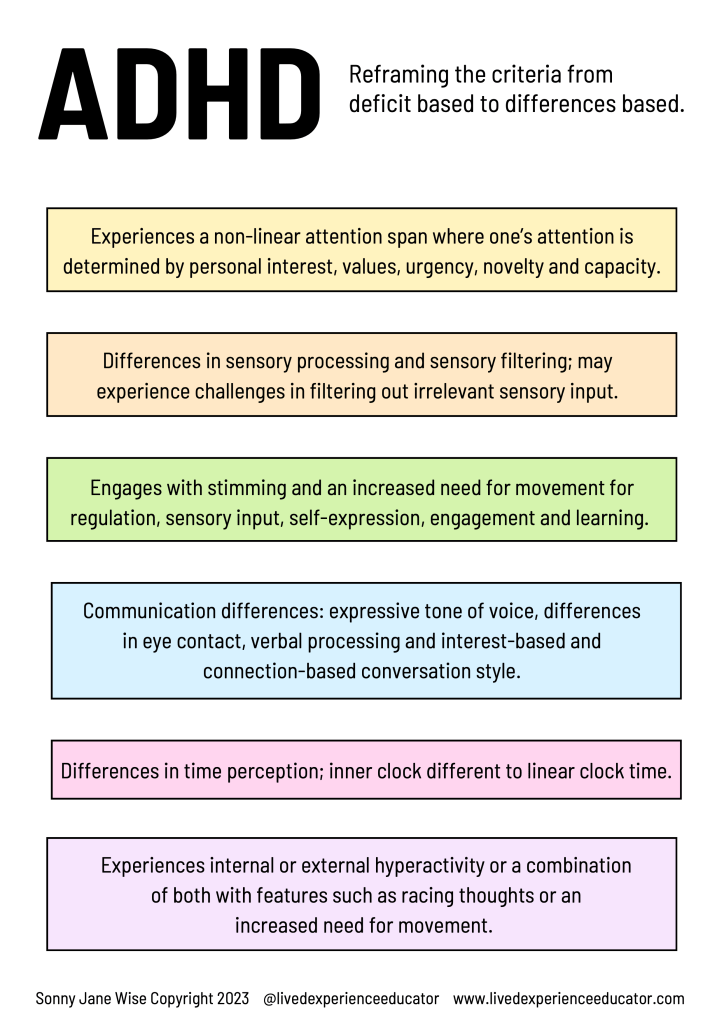
Experiences a non-linear attention span where one’s attention is determined by personal interest, values, urgency, novelty and capacity.
Differences in sensory processing and sensory filtering; may experience challenges in filtering out irrelevant sensory input.
Engages with stimming and an increased need for movement for regulation, sensory input, self-expression, engagement and learning.
Communication differences: expressive tone of voice, differences in eye contact, interest-based and connection-based conversation style and verbal processing.
Differences in time perception; inner clock different to linear clock time.
Experiences internal or external hyperactivity or a combination of both with features such as racing thoughts or an increased need for movement.
”ADHD: Reframing the criteria from deficit based to differences based.” by Sonny Jane Wise of Lived Experience Educator
The ADHD neurotype is: neural hyperconnectivity, monotropism, holotropic sensory gating, a neuroceptive need for novelty and variety, an interest-driven dopamine system, and varying processing styles (both bottom-up and top-down processing).
(These innate traits of ADHD are still being compiled from the ADHD community, so there may be a few more traits that need to be added to the list in the future, but this list is a good start at describing what the ADHD neurotype is before or without trauma, or what the ADHD genes code for as a heritable phenotype.)
The ADHD neurotype is genetic and involves differences in brain structure. If the environment was absolutely perfect, with no trauma or overwhelm, an ADHD person would still be born with the ADHD neurotype. People with this neurotype have existed throughout history, and can usually be traced through family lines, though it can sometimes/rarely skip a generation.
Being ADHD in a world designed for neurotypicals is extremely challenging and sometimes causes a lot of suffering. Blaming our own brains amplifies this suffering. Naming the source of our suffering shows us a path to relief: we need neurodivergent communities, we need neurotype friendly environments, we need liberation from systemic ableism. Working towards these collective solutions is what the neurodiversity movement is all about.
Separating innate traits from distress symptoms: a neuro-affirming definition of ADHD — Neurodiverse Connection
Attention and Interest
KCS recognizes and celebrates that “attention and its partner, interest, operate differently according to the type of brain one has.”
Whether we align our interests with others as in polytropism or follow the dictation of our dominant interest, as in monotropism, it’s all about ‘interest’.
The most important discovery I have made is that attention and its partner, interest, operate differently according to the type of brain one has. By ‘type’ of brain I mean whether you are AS or NT. Murray’s work on monotropism (tightly focused interest) and polytropism (diffused interests) (Murray 1986, 1992, 1995, 1996) is foundational to this thinking.
The Passionate Mind: How People with Autism Learn
The textbook symptoms of attention deficit hyperactivity disorder (ADHD or ADD) — inattention, hyperactivity, and impulsivity — are inadequate; they fail to reflect the complexity of the condition, and several of its most prevalent and powerful attributes.
Patients and clinicians who rely on the DSM-5 alone tend to overlook these defining features of ADHD:
1. an interest-based nervous system
2. rejection sensitive dysphoria
3. intense emotional responsiveness
In this hour-long webinar replay, leading ADHD expert William Dodson, M.D., explains how these core features affect the daily life of individuals with ADHD, and how they often complicate diagnoses and treatment plans.
Defining Features of ADHD That Everyone Overlooks: RSD, Hyperarousal, More (w/ Dr. William Dodson) – YouTube
First thing and this really is probably the most important thing that defines the syndrome is the cognitive component of ADHD: an interest-based nervous system.
So ADHD is a genetic neurological brain based difficulty with getting engaged as the situation demands.
People with ADHD are able to get engaged and have their performance, their mood, their energy level, determined by the momentary sense of four things:
Defining Features of ADHD That Everyone Overlooks: RSD, Hyperarousal, More (w/ Dr. William Dodson)
- Interest (Fascination)
- Challenge or Competitiveness
- Novelty (Creativity)
- Urgency (Usually a deadline)
Hyperfocus, Omnipotential, and Flow States

Entering flow states – or attention tunnels – is a necessary coping strategy for many of us.
Glickman & Dodd (1998) found that adults with self-reported ADHD scored higher than other adults on self-reported ability to hyper-focus on “urgent tasks”, such as last-minute projects or preparations. Adults in the ADHD group were uniquely able to postpone eating, sleeping and other personal needs and stay absorbed in the “urgent task” for an extended time.
From an evolutionary viewpoint, “hyperfocus” was advantageous, conferring superb hunting skills and a prompt response to predators. Also, hominins have been hunter gatherers throughout 90% of human history from the beginning, before evolutionary changes, fire-making, and countless breakthroughs in stone-age societies.
Hunter versus farmer hypothesis – Wikipedia

The most important feature is that attention is not deficit, it is inconsistent.
“Look back over your entire life; if you have been able to get engaged and stay engaged with literally any task of your life, have you ever found something you couldn’t do?”
A person with ADHD will answer, “No. If I can get started and stay in the flow, I can do anything.
Omnipotential
People with ADHD are omnipotential. It’s not an exaggeration, it’s true. They really can do anything.
Defining Features of ADHD That Everyone Overlooks: RSD, Hyperarousal, More (w/ Dr. William Dodson)
Performance, Mood, and Energy
People with ADHD live right now.
Defining Features of ADHD That Everyone Overlooks: RSD, Hyperarousal, More (w/ Dr. William Dodson)
Defining Features of ADHD That Everyone Overlooks: RSD, Hyperarousal, More (w/ Dr. William Dodson)
- Performance is usually the only aspect that most people look for.
- Boredom and lack of engagement is almost physically painful to people with an ADHD nervous system.
- When bored, ADHDers are irritable, negativistic, tense,
argumentative, and have no energy to do anything.- ADDers will do almost anything to relieve this dysphoria. Self-medication. Stimulus seeking. “Pick a fight.”
- When engaged, ADHDers are instantly energetic, positive, and social.
- This shifting of mood and energy is often misinterpreted as Bipolar Disorder.
People with ADHD live right now. They have to be personally interested, challenged, and find it novel or urgent right now, this instant, or nothing happens because they can’t get engaged with the task.
Passion. What is it about your life that gives your life meaning purpose? What is it that you’re eager to get up and go do in the morning? Unfortunately, only about one in four people ever discover what that is, but it is probably the most reliable way of staying in the zone that we know of.
Defining Features of ADHD That Everyone Overlooks: RSD, Hyperarousal, More (w/ Dr. William Dodson)
All the Feels
People who have ADHD nervous systems lead intense passionate lives. Their highs are higher, their lows are lower, all of their emotions are much more intense.
An ADHD Guide to Emotional Dysregulation and Rejection Sensitive Dysphoria (w/ William Dodson, M.D.)
At all points in the life cycle, people who have an ADHD nervous system lead intense, passionate lives.
They feel more in every way than do Neurotypicals.
Consequently, everyone with ADHD but especially children are always at risk of being overwhelmed from within.
School and Second-Hand Importance
People with ADHD do not fit in any school system.
Defining Features of ADHD That Everyone Overlooks: RSD, Hyperarousal, More (w/ Dr. William Dodson)
All schools are based on what we call second-hand importance. The ADHD nervous system doesn’t do importance when it’s in first hand. But schools are second hand importance. What does somebody else, your teacher, think is important enough to teach and important enough to put on the test because it’s important that you know it 10 years from now. This is utterly and completely useless to a kid with ADHD.
For a person with an ADHD style interest based nervous system, these motivations are utterly useless and just a frustration.
Defining Features of ADHD That Everyone Overlooks: RSD, Hyperarousal, More (w/ Dr. William Dodson)
Those schools and their teachers witnessed the slow disintegration of a young child, who had much potential – more than most – into deeper dysfunction and depression as each year passed.
The system made that emotional disintegration my fault. These people were not just teachers, they were perpetrators. Insulated from responsibility because they were the system.
How can you “snap out” of ADHD?. This is the barbarity of School. I never saw it before, the signs were there and I can now see why I have been a slave to depression and anxiety my entire life.
Autism + ADHD = Irrepressible Genius + Depression & Anxiety. | The Grinch Manifesto
Rejection Sensitive Dysphoria
Rejection sensitive dysphoria (RSD) is extreme emotional sensitivity and pain triggered by the perception that a person has been rejected or criticized by important people in their life. It may also be triggered by a sense of falling short—failing to meet their own high standards or others’ expectations.
How ADHD Ignites Rejection Sensitive Dysphoria
Rejection sensitive dysphoria is a triggered, wordless emotional pain that occurs after a real or perceived loss of approval, love, or respect.
Children with ADHD hear 20,000 additional critical or corrective messages before their twelfth birthday when compared with neurotypical children. This cannot help but have a tremendous impact on the emotions and sense of self of a developing child. People with ADHD are “the last picked and first picked on.” Most grow up with the feeling that they are less than, uncool, unwanted, defective, incompetent, and “damaged goods.”
The resulting shame and guilt often negate positive feedback and the formation of a positive self-image. Freud called shame the “master emotion,” because it dominates all other emotions and determines when and how the other emotions can be expressed or dealt with. By its very nature shame and guilt are hidden by the per- son and not confessed to even their closest friends. The resulting low sense of self-esteem is a constant torment and sucks the pleasure out of everything a person does.
RSD is an extreme emotional sensitivity and emotional pain triggered by the perception or imagination by the person with ADHD that they have:
Emotional Regulation and Rejection Sensitivity
- been rejected
- been teased
- been criticized
- disappointed important people in their lives
- withdrawn their own approval of themselves when they failed to attain their own standards or goals
The pain is extreme. “Dysphoria” is literally Greek for “unbearable.” The pain is so primitive and overwhelming that people struggle to find any words to describe it. They can talk about its intensity (“awful, terrible, catastrophic”) and cannot find words to convey the quality of the emo- tional pain.
If this emotional response is internalized, it looks like an instantaneous but triggered major depression. Most psychiatrists are trained to see depression and totally miss the ADHD. It is often mistaken for “rapid cycling” bipolar or borderline personality disorder due to the interpersonal nature of the catastrophic emotional response.
If the response is externalized, it manifests as a rage at the person or situation that wounded the person so severely. (Fifty percent of people who are court mandated for anger management treatment have previously unrecognized ADHD.)
This RSD phenomenon is often misdiagnosed as social phobia. Social phobia is an intense anticipatory fear prior to a public event that the person is going to do or say something embarrassing in public or be scrutinized harshly. Once the person is in the anxiety-provoking situation, the anxiety diminishes or even goes away. RSD is a triggered, wordless emotional pain that occurs after a real or perceived loss of approval, love, or respect.
About a third of adolescents and adults list RSD as the most impairing aspect of their ADHD. They have found ways around their academic or work performance is- sues, but they are still highly vulnerable at any moment to misinterpreting some minor slight or tone of voice as a devastating rebuke.
To some degree or another, most people with RSD be- come people pleasers. They quickly scan every person they meet and have a remarkable ability to figure out exactly what that person would admire or praise. They then pres- ent that very pleasing false self to the world. They are so intent on avoiding the possibility of displeasure from oth- ers and keeping everyone happy that they often lose track of their own goals and desires. By the time they get to their forties, they have built up a huge well of resentment about having given up their own lives to attend to the perceived needs of everyone else and getting nothing in return.
The other most common way of protecting oneself from the extreme pain of RSD is to give up trying anything new unless one is assured of quick and complete success. The notion of trying and failing or being turned down is just too painful to risk. They don’t go on dates. They don’t apply for jobs. They don’t speak in meetings or make their ideas and needs known to anyone.
There are some positive aspects of RSD. It commonly creates a desperate drive to achieve and excel. It creates a drive to be perfect or at least “above reproach.” But at what cost? Perfectionism is an unattainable goal. People with RSD become false shells or performers, but they must be constantly striving and achieving because they know that “today’s audience does not applaud yesterday’s performance.” They never experience “peace.”
Emotional Regulation and Rejection Sensitivity
For people with ADHD or ADD, rejection sensitive dysphoria can mean extreme emotional sensitivity and emotional pain — and it may imitate mood disorders with suicidal ideation and manifest as instantaneous rage at the person responsible for causing the pain.
How ADHD Ignites Rejection Sensitive Dysphoria
The ADHD Nervous System: An explanation of why we act the way we do.
“Secrets of the ADHD Brain: Why we think, act, and feel the way we do.” is a great resource that speaks to the experiences of the Kinetic DREADpirates at Stimpunks. We share selections below, but go read the whole thing.
Truths About the ADHD Nervous System: An explanation, finally, of why we act the way we do.
Secrets of the ADHD Brain: Why we think, act, and feel the way we do.
- Why We Are So Sensitive
- Why We Don’t Function Well in a Linear world
- Why We Are Overwhelmed
- Why We Love a Crisis
- Why We Don’t Always Get Things Done
- Why Our Motors Always Run
- Why Organization Eludes Us
- Why We Forget Sometimes
- Why We Don’t See Ourselves Clearly
- Why We’re Time Challenged
Why We Are So Sensitive
You cannot manage the impairments of ADHD until you understand how you process emotion. Researchers have ignored the emotional component of ADHD because it can’t be measured. Yet emotional disruptions are the most impairing aspects of the condition at any age.
Secrets of the ADHD Brain: Why we think, act, and feel the way we do.
Why We Don’t Function Well in a Linear world
The ADHD world is curvilinear. Past, present, and future are never separate and distinct. Everything is now. People with ADHD live in a permanent present and have a hard time learning from the past or looking into the future to see the inescapable consequences of their actions. “Acting without thinking” is the definition of impulsivity, and one of the reasons that people with ADHD have trouble learning from experience.
Secrets of the ADHD Brain: Why we think, act, and feel the way we do.
Why We Are Overwhelmed
People in the ADHD world experience life more intensely, more passionately than neurotypicals. They have a low threshold for outside sensory experience because the day-to-day experience of their five senses and their thoughts is always on high volume. The ADHD nervous system is overwhelmed by life experiences because its intensity is so high.
The ADHD nervous system is rarely at rest. It wants to be engaged in something interesting and challenging. Attention is never “deficit” It is always excessive, constantly occupied with internal reveries and engagements. When people with ADHD are not in The Zone, in hyperfocus, they have four or five things rattling around in their minds, all at once and for no obvious reason, like five people talking to you simultaneously. Nothing gets sustained, undivided attention. Nothing gets done well.
Secrets of the ADHD Brain: Why we think, act, and feel the way we do.
Why We Love a Crisis
Sometimes, a person with ADHD can hit the do-or-die deadline and produce lots of high-quality work in a short time. A whole semester of study is crammed into a single night of hyperfocused perfection. Some people with ADHD create crises to generate the adrenaline to get them engaged and functional. The “masters of disasters” handle high-intensity crises with ease, only to fall apart when things become routine again.
Secrets of the ADHD Brain: Why we think, act, and feel the way we do.
Why We Don’t Always Get Things Done
People with ADHD are both mystified and frustrated by the intermittent ability to be super-human when interested, and challenged and unable to start and sustain projects that are boring to them. It is not that they don’t want to accomplish things or are unable to do the task. They know they are bright and capable because they’ve proved it many times. The lifelong frustration is never to be certain that they will be able to engage when needed, when they are expected to, when others depend on them to. When people with ADHD see themselves as undependable, they begin to doubt their talents and feel the shame of being unreliable.
Secrets of the ADHD Brain: Why we think, act, and feel the way we do.
Why Our Motors Always Run
But they rarely get away with it entirely. When they tune back into what has gone on while they were lost in their thoughts, the world has moved on without them. Uh-oh. They are lost and do not know what is going on, what they missed, and what is now expected of them. Their reentry into the neurotypical world is unpleasant and disorienting. To the person with ADHD, the external world is not as bright as the fantastic ideas they had while lost in their own thoughts.
Secrets of the ADHD Brain: Why we think, act, and feel the way we do.
Why Organization Eludes Us
The ADHD mind is a vast and unorganized library. It contains masses of information in snippets, but not whole books. The information exists in many forms-as articles, videos, audio clips, Internet pagesand also in forms and thoughts that no one has ever had before. But there is no card catalog, and the “books” are not organized by subject or even alphabetized.
Each person with ADHD has his or her own brain library and own way of storing that huge amount of material. No wonder my patients often cannot access the right piece of information at the moment it is needed-there is no reliable mechanism for locating it. Important items (God help us, important to someone else) have no fixed place, and might as well be invisible or missing entirely.
Secrets of the ADHD Brain: Why we think, act, and feel the way we do.
Why We Forget Sometimes
For someone with ADHD, information and memories that are out of sight are out of mind. Her mind is a computer in RAM, with no reliable access to information on the hard drive.
Working memory is the ability to have data available in one’s mind, and to be able to manipulate that data to come up with an answer or a plan of action. The ADHD mind is full of the minutiae of life (“Where are my keys?” “Where did I park the car?”), so there is little room left for new thoughts and memories. Something has to be discarded or forgotten to make room for new information. Often the information they need is in their memory… somewhere. It is just not available on demand.
Secrets of the ADHD Brain: Why we think, act, and feel the way we do.
Why We Don’t See Ourselves Clearly
If a person cannot see what is going on in the moment, the feedback loop by which he learns is broken. If a person does not know what is wrong or in what particular way it is wrong, she doesn’t know how to fix it. If people with ADHD don’t know what they’re doing right, they don’t do more of it. They don’t learn from experience.
Secrets of the ADHD Brain: Why we think, act, and feel the way we do.
Why We’re Time Challenged
Because people with ADHD don’t have a reliable sense of time, everything happens right now or not at all. Along with the concept of ordination (what must be done first; what must come second there must also be the concept of time. The thing at the top of the list must be done first, and there must be time left to do the entire task.
I made the observation that 85 percent of my ADHD patients do not wear or own a watch. More than half of those who wore a watch did not use it, but wore it as jewelry or to not hurt the feelings of the person who gave it to them. For them, time is a meaningless abstraction. It seems important to other people, but ADDers have never gotten the hang of it.
Secrets of the ADHD Brain: Why we think, act, and feel the way we do.
Medication
Medications are the treatment of choice for ADHD.
ADHD Medication Management: How to Use and Adjust Stimulants Safely (with William Dodson, MD)
None of the behavioral management techniques..have ever been able to show any benefit at all.
It can not be treated with behavioral techniques any more than you can lower a fever with behavioral techniques.
Defining Features of ADHD That Everyone Overlooks: RSD, Hyperarousal, More (w/ Dr. William Dodson)
Medication Access
ADHD treatment is not ADHD friendly at all.
How ADHD Treatment Is Not ADHD Friendly – YouTube
Climbing Your Wall of Awful
The Wall of Awful is an emotional barrier between you and whatever it is you’re trying to do like, pay a past due parking ticket — built from past failures and all the negative emotions and outcomes that come with them.
How to Do Something That Should Be Easy (But…Is…Not)
Everyone fails. Some, like those with executive function challenges, fail more than others.
Each failure brings negative emotions – guilt, disappointment. These smaller emotions become stronger feelings of anxiety, shame and even loneliness if one is repeatedly rejected because of their errors. Each time these negative emotions are experienced, another brick is placed into that person’s Wall of Awful.
The Wall of Awful is the emotional barrier that prevents us from initiating tasks and taking the risks necessary to make reach our goals. It is the emotional consequence of having ADHD and it must be understood to be overcome.
The Wall of Awful™ – ADHD Essentials
What really puts bricks in our walls is judgement.
So if we can approach our challenges from a place of non-judgement, and a place of compassion and forgiveness and empathy, then we can avoid more bricks than we otherwise would.
Maybe not all of them, but lots of them.
How to Do Something That Should Be Easy (But…Is…Not)
I Spend, Protect My Energy, Currency
We have a couple of theme songs for KCS/DREAD/ADHD in our community: Guided by Angels by Amyl and the Sniffers and Monkey Mind by The Bobby Lees.
Guided by angels
But they're not heavenly
They're on my body
And they guide me heavenly
The angels guide me heavenly, heavenly
Energy, good energy and bad energy
I've got plenty of energy
It's my currency
I spend, protect my energy, currency

Guided by Angels by Amyl and the Sniffers
Monkey Mind
It's just my monkey mind
Monkey Mind
It's just my

I take him out, and then I sit him down
I look him in the eye, and say no more
monkeying around
Now you look-y here, you gonna leave me
alone
Cause there's no room here for a little
monkey in my home

Monkey Mind
It's just my monkey mind
Monkey Mind
It's just my

That monkey mind, he likes to eat himself alive
Think he's done, and then he takes another bite
Now see, I gotta learn to be kind
To my monkey mind, cause he'll be with me till I die

Monkey Mind
It's just my monkey mind
Monkey Mind
It's just my

Monkey Mind by The Bobby Lees
Further Reading
This post is also available in:


