
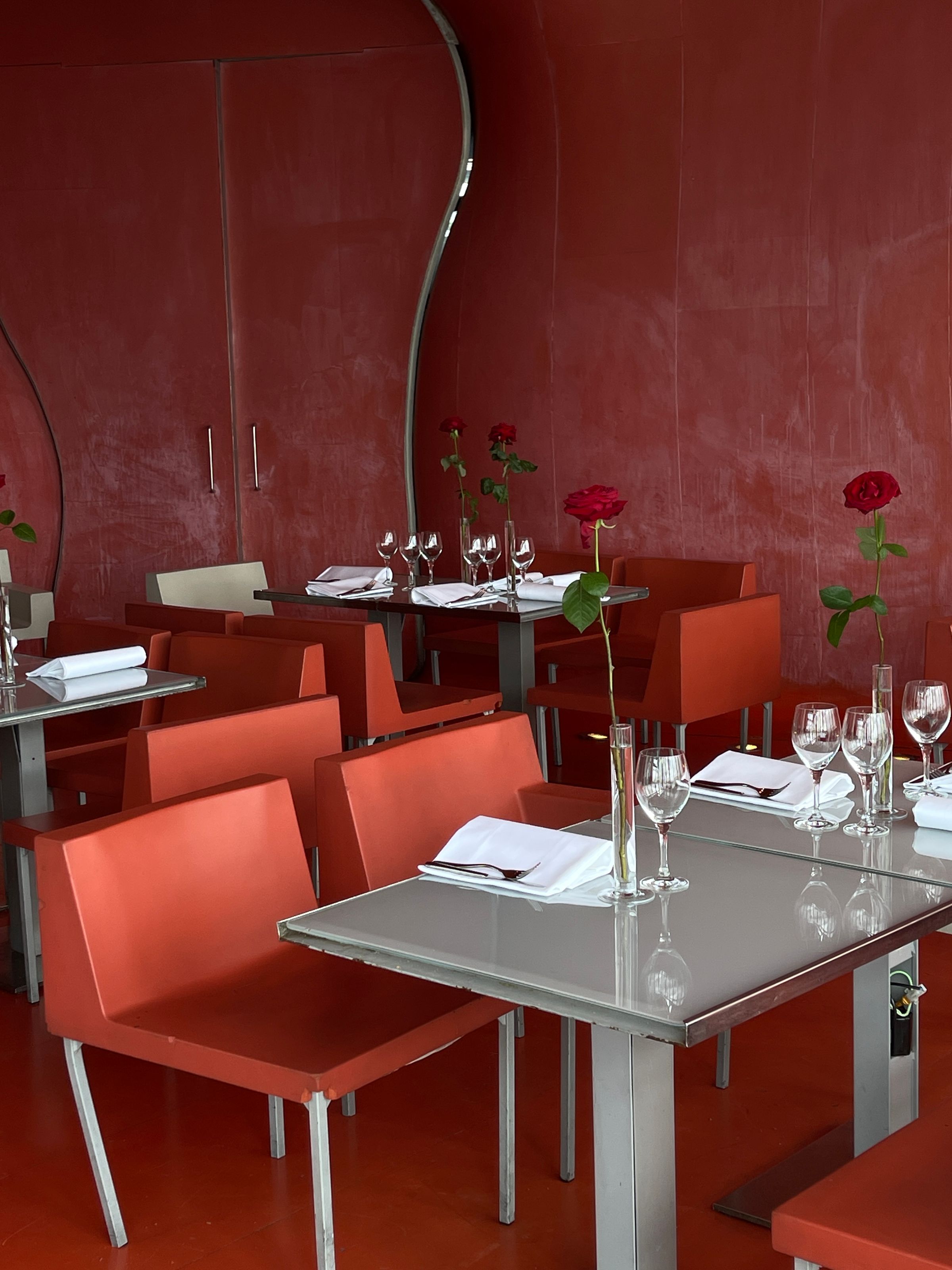
When you optimize out the friction, you optimize out the reason anyone came in the first place.
Justin Bunnell, in Why dining out doesn’t feel welcoming anymore
Are you being welcomed in or are you quietly being shown the door?
Justin Bunnell, in Why dining out doesn’t feel welcoming anymore
For our Sunday, November 29, 2026 at 10AM CT, 4PM UK Campfire Learn Together, we are watching and discussing Why dining out doesn’t feel welcoming anymore, a video essay by Justin Bunnell about why restaurants got louder, chairs got harder, and going out started to feel like being processed.
His answer is that none of it is an accident. Almost every detail of a bad night out, he says, “was engineered, not by a chef, by a spreadsheet.” He traces that spreadsheet back to a single metric invented at Cornell in 1998, follows it through three levers — sound, the chair, and friction at the checkout — and then delivers the twist: the industry’s own researchers later tested the math and found it mostly wrong. The rooms got worse for a revenue bump that barely existed.
Then he ends on a test anyone can run: “look at the floor, check the lights, feel the chair, listen to how loud it is.”
We know that test. It is a sensory checklist. We have published it in pieces for years — on our Sensory Checklist Gallery, in Neuroception and Sensory Load, in the Neurodivergent Design Checklist, and in every room description of Cavendish Space. Four weeks ago we argued that a third place needs a cave. This week a hospitality documentary walks to the same door from the revenue side. So we’ll read it closely, grant what it earns, and ask the question its ending leaves open: welcomed in — by a room built for whom?
We watch. We reflect. We bring our whole bodyminds — including the ones that knew this room was hostile long before the spreadsheet did.
Videos
We’ll watch it together — subtitles on, sound up, cameras optional. No need to have watched ahead.
Why dining out doesn’t feel welcoming anymore — Justin Bunnell, posted November 5, 2026. About twenty minutes, in fourteen short chapters, from The death of the third place through The Cornell study that challenged the math to What happens to the third place next?
It is shorter than most of our Campfire videos, which leaves more of the hour for the conversation. Fair warning for sound-sensitive viewers: there is background music under much of the narration. Subtitles help, and so does turning it down.
One question for the session: are you being welcomed in — and who was the room built to welcome?
Table of Contents
- Videos
- Engineered by a Spreadsheet
- Notice What Is Not on the List
- A Chair Is Inventory
- Loud Reads as Busy
- The Spreadsheet Was Mostly Wrong
- A Third Place With a Cover Charge
- Look at the Floor, Check the Lights
- The Stimpunks Synthesis
- Join Us
- Main Takeaways
- Related Glossary Entries
- Reflection Questions
- Resources
Engineered by a Spreadsheet
You probably think that this is bad service, corners cut, lazy design. But it isn’t. Almost every detail of that night was engineered, not by a chef, by a spreadsheet.
Bunnell opens on a night out everybody recognizes. A table the size of a cutting board. A chair “designed by someone with a grudge against spines.” A QR code instead of a menu. A room so loud “that you had to get good at lip reading just to understand what your date was trying to tell you.” And, around the forty-minute mark, a glowing tip screen held out by someone who stands there watching you.
His first move is the one that makes the whole video worth watching. He refuses to blame the people in the room. Not the server, not the cook, not the owner. The night was designed, and it was designed to do something.
That is our first move too. We call it broken systems, not broken people. When a room hurts, look at what the room was built to do before you look at the people inside it — including the person who can’t stand being in it.
His one-sentence summary of the century is the frame for everything after it:
This is the story of how restaurants spent 100 years learning how to make you stay, 30 years learning how to make you leave, and now spending a fortune trying to remember the first part of it.
Notice What Is Not on the List
Notice what is not on the list, the food. Oldenburg thought food and drink were nice to have, but not the point.
To explain what a restaurant used to be for, Bunnell reaches for the sociologist Ray Oldenburg and The Great Good Place (1989). Home is the first place. Work is the second. The third place is everywhere else you go “on purpose, voluntarily, regularly, and happily.” The diner. The barbershop. The corner café where “the same six people have argued about the same three things every single morning.”
Oldenburg’s list of what makes one work, Bunnell says, “reads like a checklist of everything a modern restaurant has quietly removed”: neutral ground, a leveler, conversation as the main event, easy to get to, regulars, a low profile, a playful mood. The food isn’t on it. The point was that you were staying somewhere. For most of the twentieth century, he argues, “the thing a good restaurant actually sold was not the plate, it was the time.”
We grant all of that. Our own Third Places entry opens on the plainest version of it: “a place that provides community without being required to buy stuff.”
But notice something else that is not on the list. Access isn’t on it either. Oldenburg’s third place is a room of talkers, and the room is built around the talk. Our essay A Third Place Needs a Cave reads the list item by item and finds the place where it breaks:
A loud bar levels class and does not level sensory access. A room can erase every status marker in the building and still sort people by how much noise, light, and crowd their bodies can take.
Our glossary keeps a name for the fix — the radical third place, which builds in “basic accommodations for the spectrum of abilities of its participants.” Hold that word, radical. Bunnell’s story is about what the spreadsheet took away from the third place. Ours starts by asking who the third place left out before the spreadsheet arrived.
A Chair Is Inventory
Under RevPASH, a chair is inventory. A guest who finishes dinner and orders nothing else is not a loyal regular having a nice time. They are inventory sitting unsold.
The uncomfortable chair is older than the Model T. Around 1900, Bunnell says, quick-lunch rooms for office workers sat you in a wooden chair with one wide arm, like a school desk, and the restaurant historian Jan Whitaker notes that one function of those seats was “explicitly to discourage lingering.” By the 1920s the trade had a name for it: the fifteen-minute chair.
After the Second World War a different model won for a while — deep booths, carpet, low lighting, “rooms that absorb sound instead of amplifying it.” Then, in 1998, an idea arrived from the airlines. An empty seat on a departing plane is worth nothing, so you manage the price and the use of every seat. A Cornell paper carried that idea into restaurants and gave it a metric: RevPASH, revenue per available seat-hour. Take an hour’s revenue, divide by the seats, and “that is what one chair is worth per hour, whether or not anyone is sitting in it.”
Bunnell is fair to the professor who invented it. She was “not a villain,” he says, just someone trying to help an industry that keeps about a nickel of every dollar. “But the metric has a worldview baked into it.”
We have a shelf of words for that worldview. Our Efficiency entry quotes David Labaree: “In the name of efficiency, we have increasingly disabled the ability of healthcare, industry, and education to carry out their missions effectively.” It quotes Goodhart’s Law: “When a measure becomes a target, it ceases to be a good measure.” And metric fixation is Jerry Muller’s name for what happens next — “the aspiration to replace judgment based on experience with standardized measurement.”
The worked example in the early papers spread “like a rumor”: shave a 60-minute meal to 50 and revenue goes up 20%. Add a point-of-sale system that timestamps your check, and “your dinner became a timestamp.” Bunnell’s line for where that leaves the industry is exact:
Hospitality now had a number, a lever, and a stopwatch.
A chair is the place a body rests. The moment it becomes a unit of inventory, the people who need to rest longest become the inventory that won’t sell.
Loud Reads as Busy
If you don’t want to tell customers to get up and leave, you got to build a room that convinces their bodies to do it before they even think about it.
This is the sentence in the video that we would put on a wall. The room speaks to your body before anybody speaks to you. We have a word for the listening half of that conversation — neuroception, the “instantaneous, subconscious processing of safety and risk.” Bunnell is describing a room deliberately tuned to send danger cues just loud enough to move you along.
Lever one is sound. He says a 1993 federal study of restaurant noise found levels peaking at 68 decibels, “the range of a normal conversation.” By 2018, SoundPrint measurements of more than 2,250 Manhattan restaurants and bars put the average restaurant at 78 and the average bar at 81. The critic Kate Wagner, he says, got 86 at brunch and 90 at a brewpub, and diagnosed it in one line: “Fashionable minimalism replaced plush opulence.” The carpet, the curtains, and the upholstered booth went out. “Polished concrete, subway tile, exposed ductwork” and an open kitchen came in.
Some of that was fashion. Some was cheaper. And some, he says, was on purpose:
Loud reads as busy. Busy reads as popular. And nobody has a long, lingering conversation when they have to shout to order a second drink.
Here the video and our library meet head-on. The acoustics researcher Carmen Rosas-Pérez’s doctoral thesis, Disabling Acoustics, surveyed 311 people who consider themselves noise sensitive — 59% of them neurodivergent, 44% with hearing differences. Asked to name environments that are often challenging, “almost 90% of participants mentioned a type of hospitality venue, restaurants, bars and pubs being the most common, with almost half of participants (47%) referring to them as often challenging.” Background music “in places like bars, restaurants and shops” was one of the sounds people were least able to get used to, with 71% saying they did not habituate to it or noticed it more over time.
That last finding matters more than any decibel reading. A key finding of her interviews with Autistic adults is the “reported absence of habituation effect.” Rather than getting used to it, people describe a cumulative effect — “increased irritation, stress, exhaustion, and sensitivity over time.” The loud room does not just hurry some of us out. It costs us for days afterwards. Our Sensory Load pattern says the same thing from the design side: “Sensory input accumulates over time.”
And the cost doesn’t stop at the meal. Rosas-Pérez writes that participants “have had to opt out of attending social events, going to bars and restaurants, concerts and others,” and that the harm of that withdrawal is “often underestimated due to the misconception that autistic people do not enjoy socialisation.” The room pushes us out, and then our absence gets read as proof we never wanted to be there.
We wrote about the school version of this in 2022, in The Sensory Hell of the Lunchroom: trays clattering, cutlery jangling, children “squeezed into rows of tiny seats bolted on to collapsible dining tables.” The lunchroom was the first room many of us learned was built to move us through, not to hold us. The restaurant Bunnell describes is the lunchroom with a cocktail menu.
Lever two is the chair again, redesigned: “The galvanized French cafe chair, the backless stool at a communal table, the bench with an inch of foam.” Lever three is friction — QR menus and handheld terminals that “turn your server into a payment courier” and put the bill in front of you “before you even have decided you’re done.”
The Spreadsheet Was Mostly Wrong
Cut your average meal time by 5% and the revenue goes up about 1%. Not five, one.
Here is the twist. In 2009, Bunnell says, Gary Thompson — an operations professor at the same Cornell school that invented RevPASH — simulated 1,296 restaurant scenarios to test the 20% promise. The word mythical is in the title of the paper. On average the real gain was less than a quarter of the promise, and even in the best case he could build, less than half.
The reason is almost funny. “The formula assumed there was always another party waiting for that seat.” There usually isn’t. Shaving ten minutes off a dinner at 8:50 does not conjure a new couple at the door.
Then it gets better. In 2004 the RevPASH paper’s own lead author and a designer timed 1,400 meals at a casual Mexican restaurant to see which tables earned the most per minute. The winner:
The booth, the comfortable one. Yeah, the plush booth.
The banquettes — long benches with tables lined up along them — came in below average. Bunnell adds a 2024 study finding that complaints start ramping around 70 decibels and that reviews mentioning loudness run about a star lower, and SoundPrint data in which 72% of New York diners say they actively avoid places that are too loud. His verdict:
The industry made rooms louder, chairs harder, and checkouts colder in pursuit of a revenue bump that its own researchers showed was mostly imaginary.
There is a word in this section worth keeping. Thompson called the promised gain mythical. Rosas-Pérez’s thesis opens by describing spaces “designed for a ‘mythical average’, as Eleine Ostroff highlights.” Two mythical figures, one room. A customer who is always waiting at the door, and a customer who can sit on anything and hear through anything. Neither one exists, and the room was built for both.
Labaree saw the general shape of this in our Efficiency entry: “effectiveness depends on a certain degree of inefficiency.” A system with no slack can’t absorb anyone. A dining room with no slack can’t hold anyone long enough to become a regular.
A Third Place With a Cover Charge
So that tells me that the third place is back, but it has a cover charge.
The company that sold the third place as a plush armchair is now trying to buy it back. During the pandemic, Bunnell says, Starbucks pulled out seating and leaned into mobile orders, and “the stores became pickup counters with a logo.” After four straight quarters of decline, a new chief executive arrived in September 2024 with a plan called Back to Starbucks, and in January 2025 the ceramic mugs, free refills, condiment bar, and names on cups came back. “A $100 billion company spent a year rediscovering the booth.”
And in the same month, he notes, it reversed its open-door policy. You now need a purchase to sit or use the restroom.
That is the line our glossary says matters most. Our essay puts it plainly:
That is why “without being required to buy stuff” is the line in our glossary that matters most, and why the loss of third places hits Disabled and neurodivergent people first and hardest. When the free room goes, the only Cavendish Space left is the one you can pay for.
Bunnell has a story that shows what a free room is for. In January 2014 a McDonald’s in Flushing, Queens, started calling the police on a group of elderly Korean regulars who arrived at 5 a.m., bought one coffee, and stayed into the night. After four police visits and a boycott, a state assemblyman brokered a truce. Bunnell’s reading is the right one: “The regulars, they weren’t freeloading. They were doing exactly what Oldenberg said a third place was for.”
On Stimpunks.World, our street of rooms online, we built the opposite rule into the bar. A Quiet Pint, as our essay describes it, pours every pint alcohol-free first, in the same glass, and “nobody has to order anything to sit down.”
The video ends this stretch on the newest thing: phone-free bars. At Hush Harbor in Washington, D.C., a host seals your phone in a locking pouch at the door. Inside: books, board games, Polaroids, a pen for giving someone your number, a bar phone if anyone needs to reach you. Listening bars. Supper clubs with no table limit. “Carpet on the floor and a dimmer switch on the wall.” They are selling, Bunnell says, “the one thing the spreadsheet could not price. Presence.”
He is honest about the catch. “You cannot carpet your way out of a 36% increase in expenses.” The market is splitting into automated pickup lockers on one end and “slow rooms that charge for the privilege” on the other, with bankruptcies in the middle. So his closing question is a good one:
The question for the next decade is not whether the third place survives, it’s whether it survives as a place for everyone or as a luxury for those who can afford it.
We’ll argue with the word everyone in the Synthesis. We’ll also argue with the pouch.
Look at the Floor, Check the Lights
So the next time you sit down somewhere, run the test, look at the floor, check the lights, feel the chair, listen to how loud it is before the drinks even arrive, and ask yourself one question.
This is the alignment that made us want to watch the video together. Bunnell’s test has four items. Every one of them is already on a Stimpunks checklist — usually with a reason and a fix attached.
The floor. In Neuroception and Sensory Load, our Sensory Environment Checklist carries the Local Government Association’s table of challenges and alternatives. Three rows are about floors: “Hard floors and walls, adds to noise (eg footsteps) and creates echo” — answered with “Soft furnishings (carpets, curtains, furniture) absorb noise.” “Reflective surfaces eg flooring or walls” — “Consider a matt finish.” And “Patterns on floors, carpets and soft furnishings” — “Plain materials in neutral colours.” The polished concrete in Bunnell’s video fails the first two at once.
The lights. Our Sensory Checklist Gallery has a card called Lighting (Stop the Glare): “Avoid flickering LEDs/fluorescents,” “Provide dimmable zones if possible,” “Don’t force bright rooms for ‘alertness.’” Its goal line: “fewer sensory spikes, more regulation.”
The chair. The card called Seating + Body Comfort reads like a reply to the fifteen-minute chair: “Chairs with backs; varied options,” “No ‘sit still’ policing,” and our favorite, “Comfort is not laziness.” Its goal: “bodies supported, not managed.” The booth that won the Cornell study is that card, measured in revenue per minute.
The loudness. The card called Sound (Lower the Noise Floor): “Use soft materials to reduce echo,” “Provide earplugs or allow headphones,” “Normalize ‘I need less sound.’” Its goal line is the shortest summary of this whole Campfire we have: “participation without bracing.”
We would add two items Bunnell’s test leaves out, because both are on our cards and both decide whether a room is a third place or a waiting room. The door: Crowds + Flow asks for “easy exits and re-entry” and says “Make ‘step out’ normal.” And the controls: our Neurodivergent Design Checklist asks whether “Lighting can be adjusted” and “Quiet spaces are available.”
Cavendish Space is what those cards look like when they become a whole room. The Cavendish classroom on cavendish.space has “soft surfaces so the room does not ring,” lamps on a dimmer “that does not flicker or hum,” “more places to be than there are children,” and a rule we’d hang in every dining room: “Nobody is told to sit still.” Underneath the picture are the room’s own controls — “the lamps, the blinds, the fan, and the lights in the cave. They are the settings the class has, and you can change them.”
Our checklist cards close on one line, and it fits Bunnell’s ending exactly: “Sensory access is not rocket science. Lower the load. Enable dignity.”
The Stimpunks Synthesis
The following is a Stimpunks synthesis — our own extension and critique, not a claim made by the video or by Justin Bunnell.
Grant it all first, because it earns it. This is a hospitality documentary that refuses to blame workers or owners, names the metric instead of the mood, cites the industry’s own research against the industry, and ends by handing every viewer a sensory audit. It treats the elderly regulars in Flushing as the point of a third place, not a problem for one. And it says out loud the thing most writing about restaurants won’t: “Hospitality was never an engineering problem.” Here is where we would push — and the last push is aimed at us.
First: this test is older than the video, and the people who ran it first were called picky. Bunnell frames the loud room as everybody’s annoyance, and for a lot of diners it is. For others it is the door. Rosas-Pérez names what happens when those others say so: sensory gaslighting. Her participants describe “constant dismissal of their experiences” leading to masking, avoidance, and emotional distress. When staff were asked to turn music down, the reasons for refusing included “People want to have fun.” Even the video’s opening joke has a second reading. Getting good at lip reading is not a party trick for Deaf and hard-of-hearing diners — it is how many already eat out, and it fails in exactly the room he describes. What is a complaint for one diner is a closed door for another. The loud room did not become a problem in 2018. It became a problem for the people the industry was trying to keep.
Second: don’t win this argument on the spreadsheet’s terms. The most satisfying part of the video is the reversal — the math was wrong, so the hostility didn’t even pay. We cheered too. But look at what the corrected math still measures: revenue per seat, per hour. The booth won because it earned more per minute. If the case for a chair with a back is that it pays, the chair goes the next time the numbers say otherwise. That is the McNamara fallacy with upholstery. Our Efficiency entry quotes Muller on the underlying mistake: “not everything that is important is measureable, and much that is measurable is unimportant.” A room that holds people is worth building whether or not it shows up in RevPASH. Comfort is not a revenue tactic. It is access.
Third: nostalgia is not a design brief. Back to Starbucks. Back to the booth. Back to 68 decibels, “the range of a normal conversation.” Every restoration in the video aims at the room as it was, and the room as it was had conversation as its main event and talking as its price of entry. Restoring the 1990s room restores it for the people it already fit. Bunnell’s final question — a place for everyone, or a luxury? — skips a third answer. A place for everyone has to be designed from the edges, not restored from memory. Our essay says what that takes: “Conversation is welcome there. It is not owed.” A cave to retreat to. A door you can stand outside. Regulars who, like Cavendish’s Monday Club, “change how they talk so the person at the edge can come in.” Our glossary already has the word for that. It is the radical third place, and it has never existed by default.
Fourth: presence can’t be confiscated into being. We like what the phone-free bars are reaching for — attention, books, a pen, a room where nobody is half-elsewhere. But for many Disabled and Autistic people, the phone is the access. It holds captions, the AAC app, the noise-cancelling controls, the decibel meter, the text thread that replaces talking, the ride home, the medical alert, the way to reach someone who needs to reach you. Our own communication access card is titled “Anything but the Phone” — and here the phone is the anything. The video doesn’t say whether the pouch has exceptions. That is the question we would ask at the door. We have had this argument before, about straws: a fix aimed at everybody’s habit lands on the people for whom the object is not a habit at all. Cavendish Space gets to presence another way — parallel play, body doubling, presence as participation, and joining in left optional. Presence chosen is a third place. Presence enforced is a policy.
Fifth: whoever holds the dimmer decides who stays. Bunnell is right that the operator with the loud room is usually not the villain. Rosas-Pérez’s survey shows who else is stuck in it. Some participants were thanked by staff for asking to turn the music down, “because they don’t like the constant noise but are only allowed to turn it off if a customer asks. Some shops can’t alter the noise level as it’s done at the head office.” She adds that the volume “can have an important impact on workers of these places too,” and should be treated as occupational noise. The noise-sensitive diner and the server are on the same side of the spreadsheet. So the fix is not only carpet. It is moving the controls into the room. The Cavendish classroom’s controls belong to the class. A dining room whose music is set at head office has handed its welcome to someone who will never sit in it. That is a design justice question before it is an acoustics one: “We center the voices of those who are directly impacted by the outcomes of the design process.” Hospitality may not be an engineering problem. It is still a design problem. The question is the one we keep asking: designed by whom?
Sixth, and aimed at ourselves: our checklists talk to the wrong people. Count the audiences on our sensory pages — schools, homes, workplaces, events, community spaces, cities. Almost nothing on our site is written to the person who runs the diner on the corner and keeps a nickel of every dollar. A checklist that ignores the nickel gets ignored. And our own free rooms are easy to keep free. A Quiet Pint can say nobody has to order anything to sit down because it is made of pixels and pays no rent. A room with a floor and a lease cannot say that on goodwill. Our Free for All Campfire already found the answer: “Charity builds the palace; public funding keeps it free.” The free third place that survived is the library. If we want restaurants and cafés to hold us, we owe the people running them a checklist written in their language — and we owe the commons our votes, not just our nostalgia.
None of which makes Bunnell wrong. It makes him an argument in progress, which is the best kind to bring to a campfire — especially one held in a room we tried to build so nobody gets shown the door.
Join Us
Campfire Learn Together happens every Sunday at 10AM Central in the Events Room in Stimpunks.World. This session is on Sunday, November 29, 2026 at 10AM CT, 4PM UK. Open to the whole community — no preparation needed, no expertise required. Come as you are.
Getting in: the call in the Events Room is open to anybody. Type the name you want to be called, and knock. You’ll wait in the lobby until a moderator lets you in. Your camera and microphone start off.
We’ll watch the video, take a bodymind break, and then open up the reflection questions as a community conversation. You can take part by video, voice, text chat, or just by being in the room. All modes are welcome. Cameras optional. Silence is participation.
There is no designated expert, including us. Nobody needs to know what RevPASH stands for to know how a room made them feel. This is omni-directional learning in a Cavendish Space campfire — and for one hour, a third place with no cover charge. Nobody has to buy anything to sit down. Nobody times your stay. Leave and come back.
Join our community, and our Campfire Learn Together page describes some of what to expect. If this is your first Campfire, you’re in good company — many of our regulars showed up for the first time not knowing quite what to expect, and stayed.
Come with one room you know by its floor, lights, chair, and loudness — a café that holds you, a restaurant that hurries you, or the lunchroom you still remember. Any of them is a good place to start.
Main Takeaways
- A chair is the place a body rests. The moment it becomes inventory, the people who need to rest longest are the stock that won’t sell.
- The room speaks to your body before anyone speaks to you. A room can be built to send danger cues on purpose, and neuroception hears every one.
- Loud reads as busy. Busy is not welcome. For many of us, loud is not an annoyance. It is the door.
- Some of us never get used to it. No habituation, just cost that accumulates — and then our absence gets read as not wanting to come.
- The spreadsheet was wrong — and it would have been wrong if it were right. Don’t defend comfort on revenue’s terms. Comfort is not laziness. It is access.
- Two mythical customers, one room. The one always waiting at the door, and the one who can sit on anything and hear through anything.
- A loud bar levels class and does not level the senses. A third place that only fits talkers was never for everyone.
- A third place with a cover charge is a shop with chairs. Nobody should have to order anything to sit down.
- Nostalgia is not a design brief. Design from the edges. Don’t restore from memory.
- Presence chosen is a third place. Presence enforced is a policy. For many of us, the phone is the access.
- Whoever holds the dimmer decides who stays. Move the controls into the room.
- Floor, lights, chair, loudness. It is a sensory checklist by another name — and Disabled and Autistic people have been running it for years.
Related Glossary Entries
- Third Places — Community without being required to buy anything. Radical third places build in access, and that is the version we want back.
- Cavendish Space — Psychologically and sensory safe spaces. A third place with a cave and a campfire in it, and a door you can stand outside.
- Caves, Campfires, and Watering Holes — Three timeless learning spaces. The classic restaurant is a watering hole with no shade.
- Efficiency — Goodhart, Labaree, and the cost of a system with no slack. RevPASH in one entry.
- Metric Fixation — Replacing judgment with standardized measurement. How dinner became a timestamp.
- McNamara Fallacy — If you can’t measure it, it doesn’t matter. Why it pays is a dangerous defense of a good chair.
- Neuroception — The body’s instant, subconscious reading of safety and risk. What a room built so it “convinces their bodies” is talking to.
- Sensory Hell — Sensory input that is completely unbearable. Our name for the room at its worst.
- Masking — Hiding how we are to get through a space. What sensory gaslighting teaches.
- Crip Tax — The hidden costs of being Disabled. A third place with a cover charge charges some of us twice.
- Threshold Anxiety — The dread that lands at the edge of a change. Why reading the door before you open it is part of a welcome.
- Parallel Play — Being alone together. Presence without the price of conversation.
- Straws — When a fix for everyone’s habit landed on Disabled people’s access. The phone pouch, a decade early.
- Edges — Design is tested at the margins. Who a room fits last tells you what the room is.
- Design Justice — Design centered on the people most affected by it. The answer to designed by whom?
Reflection Questions
On the test. Think of one place you go to eat or drink, or used to. Run Bunnell’s test on it from memory: the floor, the lights, the chair, the loudness. What did your body know about that room before you did? Would you add anything to his four?
On being moved along. Have you ever left a place sooner than you meant to — and only worked out later that it was the room, not you? What was it: the sound, the seat, the light, the bill arriving early? What would have let you stay?
On being called picky. Have you ever asked for less noise, a different seat, or the music turned down? How was it received? Who was there to back you up — and who was quietly glad you asked?
On the cover charge. Where in your life can you still sit, indoors, without buying anything? A library, a park bench, a friend’s porch, a place of worship? Which of those would still be there if it had to make money per seat?
On the phone. Imagine handing your phone over at a door and getting it back on the way out. What would you lose for that hour — attention you’d gladly give up, or access you can’t? What would a phone-free room have to offer you before you could say yes?
On regulars. The regulars in Flushing were doing exactly what a third place is for, and the police were called. Have you ever been a regular somewhere? Did the place change to keep you, or did you change to keep the place?
On the controls. Who holds the dimmer in the rooms you spend the most time in — your home, your school or work, the places you eat? What is one setting you would change tomorrow if the control were yours?
—
This page draws on “Why dining out doesn’t feel welcoming anymore,” a video essay by Justin Bunnell (posted November 5, 2026). Quotations from the video are taken from its automatic captions, lightly cleaned of false starts and obvious mis-transcriptions; figures in the video are given as Justin Bunnell cites them, attributed to the sources he names. Carmen Rosas-Pérez’s doctoral thesis “Disabling Acoustics” is quoted from the copy in our library and from her thesis website; its survey figures describe 311 self-identified noise-sensitive participants, not the general public. Ray Oldenburg is quoted as the video and our own essay quote him. David Labaree, Jerry Muller, the Local Government Association, and the Design Justice Network are quoted from entries on our glossary and pages that cite them. The Stimpunks Synthesis section is our own extension and critique, not attributed to Justin Bunnell.
Resources
- Why dining out doesn’t feel welcoming anymore — Justin Bunnell, YouTube — posted November 5, 2026
- Disabling Acoustics: Impact of daily life acoustic environments on neurodivergent, auraldivergent and noise sensitive people — Carmen Rosas-Pérez, PhD thesis, Heriot-Watt University (2026) — doi:10.13140/RG.2.2.20107.66086
- Ray Oldenburg, The Great Good Place (1989)
- A Third Place Needs a Cave: Cavendish Space as Third Place — Stimpunks Foundation
- A third place needs a cave — Cavendish Space
- Walk a Cavendish classroom — Cavendish Space
- Zone a room — Cavendish Space
- Designing Cavendish Space — Stimpunks Foundation
- Sensory Checklist Gallery — Stimpunks Foundation
- Neuroception and Sensory Load: Our Complex Sensory Experiences — Stimpunks Foundation
- The Neurodivergent Design Checklist — Stimpunks Foundation
- Livable Worlds Checklist — Stimpunks Foundation
- Designing Sensory-Safe Spaces — Stimpunks Foundation
- Pattern 03 — Sensory Load — Stimpunks Foundation
- Neurodivergent Community Spaces — Stimpunks Foundation
- Burnout & Sensory Safety — Stimpunks Foundation
- Event Access Guide — Stimpunks Foundation
- The Sensory Hell of the Lunchroom — Stimpunks Foundation
- Broken Systems, Not Broken People — Stimpunks Foundation
- A Quiet Pint — Stimpunks.World
- The Events Room — Stimpunks.World
- Bodymind Break — Stimpunks Foundation
- Campfire Learn Together Recap: In Defense of Inefficiency — Stimpunks Foundation
- Campfire Learn Together: Free for All — Stimpunks Foundation
- Campfire Learn Together: Who’s Paying for It? — Stimpunks Foundation