
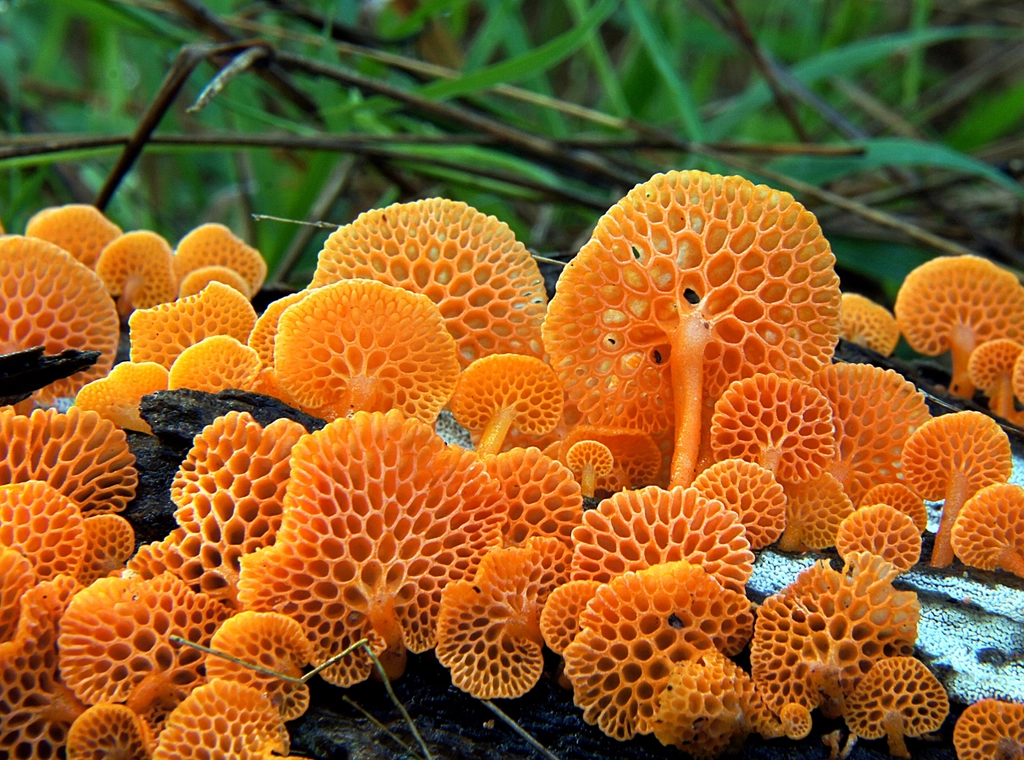
“But if I had to pick one gift from fungi and those who know them well, it would be the power of mischief. They all gleefully defy well-established assumptions, operating both as individuals and networks and creating new possibilities while decomposing old structures. They are punk.”
For our July 12 Campfire Learn Together, we are watching and discussing two short films about fungi, mycelial networks, and the people who think alongside them — a six-minute overture and a thirty-five-minute documentary, forty-one minutes in all. Together they carry an argument we already live by: that the way fungi grow, decompose, connect, and refuse the world as given is not just good ecology. It is a worldview. And that worldview is punk.
The mycelial network is the oldest anarchist in the room. It has no head office. It grows in every direction at once, feeds its neighbors, breaks down what has died into what can live again, and does almost all of it underground, unseen, asking no one’s permission. When the mycologists and legal thinkers of the MOTH collective call this “punk science” and “punk law,” they are naming something the neurodivergent and disabled community has known in the bodymind for a long time: the most transformative work often happens at the edges, in the quiet and the dark, without a commanding center.
We watch. We reflect. We bring our whole selves. And we look for ourselves in the fungi.
Videos
We’ll watch these together at the start of the session — subtitles on, sound up, cameras optional. No need to have watched ahead. The first is a short overture in the mycelial voice; the second is a full documentary produced across ways of knowing, so we’ll screen it together and pause to talk.
The Mycelial Worldview — Moth — More Than Human Life — six minutes, in Spanish with English subtitles. A brief immersion in thinking like a network rather than an individual: distributed, interdependent, and rooted in relationship.
Allpa Ukundi, Ñukanchi Pura. Underground, around, and among us — Vimeo — thirty-five minutes, with English subtitles and a Spanish transcript. A documentary on Indigenous and Western understandings of the underground, produced in collaboration with the Sarayaku people of the Ecuadorian Amazon, the Fungi Foundation, and SPUN. It is the concrete result the MOTH essay describes — punk law and punk science doing serious, laughter-filled work together.
Two films, one question: what does the underground know that the surface keeps forgetting?
Master Decomposers
Fungi are master decomposers. They break down the toughest materials, from rocks to oil to nuclear waste. What if we enlisted those powers to transform the law, one of the most resistant social structures? Fungi give us precious cues for the changes we need at this critical time in human and planetary history. Perhaps their greatest transformative power is their invisibility. In a world of influencers and incessant self-promotion, mycelial networks engineer whole ecosystems in the quiet and the dark. That is how they infiltrate bodies and minds. Before you know it, they get into you. They have certainly gotten into me. You cannot get this close to fungi without being changed.
Decomposition has an image problem. We hear the word and think of rot, loss, the end of something. But fungi reframe it entirely: decomposition is how the toughest, most resistant structures are broken back down into materials that life can use again. Rock becomes soil. Oil becomes food. A fallen tree becomes a nursery. Nothing is wasted; it is only waiting to be metabolized into the next thing.
The MOTH essay makes the leap that turns this from biology into politics: what if we enlisted those powers on the law — one of the most resistant social structures we have? We would ask the same question of a great many structures. The pathology paradigm that files neurodivergent people as broken. The deficit framing that treats a spiky profile as a problem to be smoothed. The systems that were, as we often say, built to be hostile toward the people who most need them. These are hard structures, and hard structures resist. Fungi are patient with hard structures. They do not argue with the rock. They grow into its cracks and, over time, turn it into ground.
This is why we do our best work at the edges and through bricolage — making what we need from what the old structures left behind. The errant thing, the one that does not fit the scheme, is not a filing error. Composting is not destruction. It is how a commons renews itself. You cannot get this close to the mycelial worldview without being changed.
An Intelligence With No Center
Mycelial networks do not have a brain, a boss, or a plan on file. They experiment with different strategies, growing simultaneously in many directions, adapting quickly, forming new connections and fine-tuning their exchanges with the plants they partner with. Their intelligence is distributed — problems get solved without a commanding center telling each thread what to do.
We recognize this instantly, because it is how we try to organize ourselves. A competency network is a mycelial idea: no single expert at the center, but a web of people who each know something, sharing what they have with whoever needs it. Mutual aid is the fungal trade made social — resources moving through the network to wherever the need is greatest, not up a hierarchy to be rationed back down. Omni-directional learning is what a mycelium does by default: everyone teaching, everyone learning, growth happening in every direction at once instead of flowing one way from a podium.
Our Campfire runs on exactly this principle. There is no head of the table because there is no table — there is a ring, and the fire is in the middle, and whoever has something to add adds it. Zero hierarchy is not an aspiration we impose on the network. It is the shape the network takes when you stop forcing it into a chain of command. The mycelium has never needed a manager. Neither, it turns out, do we — we need interdependence, which is a very different thing.
They Are Punk
Fungi have a lot more to teach those of us seeking new ways to advance social and ecological justice. Mycelial networks experiment with different strategies, growing simultaneously in different directions. They adapt quickly to their environment, developing new connections and fine-tuning their trade with plants. Their intelligence is distributed, solving problems without a commanding center.
But if I had to pick one gift from fungi and those who know them well, it would be the power of mischief. They all gleefully defy well-established assumptions, operating both as individuals and networks and creating new possibilities while decomposing old structures. They are punk. As SPUN’s leader, Toby Kiers, has put it, theirs is “punk science” because they’re “trying to cross boundaries and disciplines and not accept the state of the world as a given, while celebrating science that is rooted in creativity.”
Watching Toby proclaim “punk science” at the recent events celebrating her Tyler Prize win (the “Nobel prize” for environmental science), I recognized the gleam of mischief that I had seen in her during our fieldwork in the Amazon and other activities of the MOTH collective. I have told her that MOTH is also doing “punk law” by bridging disciplinary divides, experimenting with new legal actions, and questioning the law’s human supremacism.
Doing punk law with mycologists and the rest of the MOTH collective has been serious fun. It is laughter-filled hard work, with concrete results like a MOTH documentary on Indigenous and Western understandings of the underground, produced in collaboration with the Sarayaku people of the Ecuadorian Amazon, the Fungi Foundation and SPUN.
Crossing boundaries and disciplines. Refusing to accept the state of the world as a given. Rooting the work in creativity. Doing serious, laughter-filled hard work at the edges of what a field is supposed to allow. Read that description of punk science back without the word “fungi,” and it is a description of us.
Punk was always a making tradition before it was a musical genre — do it yourself, roll your own, build it from what you have because no one is going to build it for you. That is the bricolage at the heart of the neurodivergent making tradition, and it is why we keep reaching for the word. To neuroqueer a space is a punk act: it defies the well-established assumption that there is one correct way to have a mind, and it creates new possibilities while decomposing the old ones. To imagine a Solarpunk future — livable, interdependent, ecological, built by and for the people the current world discards — is punk science aimed at the horizon.
We have written before that no competition of hierarchies should prevail — that the rhizome and the mycelium give us a model of connection without ranking, difference without a pecking order. Fungi are the proof of concept. They defy the assumption that intelligence needs a center, that growth needs a plan, that transformation needs a throne. They are mischief with a purpose. They are punk.
The Quiet and the Dark
The essay names the gift most likely to be overlooked: invisibility. In a world of influencers and incessant self-promotion, mycelial networks engineer whole ecosystems in the quiet and the dark. The work that changes everything is the work no one is watching.
There is deep resonance here for anyone who has been told to be louder, more visible, more legibly productive to count. So much of the labor that holds our communities together is quiet crip labor — unglamorous, unposted, done in the dark where the metrics never reach it. Unmasking is often a retreat from the stage lights into a truer, quieter mode of being. And monotropism — our tendency to sink all the way down into a single interest — needs exactly the conditions the mycelium thrives in: undisturbed, unhurried, unsurveilled depth. You cannot follow a thread all the way to the taproot while someone is asking you to smile for the camera.
This is what a cave is for. Our Cavendish Space framework builds the quiet and the dark on purpose — the psychological safety to go deep without performing, to grow in the direction your attention actually wants to grow. The mycelium reminds us not to mistake invisibility for absence. The network is busiest exactly where you cannot see it.
Underground, Around, and Among Us
The longer film takes its name from Kichwa: Allpa Ukundi, Ñukanchi Pura — underground, around, and among us. It is not a nature documentary in the usual mold, where Western science narrates over pretty footage. It is a bridge, built in collaboration with the Sarayaku people of the Ecuadorian Amazon alongside the Fungi Foundation and SPUN, holding Indigenous and Western understandings of the underground in the same frame without collapsing one into the other.
That refusal to pick a single authoritative lens is holistic thinking and interdisciplinary learning doing exactly what fungi do — crossing boundaries, fine-tuning the trade between different kinds of knowing, letting the network be smarter than any one node. It is epistemic pluralism rooted in soil: the recognition that the Sarayaku relationship with the underground and the mycologist’s relationship with the underground are not competitors for one correct account, but partners in a fuller one.
We keep a mycelium and a rhizome close as organizing images for precisely this reason. The film shows what those images look like when they leave the whiteboard and go into the ground of a real forest, held by people who have lived in relationship with that ground for generations. The underground is not a metaphor to them. It is around them, and among them, and it is us too.
The Stimpunks Synthesis
The following section is a Stimpunks synthesis — an extension of the essay’s and the documentary’s themes through our own lens, not a claim made by their authors.
The mycelial worldview is not something we are borrowing for the occasion. It is already load-bearing in how we think. We reach for the rhizome and the mycelium whenever we need to explain a form of connection that has no top — a way of belonging together that does not require anyone to be ranked above anyone else. Fungi are the living argument that no competition of hierarchies should prevail. An intelligence with no commanding center is not chaos. It is a competency network doing what it does best.
Read our vocabulary against the fungal one and the overlap is almost total. Decomposition is bricolage — making the new from the broken-down old, at the edges where the useful scraps collect. Distributed intelligence is mutual aid and omni-directional learning — resources and knowledge flowing to wherever the need is, in every direction at once. Boundary-crossing punk science is neuroqueer practice and the Solarpunk imagination — refusing the world as given and building a livable one from creativity. The power of invisibility is monotropism and the unsurveilled quiet of a cave, where the deepest work gets done far from anyone’s feed.
And underneath all of it is interdependence — the trade between fungus and root, the sharing that makes the whole forest more alive than the sum of its trees. That is the thesis of everything we do. Our caves, campfires, and watering holes are a fungal architecture: quiet depth, gathered warmth, and open flow, all growing from the same underground. Our library is a knowledge commons that behaves like mycelium — what you take and return becomes infrastructure for the next person. We are not a hierarchy that occasionally cooperates. We are a network that occasionally surfaces.
So we watch these films not as outsiders admiring a clever organism, but as kin recognizing a relative. The mycelial worldview is punk, and punk is a Stimpunks worldview, and the underground has been among us all along.
Join Us
Campfire Learn Together happens every Sunday at 10AM Central, online via Discord. This session is on July 12. Open to the whole community — no preparation needed, no expertise required. Come as you are.
We’ll watch together, take a bodymind break, and then open up the reflection questions as a community conversation. You can participate by video, voice, text chat, or just by being in the room. All modes are welcome. Cameras optional. Silence is participation.
Join our community to get access, then find us in our online space. Our Campfire Learn Together page describes some of what to expect. If this is your first Campfire, you’re in good company — many of our regulars showed up for the first time not knowing quite what to expect, and stayed.
Come with something the underground taught you.
Main Takeaways
- Decomposition is creation, not destruction. Fungi break down the most resistant structures — rock, oil, nuclear waste, and, the MOTH collective proposes, even the law — into materials life can use again. We do the same work on the pathology paradigm and the systems built to be hostile: we compost hard structures into ground.
- Intelligence does not need a center. Mycelial networks solve problems, adapt, and grow in every direction at once with no commanding center. This is a competency network, mutual aid, and omni-directional learning in biological form — and it is why zero hierarchy is a shape, not just a value.
- Punk science and punk law describe us. Crossing boundaries, refusing the world as given, rooting the work in creativity, doing serious laughter-filled work at the edges — that is bricolage, neuroqueering, and the Solarpunk imagination under a different name.
- The most transformative work is often invisible. Mycelial networks engineer whole ecosystems in the quiet and the dark, away from the influencer economy of incessant self-promotion. Quiet crip labor, unmasking, and monotropic depth all live in that same undisturbed dark. Invisibility is not absence.
- Ways of knowing are partners, not competitors. The documentary bridges Indigenous and Western understandings of the underground without collapsing one into the other — epistemic pluralism rooted in soil, and interdisciplinary, holistic thinking doing what fungi do.
- The mycelial worldview is already ours. The rhizome and the mycelium are load-bearing images in how Stimpunks organizes: connection without ranking, a network that occasionally surfaces rather than a hierarchy that occasionally cooperates.
Related Glossary Entries
- Interdependence — The trade between fungus and root made into a social principle: we are more alive together than the sum of us apart. The opposite of forced independence, and the ground everything else grows from.
- Competency Network — Distributed intelligence with no commanding center. A web of people who each know something, sharing it with whoever needs it, instead of routing everything through a single expert or authority.
- Mutual Aid — The fungal trade made social: resources moving through the network to wherever the need is greatest, horizontally, rather than up a hierarchy to be rationed back down.
- Omni-Directional Learning — Everyone teaching, everyone learning, growth happening in every direction at once — the way a mycelium grows, and the way a Campfire runs.
- Monotropism — The tendency to sink all the way into a single interest. Like the mycelium, it thrives in undisturbed, unhurried, unsurveilled depth — the quiet and the dark.
- Bricolage — Making what you need from what the old structures left behind. Decomposition turned into a making tradition: roll your own, at the edges, from the useful scraps.
- Neuroqueer — Defying the well-established assumption that there is one correct way to have a mind, and creating new possibilities while decomposing the old ones. A punk act.
- Pluralism — Holding more than one valid way of knowing in the same frame without collapsing them — Indigenous and Western understandings of the underground as partners in a fuller account, not competitors for one correct one.
Reflection Questions
The films invite us to think like a network instead of an individual — to see decomposition as renewal, invisibility as power, and connection as intelligence. These questions are an invitation to bring your own bodymind into the underground.
On decomposition. Fungi break down the toughest structures into ground for new life. What hard structure in your own life or community is waiting to be composted rather than fought head-on? What would it mean to grow into its cracks instead of arguing with the rock?
On the center that isn’t there. A mycelial network solves problems with no commanding center. Where have you experienced intelligence or care that flowed without a boss — a competency network, a mutual-aid thread, a Campfire? What made it work, and what does it need to keep working?
On mischief. The essay names mischief — the gleeful defiance of well-established assumptions — as the great fungal gift. Where has your own mischief created new possibilities? When has refusing to accept the world as given been the most creative thing you did?
On the quiet and the dark. The most transformative work often happens where no one is watching. What work do you do in the quiet and the dark that the metrics and the feeds never see? What would you lose if you had to make it visible to count?
On ways of knowing. The documentary holds Indigenous and Western understandings side by side without ranking them. Whose knowledge of the underground — literal or figurative — have you been taught to discount? What becomes possible when two ways of knowing partner instead of compete?
On being kin, not spectators. We watch these films as relatives recognizing a relative, not as outsiders admiring an organism. Where do you see yourself in the mycelium? What would it change to live as a network that occasionally surfaces, rather than a self that occasionally connects?
This page draws on the MOTH collective’s essay Punk Law: Lessons from Fungi, the short film The Mycelial Worldview, and the documentary Allpa Ukundi, Ñukanchi Pura (Underground, Around, and Among Us), produced with the Sarayaku people, the Fungi Foundation, and SPUN. The Stimpunks synthesis section is our own extension, not attributed to those sources.
Resources
- Punk Law: Lessons from Fungi – Moth – More Than Human Life
- Bridging Indigenous and Western Sciences – Moth – More Than Human Life
- Allpa Ukundi, Ñukanchi Pura: Underground, Around, & Among Us – Moth – More Than Human Life
- A Mycelium and a Rhizome – Stimpunks Foundation
- No Competition of Hierarchies Should Prevail: Identity Politics, Strategic Essentialism, Rhizomes, Punk, and Oppression Olympics – Stimpunks Foundation
- Interdependence – Stimpunks Foundation
- Roll Your Own: Bricolage, Punk, and the Neurodivergent Making Tradition – Stimpunks Foundation
- Interdisciplinary Learning – Stimpunks Foundation
- Holistic Thinking – Stimpunks Foundation