
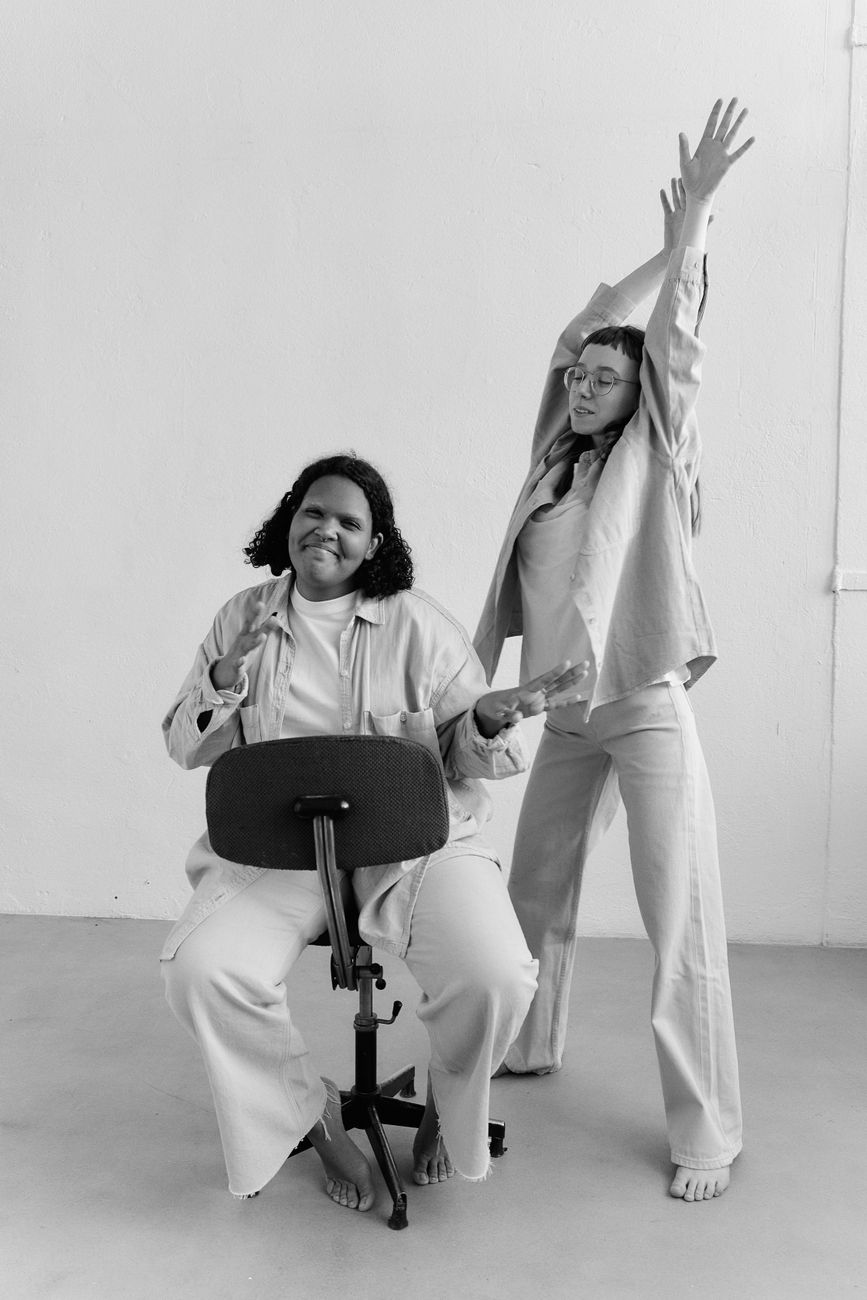
…not only can traumatic knowledge be passed down, so can bodily survival knowledge — knowledge about how to survive the debilitating effects and symptoms of PTSD.
— Dolores Garcia, Because We Have To: Flamenco as Survival Strategy against Detrimental Effects of Post-Traumatic Stress Disorder
When I try to explain Winnicott’s theories to fellow autistics, most of them instantly grasp my meaning when I say that the False Self is the self with quiet hands.
— Nick Walker, Transformative Somatic Practices and Autistic Potentials
For our Sunday, August 23, 2026 at 10AM CT, 4PM UK Campfire Learn Together, we are not just watching. We are moving.
This session is a practice, a reading, and an argument, in that order. We start with a twenty-three-minute seated tai chi and qigong class. We talk about Nick Walker‘s work on transformative somatic practices — his dissertation is in our library, and there is a recent ninety-minute conversation between him and Katy Higgins Lee that puts somatics and neuroqueering in the same room. Then we get loud: a punk happy flappy chair stim dance to Screaming Females covering “Shake It Off.” Then we watch a flamenco farruca and steal the hand movements and the foot stomps, seated. Then we close with a music video by our friend Scarlet Monk.
Everything is presented seated. Not as a modification. As the design.
Ryan has Stiff Person Syndrome. Standing and walking for long is not available. If bodily survival knowledge is real knowledge — and we think it is — then it has to be transmissible to a body that cannot get on a mat, cannot ground through its feet, and cannot take a deep breath without triggering a cramp cascade. That is not a special case. That is where design gets tested.
Do what your bodymind wants to do. Sit. Lie down. Move one hand. Move nothing. Watch other people move and let that be your stim — stim-watching is participation.
We watch. We move. We bring our whole bodyminds — seated, and out loud.
Videos
We’ll watch and move through these together during the session — subtitles on, sound up, cameras optional. No need to have watched ahead. Nothing here requires standing, and nothing here requires moving at all.
Seated Tai Chi for Beginners and Seniors — about twenty-three minutes, taught by Annette of Itstimefitness. A combination of tai chi and qigong, done entirely in a chair. Named forms: Repulse Monkey, Parting the Horse’s Mane, Cloud Arms. Three repetitions of everything, “so that all the exercises become familiar.”
Neuroqueering Somatics: A conversation at the intersection of neurodivergence and somatic practice — about eighty-eight minutes, hosted by ISMETA, recorded June 26, 2025. Katy Higgins Lee interviews Dr. Nick Walker. Over six hundred people registered. We won’t watch the whole thing at the campfire; come back to it after.
Screaming Females cover Taylor Swift’s “Shake It Off” — four minutes, recorded for The A.V. Club’s Undercover series in 2015. Marissa Paternoster’s guitar takes a pop song about not caring what people think and makes it sound like it means it. This is the chair dance. Flap, rock, head-bang, drum the armrests, stay completely still — all of it counts.
Melina Najjar — Flamenco dance Farruca, with Yazan Ibrahim — under seven minutes. We watch, then we copy: the hand movements, the wrist rotations, the arm carriage, and the foot stomps, all from a chair. Floreo without the floor.
“Thrive” by Scarlet Monk — under six minutes. A song that climbs a spine and calls it blooming, by a friend of ours. We end here on purpose.
One session, one question: who gets to inherit knowledge that lives in the body?
Table of Contents
- Videos
- It Doesn’t Matter If Your Neck Doesn’t Move Very Far
- Maybe Advance to Standing
- The Self With Quiet Hands
- Tend to Your Nervous System
- Three Seconds In
- Because We Have To
- Every Movement Must Be Slow, Cautious, and Deliberate
- The Stimpunks Synthesis
- Join Us
- Main Takeaways
- Related Glossary Entries
- Reflection Questions
- Resources
It Doesn’t Matter If Your Neck Doesn’t Move Very Far
Just a gentle tilt to the side. It doesn’t matter if your neck doesn’t move very far. We’re just trying to warm up.
Twenty-three minutes, a chair, and a woman named Annette who never once tells you that you are doing it wrong.
Watch what the instruction actually does. It names a target and then immediately releases it. Tilt your head — and it doesn’t matter how far. Lift your leg — “not very far.” Lift your heels and then your toes — “some of the movements might be a little bit hard, but it’ll get better over time.” Add the leg work to the arm work — “you just do what you can, you can just do arms if you want.” Every single instruction arrives with its own escape hatch already attached.
This is not softness. It is precision about what the practice is for. The movement is not the point; the relationship to the movement is the point. A neck that tilts two degrees and a neck that tilts thirty degrees are doing the same practice.
Notice the other thing she does: she names everything. Repulse Monkey. Parting the Horse’s Mane. Cloud Arms. Squash the ball. Brush the wall, scoop the water. Three repetitions of each, and she says why — “so that all the exercises become familiar.” Then, at the end: “you can come back and practice this video over and over.”
Named forms. Explicit rules. Predictable repetition. Permission to re-run it as many times as you want. If that sounds like an Autistic person’s list of access needs, that is because it is one. Walker has a term for this exact phenomenon, and we will get to it — but hold onto it: nobody designed this video for us, and it works for us anyway.
Also worth naming, because it will matter later: she says the breathing is “a very important part of the movement,” and she says “not holding your breath.” She does not say take a deep breath. For some of us that difference is the difference between a practice and an injury.
Maybe Advance to Standing
Modified Tai Chi Qi Gong seated is great for seniors, beginners and all ages to learn some basics of Tai Chi and improve balance, mobility and coordination and develop confidence to progress to standing Tai Chi and join more advanced classes in the community.
— from the video’s own description
Here is where we have to be careful, and honest, and generous all at once.
The video is good. The description around it tells a different story than the video does.
Read the description and seated tai chi is a waiting room. It is for “beginners.” You do it “when unsteady.” You do it to “develop confidence to progress to standing.” Later: “when confident move to the standing program.” Later still: “maybe advance to standing and classes in the community setting in the future.” Three separate times, the accessible version is framed as a stop on the way to the real one.
Now read the video. In twenty-three minutes Annette never once says advance to standing. She says do what you can. She says it doesn’t matter how far. She says come back and practice this over and over. The practice is more accessible than its own framing.
That gap is not a small thing, and Nick Walker gives us the exact tool for it. Asked in the ISMETA conversation whether the field of somatics has ever been out of alignment with neuroqueer intentions, he does not attack any particular method. He goes after framing:
I think the problems have largely been problems of framing. […] The practices may be good, but the framing is really messed up.
He gives Janet Adler’s authentic movement work with Autistic children as his example — genuinely liberating practice, wrapped in the most pathologizing language available at the time. “I cringe now to look at how she talks about it, but I realize, okay, that was the best framing that was available to her.”
The framing available to a senior fitness instructor in 2021 was rehabilitation: seated as deficit, standing as recovery, community classes as the destination. That framing is not cruelty. It is the water. And it means that a person who will never stand — not next year, not with more confidence, not ever — opens the description and reads that they are permanently at the start of something.
We are going to take the video and leave the description. That is allowed. Walker again, on learning Rolfing despite its dogma about the one correct spine: “to try it on and then take from what I needed from it was great.”
Take the practice. Refuse the ladder.
The Self With Quiet Hands
I quickly jam my hands into my pockets and walk on, pretending to be going somewhere. The boys ignore me. It worked! Next time I walk around the playground, I keep my hands in my pockets. It makes me a little bit safer, and I barely notice that I feel a little bit less alive.
Nick Walker’s 2019 dissertation at the California Institute of Integral Studies is an autoethnography: four decades of aikido and two decades of paratheatrical research, read through the neurodiversity paradigm. Melanie Yergeau sat on the committee. It is in our library, and it is one of the most useful things ever written about what happens to an Autistic body inside a world that watches it.
The core move is to take character armor — Wilhelm Reich’s term for the chronic, unconscious muscular holding we acquire defending ourselves in childhood — and apply it to masking. Not as metaphor. As mechanism.
To repress the embodiment of one’s truest and most vital self, to extinguish the unique dance by which that self intuitively seeks to engage with the world, takes countless tiny decisions, most of which end up lost to conscious memory if they were even consciously made in the first place.
He names the two states with Winnicott’s language and then, in one sentence, translates it into something no Autistic reader needs explained: the True Self is the self that traces patterns in the air with stimming fingers, and the False Self is the self with quiet hands.
The cost is not hypothetical, and he cites it: the largest study on the subject found that long-term camouflaging “significantly predicted suicidality” in Autistic adults, and that “camouflaging is directly associated with suicidality.”
His definition of stimming is the broadest and best we have found, and it is worth reading twice, because it is doing something political:
To stim is to engage in any action that falls outside the boundaries of the social performance of normativity, and that provides some form of sensory stimulation in order to facilitate, intentionally or otherwise, some particular cognitive or sensorimotor process, or access to some particular state or capacity of consciousness or sensorimotor experience.
Read that carefully. Stimming is defined by its relationship to the norm, not by the movement. The same hand motion is a stim or it is not, depending on whether the room has decided it is allowed. Yergeau’s phrase for it, which he quotes, is “bodily disobedience.”
Which means the dividing line was never in the body. It was always in the audience.
He also refuses the consolation prize. Even the sympathetic researchers who say stims are coping mechanisms or accommodations are, he argues, still telling a story in which we are compensating for defects — “a narrative that thus implicitly dismisses the possibility that there are autistic capacities and potentials worth exploring that have nothing to do with aspiring to normativity or with mere compensation.” Stimming is not a patch. It is a way of knowing.
And then there is the sentence we keep coming back to. Steve Silberman visited Walker’s dojo while researching NeuroTribes, watched a class, and said afterward:
I think the way you do aikido has got to be the most sophisticated form of stimming I’ve ever seen.
Walker’s reply: “Exactly what I’ve been going for.”
Forty years of martial arts practice, and the thing he was building the whole time was a way to stim in public that nobody could take away from him.
One more concept from the dissertation, because it explains the tai chi video. Walker describes entering the aikido dojo and discovering that the elaborate etiquette — when to bow, where to kneel, how to sit — was spelled out explicitly to everyone, because it was strange to everyone. For once he was not losing a game whose rules were secret. He calls this an organic accommodation: “a situation in which a system that arose for other reasons happens serendipitously to function as a perfect accommodation for the needs of a specific participant or population of participants who come along after the system has already been established.”
Named forms. Three repetitions. Rewatchable forever. A chair. Annette built an organic accommodation and called it a fitness video.
Tend to Your Nervous System
Tend to your nervous system. Tend to your needs. Tend to your bodymind. As you can see, I tend to move my chair side to side. I have a rock that I’ll be kind of stimming with.
— Katy Higgins Lee, opening the ISMETA conversation
Two Autistic somatic practitioners, one of them the person who coined neuroqueer, talking for ninety minutes with over six hundred people watching. Katy Higgins Lee opens by rocking in her chair and announcing it. Walker notes that she is a back-and-forth rocker and he is a side-to-side rocker. “Got an exciting rhythm going.”
That is the whole bodymind affirmation practice, done in twenty seconds, by the presenters, on themselves, before anyone asks.
Adina Docter — the somatic movement educator who proposed the event and pushed it through ISMETA’s equity, justice, and accessibility committee — framed the invitation as exploring what somatics and neurodivergence can be “beyond the cage of ableism and the sting of being normed.” Helen Edgar was in the audience; Walker names her from the stage for her work on neuroqueer learning spaces, which she builds with us.
Walker’s definition of somatic practice is deliberately, almost stubbornly wide:
Any practices that create intentional positive transformation through working with embodiment.
Why so broad? “If we narrow the definition, we always run the risk of cutting out something valuable.” He wants room for practices that do not exist yet, and he does not want anyone told “that doesn’t count as a somatic practice because it doesn’t meet this twenty-point definition.”
Under that definition, a chair dance is a somatic practice. So is a flamenco arm you copy from a video. So is watching someone else move.
Two things he says land hard for a room of people who cannot always be themselves in public.
The first is about masking, and it is the most useful correction to unmasking discourse we have heard:
There’s something a little highly privileged about being able to blithely say how everyone should unmask.
His alternative is not “unmask everywhere.” It is: teach yourself to unmask completely in private, in whatever safe spaces you can find, so that when you must mask, you can put it on and take it off. Don’t mask tightly. “There’s a difference between deeply held bodily tensions that keep you locked into a performance of normativity versus a mask that you intentionally put on and can take off as soon as you’re alone again.” Neuroqueering is the flexibility, not the exposure.
The second is about what it takes to hold a room where that is possible:
Being able to hold a space where you’re not enforcing norms, where you’re not panicking because somebody’s not being normal. […] I don’t know what this person’s doing. I don’t know what’s emerging here. It’s not what I was taught was normal, something is happening. And as long as no one’s getting hurt, I’m going to be here for the process.
He calls this tolerance for ambiguity, and he thinks most intolerance — political, therapeutic, interpersonal — is intolerance for ambiguity wearing a costume.
And then, having said all that, he says he is a rigorous traditionalist in his own dojo. Bowing, etiquette, always starting on time. Not a contradiction:
That creates the safe container where we can play wildly with our bodies.
Strong structure, loose norms. That is a Cavendish Space in one line, and it is exactly why our campfires have a predictable shape and no required behavior inside it.
Three Seconds In
This is pure stim music. Three seconds in, I lost my shit and straight into head banging.
— from Happy Flappy
Then we stop being careful and put on Screaming Females.
The A.V. Club filmed Marissa Paternoster and the band covering “Shake It Off” in 2015. It is four minutes long. It takes a song about refusing other people’s opinions and plays it like the refusal costs something, which is the only way that song has ever made sense to us.
Our Happy Flappy page defines what happens next: stim dancing — processing sensory stimulation and emotions through repetitive and unrehearsed dance. You make the moves up as you go. Nobody choreographs it. That is the point.
Flap. Rock. Spin the chair. Drum the armrests. Head-bang three seconds in and lose your whole mind to it. Or don’t. Stim-listening is a stim. Stim-watching is a stim. Sitting completely still with the volume up while your entire nervous system does something no camera can see is a stim.
We want to be specific about what this is for, because “dance party” undersells it. Lauren Melissa Ellzey’s term is sensory euphoria:
Sensory euphoria/bliss occurs when one or more of the body’s eight senses experiences positive hyperstimulation. Instead of going through overwhelm, meltdowns, and shutdowns of overload, the result of sensory bliss might be exhilaration, full-body tingling, and happy stimming.
Deficit framings of autism have a lot of vocabulary for sensory overload and almost none for this. That absence is not neutral. It means our sensory lives get catalogued exclusively by what hurts.
And a warning we take seriously, from ClaireB, writing for us last summer in Free The Stim: Exploring Stimming For Physically Disabled People:
For those of you who want to be able to stim more actively, it’s important to think about using minimum energy for maximum effect! Being physically disabled can mean that our energy is limited and stimming should recharge our battery, not deplete it.
ClaireB is naming something the joyful version of this page can miss. Gross motor stimming — the jumping, the spinning, the dancing around the kitchen — is what gets celebrated, and it is exactly what a lot of physically Disabled Autistic people cannot access. Fidget tools need fine motor control that not everyone has. The conclusion is the one we are building this whole session around: “accessing stimming is about finding ways to work with the body you have, not against it.”
Minimum energy, maximum effect. Bring the chair.
Because We Have To
…flamenco is in itself a ballistic activity with its own built-in reward system that can then bolster the brain against traumatic stress.
— Dolores Garcia, Because We Have To
Then we watch Melina Najjar dance a farruca, and we steal it.
The farruca is one of flamenco’s most percussive forms — traditionally danced by men, traditionally hard, built out of zapateado footwork and sharp braceo arm carriage. We will take what a chair can hold. The hands, mostly: the floreo, the wrist rotations, the way the fingers open and close like something breathing. And the stomps, such as they are, from a seated position, with whatever a foot can still do — or with a hand on a thigh, or a palm on an armrest, if a foot can do nothing at all. The rhythm is the inheritance. The floor is optional.
Dolores Garcia’s 2017 MFA thesis in Theatre and Dance at the University of New Mexico asks whether daily flamenco practice can mediate the effects of PTSD. The argument runs through the fear circuit, through EMDR, and through research on throwing — skill-based, speed-and-precision activities that appear to strengthen brain regions that atrophy under post-traumatic stress. Flamenco, Garcia argues, is throwing. Ballistic, precise, rewarded, and repeated daily.
If your “threat to life” responses are being re-associated on a regular basis with flamenco responses, slowly, like polishing stone, flamenco has the potential to be an asset for people who are working through PTSD.
Slowly, like polishing stone. Not a cure. Not a breakthrough. Attrition, in the direction of living.
But the sentence we built a whole page around is the other one:
…not only can traumatic knowledge be passed down, so can bodily survival knowledge — knowledge about how to survive the debilitating effects and symptoms of PTSD.
Intergenerational trauma is a familiar idea by now. Garcia’s move is to point out that the transmission runs both ways. Communities that survived the unsurvivable did not only hand down the wound. They handed down the technique — the thing you do with your hands, the rhythm you clap, the way you hold your spine when it wants to collapse. Bodily survival knowledge is knowledge, and it is inherited, and it is inherited through practice rather than through text.
We think this is the most important idea in this session, and here is why it belongs to us specifically.
For centuries, our neurotype was called possessed for moving like this. Autistic people regulated their nervous systems anyway, instinctively, at real cost — and every institution that has ever gotten its hands on us has worked to interrupt exactly that transmission. Behaviorism is, functionally, a machine for preventing bodily survival knowledge from being passed down. Quiet hands is not just a demand made of one child. It is a break in a chain.
So the flapping is not only regulation. It is inheritance, and it is a refusal, and it is a thing you can teach someone.
Pass it down.
Every Movement Must Be Slow, Cautious, and Deliberate
Every movement must be slow, cautious, and deliberate.
That is the last line of Ryan’s 2024 piece about living with Stiff Person Syndrome, and it is also, word for word, an accurate description of tai chi.
That is not a nice coincidence. It is the whole design brief.
SPS is a rare autoimmune neurological condition that causes progressive muscle rigidity and episodes of agonizing spasm, concentrated in the torso. The list in that piece of things that can trigger a cramp cascade includes laughing, crying, yawning, coughing, sneezing, stretching, reaching, looking over your shoulder, turning over in bed, and taking a deep breath. Loud noise triggers it. Being lightly touched triggers it. Being breathed on triggers it.
Now go read a somatic practice curriculum with that list in your hand.
Take a deep breath. Ground through your feet. Stand in a stable posture. Stretch into the sensation. Notice where you’re holding and let it go. Nearly every entry-level somatic instruction in circulation is contraindicated for this body, and several of them are, specifically, injuries.
This is what we mean when we say bodily survival knowledge has to be accessible or it is not knowledge, it is a club. A practice that only transmits to bodies that can stand, breathe deeply, and bear touch is a practice with a membership requirement, however warmly the door is held open.
So here is the standard we are working to, and we would like to argue about it on Sunday:
Seated is the default, not the fallback. Everything demonstrated from a chair first. Not “here is the real version, and here is yours.”
No instruction without an escape hatch. Annette’s model. Name the movement, then immediately release the amplitude. It doesn’t matter how far.
Never prescribe the breath. “Don’t hold your breath” is safe. “Take a deep breath” is not universally safe, and the people it hurts will usually just quietly leave rather than explain why.
Minimum energy, maximum effect. ClaireB’s rule. The practice should return more than it costs, or it is crip tax with a wellness label.
Watching is doing. Stim-watching is participation, and so is being in the room with the video on and your eyes closed.
The room adjusts to the narrowest range present. Not the average. Not the median. If one person can only move their hands, the session is a hands session, and it loses nothing.
None of that is a lowering of standards. It is design tested at the edges: if it only works for the average case, it doesn’t work.
The Stimpunks Synthesis
The following is a Stimpunks synthesis — our own extension and critique, not a claim made by any of the videos, their participants, or the theses cited.
We are grateful for all of this material. Walker’s dissertation is the best account we have read of what suppression does to an Autistic body and what practice can give back. Garcia’s thesis gave us a phrase we have built a page and now a session around. Annette gave away twenty-three minutes of genuinely accessible instruction for free. Argue with none of that.
Argue with four things.
First: the somatic canon has a standing problem, and it is measurable. We went looking, in the copy of the dissertation in our library. Across 278 pages on transformative somatic practices and autistic potentials, the words wheelchair, mobility impairment, physically disabled, chronic pain, and chronic illness appear zero times. Disability appears in the body text twice: once naming disability studies as a field the work might influence, and once inside a list of oppressed groups. Everything else is in the reference list.
Be fair about what that is and is not. It is an autoethnography. One Autistic person’s account of his own forty years on a mat. He has no obligation to write anyone else’s body, and the honesty of the form is most of its power.
But the final chapter is not autoethnography. It is Implications for Praxis, and it generalizes: de-armoring is “something I recommend as part of the cultivation of autistic wellbeing (and human wellbeing in general),” alongside aikido, qigong, Authentic Movement, and Continuum. Recommendations for human wellbeing in general are addressed to bodies in general. The chapter does not pause to ask which ones can accept them.
The pattern repeats in the ISMETA conversation, gently. Asked about his own practices, Walker is warm about walking — “I encourage everyone to walk a lot… it’s such a deep part of human evolution” — and he does include us. Explicitly: “if you are mobility impaired in some way, wheel around, get out there in a chair and move around, because just that practice of moving through space mindfully does something vital for consciousness.” That is real inclusion, offered unprompted, and we are not going to pretend otherwise.
It also arrives as a subordinate clause. The design center is the walking body; the wheeling body is the amendment. Later, describing how to start with a client who fears embodiment work, he offers: take a little walk around the room, then take a little walk noticing the contact between your feet and the ground. Then, catching it: “feel your feet on the floor, if that’s accessible to you.”
The if that’s accessible to you is the sound of a field in motion, and it is not nothing. We would just like the seated version to be the one that gets written down first. Access that arrives as a subordinate clause teaches everyone in the room which body the practice was actually built for. And notably, this is already happening: Adina Docter, who proposed this very event, describes her own practice as helping people navigate chronic pain “without the ableism.” The correction is coming from inside the field.
Second: not all rigidity is armor, and the theory cannot tell the difference. This is the sharper problem, and it is structural rather than an oversight.
Somatic psychology, as our own glossary states it, rests on two principles. Body and mind are one system. And therefore: “intentional alterations to the habitual organization and use of the body can effect profound transformations of the psyche.”
That second principle contains a hidden premise — that the tension is habitual. Character armor is learned. It was acquired defending against something, and because it was learned it can be unlearned. That is a beautiful and largely true account of what masking does to a body.
It is not an account of Stiff Person Syndrome. SPS rigidity is autoimmune. It is not a habit, it was not acquired in a developmental environment, and no amount of de-armoring will touch it. The same is true of spasticity, dystonia, contracture, and a long list of other things that make a body hard to move.
When a framework built for learned tension meets unlearned tension and has no vocabulary for the difference, it does not simply fail. It silently converts into blame. If holding can always be released, then a body that will not release must not be trying. Every chronically ill person reading this has met that inference in a treatment room, usually delivered kindly.
We are not asking somatics to cure anything. We are asking it to say out loud: some of this is armor and some of this is your immune system, and the practice only speaks to one of them. Naming the limit is what makes the offer trustworthy.
Third: we publish a page Walker says is not valid, and we should say so. In the ISMETA conversation, asked where somatics has gone wrong, he volunteers this:
I have a lot of issues with polyvagal theory because I don’t think it’s scientifically valid. I don’t think their premises hold up scientifically. But also the fact that their framing of autism and ADHD is very pathologizing, and like, oh, we can fix this.
We maintain a polyvagal theory glossary entry. We cite it. We used it three weeks ago in our writeup of the Bildung Climate School to explain why safety precedes learning. Walker is the person whose framework we are teaching from this Sunday, and he thinks that particular tool is scientifically unsound and pathologizing about us specifically.
We are not going to resolve that quietly by editing a page. We are going to put it on the table. The claim we actually need — you cannot learn from a state of threat — does not depend on any particular vagal anatomy, and we should be able to make it without borrowing a mechanism we cannot defend. That is a real piece of work, and it is a good use of a campfire.
Fourth: our own page promises a reward system the seated version may not deliver. Happy Flappy says movement like this “bolsters the brain against traumatic stress” and “carries its own built-in reward system, the way flamenco does.”
We took that from Garcia, and Garcia is careful in a way our paraphrase is not. The mechanism there is ballistic: throwing, impact, speed-and-precision, the specific neurology of a body executing a hard, fast, accurate action and being rewarded for it. Zapateado is percussive strike. That is the engine.
A seated flamenco arm is not a strike. Cloud Arms at two miles an hour is not ballistic. We do not know — and we should stop implying we know — that low-amplitude seated movement recruits the same reward mechanism that Garcia is describing in a dancer hammering a floor.
Here is the thing: it might not, and the practice might still be worth everything. Rhythm, repetition, attention, flow, doing it with other people, doing it daily — those are all real and none of them require force. But an accessible practice does not need to borrow the standing practice’s evidence to be legitimate. Reaching for the borrowed claim is itself a symptom of the ladder we refused three sections ago. Seated does not have to prove it is secretly as good as standing. It has to be good.
So we will make the smaller, defensible claim, and we will make it out loud: we do not know how much of the flamenco effect survives the chair. We are going to find out by doing it every week and paying attention, which is how bodily survival knowledge has always been validated — not in a lab, but in a body, over time, in company.
Where we land is where Helen Edgar lands, writing about stimming as embodied sensory language:
Bodies do not regulate alone; they regulate in connection — with people, with spaces, with rhythms, with sensory conditions that either support or strain our capacity to stay in flow.
Which is the answer to a question nobody asked out loud: why hold this at a campfire at all, when the tai chi video is free and available at 3AM to anyone with a chair?
Because bodily survival knowledge is not a file. It is passed hand to hand, in rooms, between people who move like each other. That is what a lineage is. Ours got interrupted — by behaviorism, by quiet hands, by every adult who ever taught one of us that the dance was the problem.
Sunday morning, we start it again. Seated.
Join Us
Campfire Learn Together happens every Sunday at 10AM Central, online via Discord. This session is on Sunday, August 23, 2026 at 10AM CT, 4PM UK. Open to the whole community — no preparation needed, no expertise required, no prior movement practice of any kind. Come as you are, in whatever chair you are already in.
We’ll move together, take a bodymind break, and then open up the reflection questions as a community conversation. You can participate by video, voice, text chat, or just by being in the room. All modes are welcome. Cameras optional. Silence is participation. Stillness is participation.
There is no designated expert here, including us. None of us are tai chi teachers. None of us are somatic practitioners. We are people who move oddly on purpose, watching a video together and arguing about what it is for.
A note on the movement, said plainly: do less than you can. Nothing on this page is a target. Skip anything. Stop anything. Watch instead of doing, at any point, for any reason or none. If a movement hurts, that is information, not failure.
Join our community to get access, then find us in our online space. Our Campfire Learn Together page describes some of what to expect. If this is your first Campfire, you’re in good company — many of our regulars showed up for the first time not knowing quite what to expect, and stayed.
Come with one movement your body already knows. A rock, a flap, a tap, a rhythm, a way you hold your hands when you are thinking. Something you have been doing since before anyone told you not to. We want to see it, and we want to learn it.
Main Takeaways
- The False Self is the self with quiet hands. Walker’s translation of Winnicott into a sentence no Autistic reader needs explained. Masking is not a social strategy layered on top of a body. It is chronic muscular holding, and the largest study on it found camouflaging directly associated with suicidality.
- Stimming is defined by the audience, not the movement. Walker’s definition turns on falling “outside the boundaries of the social performance of normativity.” The same hand motion is a stim or not depending on what the room has decided is allowed. The pathology was never in the body.
- Seated is the design, not the fallback. A practice framed as a waiting room for standing tells everyone who will never stand that they are permanently at the beginning. Take the practice. Refuse the ladder.
- The practice can be more accessible than its framing. Annette never says advance to standing; her video’s description says it three times. Walker’s diagnosis fits exactly: the problems are largely problems of framing.
- Organic accommodation is real and you can go looking for it. Named forms, explicit rules, three repetitions, rewatchable forever. Nobody built that video for Autistic people. It works for us anyway, and knowing why lets us find more of it.
- Don’t mask tightly. Not everyone can unmask, and saying everyone should is a privileged sentence. Learn to drop it completely in private so that when you must wear it, it comes off.
- Not all rigidity is armor. Somatic theory assumes tension is learned and therefore releasable. Autoimmune rigidity is neither. A framework that cannot name the difference converts, silently, into blame.
- Bodily survival knowledge is inherited, and behaviorism is a machine for interrupting the inheritance. Traumatic knowledge passes down; so does the technique for surviving it. Quiet hands is not one demand made of one child. It is a break in a chain.
- Minimum energy, maximum effect. ClaireB’s rule. Stimming should recharge the battery, not drain it. A practice that costs more than it returns is crip tax with a wellness label.
- An accessible practice doesn’t have to borrow the standing practice’s evidence. We do not know how much of the ballistic flamenco effect survives a chair. Seated does not need to prove it is secretly as good as standing. It needs to be good.
- Bodies do not regulate alone. Which is why this is a campfire and not a link.
Related Glossary Entries
- Somatic — Of the body; the field holding that psyche and embodiment are one system, and that changing how you move changes how you think. The premise under everything in this session.
- Somatic Rudder — The body steering cognition rather than following it. Damasio’s somatic markers, Annie Murphy Paul’s phrase, and the reason “just think it through” is bad advice.
- Bodymind — Mind and body as one inseparable thing. Not a metaphor and not a wellness slogan; the actual unit that shows up to the campfire.
- Stimming — Repetition of movement, sound, or objects, engaging multiple senses and serving many purposes. Walker’s broader definition makes the norm, not the movement, the thing that defines it.
- Quiet Hands — The instruction that made a generation of Autistic children into False Selves. Where the chain of transmission gets broken, one child at a time.
- Neuroqueer — Intentionally subverting neuronormativity in yourself and your world. Walker coined it in a somatics class, describing what he was doing with his own body.
- Cognitive Liberty — Sovereignty over your own brain. Walker’s argument: because embodiment and cognition are entwined, forcing a body out of its natural movement style is a violation of cognition itself.
- Embodiment — Staying present in your own body to sensation, emotion, and environment without tipping into dysregulation. Helen Edgar’s framing, and the thing tai chi is actually practicing.
- Masking — Suppressing visible neurodivergence to pass. Read somatically, it is chronic muscular holding with a measurable cost.
- Autistic Joy — Including sensory euphoria: the positive hyperstimulation that deficit framings of autism have almost no vocabulary for. Three seconds into the song.
- Stim-Watching · Stim-Listening — Stimming by watching or listening to someone else’s rhythm. Why sitting perfectly still through the dance section is full participation.
- Crip Tax — The extra cost of being Disabled in a world not built for you. What a movement practice becomes when it takes more than it gives back.
- Chronic — Conditions that do not resolve. Our societies are ill-equipped to accept folks who never get better yet keep on living.
- Cripple Punk — Disabled defiance without inspiration, without cure narratives, without apology. The register of the chair dance.
- Cavendish Space — Psychologically and sensory safe space for caves, campfires, and watering holes. Strong structure, loose norms — exactly the container Walker describes building in his dojo.
- Behaviorism — The paradigm that treats stimming as behavior to be extinguished. Functionally, a machine for stopping bodily survival knowledge from being passed down.
Reflection Questions
On the movement you already know. Before anyone corrected you, your body had a way of dealing with the world — a rock, a flap, a pace, a rhythm you tapped out. What was yours? Do you still have access to it, or did it go into your pockets on a playground somewhere? What would it take to get it back, in private, this week?
On the ladder. Somewhere in your life there is an accessible version of something that is described as a stepping stone toward the real version — a seated class, a shorter shift, a modified assignment, a part-time role. Who benefits from that framing? What changes if you decide the accessible version is the practice and stop climbing?
On breath. Nearly every regulation practice in circulation starts with “take a deep breath.” For some of us that instruction is contraindicated, and the usual response is to say nothing and quietly stop attending. Where have you silently exited something rather than explain your body to a room? What would have made it possible to stay?
On armor and immunity. Some of what our bodies hold onto is learned defense that can be unlearned. Some of it is not, and no practice will touch it. Can you tell which is which in yourself? Who in your life has confused the two, and what did that cost you?
On inheritance. Bodily survival knowledge gets passed hand to hand, not written down. Who passed you something — a way to move, breathe, hold yourself, get through — and did you ever thank them for it? Who are you passing it to, and what is standing in the way?
On the room adjusting. We are proposing that a session should run at the narrowest range of movement present, not the average. That sounds obviously right until it is your range that everyone else adjusts to. Have you ever been the one the room adjusted to? What did it feel like, and did anyone make you pay for it afterward?
—
This page draws on Seated Tai Chi for Beginners and Seniors by Annette of Itstimefitness (2021); Neuroqueering Somatics, hosted by ISMETA with Dr. Nick Walker, Katy Higgins Lee, Adina Docter, and Elisabeth Osgood-Campbell (2025); Nick Walker’s dissertation Transformative Somatic Practices and Autistic Potentials: An Autoethnographic Exploration (California Institute of Integral Studies, 2019) and Neuroqueer Heresies (Autonomous Press, 2021); Dolores Garcia’s MFA thesis Because We Have To: Flamenco as Survival Strategy against Detrimental Effects of Post-Traumatic Stress Disorder (University of New Mexico, 2017); ClaireB’s Free The Stim; Helen Edgar’s Stimming as Embodied Sensory Language; and our own Happy Flappy. Quotations from the videos are transcribed from their captions, with filler words removed and proper nouns corrected. Quotations from the dissertation and thesis are as published. The Stimpunks Synthesis section is our own extension and critique, and is not attributed to Dr. Walker, Katy Higgins Lee, ISMETA, Dolores Garcia, Annette, or Itstimefitness.
Resources
- Seated Tai Chi for Beginners and Seniors — Itstimefitness — YouTube
- Neuroqueering Somatics: A conversation at the intersection of neurodivergence and somatic practice — ISMETA — YouTube
- Transformative Somatic Practices and Autistic Potentials: An Autoethnographic Exploration — Nick Walker — ProQuest
- NEUROQUEER: The Writings of Dr. Nick Walker
- The Use of Transformative Somatic Practices in Processes of Collective Imagination and Collaborative Future-Shaping — Nick Walker
- Because We Have To: Flamenco as Survival Strategy against Detrimental Effects of Post-Traumatic Stress Disorder — Dolores Garcia — UNM Digital Repository
- Melina Najjar — Flamenco dance Farruca with Yazan Ibrahim — YouTube
- Screaming Females cover Taylor Swift’s “Shake It Off” — The A.V. Club — YouTube
- “Thrive” by Scarlet Monk — YouTube · Thrive on Spotify · Scarlet Monk
- Happy Flappy: Let’s Bolster Against Stress and Pass Down Bodily Survival Knowledge — Stimpunks Foundation
- Stiff Person Syndrome, Celine Dion, and Me — Stimpunks Foundation
- Free The Stim: Exploring Stimming For Physically Disabled People — ClaireB — Stimpunks Foundation
- Inclusive Meetings, Classes, and Presentations with Access Notes, Bodymind Affirmations, and Small Changes — Stimpunks Foundation
- Five Ways to Welcome All Bodyminds to Your Learning Event — Stimpunks Foundation
- Design Is Tested at the Edges — Stimpunks Foundation
- Rules of Punk — Stimpunks Foundation
- Stimming as Embodied Sensory Language — Helen Edgar, Autistic Realms
- Neuroqueer Learning Spaces — Stimpunks Foundation
- Adina Docter — somatic movement education
- ISMETA — International Somatic Movement Education and Therapy Association
- Campfire Learn Together: Therapy Is Not Neutral — Stimpunks Foundation
- Campfire Learn Together: Being Disabled Can Be Pretty Funny — Stimpunks Foundation
- Campfire Learn Together: Solving the Frankenstein Problem — Stimpunks Foundation
- Campfire Learn Together: Head, Heart, and Hands at the End of the World — Stimpunks Foundation