
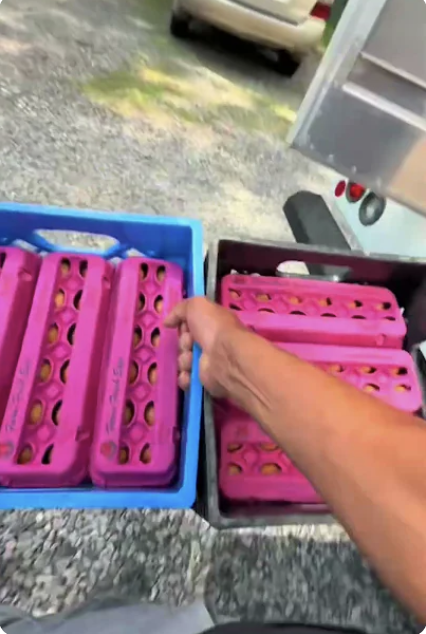
Blackbird is dedicated to solving this “First Generation Farmer Problem.” Our work centers on the idea that the production, processing and distribution of food should be under the integrated control of our communities. It should not be under the control of an adversarial relationship between family farmers and shareholder agribusiness that leaves corporations rich, farmers starved for cash and incentivized to abuse their own land, their heirs looking for a way out, and 2,300,000,000+ people living with food insecurity.
Somewhere between a kill floor in Westmoreland County and a phone camera held at arm’s length, a farmer named Chris Newman has been quietly running one of the most coherent structural critiques of America you can watch in under three minutes. He calls the channel Farming While Beige. He talks about race, class, mutual aid, decolonization, and the physics of how markets eat themselves. This week we’re pebbling his reels and following the thread all the way down: from “there’s no shame in the protein you can afford” to the seizure of a food economy by the communities it’s supposed to feed. Bring your appetite. Bring your rage. Bring a snack.
Table of Contents
- Videos
- The Stimpunks Frame
- Take the theory out of the tower and make it feed someone
- Mutual aid is a verb
- Stop telling people to get better at being poor
- Consolidation is the destination, not the glitch
- The tomb or the town
- Decolonized, or it isn’t inclusion
- Imperfect solidarity: holding the friction
- Burnout is a condition, not a character flaw
- Join Us
- How the Hour Goes
- Related Glossary Entries
- Reflection Questions
- Resources
Videos
We’ll watch a handful of short reels from Farming While Beige, the channel of Chris Newman of Blackbird Farms / Blackbird Collective. They’re short, they’re funny, and each one is a whole structural argument compressed into a pebble.
- Help us feed everybody! (~35 sec) — the thesis in miniature: stop arguing over crumbs of ideology, go feed people.
- Stop telling poor people they need to get better at being poor. (~3 min) — a demolition of the “personal responsibility” story we tell about poverty.
- Woody chicken breast (~2.5 min) — “there’s no shame in purchasing the protein you can afford.” Food shame is a class weapon; he disarms it.
- High taxes on the wealthy didn’t produce prosperity. The social contract did — until they ripped it up. (~3 min) — on Powell, Welch, Reagan, and the shredding of the deal that held wages to the cost of living.
- “This dude then said ‘keep making videos’ like I needed his blessing 😂” (~2.5 min) — where market consolidation actually comes from, and why “free markets” trend toward monopoly without intervention.
- They know how to save rural communities. They just won’t do it. (~3 min) — on the people running dying towns who’d rather have “a quiet little tomb to die in” than a thriving place.
- Who’s Squeezing Farmers Off Their Land? (5:33) — the long-form one. Why farm heirs sell (a farm is a tax-advantaged asset with lousy cash flow), how rural disinvestment turns inheritance into “king of the ashes,” the decolonial history of American agriculture, and why a farmer cartel chasing a federal price floor isn’t the victim story it looks like.
The Stimpunks Frame
Chris isn’t in our world. He’s in the food-sovereignty world, arguing with regenerative-ag influencers and dietician-Instagram and the ghost of Ronald Reagan. But he’s running the exact move we run, which is why his reels land like they were made for us.
The book “First Generation Farming” aligns with Stimpunks’ frameworks unusually well — not as a vibes-match but structurally, because Newman is doing the same move we do. He takes a liberatory theory out of the ivory tower and builds actual working infrastructure with it, then refuses to let the theory stay pretty. That’s our whole thing.
Take the theory out of the tower and make it feed someone
Blackbird’s own origin story is that “an itch developed to take decolonial theory out of the ivory tower and apply it to the hot mess of real life.” That’s us. That’s bricolage — build the thing out of what’s actually on the table, in real conditions, for real people — instead of keeping the beautiful idea clean and useless on a shelf. His whole channel is decolonial and anti-capitalist analysis that has to cash out in chickens, wages, and land, or it doesn’t count. We feel that in our bones. A framework that can’t feed anybody is just cosplay.
Mutual aid is a verb
“If Western leftists spent half as much time feeding people, housing people, and showing up for our communities as we do arguing over crumbs of ideology, pointless online discourse and interpersonal conflicts, we might actually build the power to do revolutionary shit.” Put that on the wall. This is mutual aid as doing, against mutual aid as discourse — and it’s the same mutuality we mean when we say showing up beats being right online. Chris goes further than the cozy version, too: in his writing he takes apart “keep your money in the community” as a kind of hoarding-in-place — reciprocity has to flow outward between communities, not wall each one off from its neighbors. That’s a sharper, more generous mutual aid than the one that usually gets the hashtag.
Stop telling people to get better at being poor
“Stop telling poor people they need to get better at being poor.” “There’s no shame in purchasing the protein you can afford.” This is the whole social model argument wearing an apron. The problem is not that you’re bad at being disabled / bad at being poor / bad at budgeting your woody chicken breast. The problem is a system engineered around artificial scarcity that then bills you for its failures and calls it your character. We say burnout is not a personal failing to be coped with — the conditions have to change. Chris says the same thing about farm labor and about poverty: it’s not OK, and if you’re experiencing it, something needs to change — and “acceptance” is not the change. Same refusal. Same target.
Consolidation is the destination, not the glitch
“This is exactly where free markets lead… competitor A and competitor B compete, one of them wins, one absorbs the other’s market share… that’s where market consolidation comes from. The only way to keep that from happening is through market intervention, taxes, antitrust, and regulations.” This is the engine underneath everything else — the same engine that turns learning, care, and food into things you have to be wealthy to access. It’s why we build library economies and competency networks instead of waiting for the market to decide we’re worth feeding: the market’s endpoint is the tomb, not the town.
Chris refuses the other exit, too — the survivalist one. He clocks the small-farm crowd pivoting from “alternative” to prepper (“fear sells”) and keeps pointing at the commons instead of the bunker. That’s prepping in our sense of the word: not stockpiling against your neighbors, but getting your own shit together so you’re better situated to help. Gear matters less than skills; skills matter less than relationships. The best way to upgrade your med kit is to get your friend a med kit. An abundance mindset beats a scarcity mindset over the long haul.
The tomb or the town
“These elder boomers who run these sparsely populated towns and counties, they do not want thriving rural communities. They want a quiet little tomb to die in.” This is the Solarpunk fork in the road, stated plainly. There is a version of the future that is managed decline — hospice for a place, gatekept by people who’d rather it die with them than change without them. And there’s the other version: neurodivergent, decolonized, actually-alive community that chooses to build. Chris refuses collapse-porn — he clocks the small-farm prepper pivot (“fear sells”) and keeps pointing at the thing you build now, in public, at scale. That’s our Keep on Livin’ exactly: not surviving until, but living toward.
Decolonized, or it isn’t inclusion
Under all the jokes, Chris’s history of American agriculture is a decolonial one — Indigenous foodways as the erased source that “regenerative agriculture” repackaged and sold back; private property and the invention of race as one continuous line-drawing technology of extraction. It’s the living version of our stance that inclusion must be global, decolonized, culturally and linguistically diverse, and anti-normative. You cannot bolt justice onto a foundation built to exclude. You have to go down to the foundation.
Imperfect solidarity: holding the friction
He is pointedly anti-small-farm-romance, anti-homesteading-nostalgia, and skeptical of “find your tribe” identity framing — some of which can read as abrasive against communities that value small, local, chosen-scale spaces. He’s pro-scale, pro-agribusiness-as-a-word, and comfortable with markets and profit as tools. For a neurodivergent, disability-led audience, the through-line to hold onto is: he’s not defending capitalism, he’s refusing to let anti-capitalist aesthetics substitute for material provisioning. It’s the same argument we have internally about aesthetics vs. access.
This is exactly where Virginie Servant-Miklos’s imperfect solidarity earns its keep. Imperfect solidarity is the messy, committed, long-haul work of standing with people you don’t perfectly agree with, against a problem too big for purity — it refuses both the martyr and the spectator. Chris is not going to pass every vibe check in a disability-led, chosen-scale, small-is-beautiful room. He’ll say “agribusiness” without flinching and mean it as a good word. He’ll tell you your beloved homestead is a survivalist bunker cosplaying as liberation. And that friction is the point — not a bug to smooth over. Imperfect solidarity means we can take his structural analysis of food apartheid, consolidation, and decolonized provisioning dead seriously while holding our own commitment to small, sensory-safe, self-determined spaces, and not require him to be fully “one of us” before we learn from him. We don’t need him to be pure. We need him to be feeding people, and he is. The honest version of community isn’t a frictionless utopia where everyone shares an aesthetic — it’s people choosing each other again and again, on terms that let them survive the choosing. Holding Chris and holding ourselves at the same time, without collapsing one into the other, is what that choosing looks like.
Burnout is a condition, not a character flaw
In the “Letters on Agrarian Burnout” that close the book, Chris writes about farmers the way we write about disabled people ground down by an education system and economy that were never built for them. He names the somatic reality first — “Fevers, chills, headaches, GI issues, insomnia, irritability; burnout affects everybody differently” — refusing to let it stay an abstraction. This is bodymind talk: burnout lives in the body, not just the mood. And then he does the thing almost nobody in his world does. He refuses the grit narrative — the “comes with the territory,” the ten-year expiration date farmers carry into the field like it’s weather instead of a wound — and locates the cause where it actually lives:
It’s not OK, and if you’re experiencing it, something needs to change. Importantly, that necessary change isn’t “acceptance,” where you use coping mechanisms to coexist with burnout. The conditions creating the burnout need to change. And this is non-negotiable.
Read that again with our ears. This is the social model applied to labor, and it’s the same line we hold at the burnout threshold: the problem is not that you’re bad at coping, bad at self-care, bad at bouncing back. The problem is the conditions, and coping mechanisms that help you “coexist with burnout” are a way of asking the burned-out person to absorb a structural failure as a personal one. That’s deficit ideology — locate the defect in the individual, prescribe more resilience, and leave the machine that’s grinding them up untouched. Chris says no. The machine changes, or nothing does.
There’s a design lesson underneath the refusal, too. Chris doesn’t just diagnose burnout — he engineers against it. Blackbird’s whole structure is built so the burnout conditions can’t accumulate: transparent budgets and pay so financial stress isn’t a secret shame, explicit and specialized roles so nobody’s drowning in everything at once, a weekly “how’s everyone feeling” check-in baked into the standup, a depth-first business model chosen specifically because the diversify-everything small-farm doctrine is a burnout generator. He treats the sustainability of the farmer as a condition of the farm — not a nice-to-have, but load-bearing infrastructure. That’s precisely why we say rest is policy and not reward, why we protect spoons as a design constraint rather than a personal budgeting problem, and why the sustainability of the carer is part of the care. Provisioning that burns out its providers isn’t provisioning; it’s a slower collapse. Chris builds like he knows that. So do we.
Join Us
Infodumplings — Thursday, July 2nd, 7:00 PM Central, in the Stimpunks Discord.
This is our weekly gathering for infodumping, penguin pebbling, and sharing the special interests and “I saw this and thought of you” treasures that light us up. No prep required. No hierarchy of takes. Come with a reel that grabbed you, a tangent you can’t stop thinking about, or nothing at all — the room will carry you. We watch together, we take a bodymind break, and we talk. That’s the whole ceremony.
New here? You belong here. This is a Cavendish Space — built for our bodyminds, not against them. Cameras optional, mics optional, snacks encouraged (no apology required for what’s in the bowl).
How the Hour Goes
| Time | What’s happening |
|---|---|
| 7:00 | Doors open, greetings, settling in. Interaction badges out — say hi however you have capacity to. |
| 7:03 | Quick frame: who’s Chris Newman, what’s Farming While Beige, why we’re pebbling it tonight. |
| 7:06 | Watch the opening reels (feed-everybody, protein-you-can-afford, social contract). Quick reactions between them. |
| 7:18 | Bodymind break. Stand, stim, stretch, snack, look at something green. |
| 7:23 | Watch the anchor: “Who’s Squeezing Farmers Off Their Land?” (5:33) — the whole structural argument in one piece. |
| 7:30 | Watch the closing reels (consolidation, “keep making videos,” tomb-or-town). Riff as they hit — no need to wait your turn. |
| 7:44 | Open floor: whatever grabbed the room, plus a pebble exchange — drop your own finds and links in chat. |
| 8:00 | Soft close. Stay and hang if you’ve got the spoons; drift off if you don’t. |
Timings are a loose current, not a schedule. We follow the room. If a screening’s running long, skip a reel or two and get to the talking — the clips will still be there in the channel afterward.
Related Glossary Entries
- Mutual Aid
- Mutuality
- Artificial Scarcity
- Library Economy
- Competency Network
- Bricolage
- Social Model
- Solarpunk
- Chosen Family
- Cavendish Space
- Bodymind
- Infodump
- Penguin Pebbling
- Prepping
Reflection Questions
On shame and scarcity
Where in your own life have you been told to “get better at being poor” — better at being disabled, better at coping, better at making do — when the honest answer was that the conditions needed to change? What would it feel like to set that shame down?
On doing vs. discoursing
Chris says leftists argue over crumbs of ideology instead of feeding people. Gently, without self-flagellation: where’s the line for you between the talking that builds toward action and the talking that quietly replaces it?
On the tomb or the town
Think of a place, a group, or an institution in your life that’s being run like “a quiet little tomb to die in.” What would it look like if it were being built like a town instead — and who’d have to let go of control for that to happen?
On outward reciprocity
Mutual aid that only circulates inside your own group can start to look like hoarding. Who’s just outside your circle that you could be in reciprocal relationship with — and what’s the smallest first exchange?
On imperfect solidarity
Think of someone whose work you genuinely admire but whose vibe, language, or politics rub you wrong — someone you’d hesitate to call “one of us.” What could you learn from them if you didn’t require them to pass a purity check first? And where’s your own line between solidarity that’s honestly imperfect and a compromise that costs too much?
On aesthetics vs. access
Where in your life have you been offered the look of liberation — the aesthetic, the identity, the right words — in place of the actual material thing you needed? When have you caught yourself reaching for the aesthetic instead of the access? No shame in the noticing; that’s where the honesty starts.
On burnout as a condition
Chris says the change burnout demands isn’t “acceptance” — it’s the conditions themselves. Think of a burnout you’ve carried (or are carrying). Setting aside, just for a moment, every coping mechanism you’ve been handed: what condition would actually have to change? You don’t have to be able to fix it to name it.
On designing against the grind
Blackbird builds so the burnout conditions can’t pile up — transparent money, bounded roles, rest as infrastructure. What’s one small condition in a space you’re part of that could be redesigned so people don’t have to be resilient about it? What would it look like to treat someone’s sustainability as load-bearing rather than optional?
Resources
- Farming While Beige — YouTube Shorts
- Blackbird Farms / Blackbird Collective
- Farming While Beige on Patreon
- First Generation Farming by Chris Newman — his blueprint for community-controlled, cooperative agribusiness
- Solarpunk, Neurodivergent
- Keep on Livin’
- Inclusion Must Be Global, Decolonized, Culturally and Linguistically Diverse, and Anti-Normative
- Stimpunks Events
- Infodumplings
Chris Newman is a farmer and agribusiness entrepreneur in Westmoreland County, Virginia, founder of Sylvanaqua Farms and co-founder of the Blackbird Collective. The reels and quotes belong to him and to Farming While Beige; we’re just pebbling them your way with love and admiration.