
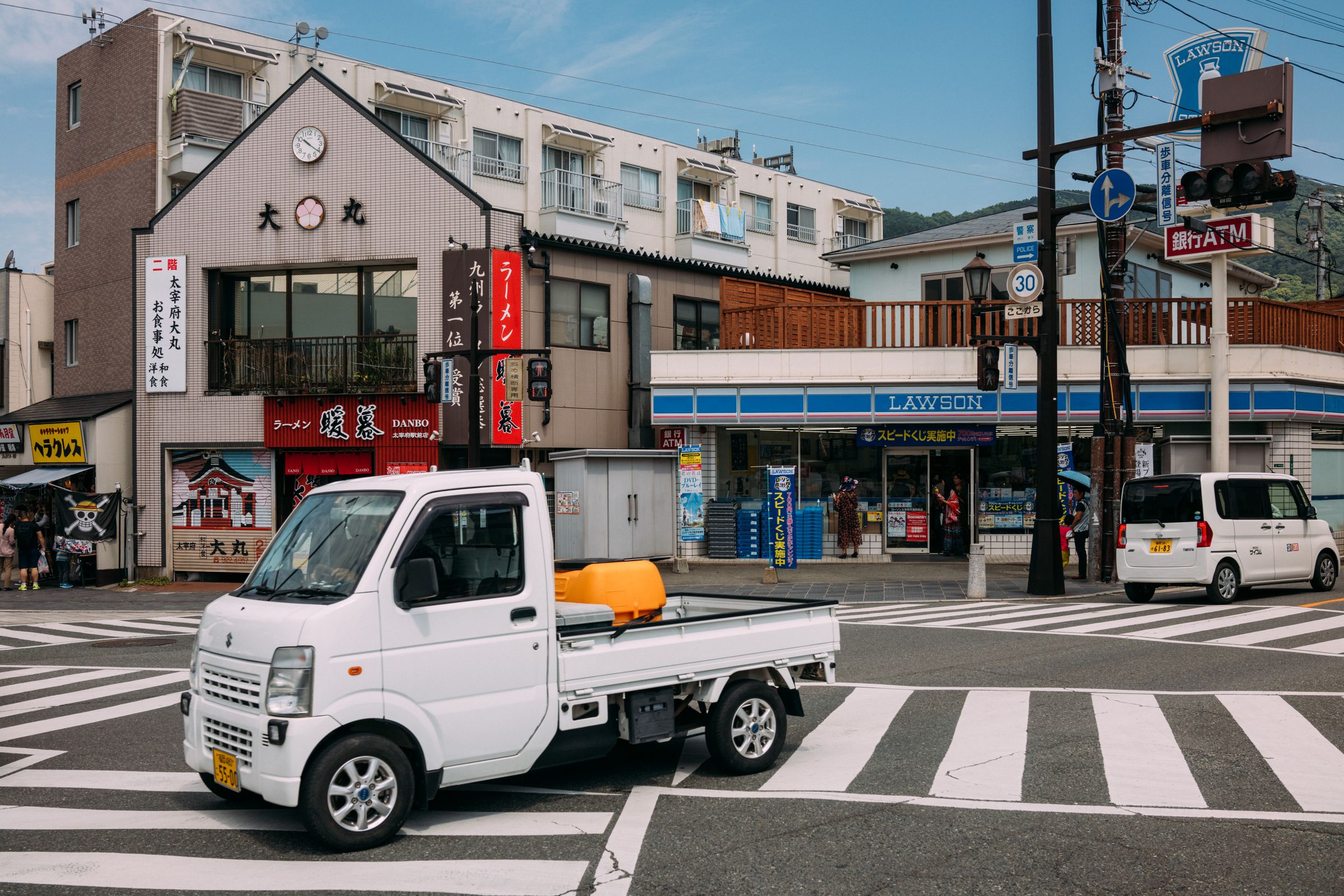
I couldn’t go to a gas station without somebody asking me about it or trying to figure out how they could get their own.
Jake Simpson, a kei truck importer in Pennsylvania, in Japan’s ‘Kei’ trucks hitting U.S. roads — NHK WORLD-JAPAN
You use what’s available. You share what you’ve made. You treat the constraints as materials.
Roll Your Own: Bricolage, Punk, and the Neurodivergent Making Tradition
A community member asked for this one, and it is a very good rabbit hole: kei trucks, the tiny Japanese work pickups that have been turning up on American farms, job sites, and gas station lots.
Kei is short for kei-jidōsha, 軽自動車, “light automobile.” It is Japan’s smallest class of four-wheeled vehicle, held by law to a box about eleven feet long and under five feet wide. Inside that box, people built a pickup with a full-length bed, three fold-down sides, and an engine you reach by lifting a seat or popping a hatch. More than 30,000 have reportedly been shipped to the United States in the past five years, according to NHK. And they have picked up exactly the kind of fandom we love: people who get stopped at the pump, people who name their trucks, and at least one person who has called, in his words, “probably every single state senator.”
We have four videos queued, from a public broadcaster’s news report to a buyer’s guide, a walkaround, and a backyard build. Then the floor is yours: if a kei truck turned up in your driveway tomorrow, what would you build it into?
Or bring a different small, fixable machine you love — a bike, a sewing machine, a calculator, a tractor, a Game Boy. Or bring nothing at all and come to listen. Lurking is a real and honored way to show up.
Date and Time: Thursday, October 15 at 7PM Central
The Playlist
About an hour and a quarter of footage for an hour on the clock, so we play the news report whole and dip into the rest. Every link is here if you want to watch the full versions later — or ahead, though nobody needs to.
The news report. Japan’s ‘Kei’ trucks hitting U.S. roads — NHK WORLD-JAPAN, six minutes. A used car lot in Pennsylvania full of kei trucks, including a red one still lettered for a local fire squad in Kani City, Gifu Prefecture. Its importer, Jake Simpson, brings in fifteen to twenty a month. Then a New Yorker named Joey Iorio, who is trying to make them legal in New York, one of the strictest states in the country. The best six-minute primer on the scene we found.
The buyer’s guide. Don’t Buy A KEI Truck Without Watching This Video — Dirt Lifestyle, eighteen and a half minutes. A self-described gearhead in Washington State, who also owns a heavy-duty Kodiak, buys a Subaru Sambar with 52,000 miles on it for $7,000. He loads it to the payload on the sticker — 350 kilos, about 770 pounds — fixes two loose vacuum lines, gets it registered, and then makes his case for the Sambar over the Honda Acty and the Suzuki Carry: the only four-cylinder in the class, an engine all the way behind the rear axle, and a bed longer than the one on his Tacoma. His warning before you open Marketplace: check whether your state will register one.
The walkaround. What is A Kei Mini Truck From Japan All About? — Our Life In Trees, thirty-eight minutes. A brand-new 2025 Daihatsu Hijet with a dump bed, on loan from a dealer — he says so up front — driven up a mountain in a national forest in southeastern Oklahoma. A new one cannot be street legal in the US, so it arrives as an off-road and farm machine, on ATV tires, governed at 40 kilometers an hour. We will play the best few minutes: the bed sides folding flat, the bed dumping, and the seat lifting up to show the engine.
The build. We bought a Japanese 4×4 Kei Truck… Now we BUILD — Forged 4×4, fourteen minutes. A 1999 Subaru Sambar named Kiki, bought with the money from their last kei truck video, and four build concepts put to an audience vote: the Mutt Cutts van from Dumb and Dumber, a Jurassic Park service vehicle, Marty McFly’s truck from Back to the Future, or an overland camper with a rooftop tent. This is the one that sets up the open mic.
The Stimpunks Frame
A legal box, and what people built inside it
Japanese law holds a kei vehicle to 3.4 meters long, 1.48 meters wide, under 2 meters tall, and under 660cc of engine, in exchange for lower tax and insurance (Kei car, Wikipedia). There is even a horsepower ceiling, 64 PS, and it is not a law at all — it is a gentlemen’s agreement among the manufacturers.
The designers did not fight the box. They built to it. The driver sits on top of the front axle, there is no hood, and nearly the whole length of the vehicle becomes bed. In the NHK piece, Jake Simpson measures a kei truck bed — 78 inches — and then the bed of a RAM 3500. Also 78 inches. Dirt Lifestyle finds his Sambar’s bed is longer than the one on his Tacoma, and longer than the one on his wife’s Gladiator. NPR found a kei owner, Ryan Douglass, who replaced his midsize American pickup with one: “I can lay down in the bed and not even touch the ends of it” (Camila Domonoske, NPR). And the whole truck still parks on Main Street. As Dirt Lifestyle puts it: “it fits everywhere.”
Then the three sides fold down, and the bed becomes a table at waist height. From the NHK report:
Being able to load from waist height is much easier than some of these bigger trucks we have to go, you know, up and over.
That is an access feature. A bed you load at waist height is a bed more bodyminds can use, for more years, with less pain. Nobody designed it as accommodation. It fell out of a constraint, which is how a lot of good access happens — and it is a fair description of what our own bricolage page means by treating the constraints as materials.
American trucks went the other way. Over the past thirty years, the average US passenger vehicle has grown about 4 inches wider, 10 inches longer, 8 inches taller, and roughly 1,000 pounds heavier (IIHS). Some of that is what buyers ask for, and some of it is that, as NPR puts it, automakers “make bigger profits on bigger vehicles.” Either way, nothing this small is sold new in the US. The kei fandom is, among other things, people buying back a size of tool the market does not offer them.
We have a word for that size: human scale. Just enough truck.
Lift the seat. There’s the engine.
Our Life In Trees flips up the passenger seat of the Hijet, and the engine is sitting right there under it. His verdict: “about the easiest engine to access I’ve ever seen.” The Sambar puts its engine behind the rear axle instead, under a hatch you open with the key, and Dirt Lifestyle says everything he read agreed it has “the easiest timing belt in your life.”
Forged 4×4’s Sambar goes further, because it is a 1999. “There’s no computer components that, you know, complicate things if you have to change out some spark plugs or change the oil,” the host says, and if the engine dies, “you could swap the engine out for a thousand bucks.” (The new ones are not so simple. The 2025 Hijet has a computer, lane-keep assist, and collision avoidance. The analog charm belongs to the 25-year-old trucks.)
A machine you can open is a machine you are allowed to understand. That is the whole of what we mean by Luddite sensibilities: not hating technology, but taking it back from the institutions that control it and handing it to the people who use it. It is the hacker ethos on four 12-inch wheels.
Disabled people know this one in our bones. Our bricolage page tells the story of the Rolling Quads, disabled students at UC Berkeley in the late 1960s who built a wheelchair repair shop modeled on DIY bicycle repair shops, to meet needs their university wouldn’t. Liz Jackson says it plainly:
People with disabilities are the original life hackers because our motivation is so high. If we don’t hack we often go without.
Liz Jackson, quoted on our bricolage page
And then there is what people do with a machine they can open: they play with it. Forged 4×4 cannot decide between a dog-eared van, a dinosaur-park service truck, a time machine’s getaway vehicle, and a camper, so they are letting the audience vote. That is not a waste of a work truck. That is a work truck becoming somebody’s special interest, and you can watch it happen on camera.
A special interest that called every state senator
Here is the legal patchwork, as plainly as we can put it.
- Federal: a vehicle built to another country’s safety rules can be imported once it is 25 years old, which makes it an antique and exempt from US federal safety standards (NPR). A new one comes in as an off-road machine instead, which is why the Oklahoma Hijet is wearing ATV tires and a speed governor.
- State: each state decides whether you can register one for the road. NHK counts around 30 that now allow it. New York is, in Iorio’s words, “probably one of the strictest states”: it wants proof the truck meets the federal standards it is legally exempt from.
- Across state lines: Dirt Lifestyle’s Sambar came from an Oregon owner who could not register it there. He registered it in Washington, fingers crossed, and it worked — and he points out that his Washington plates let him drive it through states whose own residents are not allowed to register one.
So Joey Iorio did what a person with an interest does. He made it his job. He helps other enthusiasts find their state assemblymember and state senator, and they call:
These vehicles, they’re legal to import. They’re not under the federal motor vehicle safety standards, yet New York says that they have to be, even though they’re exempt.
How many calls? “I’ve called probably every single state senator.” NHK credits advocates in Texas with pushing the first change in the law, and other states following.
We do not know who in the kei scene is Autistic, and it does not matter. The pattern is one we know. An interest held with that much intensity gets called obsessive — Simpson says it about himself, cheerfully, “it’s like I’m obsessed with it” — and then turns out to be the engine of a community organizing campaign. Our fandom entry quotes Devon Price’s Unmasking Autism: “Autistic people created the concept of fandom.” Price, drawing on Steve Silberman’s NeuroTribes, describes Autistic nerds in the early 1900s crossing the country by car, on foot, and by hopping trains to meet people who shared their interests. The kei people find each other at the gas pump. Drive one around town, Forged 4×4 says, and “people give you a thumbs up.” Dirt Lifestyle gets waves, thumbs up from kids, and a question from the woman at the title office about his “little beep beep” in the parking lot. “I can’t help but smile every single time I get in it.” A small truck turns out to be an affinity space on wheels.
Safe for whom?
We are not going to pretend the regulators made the danger up. Forged 4×4 is honest about it: “If you hit someone, you’re losing. It’s pretty simple. That’s just physics.” NPR notes that the flat front means no crumple zone — “your knees take the hit directly.” One owner of a 1992 Suzuki Cappuccino summed up his relationship with risk: “I accept the terms and conditions.” Dirt Lifestyle, on whether he would be safer in a Chevy S10: “you probably would be,” since his feet are at the front bumper.
One point comes up again and again, from Dirt Lifestyle and from the enthusiasts NPR talked to: the same states that refuse a kei truck in the name of safety will register a motorcycle.
But listen to Dan Kobayashi, who drives a Honda Acty kei truck, asking the better question:
What is a ‘safe’ vehicle?
Dan Kobayashi, in Can Americans learn to love tiny, cheap kei cars? — NPR
He pointed out that a small, slow truck is safer for the people outside it, and that with no hood in the way he can see what is in front of him: “I don’t have to worry about hitting kids in front of me, because I can see in front of me.” The crash data agrees with him. The Insurance Institute for Highway Safety studied nearly 18,000 crashes and found that pickups, SUVs, and vans with hoods taller than 40 inches are about 45 percent more likely to cause a death in a pedestrian crash than lower, sloped vehicles. Its president, David Harkey: “It’s clear that the increasing size of the vehicles in the U.S. fleet is costing pedestrians their lives” (IIHS, 2023).
So “safe” has to answer safe for whom. A kei truck mostly risks the person who chose to drive it. A giant truck exports its risk to people who never chose anything — the kid in the crosswalk, the wheelchair user, the person walking because they cannot drive. Design from the edges — center the people directly impacted by the outcome, the second principle of design justice — and the question changes shape.
And notice what the 25-year rule actually does. It puts a 1999 truck on the road and keeps a 2025 version of the same kind of truck — airbags, collision avoidance, lane-keep assist — off it. A rule that only admits the oldest version of a thing all but guarantees you get the least safe version of it. That is not the enthusiasts’ failure. It is a design failure, written into the law.
Join Us
Infodumplings happens every Thursday at 7PM Central in the Stimpunks Learning Space.
Bring your build idea for a kei truck — Mutt Cutts, Jurassic Park, time machine, camper, or something nobody has thought of yet. Bring a different small machine you love, and what you love about it. Bring a photo of the tiny truck you saw once and never forgot. Bring a fact about kei trucks you have been waiting to tell somebody. Or bring nothing and come to listen — lurking is a real and honored way to show up.
- Cameras optional. Chat-only participation fully valid.
- Stims, movement, and fidget tools encouraged.
- No one will be called on. Silence is participation.
- Screen sharing available if you want to show your truck, your sketch, or your favorite listing.
- Five minutes is plenty. You don’t need a whole segment.
Want to curate a future session? Get in touch →
How the Hour Goes
| Time | What’s happening |
|---|---|
| 7:00 PM | 👋 Welcome & housekeeping — who asked for this one, and what a kei truck is |
| 7:05 PM | 📺 NHK: Japan’s ‘Kei’ trucks hitting U.S. roads — the whole six minutes |
| ~7:12 PM | 🛻 The walkaround — the bed folds flat, the bed dumps, the seat lifts up, plus the buyer’s guide |
| ~7:27 PM | 🔨 The build — Forged 4×4’s four concepts and the vote |
| ~7:35 PM | 🧠 Bodymind break — 5 minutes, do whatever you need |
| ~7:40 PM | 🎤 Open floor: if a kei truck turned up in your driveway tomorrow, what would you build it into? |
| 8:00 PM | ✨ Cozy overflow + next week’s reveal |
Sessions run approximately one hour with cozy overflow after. Camera optional, chat always open, safe foods and stimming always welcome.
Related Glossary Entries
- Special Interest
- Infodump
- Fandom
- Affinity Space
- Monotropism
- Autistic Joy
- Play
- Bricolage
- Hacker Ethos
- Luddite Sensibilities
- Human Scale
- Community Organizing
- Edges
- Design Justice
Reflection Questions
On the trucks
- If a kei truck turned up in your driveway tomorrow, what would you build it into?
- What is a machine you love because it is just enough — not the biggest, not the fastest, just right?
- Have you ever owned something that made strangers stop and talk to you? What was that like?
On fixing things yourself
- What is something you own that you are allowed to open? What is something you are not?
- When has a tool you could fix yourself mattered more than a better tool you couldn’t?
- Where have you hacked something to make it work for your bodymind, because nobody else was going to?
On rules and who they protect
- When you hear that something is “unsafe,” how do you work out who it is unsafe for?
- What is a rule you have lived under that let in the worst version of something and kept out the better one?
- What would you call every state senator about?
Resources
- Japan’s ‘Kei’ trucks hitting U.S. roads — NHK WORLD-JAPAN, the news report
- Don’t Buy A KEI Truck Without Watching This Video. Honda Acty, Subaru Sambar, Suzuki Carry — Dirt Lifestyle, the buyer’s guide
- What is A Kei Mini Truck From Japan All About? — Our Life In Trees, the walkaround (a dealer loaned the truck, and he says so)
- We bought a Japanese 4×4 Kei Truck… Now we BUILD — Forged 4×4, the build
- Camila Domonoske, Can Americans learn to love tiny, cheap kei cars? — NPR, December 22, 2025. The 25-year rule, the safety debate, and a kei car club in Northern Virginia
- Vehicles with higher, more vertical front ends pose greater risk to pedestrians — Insurance Institute for Highway Safety, November 14, 2023
- Kei car and Kei truck — Wikipedia, for the size and engine limits
- Roll Your Own: Bricolage, Punk, and the Neurodivergent Making Tradition — our page on disability hacking, punk DIY, and the Rolling Quads
- Infodumplings — the event, the format, and how to curate a session
- Bodymind Break
—
Part of Stimpunks Recurring Events. See also: Solidarity Sesh and Watering Hole Hangs.