
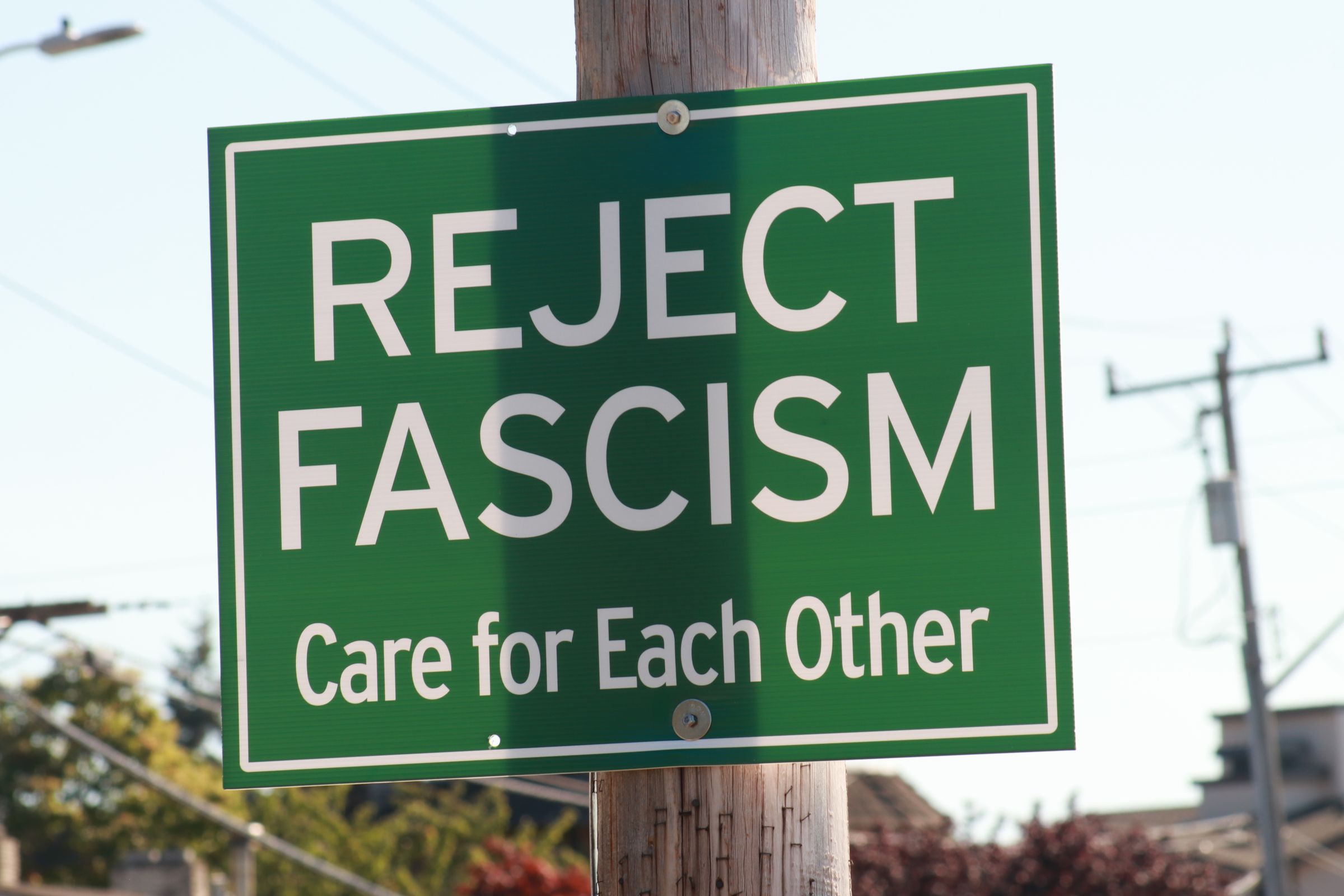
Could you imagine that that might be you too? And this story is for you.
— Then & Now, How to Make a Fascist
I think fascism comes in a very large part from a fear of chaos. It is in some way, then, the ultimate form of ordering ideology.
— Then & Now, How to Make a Fascist
For our Sunday, October 18, 2026 at 10AM CT, 4PM UK Campfire Learn Together, we are watching and discussing How to Make a Fascist, a video essay from the history and philosophy channel Then & Now. It runs nearly four hours, took about a year of reading to make, and is built like a recipe: thirteen chapters, each adding an ingredient, until by the end you are holding a fascist and can see everything that went into one.
Its hardest claim is that nobody was hypnotized. Not the veterans, not the farmers, not the teachers, not the students, not the crowds who marched with torches. The video spends four hours refusing the comfortable story — the spell, the propaganda, the handful of evil men — and replacing it with ordinary people making choices that felt reasonable, even righteous, inside conditions that made those choices easy.
I grew up in Christofascism and white supremacy where folks said “Might makes right”, “Survival of the fittest”, “Manifest Destiny”, “Kill them all and let God sort them out”, and “I’m right of Attila the Hun.” I watched family and neighbors radicalize on white resentment coming to them via their churches, radios, and TVs. I saw the Southern Strategy and dog-whistle politics do their work. It was awful and alienating.
The politics of resentment are powerful.
If you can convince the lowest white man he’s better than the best colored man, he won’t notice you’re picking his pocket. Hell, give him somebody to look down on, and he’ll empty his pockets for you.
— President Lyndon B. Johnson, LBJ: ‘Convince the Lowest White Man He’s Better Than the Best Colored Man’
The rise of MAGA in the US and fascism globally has been depressing and disheartening. Last month the far-right AfD won in Saxony-Anhalt, in the country this video spends most of its time in.
Then & Now names a dozen ingredients. This post circles two of them, because they are the two we keep watching work: austerity and resentment. Take away what people need, then hand them someone to blame for its absence.
We watch. We reflect. We bring our whole bodyminds. And we look hard at who gets blamed when there isn’t enough.
Videos
We’ll watch three of the thirteen chapters together, about forty minutes in all — subtitles on, sound up, cameras optional. No need to have watched ahead. We’ll take a bodymind break before we talk.
How to Make a Fascist — Then & Now, December 2025. Nearly four hours in thirteen chapters, fan-funded, with a bibliography and reading list on Patreon. We’re watching these three:
- Introduction: How to Make a Fascist — about nine minutes. A soldier who needed his war to mean something, and an invitation to imagine yourself inside the story instead of above it.
- Chapter Seven: When Things Fall Apart — starts at 2:00:56, about nineteen minutes. Hyperinflation, the Depression, a welfare state that cannot help, and what an ordinary person reaches for when nothing works.
- Chapter Thirteen: The Soul of Fascism — starts at 3:40:42, about twelve minutes. Money, the full ingredient list, and the fear of chaos.
If you watch one more on your own time, make it Chapter Three: The Science of Struggle (47:08). It is the chapter our community is in without being named. The post below reads all thirteen.
Content note. The video quotes antisemitic, racist, and eugenic writing at length, describes torture, murder, and street violence, and reports a Nazi march chanting for the deaths of Jews. It is history told straight, not gratuitously, but it is heavy. Take it in pieces. Leave the room whenever you need to, and come back, or don’t.
Three chapters, one question: who gets blamed when there isn’t enough — and who decided there wouldn’t be?
Table of Contents
- Videos
- This Story Is for You
- The Sick, the Infirm, the Weak
- Fitting In the Place of Things
- The More an Economy Fails
- They Brought You In
- Not Without the Establishment
- A Fear of Chaos
- The Stimpunks Synthesis
- Join Us
- Main Takeaways
- Related Glossary Entries
- Reflection Questions
- Resources
This Story Is for You
You think it’s all about being captured by Hitler’s spell? … This interpretation of how you might become a fascist is wrong.
The video opens in the trenches of the First World War with Ernst Jünger, a German soldier wounded more than a dozen times over the course of the war, whose memoir Storm of Steel does not mourn the war so much as exalt it. After the war, the video tells us, Jünger said that if the war was meaningless, it would become necessary to give it meaning. He wrote that the blood of the Great War cannot have flowed for nothing.
Then the video turns and looks at us. Jünger’s generation was bored of routine, of bourgeois life, suspicious of materialism and decadence, desirous of heroism, of something meaningful.
Does that sound familiar to you? Could you identify with that?
This is the first move, and the whole video depends on it. Fascists were not a different species. Ambiguous people are everywhere here, it says. Ordinary people like you and me. Jünger hated democracy and flirted with fascism without joining it; he also made, in the video’s words, great, authentic, earnest art. The video wants you to hold that discomfort for four hours, and it will not let you off by the end:
We too often think of people brainwashed by propaganda and fear and tyranny and the desire to conform with their neighbors. But that’s not what happened. This was a bottom up, real, thoughtful, self-justifying movement with true, powerful, convincing, fundamental roots.
The brainwashing story is a comfort. It puts fascism outside of us — in a spell, a speech, a few bad men. The recipe puts it in ordinary kitchens. That is a structural argument, and it is the right correction to the fundamental attribution error, which our glossary defines as overestimating the power of the person and underestimating the power of the situation. The video gives the situation its due without excusing a single person in it.
Watch what Jünger does with his wounds. Something unbearable happened, so it must have been worth it. Timothy Snyder names the same move in the passage we keep on our sadopopulism entry: The politics of eternity converts pain to meaning, and then meaning back into more pain. Pain that has to mean something is pain that can be recruited. The video thinks this is the ingredient that matters most — what it calls the [spiritualizing] or heightening of violence — and it opens with it for that reason.
Near the end, it tells us how it wants to be used:
Maybe in a way, I like to think of myself like a cooking channel. I want to show you the ingredients.
It’s up to you how you interpret them, the weights you give them, the things you think I’ve missed. That is an invitation to a campfire. We take it up in the Synthesis.
The Sick, the Infirm, the Weak
One of the most obvious expressions was that the poor and needy were destined to perish, and the fit and the strong were destined to thrive.
Chapter Three, The Science of Struggle, is about how a few scientific discoveries became common sense. Germ theory taught a generation that invisible enemies lived under the skin, and it led to [an] obsessive hygiene drive, an obsession over cleanliness. In Jim Crow America, the video notes, advertisements showed Black Americans as dirty and diseased. Darwin’s On the Origin of Species arrived in the same half-century, and survival of the fittest went with it.
The video is careful here. Darwin himself believed altruism was compatible with natural selection. Then:
But it didn’t really matter what Darwin thought because many believed this was obvious.
And it says out loud what obvious meant, in the voice of the period:
Of course, the sick, the infirm, the weak hold us back in some way.
It reaches for a schoolyard to make the logic feel familiar — take the example of a school race that you want to win. What if it was made up of the worst team members? From there the chapter climbs. Mussolini, still a socialist, describes expelling party members as an immune response, the impure elements circulating in the same way that damaging germs circulate in the blood. Hitler, in 1920, speaks of racial tuberculosis. Some have even called [Nazism] applied biology, the video says. Phrenologists claimed an inner essence could be read off a face, so that people could be sorted by what they were supposedly suited for:
Then you could construct a perfectly simple, rational, ordered utopia where everything was in its place.
This is our territory, and the video does not say so. It is describing eugenics before the word did its worst work. Our entry quotes Angela Saini’s definition: a cold, calculated way of thinking about human life, reducing human beings to nothing but parts of the whole, either dragging down their race or pulling it up. The sick, the infirm, the weak are Disabled people, named in the language of a hundred years ago. Everything in its place is the pathology paradigm, which still assumes there is one right way for a mind to work and files every other way as a disorder.
Two of the slogans at the top of this post — Survival of the fittest, Might makes right — are this chapter, still in circulation a century later.
But the same science held another reading, and it was written in the same years. Our evolution entry puts it plainly: The notion of life as a competitive game found its way into the science of biology by interpreting Darwin’s theory of evolution through the cultural lens of capitalism. Peter Kropotkin’s Mutual Aid: A Factor of Evolution (1902) read the natural world as cooperative and was largely ignored in the capitalist West. Our mutual aid entry carries Kropotkin’s line by way of A Mind Unstrange:
Peter Kropotkin observed that “Those communities which included the greatest number of the most sympathetic members would flourish best.” In other words, survival does not belong to the fittest alone—it belongs to the most caring.
The science did not decide. The reading did. That is exactly the video’s own point — it didn’t really matter what Darwin thought — carried one step further. Somebody chose which Darwin to believe, and the choice suited them.
We will come back to where this chapter went next. The video doesn’t.
Fitting In the Place of Things
It’s a matter of fitting in sociologically, quite literally fitting in the place of things.
Chapters Two and Four start with sympathy. You are a woodworker in a village, using your grandfather’s tools, until furniture starts arriving by train from factories in cities you have never seen, advertised in national color, printed catalogs. Against that, German Romanticism offered rootedness: soil, community, story, the knowable network of people around you. The video does not sneer at this. And all of this makes absolute sense, right? it asks — and confesses its own pull: It’s something I feel very often, and I’ve been very heavily influenced by the Romantics.
Then it shows what rootedness needed in order to work:
That if you have a pure model, a pure German, a pure blood, an ideal, then that assumes logically an opposite, an antithesis, the impure.
The merchant who travels. The worker who moves from job to job. And most of all, in the rhetoric of the time, the Jew — cast as homeless, [rootless], the wandering enemy within. The video’s point is that the new antisemitism of the late nineteenth century was no longer mainly about religion. It was about where people belonged.
It also refuses to call this purely irrational. The tragedy of othering is that [there] often becomes a kind of logic to it, a dire rationalism. Jews were excluded from guilds and settled professions, pushed toward finance and trade, and then blamed for being there. And so they became the stereotypes that were set for them.
Then the video makes it small enough to recognize:
If you’re in a work meeting about the crisis and John doesn’t show up, who’s easiest to blame? John. He’s not there. He can’t fight back. He’s not one of the in-group.
And it’s easy to scapegoat the person, the threat, the group that are least visible, least present, least able to respond.
And it ties the blame to the economy. When depressions hit in the late nineteenth century, antisemitism surged; but as the economy improved, this wave of anti-Semitism died down. It was, the video says, a useful outlet for those who felt something had gone wrong, but couldn’t quite put their finger on what.
We want to be careful here, the way we were careful with Maya Angelou and James Baldwin last week. This chapter is about antisemitism, and antisemitism is not a metaphor for anything else. It was the engine of the Holocaust, and it is rising again now.
But the mechanism the video describes runs on two parts we know from the receiving end. One is a fixed idea of where everyone fits. The other is blame that flows toward whoever fits it least. Fitting in the place of things is what neuronormativity demands, and masking is what it costs. They became the stereotypes that were set for them is our labels entry in one sentence. And John — least visible, least present, least able to respond — is a fair description of who gets talked about, and not with, in a budget meeting about disability services. That is why we keep saying nothing about us without us. The person who isn’t in the room is the easiest one to cut.
The More an Economy Fails
The great and sad irony of the welfare state is that the more an economy fails, the more people need help and the less the state has the money to help.
This is Chapter Seven, the middle of the three chapters we’re watching together, and it is the heart of this post.
The video asks you to stand where an ordinary German stood in the early 1920s. Millions of children are growing up without fathers. Veterans come home missing limbs and cannot work, and pensions are being paid to almost a million of them by a country that borrowed heavily to fight the war. Then the money stops meaning anything. The video reads from a 1923 Daily Mail report on shop prices, typed up and posted hourly: a gramophone at 10 a.m. was 5 million marks, but at 3 p.m. it was 12 million marks. Wages are collected in wheelbarrows. Gangs roam the countryside stealing crops. One prison reports that of a hundred men sent to it, sixty-eight had no shoes.
And it names who resented paying to hold people up:
Welfare payments added to financial pressure. Big business often despised being forced to pay [for] welfare.
Ten years later the Depression lands on top of the memory. In 1932, 1 in 3 Germans were unemployed. The video asks you to be the person living it:
You’re doing the same thing plowing your field, building furniture, whatever it is. But no matter what you do, you’re on the verge of bankruptcy. You can’t find work.
It quotes the historian Richard Evans on Munich in 1919, where virtually every social and political group in the city burned with resentment, fear and lust for revenge. And in a later chapter it puts the question to you directly:
If you’re struggling to feed your family and you see people buying bread with wheelbarrows of money, would you not be a part of this movement?
Cory Doctorow said the same thing in one breath, talking with Jon Stewart on The Weekly Show:
When you do austerity, you make people into fascists.
…
You just become a sucker for people who show up and say undeserving others are the reason you don’t have what you need.
Austerity and resentment are not two ingredients. They are one move in two steps. Take away what people need. Then hand them someone to blame for its absence.
We have watched that move at home. Our Southern Strategy entry opens with George McGovern’s summary of the bargain, quoted by Ian Haney López:
Let the poor stay poor, let your economy trail the nation, forget about decent homes and medical care for all your people, choose officials who will oppose every effort to benefit the many at the expense of the few-and in return, we will try to overlook the rights of the black man …
The poverty is the price. The status is the payment. Haney López traces what it did to the meaning of public help, in the passage on our resentment entry: what had been liberal “programs” when they helped whites became “welfare” when extended across the colorline. And: Conservative dog whistling made minorities, not concentrated wealth, the pressing enemy of the white middle class.
Snyder gives the mechanism its name — sadopopulism:
That’s how sadopopulism works: the government makes you hurt, and then you want somebody else to hurt more.
Umberto Eco put it on his list of the features of what he called Ur-Fascism, in 1995:
Ur-Fascism derives from individual or social frustration. That is why one of the most typical features of the historical fascism was the appeal to a frustrated middle class, a class suffering from an economic crisis or feelings of political humiliation, and frightened by the pressure of lower social groups.
Scarcity needs a scapegoat. Real scarcity will do. Manufactured scarcity — the kind our artificial scarcity entry describes, where programs are underfunded, so caregivers, teachers, social workers, and disabled people themselves are all pushed to project their needs as necessary and virtuous — works even better, because someone can turn the tap on and off.
They Brought You In
In this sense, they were new in that they accepted you in, they brought you in, they invited you in, and they made you part of something bigger.
Old conservatives, the video says, distrusted the masses — the little people who they believed should be led. Bismarck rejected them entirely. The fascist innovation was to invite them in.
Veterans had learned order and brotherhood and belonging in tight knit, nationalist, hierarchical units, and they came home to strikes, street fights, and nothing to do with any of it. In Italy they formed squads, groups of 30 to 50 men, that roamed the countryside in trucks looking for socialists to beat. It was the war mirrored domestically. In Germany, the Brownshirts appealed to young Germans looking for some kind of belonging, some kind of order, and grew to four million members — larger than the German army itself.
Then the video names what held all of it together:
Hitler found that antisemitism was the most uniting force to all sides and to the base. It had a kind of unifying power. It provided an ideology, a glue.
It also notes what was quietly dropped. The early party programs promised pensions, profit-sharing, and land reform. But Hitler did not want to revolutionize and radically change the economic base except for some minor reforms, some minor tweaks. So where would the change come from? It would be cultural. Walter Benjamin, writing in 1936, saw the trade from inside it:
Fascism attempts to organize the newly proletarianized masses without affecting the property structure which the masses strive to eliminate. Fascism sees its salvation in giving these masses not their right, but instead a chance to express themselves.
Belonging instead of bread. Expression instead of rights.
And it worked on people who wanted what everyone wants. The video quotes a witness to the torchlight parade the night Hitler became chancellor in January 1933. He had just seen a Brownshirt strike a man, and felt horror almost imperceptibly spiced with an intoxicating joy:
I was overcome with a burning desire to belong to these people, for whom it was a matter of death and life. … I wanted to escape from my childish, narrow life, and I wanted to attach myself to something that was great and fundamental.
That is a person describing the need our belonging entry is about — to stop being small and alone. Our entry defines belonging as being able to participate without constantly having to explain yourself, hide parts of who you are, or push past exhaustion just to keep up. What he found was the inverse: belonging bought by pointing at someone else. The Atlantic’s The Cruelty Is the Point, which we keep on the same sadopopulism entry, describes the adhesive: Their cruelty made them feel good, it made them feel proud, it made them feel happy. And it made them feel closer to one another.
Belonging that needs an enemy is recruitment.
Not Without the Establishment
But the key point is this[:] in both Italy and Germany, fascists could not win power without some kind of conservative establishment support.
Chapter Twelve corrects another comfortable story: that fascists seized power. In Italy they were a small bloc in parliament. They took local councils by intimidation, and when they finally marched, the king could have stopped them. Historians have since mostly agreed that the army could actually have easily stopped the march. If the politicians and the king had had the will to do so. He stood down.
In Germany, the courts had been leaning for years. The army, the police, the judiciary, the courts, and the judges tended to prosecute those on the left more and turn a blind eye to those on the right. The Weimar constitution’s Article 48 let the president rule by decree in an emergency — a dangerous clause because of the ambiguity of the word emergency — and the first Social Democrat president used it 136 times before the Nazis came anywhere near power. Conservatives appointed Hitler chancellor in January 1933 believing they could contain him. A month later the Reichstag burned, and one decree suspended free speech, free assembly, a free press, and the privacy of the mail.
The video names the pattern:
The spark that convinces conservatives to do this, usually cynically and hesitantly, is a crisis or a deep fear of the left[.]
Our conservatism entry opens with Wilhoit’s Law: There must be in-groups whom the law protects but does not bind, alongside out-groups whom the law binds but does not protect. A Weimar courtroom prosecuting the left and waving the right through is that sentence with a gavel in its hand.
Underneath this chapter is the contempt that runs through the whole video. Jünger wanted to overthrow a lying, divided parliamentary talking shop. The syndicalist Georges Sorel hated intellectuals and their abstractions. Weimar’s critics asked what good debate was when the country needed a man of action. And the summary of the whole era:
It was heroes over democracy.
Eco put the same thing on his list: For Ur-Fascism, disagreement is treason. And: Action being beautiful in itself, it must be taken before, or without, any previous reflection. Thinking is a form of emasculation.
Fascists do not take power alone. Someone opens the door — and someone else has already called the talking unbearable. We watched our own version of the door this summer. Community Living Is Being Dismantled on Every Front at Once describes rights stripped through courts, through budgets, through quiet rule changes that never make the news, and the tools to defend them weakened at the same time: The attack on the right and the attack on the means of defending the right are not two stories. That is what Article 48 teaches. Watch the emergency powers, and watch who is quietly granting them.
A Fear of Chaos
It’s utopian in that it promises a special order, glory, a national belonging, a place, a leader, a good struggle, a clear enemy.
The last chapter is the one we’ll watch to close, and it starts with money. The video takes seriously the old Marxist reading that fascism was the dictatorship of big capital, and finds it too simple. Most early Nazi funding came from small donors and dues; big business preferred ordinary conservatives until it didn’t. It quotes the historian Fritz Stern:
A thousand teachers in republican Germany who in their youth had worshiped [Lagarde] or [Langbehn], were just as important in the triumph of National Socialism as all the putative millions of marks that Hitler collected from the German tycoons.
And then, in the next breath: But Hitler did collect those millions from those tycoons. That is the video at its best — both things, held at once.
A thousand teachers. We are an organization that writes about schools, and we notice who the video says carried the ideas.
Then it lays out the whole recipe: the spiritualizing of violence; anti-rationalism and a reaction to the Enlightenment; heroism and action over debate; myth over reason; vulgar or social Darwinism, the scientism of struggle; ultranationalism and the Volk as answers to a crisis of capitalism and liberalism; authority and order over freedom and chaos; anti-Bolshevism; paramilitaries; the shock of the First World War; and establishment support from big money and big politicians.
What sets fascism apart from ordinary authoritarianism, it argues, is the drive, the energy for some kind of outer inner expansion driven at heart by the heightening and [spiritualization] of violence. And underneath that, fear:
I think fascism comes in a very large part from a fear of chaos. It is in some way, then, the ultimate form of ordering ideology.
It is a response to chaos, but it requires active participation, heroic violence to secure that ordered utopia.
Remember the phrenologists: a perfectly simple, rational, ordered utopia where everything was in its place. An ordering ideology needs someone to be the mess. Neurodivergent and Disabled people have been cast as that mess by every tidy vision of society on record. Robert Chapman, in the passage we quote in our review of Empire of Normality, says it without hedging: some neurodivergent disablement and illness will always exist, and that imagined worlds where they do not exist at all are fascistic fantasies. The neurodiversity paradigm starts from the opposite premise. Variation is not disorder. It is what a living population looks like.
To a fear of chaos, we are the chaos.
The video ends on a question rather than an answer. Was fascism an anomaly of its time — historic, … containable — or part of an ever-present struggle between freedom and power?
What does it mean to think about fascism today or fascism tomorrow?
That is the question we’re bringing to the fire.
The Stimpunks Synthesis
The following is a Stimpunks synthesis — our own extension and critique, not a claim made by Then & Now or the video.
Grant it all first, because it earns it. This is a patient, serious piece of popular history. It refuses the cartoon villains and the brainwashing story. It treats ordinary people as people who chose. It names the conservative establishments that opened the door, and it names big money without reducing everything to it. It admits its own attraction to the Romantic ideas it is dissecting. And it asks to be argued with — the weights you give them, the things you think I’ve missed. So here are our weights, and four things we think it missed. The fifth is aimed at us.
First: ableism is an ingredient, not a side dish. The video names the sick, the infirm, the weak as what the era’s common sense wanted gone. It tours racial hygiene, germ metaphors, and phrenology. Then it moves on, and never follows that thread to where it went first. The video says what fascists did in power belongs to later videos, and that is fair. But eugenics was not only something fascists did once they had power. It was part of the mixture that made them, and the video’s own Chapter Three shows it. Where it went is on our eugenics entry, in Steve Silberman’s words from NeuroTribes:
More than two hundred thousand disabled children and adults were murdered during the official phases of the child euthanasia and T-4 programs, and thousands more were killed in acts of “wild euthanasia” by doctors and nurses on their own initiative.
Jacobin’s introduction to its interview with the historian Ishay Landa names the logic plainly: Nazi social Darwinism, counting the “unproductive” as mere wasteful expense, obeyed the logic of judging human life by the yardstick of profit. That is austerity’s arithmetic taken to its end. We said it in our Campfire on Head, Heart, and Hands at the End of the World: Disabled people are always early on that list, in every triage protocol and every “survival of the fittest” turn a crisis takes. A recipe for a fascist that leaves out who it was first tested on is written from the kitchen, not the table.
Second: austerity is a choice, and the video files it under weather. The great and sad irony of the welfare state — irony is a word for something nobody did. The video tells us who resented paying for welfare — big business — and then calls the result an irony. It follows hyperinflation, reparations, and the Depression like a storm the ingredients happened to fall into. It treats Article 48 as a flaw in the constitution, which it was, and never asks what the emergency decrees of the Depression years actually did, or to whom. That is a question worth bringing to the fire. Doctorow’s verb is the one we would keep: when you do austerity. Someone does it.
Our Southern Strategy entry is the proof that it can be done on purpose, because there the poverty is written into the bargain as its price. And we are living through the current version. Our post on community living tracked roughly $1 trillion cut from Medicaid over ten years, and disabled people now required to prove they cannot work. It found that the savings, case by case, do not survive the arithmetic: What remains, once the accounting fails, is the ideology — the conviction that disabled lives are worth less, lived smaller, and best kept out of sight. That is deficit ideology written as budget policy, in the post’s own words, and it is what neoliberalism has meant in practice. Austerity is not the soil the recipe grows in. It is one of the cooks.
Third: the video speaks to the recruit, not the target. Could you imagine that that might be you too? It is a good question for an audience that assumes it is safe. Many people in our community have to ask a different one. Not could I be recruited? but when the list is drawn up, am I on it — and who stands next to me? The philosopher Robert Chapman, author of Empire of Normality, describes how the target has shifted, in The Fascist Echo in Labour’s “Over-diagnosis” Inquiry:
Early fascists had focused their efforts on eliminating disabled people, first through mass sterilisation and then mass murder. Yet they only saw disabled people as posing a hereditary threat to the health of the race. They did not see disabled people as a serial collective with political agency and the power to challenge them. … Hence the fascists of today are less worried about disabled people corrupting the gene pool and are more worried about us corrupting culture and morality.
He shows how talk of “overdiagnosis” of autism and ADHD has become a new moral panic, whose main function so far, he writes, has been to justify cruel cuts to welfare. He also notes that the United States health secretary has suggested sending people who take ADHD medication to labour camps. Ombre Tarragnat, in an essay translated with Helen Edgar for Autistic Realms, names another use of us: At a time of resurgent fascism in the West, anti-trans movements increasingly instrumentalise neurodivergent people (particularly Autistic people) to justify bans on gender-affirming care for minors. So we would add a second question to the video’s first. Not only “could it be you?” but “who is John, and will you speak up for him?” The cheapest act of resistance in the video is available at every meeting: notice who isn’t in the room before you agree on whose fault it is.
Fourth: you cannot out-story an empty fridge. The video gives myth its due — Sorel’s myth of the general strike, Wagner, the heroes we all absorbed from films and books. These aren’t just fictions. They actually structure how we think of the world. We agree, and we are a storytelling organization. But Benjamin’s line cuts the other way. Fascism offered expression instead of rights, and a better counter-myth offered instead of bread repeats the same trick. The answer to austerity and resentment is provision and solidarity, together. Care is infrastructure: a public good, a shared responsibility, and a baseline condition for dignity. Doctorow, in the same interview, points at the other half: if all you do is shop your politics, you’re going to look over at your friends who shop differently from you … and the people you need to be in community with and in solidarity with, you’re going to end up being angry at them. Join a local group. Resentment turns sideways too. Mutual aid and community organizing turn it back toward the people who decided there wouldn’t be enough. And we keep the limit we wrote down this summer: Mutual aid is not a replacement for the systems being dismantled. … Defending the systems and building the networks are not alternatives. We do both, because we have to.
Fifth, and aimed at ourselves: some of these ingredients are in our pantry. Read the list again with our website open. Suspicion of technocrats and measurement — we have a Luddite sensibilities entry and a whole philosophy of when you measure, include the measurer. Romance for community, story, and rootedness — we built a Cavendish Space out of caves, campfires, and watering holes. Back-to-the-land communes, which the video calls basically hippies. A philosophy page that says find your people. None of that is fascist. The video’s own point is that none of it was, on its own. What separated their campfire from ours was never the ingredients. It was whether the fire needed an enemy, and who was allowed to sit at it. Find your people turns ugly the moment it requires a not-people. So we hold ourselves to the test our belonging entry sets — belonging without having to hide, explain, or push past exhaustion — and to interdependence, which, as Mia Mingus writes on that entry, acknowledges that our survival is bound up together. Bound up with everyone, including the people the ordering ideology would file as the mess. Especially them.
The video opens with a man who needed his pain to mean something, and made it glorious. We would rather pain meant something else: that nobody should have to go through it again — and that the people around us are why most of us got through it at all.
None of which makes the video wrong. It makes it an argument in progress, which is the best kind to bring to a campfire — and on this subject, the argument is overdue.
Join Us
Campfire Learn Together happens every Sunday at 10AM Central, online via Discord. This session is on Sunday, October 18, 2026 at 10AM CT, 4PM UK. Open to the whole community — no preparation needed, no expertise required. Come as you are.
We’ll watch three chapters together, take a bodymind break, and then open up the reflection questions as a community conversation. You can participate by video, voice, text chat, or just by being in the room. All modes are welcome. Cameras optional. Silence is participation.
There is no designated expert here, including us, and including a four-hour video essay that asked us to tell it what it missed. This is omni-directional learning in a Cavendish Space campfire — which is to say, a talking shop, on purpose. In a story where every fascist movement started by sneering at people sitting around talking, we think that is worth defending.
Join our community to get access, then find us in our online space. Our Campfire Learn Together page describes some of what to expect. If this is your first Campfire, you’re in good company — many of our regulars showed up for the first time not knowing quite what to expect, and stayed.
Come with one slogan. A line you grew up hearing that turns out to be in this recipe — and, if you have it, the sentence you answer it with now.
Main Takeaways
- Nobody was hypnotized. Fascism was, in the video’s words, a bottom up, real, thoughtful, self-justifying movement. The brainwashing story is a comfort that puts it outside us.
- Austerity is a choice, and resentment is how it gets sold. When you do austerity, you make people into fascists. Take away what people need, then hand them someone to blame for its absence.
- Scarcity needs a scapegoat. Blame flows to whoever is least visible, least present, least able to respond. John is not at the meeting.
- Survival of the fittest had a first list, and Disabled people were on it. Eugenics was an ingredient before it was a policy.
- The science did not decide. The reading did. Darwin’s world also held Kropotkin’s mutual aid. Somebody chose which Darwin to believe.
- Belonging that needs an enemy is recruitment. Fascism invited people in, and offered them expression instead of rights.
- Fascists do not take power alone. In Italy and Germany, conservative establishments opened the door — cynically, hesitantly, and in the name of an emergency.
- An ordering ideology needs someone to be the mess. To a fear of chaos, neurodivergent and Disabled people are the chaos.
- You cannot out-story an empty fridge. Provision and solidarity, together. Care is infrastructure.
- Defend the talking shop. For fascism, disagreement is treason. A campfire with no designated expert is the opposite of that.
- Speak up for John. Before you agree on whose fault it is, notice who isn’t in the room.
Related Glossary Entries
- Resentment — Politics that provides scapegoats instead of solutions. The second half of this recipe.
- Southern Strategy — Let the poor stay poor in exchange for someone to look down on. Austerity and resentment sold as one package.
- Sadopopulism — The government makes you hurt, and then you want somebody else to hurt more.
- Artificial Scarcity — Underfunding that forces people to compete for help. Scarcity someone can switch on.
- Deficit Ideology — Explaining inequality by the supposed deficiencies of the people who have least. Our community living post calls its budget form deficit ideology written as budget policy.
- Eugenics — The ingredient the video names and never follows to its first victims.
- Evolution — The competitive reading of Darwin was a cultural lens. Kropotkin’s cooperative reading was ignored.
- Mutual Aid — Survival belongs to the most caring. What we build alongside the systems we defend, never instead of them.
- Conservatism — Wilhoit’s Law: in-groups the law protects but does not bind. A Weimar courtroom, described in one sentence.
- Moral Panic — Fear used to manipulate. Today’s “overdiagnosis” discourse, aimed at us.
- Empire of Normality — Normal defined by productivity. Robert Chapman’s name for the system that files us as the mess.
- Pathology Paradigm — One right way for a mind to work. The phrenologist’s everything in its place, still in use.
- Belonging — Participating without explaining, hiding, or pushing past exhaustion. The opposite of belonging that needs an enemy.
- Interdependence — Our survival is bound up together. With everyone.
Reflection Questions
On the slogans you grew up with. Might makes right. Survival of the fittest. What did people around you say when you were young that you now hear in this recipe? When did you first notice it? Is there anyone you grew up with who still says it, and what would you want to say to them?
On John. The video’s easiest scapegoat is the person who isn’t at the meeting. When have you been John? When have you been in the room while someone else was being blamed in their absence? What would it have cost you to say let’s not do this without them?
On “not enough.” Where have you watched scarcity turn neighbors against each other — at school, at work, in a waiting list, in your own family? Was the scarcity real, or did someone decide it? How could you tell the difference?
On belonging with a price. The witness at the torchlight parade wanted to escape a narrow life and be part of something great. Have you ever belonged somewhere that needed an enemy to hold together? What did it give you, and what did it ask of you? What does belonging without an enemy feel like?
On the people who open the door. The video says fascists could not take power without help from people who thought they could control them. Who are the hesitant enablers in our own time? What would it take for them to stand down — or to stand up?
On our own pantry. Rootedness, community, story, suspicion of experts — some of these ingredients are things we love. Which ones do you love? How do you keep them from needing an enemy?
On tomorrow. The video closes by asking what it means to think about fascism today and tomorrow. What is one small thing you could do this week that makes the recipe harder to follow — a group to join, a neighbor to feed, a meeting where you could speak up for John?
—
This page draws on How to Make a Fascist by the history and philosophy channel Then & Now (December 2025). Quotations are transcribed from the video’s automatic captions, with capitalization and punctuation ours and obvious caption errors corrected in brackets. The captions misspell several names, which we have spelled correctly outside quotations: Ernst Jünger, Georges Sorel, Paul de Lagarde, and Julius Langbehn. Where the video quotes historians and writers — Richard Evans, Fritz Stern, Ernst Jünger, and others — we quote them as the video reads them. Cory Doctorow is quoted from The Weekly Show with Jon Stewart. Timothy Snyder, Ian Haney López, George McGovern, Angela Saini, Steve Silberman, Peter Kropotkin, Mia Mingus, and The Atlantic are quoted from entries on our glossary that cite them. Umberto Eco is quoted from Ur-Fascism (1995); Walter Benjamin from his 1936 writing on fascism; Robert Chapman from his Substack; and Ombre Tarragnat’s essay, translated with Helen Edgar, from Autistic Realms, which is Helen’s site and not ours. The Stimpunks Synthesis section is our own extension and critique, not attributed to Then & Now.
Resources
- How to Make a Fascist — YouTube — Then & Now, December 2025
- Bibliography and reading list for How to Make a Fascist — Then & Now on Patreon
- AI and the Enshittification Era w/ Cory Doctorow — The Weekly Show with Jon Stewart
- LBJ: ‘Convince the Lowest White Man He’s Better Than the Best Colored Man’ — Snopes
- AfD Victory in Saxony-Anhalt Sends a Signal to Europe — The New York Times
- Ur-Fascism — Umberto Eco
- The Fascist Echo in Labour’s “Over-diagnosis” Inquiry — Robert Chapman
- The Nazis Weren’t Socialists — They Were Hypercapitalists — Jacobin, interview with Ishay Landa
- Timothy Snyder Speaks, ep. 4: Sadopopulism — YouTube
- Ian Haney López, “Dog Whistle Politics: Coded Racism and Inequality for All” — YouTube
- Mutual Aid: How We Survive, How We Transform — A Mind Unstrange
- What Would A Neuroqueer Pedagogy Be? — Ombre Tarragnat, translated with Helen Edgar, Autistic Realms
- Community Living Is Being Dismantled on Every Front at Once — Stimpunks Foundation
- Monitor Power, Not People — Stimpunks Foundation
- Empire of Normality: An Important Book Necessary to Our Times — Stimpunks Foundation
- Care Is Infrastructure — Stimpunks Foundation
- Find Your People — Stimpunks Foundation
- Nothing About Us Without Us — Stimpunks Foundation
- When You Measure, Include the Measurer — Stimpunks Foundation
- Campfire Munch Together: Why Don’t Fascists Eat Vegetables? — Stimpunks Foundation
- Campfire Learn Together: Head, Heart, and Hands at the End of the World — Stimpunks Foundation
- Campfire Learn Together: The Job Still to Be Done — Stimpunks Foundation