
Broadsides — sheets you can put in a hand
New on stimpunks.org: printable single sheets, made to be carried into a room and handed to someone.
A zine or Why Sheet is read. A broadside is carried, handed over, and pinned up. It goes where nobody is going to open a laptop — a kitchen table, a clinic waiting area, a staff room, a door. It gets photocopied badly and folded into a pocket. The form isn’t ours: it’s Alfie Kohn’s Why Axis handouts, and the historical broadside before that — one cheap sheet, posted where people would see it.
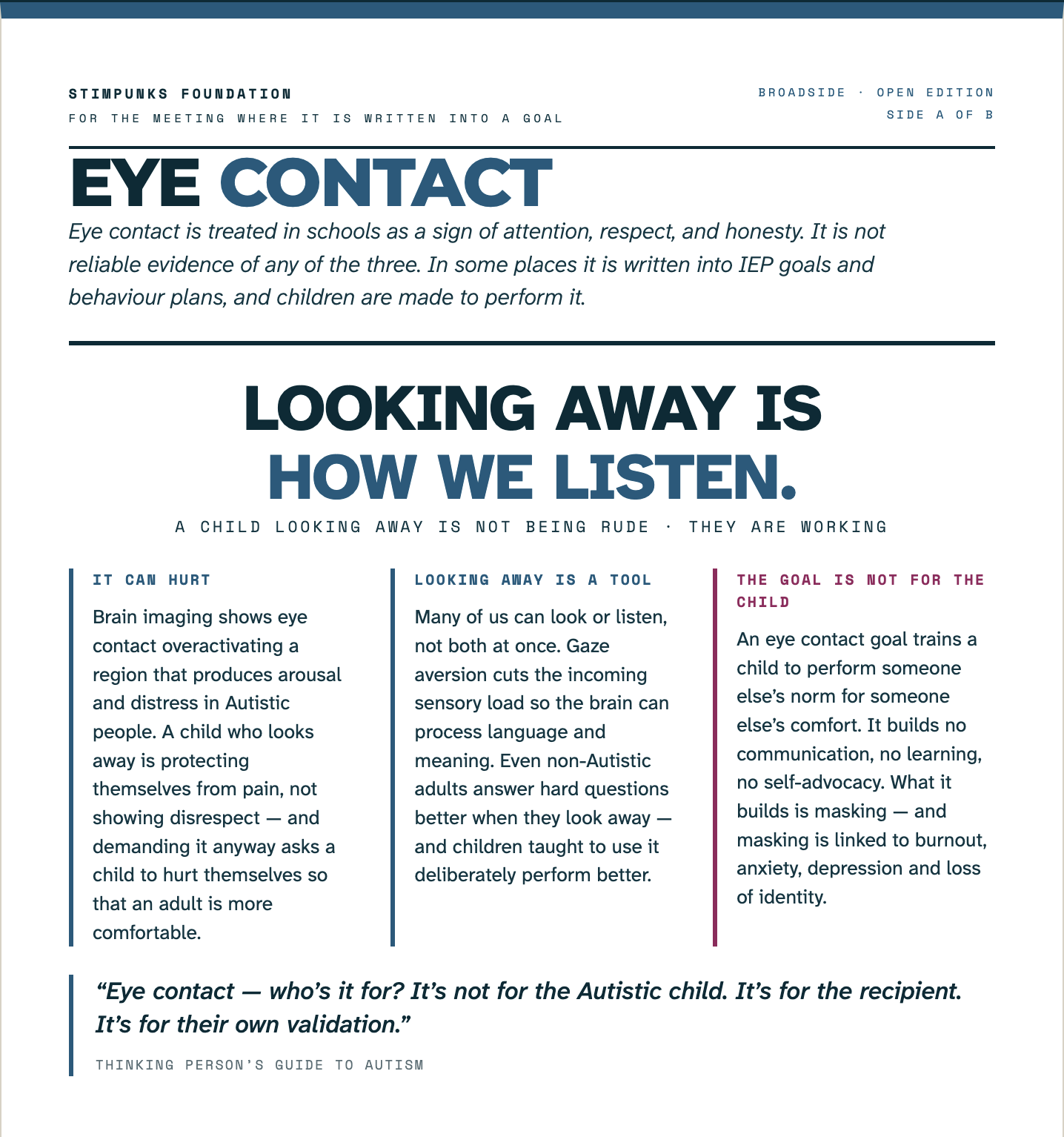
Every sheet is one piece of paper, printed both sides, 190 × 259 mm — the intersection of A4 and US Letter, so the same file comes out of any printer uncropped in either country. Side A is a face you’d pin up, readable across a room. Side B does the work: what to do instead, and the sources. Press Print and you get the sheet, not the website — no header, no menu, no sidebar, no footer.
All of them are CC0. Free to print, copy, change, and share, with no permission needed and no attribution required. Print a stack and give them away.
Five sheets are up. Each names the moment someone reaches for it — the part that decides whether a thing should be a sheet at all.
Eye Contact — the moment: it’s about to be written into an IEP goal. Forcing eye contact harms Autistic and Neurodivergent students. It can be physically painful, it competes with listening, and for many of us looking away is how we pay attention.
Behaviorism — the moment: the behaviour is being called the problem. Thoughts, trauma, anxiety, sensory pain, and motive can’t be measured from outside, so none are in the model — and distress gets filed as non-compliance.
Sensory Access at Work — the moment: you’re going into an access conversation. A catalogue rather than an argument. Five external senses on the face; the three internal ones — proprioception, vestibular, interoception — on the reverse. Senses without folk names get argued down as preferences, so we name them.
Positive Greetings at the Door — the moment: door greetings are about to become policy. Eye contact, a touch, or a spoken greeting from every student on the way in — on demand, in front of everyone, at the moment of transition. The reverse says you don’t need to do this at all, and if you must, every modality should count — including no response, which is the whole argument.
Cavendish Space — the moment: you’re about to design a space, or redesign one. Caves, campfires, watering holes — and the vocabulary for building them. The only sheet so far that refuses nothing; it hands over words instead.
Print one and hand it to someone. That’s the point. If a sheet gets something wrong, tell us — the sources are on the back, so it’s checkable.